Tactile Tech and Chemical UX
GUEST POST from Art Inteligencia
Introduction: Beyond the Glass Screen
The digital experience is currently trapped behind a rigid, cold pane of glass. While we have mastered the art of visual and auditory immersion, we are systematically ignoring the physical and chemical dimensions that define our lived reality. Our current interfaces are fundamentally incomplete.
This is the moment to introduce Chemical UX — the intentional orchestration of haptic, olfactory, and gustatory stimuli — as the next major imperative in human-centered design. We must move beyond “viewing” and “hearing” toward “feeling” and “sensing.”
The future of innovation lies in our ability to engineer interactions that bridge the widening gap between the world of bits and the world of atoms. To achieve true immersion, we must stop designing for the screen and start designing for the human nervous system.
The Evolution of Haptics: From Vibrations to Texture
For decades, digital touch has been limited to the crude feedback of motorized buzzes and clicks. Breaking this “buzz ceiling” is the first step toward true sensory immersion. Simple actuator-based vibration is no longer sufficient for a generation of users demanding deeper digital engagement; we must move toward high-fidelity haptic feedback that replicates the nuanced textures of the physical world.
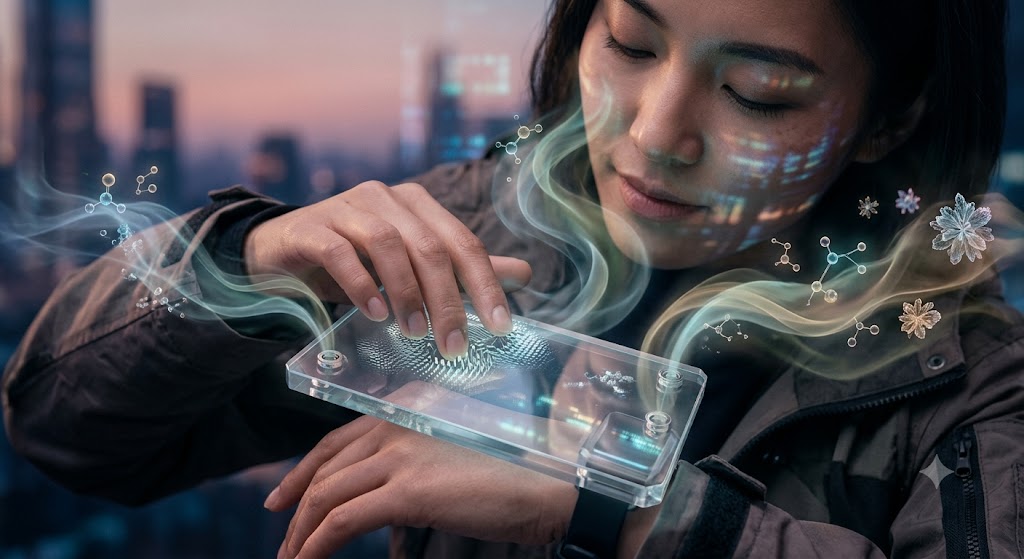
The cutting edge of this evolution lies in micro-fluidics and electro-osmotic arrays. By manipulating microscopic amounts of fluid or applying dynamic electrical currents directly beneath an interface surface, we can achieve real-time physical deformation. This allows us to create variable-friction surfaces where a user can actually feel the grain of wood, the weave of a fabric, or the contour of a physical button on a completely flat touchscreen or wearable device.
From an experience design perspective, the goal is to bridge the training and operational gap. High-fidelity tactile feedback allows for complex, physical-world task training — such as delicate medical surgeries, remote mechanical repairs, or precise industrial design — to happen entirely within a digital environment without losing the tactile intuition required for real-world mastery.
Chemical UX: Engineering Scent and Taste
The olfactory bulb and gustatory senses represent the most powerful, underutilized vectors in experience design. Because these senses bypass the logical centers of the brain and wire directly into the limbic system, they act as immediate triggers for human emotion, memory, and visceral reaction. Leaving them out of our design framework means ignoring the very channels that anchor human memory.
To systematically deploy these senses, we are building a “chemical-to-digital” pipeline. On the olfactory side, this relies on precisely synchronized micro-dispensing cartridges and rapid-evaporation synthetics capable of releasing and clearing specific scent profiles instantly. On the gustatory side, innovations like Galvanic Tongue Stimulation apply targeted, micro-electrical currents to the tongue to trick receptors into perceiving sour, salty, bitter, or sweet notes without any actual caloric intake or physical substance.
The ultimate strategic goal is contextual scent mapping and environmental branding. By embedding these chemical signatures into specific digital physical boundaries or virtual spaces, we can anchor brand loyalty and ambient environments in the user’s deepest subconscious, establishing an unprecedented depth of engagement.
Designing the “Multi-Sensory Loop”
True immersion cannot be achieved with isolated sensory outputs; it requires a tightly orchestrated multi-sensory loop. This framework demands that tactile and chemical stimuli are mapped dynamically to user actions and environmental shifts in real-time. When a user reaches out to touch a virtual object, the visual, auditory, haptic, and olfactory feedback must align instantly to create a cohesive psychological reality.
In this architecture, latency is the ultimate enemy. While our eyes can tolerate slight visual delays, our chemical and physical senses are incredibly sensitive to timing mismatches. If a scent triggers even a few milliseconds out of sync with a visual motion, or if a tactile texture lags behind a gesture, it causes severe sensory dissonance. This mismatch is the primary driver of digital disorientation and motion sickness.
As we design these deep neural interactions, ethical guardrails must be baked into the system architecture. Continuous exposure to high-fidelity physical and chemical stimuli risks causing rapid sensory fatigue. Human-centered design requires that users maintain absolute sovereignty over their environments, meaning systems must include accessible controls for customized thresholds and immediate “sensory scrubbing” to reset the environment.
Futurology: The 2030 Interaction Stack
Looking toward the next decade, the hardware paradigms we rely on today will fundamentally dissolve. We are moving rapidly into a post-device reality where rigid, handheld smartphones are replaced by soft, skin-conforming wearables, smart textiles, and specialized micro-respiratory interfaces. The interaction surface is migrating from external glass directly onto the human body.
This macro-shift completely redefines human-computer interaction (HCI). We are transitioning from active input, where a user must consciously look at and touch a device, to ambient input and response. In this new paradigm, humans live within a highly sensitized, reactive environment that reads biometric shifts and responds with subtle, contextual changes in texture, temperature, and atmospheric chemistry without requiring explicit commands.
Ultimately, this gives rise to what I call the “Feeling Economy.” As functional automation becomes completely commoditized, enterprise differentiation will shift entirely to deep emotional resonance. Organizations that successfully engineer authentic tactile and chemical interactions will command unprecedented brand equity, capturing market share not just through digital utility, but through visceral, biological loyalty.
Conclusion: Human-Centered Engineering
The ultimate goal of this technological evolution is a return to our biological roots. For decades, humans have been forced to adapt to the limitations of machines — bending over keyboards, staring at flat screens, and reducing our rich sensory capabilities down to the click of a mouse. Human-centered engineering flips this dynamic entirely, demanding that technology finally adapts to our natural biological evolution.
To realize this future, innovation leaders must rethink how they build teams. The traditional silo of visual UI/UX designers and software engineers is no longer sufficient to build the next generation of experiences. Forward-looking enterprises must immediately begin establishing dedicated sensory engineering departments, blending behavioral psychology, material sciences, and chemical mechanics into a unified discipline.
The next great leap in innovation will not be defined by higher resolutions, faster processors, or larger screens. It will be defined by depth, authenticity, and emotional truth. The future of design won’t just look better; it will feel real.
Frequently Asked Questions: Chemical UX & Tactile Tech
What is Chemical UX?
Chemical UX is the human-centered practice of designing digital interfaces that actively incorporate the human chemical senses — olfaction (smell) and gustation (taste) — alongside advanced haptics (touch) to create deeply immersive, memorable, and emotional interactions.
How do you simulate taste without real food?
We use technologies like Galvanic Tongue Stimulation (GTS). By sending precise, micro-electrical currents to specific taste receptors on the tongue, we can trick the nervous system into perceiving sweet, salty, sour, or bitter notes instantly, without any physical substance or caloric intake.
Why are chemical interfaces important for the future of business?
As functional technology becomes commoditized, enterprise value shifts to the “Feeling Economy.” Scent and touch wire directly into the brain’s emotional and memory centers, allowing brands to build visceral, biological loyalty that visual-only screens simply cannot replicate.
Bottom line: Futurists are not fortune tellers. They use a formal approach to achieve their outcomes, but a methodology and tools like those in FutureHacking™ can empower anyone to be their own futurist.
Image credit: Pexels
 Sign up here to get Human-Centered Change & Innovation Weekly delivered to your inbox every week.