From Reluctant to Ready
LAST UPDATED: December 22, 2025 at 12:02PM

GUEST POST from Chateau G Pato
Change does not fail at the strategy level as often as leaders think. It fails at the human level. Organizations announce transformation, deploy tools, and track milestones, only to discover that people quietly revert to old behaviors. Adoption, not execution, is the real bottleneck.
As a human-centered change and innovation practitioner, I see resistance as a signal, not a setback. The journey from reluctance to readiness is the leader’s most important responsibility.
Re-framing Resistance
Resistance is frequently misdiagnosed as unwillingness. More often, it reflects uncertainty about competence, consequences, or credibility. People ask themselves whether they can succeed, whether the change will last, and whether leadership can be trusted.
Leaders who re-frame resistance as feedback gain clarity about what readiness requires.
Readiness Is Built, Not Announced
Readiness emerges when people understand the change, believe it matters, and feel capable of acting differently. This requires time, practice, and reinforcement.
Human-centered leaders design change as a learning journey rather than a rollout.
Case Study One: Microsoft and the Power of Modeling
Microsoft’s cultural shift under a growth mindset philosophy succeeded because leaders modeled the behavior they expected. Curiosity replaced certainty, and learning replaced defensiveness.
This visible shift reduced fear and normalized experimentation, accelerating adoption across the organization.
Psychological Safety as an Adoption Accelerator
People adopt change faster when they feel safe admitting what they do not know. Psychological safety turns learning into a shared endeavor rather than an individual risk.
Leaders create safety through transparency, patience, and consistent reinforcement.
Case Study Two: Clinician-Led Change in Healthcare
A hospital system struggling with digital adoption shifted its approach by empowering respected clinicians as change champions. Peer-led learning replaced top-down mandates.
Adoption improved because trust already existed within peer networks.
The Change Adoption Canvas
The Change Adoption Canvas is a practical, human-centered tool designed to help leaders move beyond announcing change and toward achieving sustained behavior adoption. Rather than focusing on project plans or communications alone, the canvas prompts teams to examine change through the lived experience of the people who must actually behave differently.
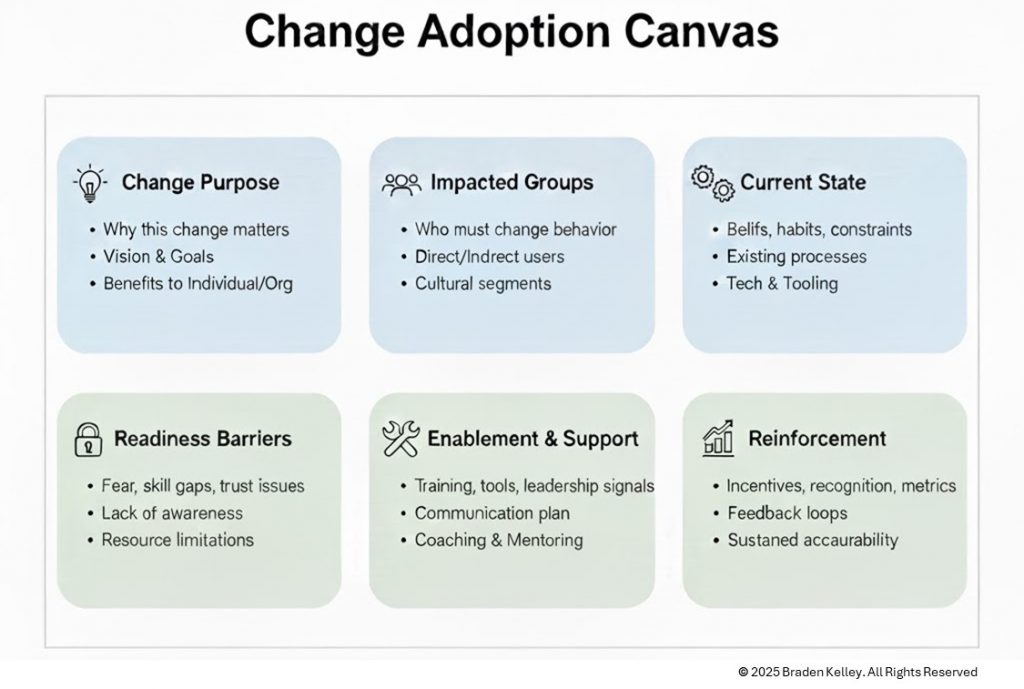
By working through the six sections, leaders clarify why the change matters, identify who is most impacted, and surface the beliefs, habits, and constraints that shape current behavior. The canvas is best used collaboratively in workshops or leadership sessions, where diverse perspectives can reveal hidden readiness barriers and misaligned signals. Once those barriers are visible, the canvas guides leaders to intentionally design enablement, support, and reinforcement mechanisms that build confidence and trust over time. Used iteratively, the Change Adoption Canvas becomes both a diagnostic and a design tool, helping organizations course-correct, strengthen adoption, and embed change as a repeatable capability rather than a one-time effort.
Signals Over Statements
People believe what leaders do more than what they say. Promotions, budgets, and recognition send powerful signals about what truly matters.
Aligning these signals with desired behaviors is essential to sustaining change.
“Leaders do not create readiness by demanding change; they create it by making people feel capable, supported, and safe enough to begin.”
Conclusion
The journey from reluctant to ready is not linear, and it cannot be rushed. It requires empathy, patience, and intentional design.
Leaders who invest in readiness do more than implement change. They build organizations capable of continuous adaptation.
Frequently Asked Questions
Why do well-communicated changes still fail?
Because understanding does not automatically create confidence or capability.
How can leaders measure change adoption?
By observing sustained behavior change and real-world usage, not just task completion.
What role does leadership behavior play in adoption?
Leadership behavior sets the tone and determines whether people feel safe embracing change.
Extra Extra: Because innovation is all about change, Braden Kelley’s human-centered change methodology and tools are the best way to plan and execute the changes necessary to support your innovation and transformation efforts — all while literally getting everyone all on the same page for change. Find out more about the methodology and tools, including the book Charting Change by following the link. Be sure and download the TEN FREE TOOLS while you’re here.
Image credits: Pixabay, Google Gemini
 Sign up here to get Human-Centered Change & Innovation Weekly delivered to your inbox every week.