Tag Archives: automation

The Future of Work

Embracing Automation and Artificial Intelligence

The Future of Work

GUEST POST from Chateau G Pato

As we step into the rapidly evolving realm of automation and artificial intelligence (AI), the future of work beckons exciting prospects and transformative changes. While concerns about job displacement persist, forward-thinking organizations have already begun embracing automation and AI as catalysts for innovation, increased efficiency, and enhanced employee experiences. In this thought leadership article, we will explore how businesses can navigate this shifting landscape, highlighting two compelling case studies that demonstrate the successful integration of automation and AI technologies.

Case Study 1: Automating Tedious Processes – Digital Evolution Inc.

Digital Evolution Inc. (DEI), a leading software solutions provider, creatively harnessed automation to revolutionize their business processes. Identifying a need to streamline complex data migration tasks for their clients, they introduced an AI-powered automation system called “MigratePro.” This system seamlessly migrated vast amounts of data between different platforms, eliminating the need for extensive manual intervention.

By embracing automation, DEI reduced the time required for data migrations by 70%, resulting in significant cost savings for their clients. Moreover, the system allowed their employees to focus on value-added tasks, such as data analysis and problem-solving, rather than being bogged down by repetitive, time-consuming work. The successful integration of automation not only increased customer satisfaction but also improved employee satisfaction and retention rates, as employees felt empowered by technology to contribute meaningfully to the organization.

Case Study 2: AI for Enhanced Decision-Making – Mindful Investments Corp.

Mindful Investments Corp., a wealth management firm, harnesses the power of AI to drive better decision-making and superior customer experiences. Recognizing the challenges their advisors faced in analyzing vast volumes of financial data to provide personalized recommendations, they developed an AI-driven tool called “InvestAID.” This tool utilized natural language processing and machine learning algorithms to analyze historical market data, investor preferences, and current trends, enabling advisors to make informed investment decisions efficiently.

With the integration of AI technology, Mindful Investments Corp. witnessed a remarkable increase in client satisfaction. The accuracy and speed of recommendations improved significantly, leading to better investment outcomes. Additionally, the AI tool provided advisors with real-time insights and notifications, enhancing their ability to provide a personalized touch to their clients. This implementation not only exemplified the firm’s commitment to innovation but also augmented client trust and loyalty.

Conclusion

The future of work lies in the harmonious coexistence of humans and technology. Properly leveraging automation and AI can unlock untapped potential, improving operational efficiency, fostering innovation, and elevating employee experiences. The case studies of Digital Evolution Inc. and Mindful Investments Corp. showcase how embracing automation and AI can yield tremendous benefits for businesses across various sectors.

Forward-thinking organizations must seize the opportunity to restructure their workflows, empowering employees to take on more strategic and creative roles while technology handles mundane tasks. Preparing the workforce for this transformative future requires reskilling and upskilling initiatives to equip employees with the necessary skills to work alongside AI systems effectively.

By embracing automation and AI, companies can forge a future of work that optimizes efficiency, augments decision-making, and cultivates a workforce prepared for the ever-evolving technological landscape. Embracing the potential of automation and AI is the key to staying ahead in an increasingly competitive world.

SPECIAL BONUS: Futurology is not fortune telling. Futurists use a scientific approach to create their deliverables, but a methodology and tools like those in FutureHacking™ can empower anyone to engage in futurology themselves.

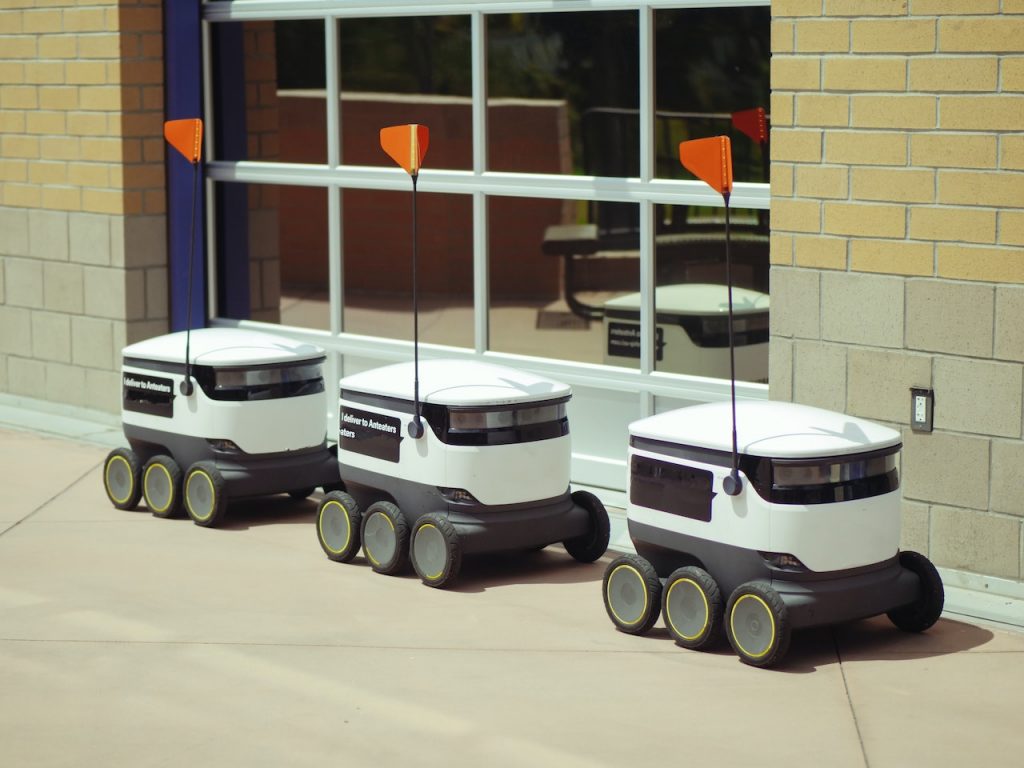
Image credit: Unsplash

Subscribe to Human-Centered Change & Innovation WeeklySign up here to get Human-Centered Change & Innovation Weekly delivered to your inbox every week.

Robots and Automation

Redefining Industries and the Workforce

Robots and Automation

GUEST POST from Art Inteligencia

The world is undergoing a technological revolution, where robots and automation are increasingly prevalent in industries, altering the way we work and transforming entire sectors. This paradigm shift has given rise to a new era for the global workforce, with significant implications for the economy and society as a whole. In this thought leadership article, we will explore how robots and automation redefine industries and reshape the workforce by examining two compelling case study examples.

Case Study 1: The Automotive Industry

The automotive industry has witnessed a remarkable transformation due to the integration of robots and automation. Assembly lines that were once dominated by human labor have now become hubs of robotic efficiency. Manufacturing giants like Tesla and Toyota have turned to automation to enhance production speed, improve quality control, and ultimately increase profitability.

The deployment of robots and automation in the automotive sector has proven to be a game-changer. By automating repetitive and labor-intensive tasks, such as welding, painting, and assembly, manufacturers have achieved greater precision and consistency in their operations. This shift has also led to a reduction in workplace injuries, as robots effectively handle hazardous tasks and operate in environments inhospitable to humans.

Yet, the introduction of automation in the automotive industry has not come without its challenges. While overall productivity has surged, concerns about job displacement have mounted. However, it is important to note that automation has typically resulted in the creation of new jobs that are more cognitively demanding and require advanced technical skills. Moreover, the shift to automation allows human workers to be up-skilled in areas such as robot programming, maintenance, and supervision, leading to higher job satisfaction and improved career prospects.

Case Study 2: E-commerce and Warehousing

The rapid growth of e-commerce has revolutionized the retail industry, prompting a surge in demand for warehousing and fulfillment centers. Robots and automation have played a pivotal role in meeting this demand by redefining the warehousing landscape. Companies like Amazon have embraced robotics to optimize their logistics operations, enhance efficiency, and streamline processes.

Robots deployed in e-commerce warehouses are capable of picking, packing, and sorting products at remarkable speeds, far surpassing the capabilities of human workers. They navigate the warehouse floor with precision and utilize machine learning algorithms to continuously improve their performance. Automation allows for a much quicker order fulfillment process, leading to reduced delivery times and improved customer satisfaction.

While the use of robots in e-commerce warehouses has raised concerns about job displacement, it is vital to understand the broader picture. As demand for online shopping and rapid delivery increases, the need for more sophisticated logistics operations grows as well. This expansion necessitates a larger workforce to manage, program, and maintain the robotic systems. Furthermore, the integration of automation in e-commerce has opened up new opportunities for workers in areas such as inventory management, data analysis, and customer service, illustrating the transformative nature of this technology.

Conclusion

Robots and automation are undoubtedly redefining industries and transforming the global workforce. As exemplified by the automotive industry and e-commerce sector, the integration of this technology has led to increased productivity, improved quality control, and enhanced safety measures. While concerns about job displacement persist, historical evidence suggests that automation creates new roles that require advanced skills, benefiting workers in the long run. To adapt to this rapidly changing landscape, harnessing the potential of robots and automation will be crucial for individuals, companies, and policymakers alike. It is through proactive adaptation and up-skilling that we can embrace this technological revolution and shape a future where robots work alongside humans for the betterment of society.

Bottom line: Futurists are not fortune tellers. They use a formal approach to achieve their outcomes, but a methodology and tools like those in FutureHacking™ can empower anyone to be their own futurist.

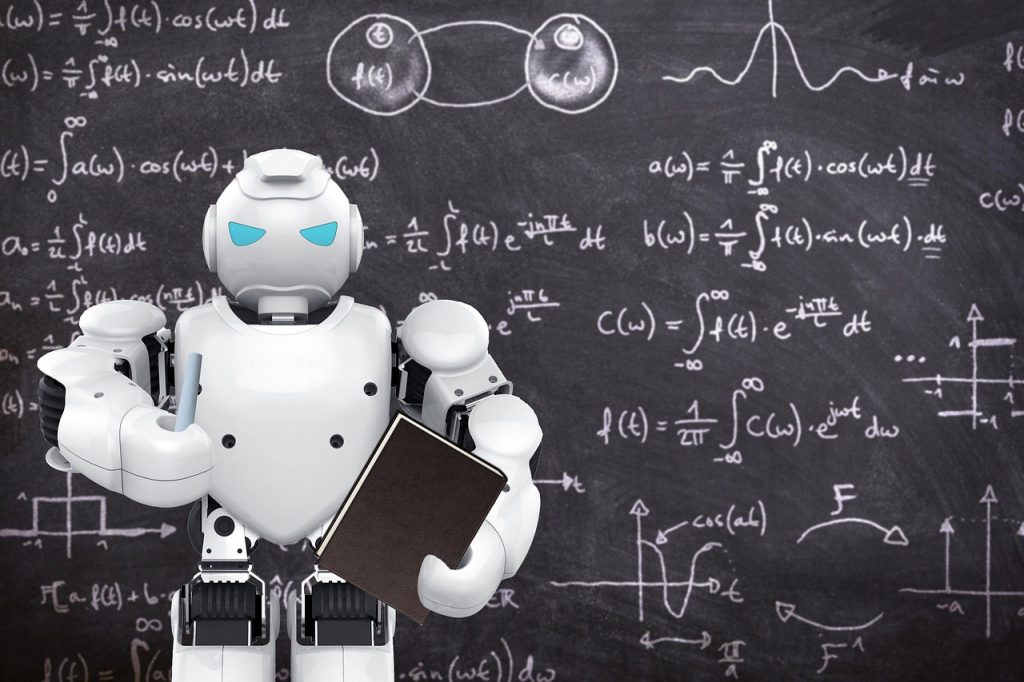
Image credit: Wikimedia

Subscribe to Human-Centered Change & Innovation WeeklySign up here to get Human-Centered Change & Innovation Weekly delivered to your inbox every week.

The Future of Robotics: How Automation Will Transform Industries

The Future of Robotics: How Automation Will Transform Industries

GUEST POST from Art Inteligencia

Over the past few decades, advancements in robotics and automation have heralded a new era in industries across the globe. From manufacturing and healthcare to transportation and agriculture, the potential of robots has reached unprecedented heights. This technological revolution has not only increased efficiency and productivity but also sparked considerable speculation about how it will transform various sectors. Two case studies demonstrate the transformative power of automation and provide insights into the future of robotics in industries.

Case Study 1: Automotive Manufacturing

The automotive industry has long been at the forefront of automation, and the rise of robots has significantly transformed the sector. Traditionally, car manufacturing involved human workers on assembly lines performing repetitive tasks. However, the introduction of robots has revolutionized this process, leading to increased precision, speed, and cost-effectiveness.

Tesla, the electric vehicle manufacturer, is a prime example of how robotics have transformed automotive manufacturing. Tesla’s Gigafactory in Nevada, one of the largest manufacturing facilities in the world, heavily relies on automation. The plant is equipped with thousands of robots that perform tasks like welding, painting, and assembly, greatly reducing the need for human labor. As a result, Tesla can produce vehicles faster, with higher quality, and at a lower cost.

The future of robotics in automotive manufacturing lies in the development of autonomous vehicles. Companies like Waymo and Uber are already testing self-driving cars, which will have a profound impact on transportation and mobility. This integration of robotics and artificial intelligence (AI) will not only revolutionize the way vehicles are manufactured but also disrupt the entire automotive industry.

Case Study 2: Healthcare

As the demand for healthcare services continues to rise, robotics and automation offer potential solutions to challenges faced by the sector. From surgical procedures to patient care, robots are being developed to improve medical outcomes, reduce costs, and enhance overall efficiency.

Intuitive Surgical’s da Vinci Surgical System is a prime example of how robotics have transformed surgical procedures. The da Vinci System enables minimally invasive surgeries by providing surgeons with enhanced vision, precision, and control. This advanced robotic technology allows for smaller incisions, reduced blood loss, and faster patient recovery times. As a result, patients experience shorter hospital stays and fewer complications.

In addition to surgical robotics, automation is increasingly being used in rehabilitation and eldercare. Robots like PARO, a therapeutic seal robot, and Pepper, a humanoid social companion robot, are being employed in healthcare settings to provide emotional support, alleviate loneliness, and assist in physical therapy. These robots not only enhance patient experiences but also alleviate the burden on healthcare professionals.

Looking ahead, the future of robotics in the healthcare sector holds immense potential. Advancements in AI and machine learning will enable robots to perform more complex medical procedures, analyze large amounts of patient data, and provide personalized healthcare recommendations.

Conclusion

The future of robotics and automation is undeniably changing the landscape of industries around the world. As seen in the automotive manufacturing and healthcare sectors, robots are revolutionizing traditional processes, increasing efficiency, and improving outcomes. Looking ahead, the integration of AI, machine learning, and advanced robotics will continue to transform industries, leading to increased productivity, cost savings, and even new job opportunities. Harnessing the full potential of robotics and automation will be crucial for industries to thrive in the future.

Bottom line: Futurists are not fortune tellers. They use a formal approach to achieve their outcomes, but a methodology and tools like those in FutureHacking™ can empower anyone to be their own futurist.

Image credit: Pexels

Subscribe to Human-Centered Change & Innovation WeeklySign up here to get Human-Centered Change & Innovation Weekly delivered to your inbox every week.

Exploring the Benefits of Automation

How to Use Technology to Streamline Innovation

Exploring the Benefits of Automation

GUEST POST from Art Inteligencia

Automation is one of the leading protagonists in the fourth industrial revolution. As technology continues to evolve at a rapid pace, companies are seeking ways to streamline their processes, increase productivity, and reduce costs while maintaining a high level of quality and service. At the heart of these opportunities is the incredible potential of automation technology.

Automation is the use of systems, such as computers or robots, to perform tasks that would usually require human intervention. The benefits of automation are numerous and range from increased efficiency and consistency to the reduction of errors. With automation in place, businesses can focus on strategic, innovative projects that can yield significant results.

Let’s delve deeper into the potential of automation and how it can be leveraged to streamline innovation and benefit businesses. We will illustrate this through the lens of two key case studies.

Case Study 1: Amazon

Our first example is one that is universally known: Amazon. The eCommerce giant has proven itself at the forefront of automation in multiple arenas, focusing especially on its warehouse operations. Using robots in its warehouses has helped Amazon achieve incredible efficiency in handling, storing, and moving goods.

Amazon employs over 200,000 robotic units in conjunction with human employees. These robots perform tasks like moving goods around in warehouses. This has reduced the walking time of human workers, increasing efficiency and reducing errors due to fatigue. More importantly, automation allows Amazon to process and ship orders swiftly, with robotics ensuring that the right package gets to the right place at the right time, thereby enhancing customer satisfaction.

The benefits Amazon reaped from automation led to the inception of Amazon Robotics where their technological advancements like AI-powered drones for package delivery or their anticipatory shipping model are creating groundbreaking changes in the distribution landscape.

Case Study 2: General Motors

Our second case is a little closer to home, being a part of our everyday commute. General Motors, one of the largest automakers, leverages automation to streamline their operations. GM utilizes over 30,000 robots for jobs such as welding, painting, and assembly. Robots have enabled the car manufacturer to maintain high consistency levels in the manufacturing process, ensuring that every part works perfectly before being integrated into a car.

Further, by taking over the labor-intensive tasks, robots have drastically reduced the chances of human error and injury in the assembly line. As a result, GM has managed to boost their factory productivity. Thanks to these automated systems, their production line can churn out a staggering one vehicle every minute around the clock.

Such automation has also allowed General Motors to innovate and adapt to the changing market. For instance, during the COVID-19 pandemic, GM swiftly repurposed their production line to produce much-needed ventilators.

Conclusion

Innovation and implementation of automation have certainly paved the way for success in both Amazon and General Motors. While automation can necessitate a significant initial investment, the long-term benefits concerning efficiency, cost reduction, and innovation potential can be transformative.

Technology continues to evolve, and with it, the potential for automation increases. From streamlining existing processes to developing groundbreaking innovations, automation provides businesses with opportunities to stay competitive and responsive in a dynamic, ever-changing market. The challenge is for businesses to harness this potential, exploring automation in ways that are practical, beneficial, and ultimately essential to maintaining a competitive edge.

Image credit: Pixabay

Subscribe to Human-Centered Change & Innovation WeeklySign up here to get Human-Centered Change & Innovation Weekly delivered to your inbox every week.
The Hyper-Local Boom

How Autonomous Tools Revitalize Community-Centric Economies

The Hyper-Local Boom

GUEST POST from Chateau G Pato


I. Introduction: The Pendulum Swings Back

The Globalist Peak

For decades, the narrative of progress was defined by hyper-globalization. Massive, centralized platforms and sprawling global supply chains optimized for efficiency, driving down costs at the expense of local economic resilience. While this interconnectedness brought unprecedented access to goods, it simultaneously stripped communities of their unique flavor, hollowed out local marketplaces, and left neighborhoods vulnerable to systemic global shocks.

The Catalyst

Today, we are witnessing a profound structural shift. The convergence of autonomous AI, decentralized manufacturing, and hyper-local logistics is fundamentally rewriting the rules of production and distribution. Technologies once feared as cold or isolating are maturing into the foundational infrastructure for a new era of localized commerce.

The Thesis

Autonomous tools are not isolating us; they are doing the exact opposite. By shifting the economics of production and distribution away from distant fulfillment centers and back to the neighborhood block, automation is enabling a massive, human-centered renaissance of community-centric economies. This is not a step backward into isolationism, but a leap forward into an empowered, self-sustaining future where technology serves to anchor us closer to home.

II. The Architecture of the Autonomous Local Engine

Micro-Production & Decentralized Supply Chains

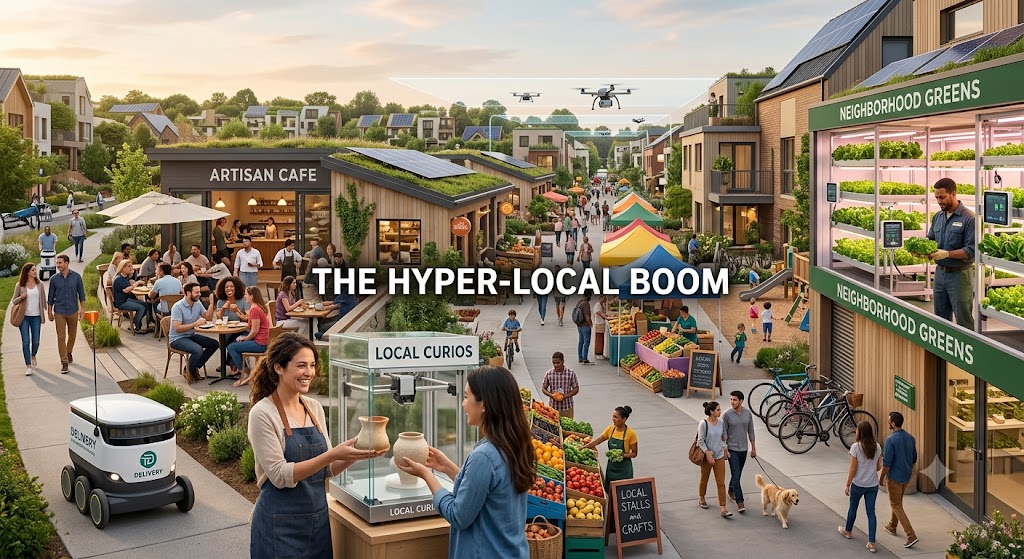
The traditional model relies on massive, centralized factories pushing goods across vulnerable, thousands-of-miles-long supply chains. The autonomous local engine flips this paradigm to on-demand, decentralized creation. Advanced 3D printing micro-factories, automated vertical farming pods, and localized CNC routing stations are embedding production directly into our neighborhoods. This shifts the focus from economies of scale to economies of proximity, allowing communities to build, grow, and manufacture exactly what they need, the moment they need it, vastly improving local resilience.

Autonomous Micro-Logistics

The “last mile” of delivery has historically been the most expensive and carbon-intensive leg of commerce, often forcing local businesses to rely on monopolistic logistics giants. The introduction of autonomous micro-logistics—sidewalk delivery bots, neighborhood drone networks, and automated local dispatchers — slashes these barriers to near zero. By making neighborhood-to-neighborhood commerce functionally frictionless, we empower local makers and growers to distribute their goods just as efficiently as multinational conglomerates, but with a vastly smaller footprint.

Intelligent Local Marketplaces

Technology must serve as a bridge, not a barrier. As artificial intelligence integrates with hyper-local commerce, we are seeing the rise of intelligent local marketplaces. These are not just digital storefronts; they are dynamic, predictive ecosystems that anticipate community needs and seamlessly match local supply with local demand. By decentralizing the marketplace, AI tools strip away the need for massive corporate middlemen, ensuring that the economic value generated by a community remains within that community, fueling a new era of participatory innovation.

III. Elevating Human Experience (The HX Factor)

From Transactional to Relational

The true value of automation lies not in replacing humans, but in freeing them to do what they do best. When autonomous tools seamlessly absorb the burden of routine backend logistics — handling inventory forecasting, automated billing, and micro-routing — local business owners are liberated from the keyboard and the stockroom. They can redirect their energy toward what truly drives customer loyalty: deep relationship-building, bespoke customization, and genuine empathy. Commerce shifts from a cold, transactional exchange back to a warm, relational experience.

The “New Artisan” Economy

Historically, scaling a business meant taking on massive capital risk, securing complex infrastructure, and giving up creative control. Today, autonomous micro-production and frictionless local logistics drastically lower the barrier to entry. This democratization gives rise to a “New Artisan” economy. Local creators, boutique chefs, and precision builders can leverage automated tools to manage the complexities of production and distribution, allowing them to scale their unique craft sustainably within their immediate geographic region without needing venture capital.

Designing Frictionless Community Spaces

To fully realize this shift, we must rethink the physical spaces where we live and gather. The community hub of the future is an experience-first destination. By moving autonomous fulfillment, micro-storage, and sorting infrastructure quietly into the background — or beneath the floorboards — the storefront is reclaimed. It ceases to be a mere warehouse for boxes and becomes a sanctuary for human connection, sensory engagement, and experiential retail where people come to gather, co-create, and share stories.

IV. Navigating the Change: Friction, Equity, and Adoption

The Human-Centered Transition

Every major technological shift introduces friction, and the hyper-local boom is no exception. As autonomous tools take over the predictable mechanics of retail and traditional logistics, we face a critical transition period. Navigating this change requires a deliberate, human-centered approach to upskilling. We must invest heavily in community-led training programs that empower displaced workers to step into higher-value roles as community experience designers, digital artisans, and local system orchestrators — ensuring that technology serves to elevate human potential rather than sideline it.

Bridging the Digital Divide

Innovation must be participatory; if it only benefits wealthy tech hubs, it has failed. We must intentionally design policies and funding frameworks that deploy autonomous micro-factories, vertical farming pods, and micro-logistics networks into historical food deserts, rural outposts, and underserved urban neighborhoods. True fairness means ensuring that these decentralized economic engines are accessible to all, providing equitable wealth-generation tools where rewards remain relative to local effort, and directly revitalizing communities that the globalist model left behind.

Regulatory & Trust Hurdles

Building the infrastructure for an autonomous neighborhood requires navigating significant regulatory, safety, and psychological barriers. Communities will rightfully push back against a sudden influx of sidewalk delivery bots and low-altitude drones without clear boundaries. Overcoming this social friction means developing clear, community-governed data privacy standards and localized safety frameworks. By bringing residents into the design process early, municipal leaders can foster genuine trust and ensure that autonomous systems respect the physical and digital boundaries of the neighborhoods they are meant to serve.

V. Conclusion: The Future is Homegrown

The Futurist View

If we look forward to the neighborhood of 2035, we do not see a sterile, tech-dominated dystopia. Instead, we see a vibrant, deeply human ecosystem. We see sidewalks reclaimed for outdoor dining and community markets, while quiet, low-profile autonomous bots deliver fresh, vertically-grown produce from a block away. We see thriving local artisans whose businesses are powered by micro-manufacturing tools hidden inside community hubs. Technology, in this future, does not pull us away from our neighbors — it acts as the unseen foundation that allows local relationships and localized wealth to flourish.

The Final Charge

This decentralized, hyper-local future will not happen by accident; it must be designed with intention. It requires urban planners, entrepreneurs, civic leaders, and change agents to actively collaborate on human-centered frameworks. We must ensure that emerging autonomous systems are integrated into our towns and cities as tools of empowerment rather than extraction. The pendulum is swinging away from the distant and impersonal, back toward the close and meaningful. The tools are ready. Now, we must use them to build an economy where the future is proudly, and sustainably, homegrown.

Frequently Asked Questions

How do autonomous tools help local businesses instead of replacing them?

Autonomous tools take over the predictable, time-consuming backend mechanics of a business — such as managing inventory, automated billing, and micro-routing. By absorbing these routine logistical burdens, technology frees local business owners to focus on higher-value, human-centered activities like deep relationship-building, bespoke customization, and delivering an exceptional, empathetic customer experience.

What is the “New Artisan” economy?

The “New Artisan” economy refers to a decentralized market model where local creators, boutique chefs, and precision builders can sustainably scale their craft within their immediate geographic region. By using autonomous micro-production tools (like 3D printers and vertical farming pods) and low-cost micro-logistics networks, small businesses can match the operational efficiency of global conglomerates without needing massive venture capital or sprawling physical infrastructure.

How can communities ensure this technological shift is equitable?

Ensuring equity requires a deliberate, human-centered approach to change. Communities must invest in localized training programs to upskill workers into roles as experience designers and system orchestrators. Additionally, civic leaders must intentionally deploy autonomous infrastructure — like vertical farming and micro-manufacturing hubs — into historically underserved neighborhoods and food deserts to ensure wealth-generation tools are accessible to all.

Bottom line: Futurology is not fortune telling. Futurists use a scientific approach to create their deliverables, but a methodology and tools like those in FutureHacking™ can empower anyone to engage in futurology themselves.

Image credit: Gemini

Subscribe to Human-Centered Change & Innovation WeeklySign up here to get Human-Centered Change & Innovation Weekly delivered to your inbox every week.
The Systemic Risks of Automating the Middle Class

Beyond the Disruption Hype

The Systemic Risks of Automating the Middle Class

GUEST POST from Art Inteligencia


The Mirage of Efficient Progress

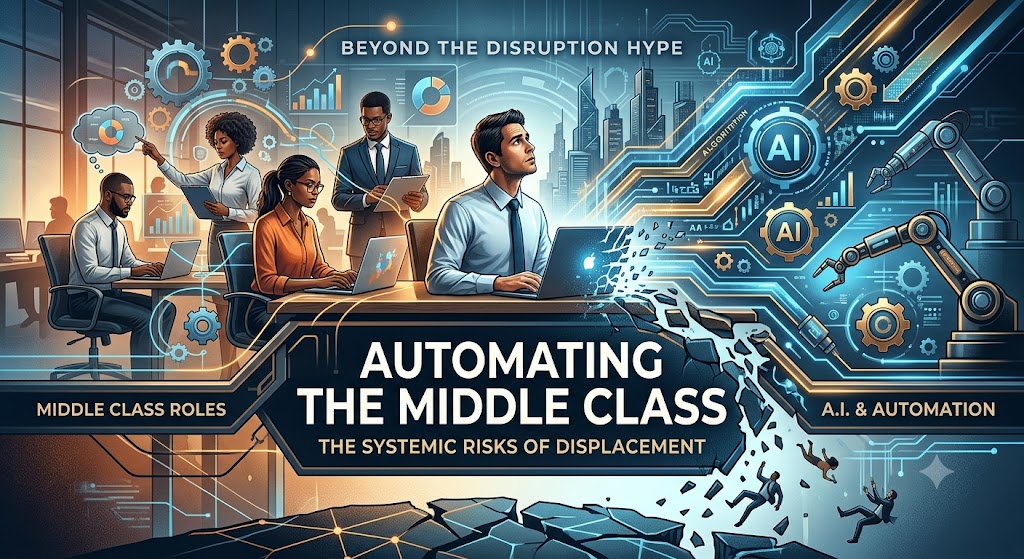
For over two decades, the global business landscape has been intoxicated by the gospel of “disruption.” We have been conditioned to view every wave of technological displacement as an unalloyed good — a friction-free path to hyper-efficiency and shareholder value. But as the crosshairs of automation shift from routine blue-collar labor to the white-collar knowledge workers who form the backbone of our enterprises, we must urgently interrogate the true cost of this transition. We have allowed a tech-centric fetish for optimization to crowd out the human-centered realities of sustainable business architecture.

The critical flaw in our current trajectory lies in the questions leadership teams are asking. The boardrooms of today are dominated by a dangerous, short-sighted query: “What can we automate?” This is the wrong question. True innovation and responsible stewardship require us to ask: “What should we automate to preserve long-term organizational, economic, and societal health?” When we treat human beings merely as expensive nodes in a workflow to be streamlined away, we fail to see the systemic dependencies that keep our companies — and our communities — alive.

The Systemic Reality: The middle class is not merely an overhead line item on a corporate balance sheet; it is the vital organ of the modern enterprise and the primary engine of the consumer economy.

Accelerating the unmitigated automation of mid-tier professional roles introduces profound systemic risks. It is a strategy that borrows against our collective future for a temporary spike in quarterly earnings. By hollowing out the corporate middle, we are not just cutting costs; we are systematically dismantling our innovation pipelines, degrading customer and employee experiences, and fracturing the economic feedback loops that sustain market demand. To build a resilient, scalable future, we must look past the disruption hype and design an automation strategy that amplifies human ingenuity rather than extinguishing it.

I. The Experience Design Deficit: Eroding the Customer and Employee Journey

The race to automate mid-tier professional roles operates on a dangerous assumption: that human presence is merely a cost to be engineered out of the system. In the rush to implement algorithmic decision-making, organizations are inadvertently creating a profound experience design deficit. By hollowing out the middle, companies are severing the vital, empathetic tissue that connects an enterprise to its people and its customers.

Losing the Human Touchpoint in CX

Customer experience (CX) is inherently emotional. While automated interfaces excel at processing predictable, binary requests, they are fundamentally unequipped to handle nuance, ambiguity, or emotional distress. When mid-tier knowledge workers are replaced by algorithms, customers lose the advocates who understand context. The result is a rigid, friction-filled experience where edge cases go unresolved, ultimately degrading brand loyalty and destroying long-term customer relationships.

The Destruction of the Mentorship Pipeline

From an employee experience (EX) perspective, middle management and mid-tier roles serve a critical evolutionary purpose: they are the training grounds for an organization’s future leadership. Human-centered innovation thrives on tribal knowledge, mentorship, and informal learning networks. When you automate the middle class, you effectively destroy the corporate ladder. Without these transitional roles, organizations lose their ability to cultivate internal talent, leaving a gaping chasm between entry-level executors and senior executives.

The Blindspot of Efficiency: Algorithms are designed to optimize for known variables based on historical data. They cannot replicate the quiet, unmapped problem-solving that human middle managers perform daily to resolve organizational friction and maintain cultural alignment.

Operational Blindspots and the Loss of Resilience

Every complex organization relies on “invisible work” — the human intervention required to bridge the gap between rigid corporate policy and unpredictable real-world scenarios. Mid-tier professionals act as the shock absorbers of the enterprise, utilizing emotional intelligence and institutional memory to navigate crises. Replacing this layer with automated systems introduces a fragile rigidity. When an unexpected market shift or operational anomaly occurs, an algorithmic middle lacks the creative flexibility required to adapt, exposing the organization to catastrophic systemic failure.

II. The Innovation Paradox: Why Efficiency Kills Creativity

The core justification for the aggressive automation of mid-tier knowledge workers is almost always efficiency. But in the architecture of a healthy enterprise, hyper-efficiency and breakthrough innovation are often at war. When an organization eliminates all human variance in pursuit of a flawless, predictable process, it inadvertently suffocates the very environment required for creative thinking and strategic foresight.

The Danger of Hyper-Optimization

True innovation is rarely neat, linear, or efficient. It thrives on friction, diverse perspectives, and what I call “happy accidents” — the unexpected insights that occur when human beings collaborate, debate, and experiment. Algorithms are designed to eliminate variance and optimize for the status quo based on historical data. By replacing the creative, analytical middle class with automated systems, companies lock themselves into a state of permanent optimization, leaving no room for the divergent thinking that drives disruptive breakthroughs.

De-skilling the Workforce

Over-reliance on automated tools creates a dangerous cognitive dependency. When mid-tier professionals spend their careers merely supervising or rubber-stamping algorithmic outputs, their own critical thinking, problem-solving, and futurology capabilities begin to atrophy. We are facing a future of organizational de-skilling, where the workforce loses the muscle memory required to question assumptions, anticipate market shifts, or architect human-centered strategies from scratch.

The Homogenization Trap: When every enterprise in an industry leverages the exact same AI models and automation frameworks to optimize their operations, competitive differentiation completely vanishes. Companies become mirror images of one another, competing on a race to the bottom.

The Loss of Participatory Innovation

Sustainable innovation cannot be a purely top-down mandate dictated by an executive suite and executed by a skeleton crew of machines. It requires participatory innovation — an inclusive ecosystem where mid-tier employees act as catalysts, identifying grassroots problems and co-creating solutions. When this layer of the organization is hollowed out, the collaborative engine stalls. Without a robust, engaged middle class to champion and iterate on new ideas, the corporate innovation bonfire simply runs out of fuel.

III. Macro-Systemic Risks: The Economic Feedback Loop

The decision to automate the middle class is often treated as an isolated, microeconomic calculation—a line-item optimization designed to please Wall Street on the next earnings call. But businesses do not exist in a vacuum. When thousands of enterprises simultaneously execute the same short-sighted playbook, individual corporate efficiencies aggregate into a massive, macro-systemic crisis. We are actively dismantling the economic architecture that allows our markets to function.

Hollowing Out the Consumer Base

The most glaring oversight in the rush to automate mid-tier white-collar roles is the hollowing out of the consumer base. The middle class is not merely a source of labor and operational cost; it is the primary engine of global consumer spending. Algorithms do not buy software, they do not subscribe to services, and they do not invest in products. By systematically stripping income and financial security from knowledge workers, corporations are shrinking the very market demand they rely on to survive. It is a modern economic paradox: hyper-efficient production paired with an engineered collapse of consumption.

The Velocity of Change vs. Human Adaptation

Fundamental principles of change management dictate that human systems require time to adapt, reskill, and transition. Previous industrial revolutions displaced labor over generations, allowing society to build new educational and institutional safety nets. The current wave of generative and cognitive automation is moving at an exponential velocity that completely outpaces human adaptation. When societies are subjected to rapid, unmanaged displacement without viable pathways to equitable outcomes, the result is widespread economic anxiety, social instability, and a severe hollowing out of the workforce.

The Corporate Trust Deficit: True organizational resilience is built on a foundation of mutual trust. When leadership views its knowledge workers as disposable commodities to be replaced by lines of code at the first opportunity, that institutional trust is irrevocably fractured, destroying employee engagement and public goodwill.

The Illusion of the Frictionless Economy

Proponents of hyper-automation often dream of a frictionless, autonomous economy. But this vision ignores the human element of risk management. Mid-tier professionals provide stabilizing feedback loops within our economic and organizational structures. Without this layer of human oversight, empathy, and ethical judgment, our economic systems become highly fragile. A top-heavy economic structure—where immense wealth is concentrated among a fraction of tech elite while the middle class is displaced—is fundamentally unstable and prone to catastrophic systemic collapse.

IV. A Manifesto for Human-Centered Automation

To avert the systemic risks of a hollowed-out enterprise and a fractured economy, leadership teams must pivot from a mindset of absolute replacement to one of intentional, human-centered design. Technology should not be weaponized to diminish human agency; it should be architected to elevate it. We must establish a new framework for technological deployment that prioritizes sustainable, long-term organizational health over short-term, fragile efficiencies.

Co-Creation and Intelligence Amplification (IA)

The true frontier of innovation lies not in Artificial Intelligence replacing the worker, but in Intelligence Amplification (IA)—designing tools that act as cognitive prosthetics for human ingenuity. True participatory innovation requires that we actively include mid-tier knowledge workers in the design of their own automated partners. When we use technology to handle cognitive drudgery, we liberate the middle class to focus on higher-value activities: strategic foresight, complex problem-solving, and deepening customer relationships.

Deploying Systemic Impact Assessments

Before any enterprise-wide automation initiative is approved, corporate governance must mandate rigorous Systemic Impact Assessments. Leadership must look far beyond immediate return on investment (ROI) metrics and simulate the long-term, cascading effects of a technological transition. These assessments must explicitly evaluate the impacts on the customer journey (CX), the internal talent and mentorship pipeline (EX), and the collective institutional knowledge of the enterprise.

The Equitable Metric: True organizational fairness dictates that our metrics evolve. We must move past cold productivity ratios and embrace Experience Level Measures (XLMs) managed by dedicated Experience Management Offices (XMOs), ensuring that technological progress yields equitable outcomes where human effort and rewards remain aligned.

Architecting the Regenerative Enterprise

We must transition from the predatory model of the hyper-optimized corporation to the sustainable model of the Regenerative Enterprise. A regenerative enterprise understands that its long-term viability is intrinsically linked to the health of its human ecosystem. This means treating change management as a core corporate capability, pacing technological deployment to match human adaptation, and actively reinvesting automation-driven profits into aggressive human reskilling and upskilling initiatives. By building a robust, tech-empowered middle class, we design an enterprise built to last.

Conclusion: Designing a Scalable Future

The path we are currently charting toward the hyper-automation of the middle class is not an inevitability; it is a design choice. For too long, the business world has accepted the false narrative that human displacement is the mandatory price of progress. As innovators, strategists, and leaders, we have a responsibility to look past the seductive glare of the disruption hype cycle and recognize that a corporate structure with a hollowed-out middle is a house built on sand — fragile, rigid, and profoundly vulnerable to systemic shock.

The choice before us is stark, but clear. We can choose to design a top-heavy, automated future that optimizes for short-term balance sheets at the expense of our innovation pipelines, customer relationships, and macroeconomic stability. Or, we can choose to architect a human-centered future. By committing to an automation strategy that leverages technology to amplify human capability rather than erase it, we can cultivate an inclusive, participatory ecosystem where technological advancement and human prosperity rise together.

A Call to Action for Innovators: True leadership requires looking beyond the next quarterly earnings report. We must muster the strategic foresight to design systems that respect, protect, and elevate the human experience, ensuring that the ultimate metric of our progress is the sustainable growth of our society.

Let us stop asking how quickly we can replace the human element, and start designing how powerfully we can empower it. The future of innovation is not artificial; it is undeniably human-centered. By building resilient, regenerative enterprises today, we ensure a scalable, stable, and prosperous tomorrow for everyone.

Frequently Asked Questions

What are the systemic risks of automating middle-class knowledge work?

Automating mid-tier professional roles can create risks beyond job displacement. It may weaken customer experience, disrupt employee mentorship pipelines, reduce institutional knowledge, and remove the human problem-solving layer that helps organizations adapt to uncertainty. The concern is not automation itself, but automation strategies that optimize short-term efficiency while damaging long-term organizational resilience.

Why can excessive automation hurt innovation?

Excessive automation can reduce the human variation, experimentation, and collaboration that fuel breakthrough innovation. When organizations optimize every process for predictability and efficiency, they risk eliminating the creative friction, diverse perspectives, and “happy accidents” that lead to new ideas and strategic breakthroughs.

What does a human-centered automation strategy look like?

A human-centered automation strategy uses technology to amplify human capability rather than simply replace people. This approach involves including employees in automation design, measuring impacts on customer and employee experiences, investing in reskilling, and building regenerative enterprises where technology and human ingenuity work together.

SPECIAL BONUS: Braden Kelley’s Problem Finding Canvas can be a super useful starting point for doing design thinking or human-centered design.

“The Problem Finding Canvas should help you investigate a handful of areas to explore, choose the one most important to you, extract all of the potential challenges and opportunities and choose one to prioritize.”

Image credit: Pexels

Subscribe to Human-Centered Change & Innovation WeeklySign up here to get Human-Centered Change & Innovation Weekly delivered to your inbox every week.
Robotics and Automation: A Look at the Potential Benefits and Challenges

Robotics and Automation: A Look at the Potential Benefits and Challenges

GUEST POST from Chateau G Pato

Robotics and automation are two technologies that are transforming many industries and causing drastic changes in the way many tasks are completed. While automation certainly has the potential to bring about substantial improvement in efficiency and quality of work, many potential challenges still remain. In this article, we will take a look at the potential benefits and challenges of robotics and automation, as well as discussing two case studies to provide more insight into how the technologies can be utilized.

First, let’s explore some of the beneficial applications of robotics and automation. One of the primary advantages of automation is the potential to reduce costs and streamline processes. By automating tedious and time-consuming tasks, manufacturers can increase production speeds and increase the accuracy of their work. Automated processes can also reduce errors in operations and help businesses remain compliant with relevant regulations. Automation can also reduce worker fatigue and improve worker safety, leading to improved worker satisfaction. In addition, adding robotics to processes is likely to result in much greater output and innovative solutions than manual processes.

Unfortunately, employing robotics and automation can present some challenges. One major challenge is that automation can sometimes require a large upfront investment in terms of purchasing the necessary machinery and integrating the related systems. Additionally, not all processes or tasks are suitable for automation, so companies must choose carefully which processes to automate and which to retain in a manual form. Exploring new technologies can also be difficult and time-consuming for many companies, and robots can require maintenance and repairs while training staff in the new technology.

Now let’s take a look at two case studies that demonstrate robotics and automation in action.

Case Study 1 – Automotive Industry

The first case study comes from the automotive industry, in which companies have implemented robotics and automation into the car production process. Automation has allowed car companies to produce cars much more quickly than before, while maintaining the same or better levels of quality. Automation has also enabled car companies to achieve additional cost savings due to eliminating steps in the production process.

Case Study 1 – Medicine

The second case study comes from the medical field, in which automation has been used to improve accuracy when performing surgeries. Automation has enabled surgeons to be more precise and has also helped reduce errors and complications during surgeries.

Case Study 1 – Conclusion

Robotics and automation can provide significant improvements in efficiency and output when effectively implemented. However, it is important to recognize the potential challenges associated with implementation, such as upfront costs and difficulty in integrating the technology. By taking a closer look at two case studies, we can gain further insight into how robotics and automation can be used in a variety of industries.

Bottom line: Futurology is not fortune telling. Futurists use a scientific approach to create their deliverables, but a methodology and tools like those in FutureHacking™ can empower anyone to engage in futurology themselves.

Image credit: Pexels

Subscribe to Human-Centered Change & Innovation WeeklySign up here to get Human-Centered Change & Innovation Weekly delivered to your inbox every week.
The Future of Automation and Artificial Intelligence

The Future of Automation and Artificial Intelligence

GUEST POST from Art Inteligencia

The future of automation and artificial intelligence is highly debated in today’s world. As technology continues to advance, so does the potential for automation and AI to radically transform how we live our lives. From automated robots in factories to smart assistants in our homes, automation and AI are becoming a reality in more and more areas of everyday life. This article will examine the potential of automation and AI, their impact on society, and provide two case study examples of where automation and AI are being applied today.

The potential of automation and AI is vast. Automation can take on mundane tasks, freeing up more time to focus on important and fulfilling work. AI can augment our knowledge, helping us to make better decisions for our businesses, families, and communities. As technology progresses, machines will more and more be used for tasks that have traditionally been done by humans. Automation and AI could soon lead to highly efficient, reliable, and even completely autonomous systems.

However, automation and AI come with their own set of risks. There is a lot of fear that automation and AI will lead to job losses, inequality, and ethical dilemmas, especially as AI becomes increasingly capable of replicating complex decisions and tasks. Though the advancement of these technologies could bring great benefits, it is important to consider potential risks and explore ways to ensure that any automation or AI systems are beneficial for everyone.

To better understand how automation and AI are impacting the world, let us look at two case study examples.

Case Study 1 – Manufacturing

The first example is the story of Foxconn, an electronics manufacturing company based in Taiwan. To increase efficiency, the company started to incorporate robots into their workflow. Recently, they announced that they will be reducing the number of employees by over 50,000 and replacing them with robotic automation. Though this might seem like a benefit to Foxconn, it has had negative impacts on their workers who are losing their jobs.

Case Study 2 – Healthcare

The second example is the application of AI in healthcare. AI is being used in a number of ways in healthcare, from automating simple tasks like medical record keeping to aiding in diagnosis and decisions. For example, a recent study found that AI systems can accurately predict heart attack risks by analyzing CT scans, which could potentially lead to earlier and more effective treatments.

Conclusion

Overall, the future of automation and AI is extremely promising, and their potential could bring tremendous benefits. It is important, however, to consider the risks and ethical implications of these technologies, and to explore ways to ensure that their application is beneficial for everyone.

Bottom line: Futurology is not fortune telling. Futurists use a scientific approach to create their deliverables, but a methodology and tools like those in FutureHacking™ can empower anyone to engage in futurology themselves.

Image credit: Pixabay

Subscribe to Human-Centered Change & Innovation WeeklySign up here to get Human-Centered Change & Innovation Weekly delivered to your inbox every week.
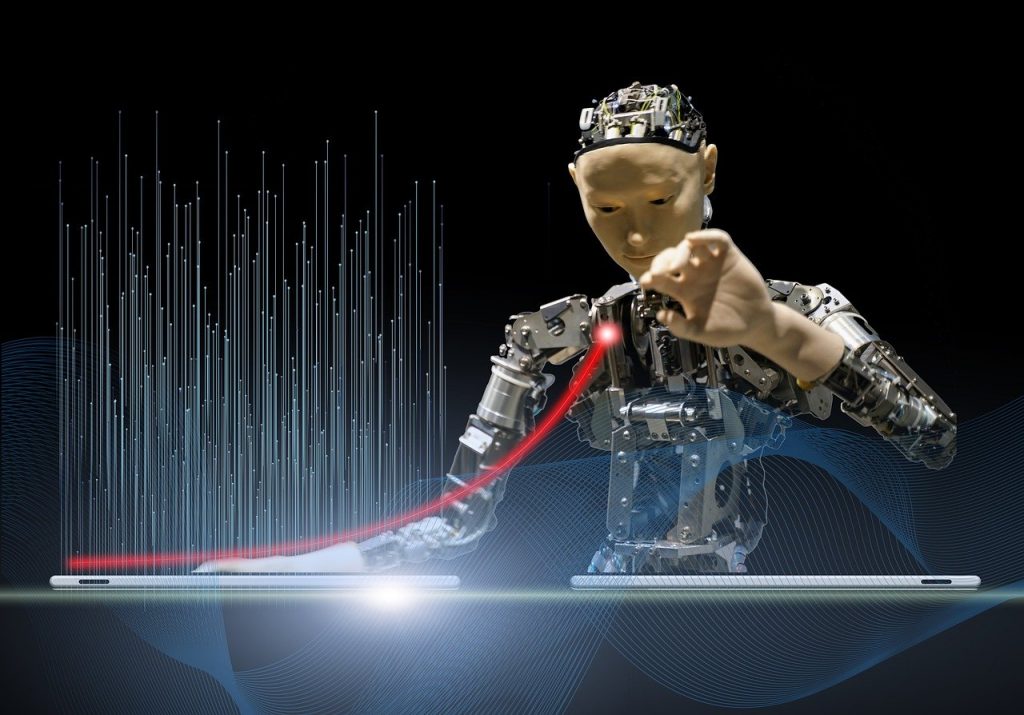
Exploring the Potential of Automated Business Processes

Exploring the Potential of Automated Business Processes

GUEST POST from Art Inteligencia

Business automation is increasingly becoming an important part of enterprise operations and is being used for a wide range of activities from payroll to customer service. Automating business processes is essentially a way for organizations to make their procedures faster, more efficient and reduce cost of operations. With so much potential for cost savings and efficiency, it is understandable why businesses are exploring automated business processes more and more.

By replacing labor-intensive processes with automated systems, businesses are finding cost savings and improved service levels that would have been difficult to achieve before. Additionally, these solutions can offer additional benefits such as better accuracy and optimization of business processes. With these potential benefits in mind, let’s explore some of the potential uses and case study examples of automated business processes.

Case Study 1 – Automated Payroll

One of the most common uses for automated processes is in the areas of employee administration and payroll. Automated systems can handle everything from on-boarding and benefits administration to payroll and taxes. This type of automation can reduce the amount of time and cost spent on administrative tasks while also ensuring that all processes are in compliance with applicable regulations.

For example, Canadian fashion retailer Reitmans recently implemented an automated payroll process that streamlined their processes and introduced cost savings of $50,000. The company was able to achieve this cost saving while still ensuring compliance with the government’s labor standards.

Case Study 1 – Order Processing

Another area where automated processes can be beneficial is order processing. Automated solutions can help manage order processing from taking an order to delivering it, furthering cost savings and faster turnover. Automation can reduce the manual effort to process orders which can lead to more orders being processed without the need to increase staffing.

One such example is from digital retailer Mabel’s Labels. The company is using an automated order processing system to automatically generate orders, check them, and ship them out within 24 hours. This automation has enabled the company to reduce order processing time from seven days to 24 hours.

Conclusion

With so much potential to automate business processes, it appears organizations are just starting to explore the potential of automation. As more organizations become comfortable with automation solutions, it’s likely we’ll see an increasing number of companies taking advantage of these solutions in the near future. Companies interested in taking advantage of automated processes should be sure to fully research the options available before implementing a solution.

SPECIAL BONUS: Braden Kelley’s Problem Finding Canvas can be a super useful starting point for doing design thinking or human-centered design.

“The Problem Finding Canvas should help you investigate a handful of areas to explore, choose the one most important to you, extract all of the potential challenges and opportunities and choose one to prioritize.”

Image credit: Pixabay

Subscribe to Human-Centered Change & Innovation WeeklySign up here to get Human-Centered Change & Innovation Weekly delivered to your inbox every week.

Humans-in-the-Loop

When to Automate and When to Pause

LAST UPDATED: March 24, 2026 at 4:57 PM

Humans-in-the-Loop

GUEST POST from Art Inteligencia


The Efficiency Trap: Why Full Automation Isn’t Always the Goal

In the relentless pursuit of digital transformation, many organizations fall into the trap of equating “automated” with “optimized.” However, a truly human-centered approach recognizes that automation should serve to enhance human potential, not merely replace it. When we automate without empathy, we risk creating rigid systems that lack the agility to handle the nuances of the real world.

The Myth of “Set It and Forget It”

The allure of “lights-out” operations often leads to organizational decay. When processes are fully removed from human oversight, we see a rapid decline in institutional knowledge. If the system fails or the market shifts, the team no longer possesses the muscle memory or the foundational understanding to intervene effectively. Full automation can inadvertently create a “black box” that stifles long-term innovation and leaves the organization vulnerable to disruption.

Technical Uptime vs. Emotional Resonance

Traditionally, IT and operations have measured success through technical uptime and processing speed. But in a Causal AI era, these binary metrics are insufficient. We must shift our focus toward Experience Level Measures (XLMs). A system may be “up” 99.9% of the time, but if the 0.1% failure occurs during a high-stakes customer crisis, the emotional resonance of that failure outweighs a thousand successful automated transactions. We must measure the cognitive load and emotional impact our systems place on both employees and customers.

Defining the “Friction Paradox”

Modern UX design often obsesses over “frictionless” experiences. Yet, in high-stakes environments — such as healthcare, financial pivoting, or ethical AI deployment — friction is a critical safety feature. Strategic friction forces a “Strategic Pause,” requiring a human to validate a decision before it becomes irreversible. By intentionally designing these moments of pause, we protect the organization from “experience leakage” and ensure that our automated outputs align with our deeper human values.

“Innovation is not about the tools we use, but the human problems we solve with them. If automation removes the humanity from the solution, it isn’t progress — it’s just a faster way to fail.” — Braden Kelley

The Strategic Pause: Identifying “Human-Critical” Junctions

In the drive for organizational agility, the most sophisticated tool at our disposal isn’t a faster algorithm — it’s the Strategic Pause. This is the intentional design of “speed bumps” in an automated workflow where human empathy, ethics, and causal reasoning are non-negotiable. By identifying these junctions, we prevent the “experience leakage” that occurs when automated systems hit a wall of human complexity they aren’t equipped to climb.

High-Empathy Moments: When Digital Feels Hollow

Every customer journey has “make-or-break” moments where the emotional stakes are high. In these scenarios, a perfectly executed automated response can feel dismissive or even cold. Whether it’s a service failure, a complex medical inquiry, or a significant financial transition, these High-Empathy Moments require the nuance of human tone and the flexibility of human judgment. Automation should flag these moments and hand them off to a person, ensuring the customer feels heard, not just processed.

Causal Complexity: Moving Beyond Correlation

Predictive AI is excellent at telling us what is likely to happen based on historical patterns, but it struggle with the why. Causal AI begins to bridge this gap, yet it still requires a human-in-the-loop to interpret intent. When a data trend deviates from the norm, a Strategic Pause allows a human strategist to ask: “Is this a shift in market sentiment, or a data anomaly?” Humans provide the context that turns raw data into actionable innovation strategy.

The Ethical Override: Establishing “Red Flag” Scenarios

Automation operates on logic; humans operate on values. We must establish Ethical Overrides — hard-coded triggers that pause an automated process the moment it touches upon sensitive territory. This includes bias detection in hiring algorithms, safety protocols in physical automation, or privacy concerns in data harvesting. A human-centered approach ensures that if a system cannot guarantee an ethical outcome, it must yield to a human operator who can be held accountable.

Designing for Intervention

A Strategic Pause is only effective if the human stepping in has the Psychological Safety and the tools to act. We must design our systems so that “pausing the machine” is seen as a proactive save rather than a technical failure. This requires clear interfaces that present the human with the necessary context — the Experience Level Measures (XLMs) — to make an informed decision quickly and confidently.

III. Designing the “Loop”: Frameworks for Collaboration

To move beyond simple task automation, we must architect a Collaborative Intelligence model. This isn’t about humans managing machines or machines replacing humans; it’s about a symbiotic loop where each party plays to its strengths. By designing the “loop” with intentionality, we ensure that digital transformation remains a human-centric endeavor rather than a purely technical one.

From Autopilot to Co-Pilot: Empowering the Workforce

The transition from “Autopilot” (where the system acts independently) to “Co-Pilot” (where the system assists) is a fundamental shift in organizational agility. A co-pilot interface must provide transparency — showing not just the output, but the rationale. When a human understands the “why” behind an AI’s suggestion, they can validate, refine, or override it based on real-time environmental context that the sensor or algorithm might miss. This maintains the human’s role as the ultimate strategist.

Experience Level Measures (XLMs) in Automation

Standard KPIs like “time-to-complete” are blind to the human experience. To truly understand if a collaborative loop is working, we must implement Experience Level Measures (XLMs). We should be asking:

  • Does this automation reduce cognitive load or merely shift it elsewhere?
  • Is the human-machine handoff seamless, or does it create a “context cliff” where the human feels lost?
  • Does the system provide enough psychological safety for a worker to challenge an automated decision?

Measuring these qualitative impacts is the only way to prevent burnout and ensure long-term adoption.

The Innovation Role Alignment

Not every person interacts with automation in the same way. By applying a structured framework of Innovation Roles (Braden Kelley’s Nine Innovation Roles is the best one), we can optimize the loop:

  • The Magic Maker: Uses automated tools to rapidly prototype and visualize “what if” scenarios, turning raw data into compelling narratives.
  • The Conscript: Provides the essential “ground truth” feedback, ensuring that the automated workflows actually function in the messy reality of day-to-day operations.
  • The Revolutionary: Acts as the ethical compass, reviewing the “Strategic Pauses” to ensure the system’s trajectory remains aligned with organizational values.

The Continuous Feedback Cycle

The loop is only complete when human insights are fed back into the system to refine the underlying logic. This Active Learning phase ensures that the system evolves. When a human overrides an automated decision, the system should prompt for the “why,” capturing that unique human intuition and converting it into a signal that improves future causal modeling. This turns every “pause” into a learning opportunity for the entire organization.

IV. Avoiding “Experience Leakage” in Digital Transformation

One of the most insidious risks of rapid automation is experience leakage — the slow, often unnoticed erosion of quality, empathy, and brand value as human touchpoints are replaced by rigid digital substitutes. To prevent this, digital transformation must be treated as a human-centered change initiative, not just a technical upgrade. We must ensure that our efficiency gains don’t come at the expense of our organizational soul.

The Customer Experience Audit: Finding the “Dead Ends”

Automation often creates “functional silos” where a customer can complete a task but cannot resolve a problem. A comprehensive Customer Experience Audit is essential to identify these friction points. We must map the journey to find where automation creates a “dead end” — a place where the system lacks the causal logic to help a frustrated user. By identifying these “revenue leakage” points, we can strategically re-insert human intervention to recover the relationship and the sale.

Psychological Safety: The Human Fail-Safe

For a “Humans-in-the-Loop” system to work, the humans must feel safe enough to speak up. If an employee sees an automated system making a biased or incorrect decision but fears “breaking the process,” the system has failed. Cultivating Psychological Safety means empowering every team member to hit the “emergency stop” button. We must move away from a culture of compliance and toward a culture of stewardship, where human intuition is valued as the ultimate safeguard against algorithmic error.

The Feedback Loop: Converting Intuition into Data

Experience leakage occurs when the “person in the machine” sees a problem but has no way to fix the underlying logic. We must build formal mechanisms where human insights directly retrain our models. When a Strategic Pause occurs, the human operator shouldn’t just fix the immediate issue; they should provide the “why” that informs the next iteration of the automation. This creates a virtuous cycle where the AI becomes more “human-aware” over time, reducing the cognitive load on the workforce.

Measuring What Matters: Beyond Throughput

To stop the leak, we must change our instrumentation. If we only measure throughput, we will always favor the machine. By integrating Experience Level Measures (XLMs) into our transformation dashboards, we gain visibility into the emotional health of the ecosystem. Are our customers feeling more empowered, or more ignored? Are our employees feeling more creative, or more like “data janitors”? The answers to these questions determine whether your transformation is building equity or leaking it.

V. Conclusion: Building a Human-Centric Future

The future of work isn’t a race against the machine; it’s a race to see who can best leverage technology to amplify human ingenuity. As we move from predictive models to causal systems, the “Humans-in-the-Loop” philosophy becomes our most significant competitive advantage. Success in this new era requires us to stop asking “How can we automate this?” and start asking “How can this automation make our people more impactful?”

The New ROI: Measuring Human Engagement

We must redefine our Return on Investment. True ROI in the age of AI isn’t just about headcount reduction or faster processing times; it’s about the quality of engagement. When we successfully automate the mundane, we unlock the capacity for our teams to engage in deep work, complex problem-solving, and high-value relationship building. If your automation doesn’t result in a more creative, energized workforce, you haven’t optimized — you’ve simply hollowed out your potential.

A Call to Action: Audit Your Pipeline

The first step toward a human-centered future is a rigorous audit of your current automation pipeline. Look for the “silent failures” where efficiency has replaced empathy.

  • Identify: Where are your “dead ends” and “experience leaks”?
  • Insert: Where is a Strategic Pause required to protect your brand or your ethics?
  • Empower: Do your people have the Psychological Safety to override the system when it’s wrong?

The Path to Infinite Innovation

By keeping humans in the loop, we ensure that our organizations remain agile, empathetic, and resilient. This approach aligns perfectly with the Eight I’s of Infinite Innovation, specifically ensuring that our Implementation phase never loses sight of the Insight and Ideation that only a human can provide. We aren’t just building faster systems; we are building a more responsive, human-centered world.

“The goal of digital transformation is not to create a world without people, but to create a world where people can do their best work. When we pause for the human element, we aren’t slowing down — we’re ensuring we’re heading in the right direction.”

Frequently Asked Questions: Humans-in-the-Loop

What is a “Strategic Pause” in automation?

A Strategic Pause is an intentionally designed “speed bump” in an automated workflow. It marks a critical junction where the system stops to require human judgment, empathy, or ethical oversight before proceeding. This prevents “experience leakage” and ensures that high-stakes decisions align with human values rather than just algorithmic logic.

How do Experience Level Measures (XLMs) differ from traditional KPIs?

While traditional KPIs (Key Performance Indicators) focus on technical output like speed and uptime, XLMs measure the human impact of a system. They track qualitative factors such as cognitive load, emotional resonance, and psychological safety. XLMs help organizations understand if automation is truly empowering people or simply creating digital friction.

When should a process NOT be fully automated?

A process should remain “human-in-the-loop” during High-Empathy Moments (such as customer crises), situations involving Causal Complexity (where the “why” matters more than the “what”), and any scenario requiring an Ethical Override. If the cost of a mechanical error is an irreversible loss of trust or safety, human intervention is mandatory.

Image credit: Google Gemini

Subscribe to Human-Centered Change & Innovation WeeklySign up here to get Human-Centered Change & Innovation Weekly delivered to your inbox every week.
