Innovation Through Synthesis

GUEST POST from Chateau G Pato
LAST UPDATED: January 18, 2026 at 1:01PM
We are currently witnessing a massive explosion in “generative output.” With the rise of Large Language Models and sophisticated AI design tools, the cost of generating a new idea has effectively dropped to zero. We can now prompt a machine to give us a thousand product concepts, marketing taglines, or business models in a matter of seconds. But here is the catch: An abundance of ideas is not the same as an abundance of innovation.
True innovation has always been a human-centered endeavor. It requires more than just the raw material of thought; it requires synthesis. Synthesis is the act of combining disparate elements to form a coherent whole that is greater than the sum of its parts. In this new era, the human role in the innovation lifecycle is shifting from the creator of components to the synthesizer of systems. We are the architects who must decide which of the AI’s bricks actually belong in the cathedral.
“AI can give us the dots, but only the human heart and mind can see the constellation. Our value in the future won’t be measured by the ideas we generate, but by the meaningful connections we forge between them.” — Braden Kelley
The “Lived Experience” Gap
AI is a master of probability, not a master of meaning. It can suggest a connection between a fitness app and a sustainability initiative because they share linguistic proximity in its training data. However, it cannot understand the visceral frustration of a user who feels guilty about their carbon footprint while trying to stay healthy. It cannot feel the tension of a boardroom or the subtle cultural nuances of a specific community.
Humans bring contextual intelligence to the table. When we look at a list of AI-generated suggestions, we filter them through our lived experience. We perform a “reality check” that machines cannot yet replicate. This synthesis is where value is created—it is where we take the “what” provided by the AI and infuse it with the “why” and the “how” that makes it resonate with other humans.
Case Study 1: The Adaptive Urban Planning Initiative
The Opportunity
A European mid-sized city sought to redesign its public transit nodes to better serve a post-pandemic workforce. They used generative AI to simulate millions of traffic patterns, pedestrian flows, and economic zoning configurations. The AI produced three hundred potential layouts that maximized efficiency and minimized commute times.
The Synthesis
The urban planning team, rather than picking the most “efficient” AI model, held a human-centered synthesis workshop. They realized the AI had completely ignored the social fabric of the neighborhoods. One AI-suggested layout destroyed a small, informal park where elderly residents gathered. Another removed a historical landmark to make room for a bus lane. The humans synthesized the AI’s data on flow efficiency with their own knowledge of community belonging. They “stitched” parts of five different AI models together to create a plan that was 85% as efficient as the top AI model but 100% more culturally sustainable.
The Move from “Producer” to “Editor-in-Chief”
For innovators, this shift can be uncomfortable. For decades, we were the ones staring at the blank page. Now, the page is never blank; it is often too full. This requires a new set of skills that I often speak about in my keynotes: Discernment, Empathy, and Strategic Intent.
As the Innovation Speaker Braden Kelley, I often remind audiences that if everyone has access to the same AI tools, then the “raw ideas” become a commodity. The competitive advantage moves to those who can curate and combine. We must become Editors-in-Chief of Innovation. We must look at the “noise” generated by the machines and find the “signal” that aligns with our organizational values and human needs.
Case Study 2: Reimagining Consumer Packaging
The Challenge
A global CPG (Consumer Packaged Goods) company wanted to create a plastic-free bottle for a high-end shampoo line. The AI generated thousands of structural designs using mycelium, seaweed derivatives, and pressed paper. Many were beautiful but physically impossible to manufacture or too expensive for the target demographic.
The Synthesis
The design team didn’t discard the “impossible” ideas. Instead, they used analogous thinking—a key component of human synthesis. They looked at an AI-generated mycelium structure and connected it to a traditional Japanese wood-binding technique they had seen in an art gallery. By synthesizing the machine’s material suggestion with an ancient human craft, they developed a hybrid packaging solution that was both biodegradable and structurally sound. The AI provided the ingredient (mycelium), but the human provided the recipe (the binding technique).
Protecting the Human Element
To avoid “Innovation Debt,” organizations must ensure that their push for AI adoption doesn’t bypass the synthesis phase. If we simply “copy-paste” AI outputs into the real world, we risk creating a sterile, disconnected, and ultimately unsuccessful future. We must fund the time required for humans to think, debate, and connect. Synthesis is not a fast process, but it is the process that ensures meaningful change.
As we move forward, don’t ask what AI can do for your innovation process. Ask how your team can better synthesize the abundance that AI provides. That is where the future of leadership lies.
Human-Centered Synthesis FAQ
What is ‘Innovation Through Synthesis’ in the age of AI?
Why can’t AI handle the synthesis phase alone?
How should organizations change their innovation workflow to accommodate this?
BONUS: The Synthesis Framework
Here is a structured Synthesis Framework designed to help your teams move from a pile of AI outputs to a high-value, human-centered innovation.
In my work as a human-centered change and innovation thought leader, I’ve found that teams often get paralyzed by the sheer volume of AI suggestions. Use this four-step methodology to transform “raw ingredients” into “meaningful solutions.”
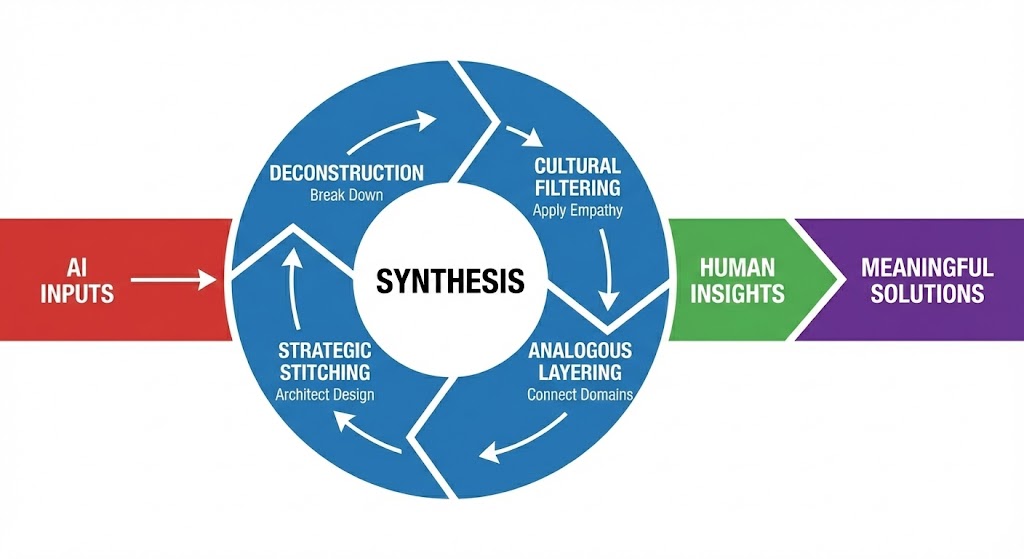
Step 1: Breaking the AI Monolith (Deconstruction)
Don’t look at an AI-generated idea as a “take it or leave it” proposal. Instead, deconstruct it into its base elements: The underlying technology, the business model, the user interface, and the value proposition.
Action: Ask your team, “What is the one ingredient in this suggestion that actually has merit, even if the rest of the idea is flawed?”
Step 2: Applying the Lived Experience (Cultural Filtering)
This is where human empathy takes center stage. Run the deconstructed elements through the filter of your specific user base. AI can’t feel the “unspoken” needs or the cultural taboos of your audience.
Action: Engage the focus on Human-Centered Change™ mindset that we encourage here to ask: “Does this connection solve a real human friction, or is it just technically possible?”
Step 3: Connecting Across Domains (Analogous Layering)
AI is limited by the data it has seen. Humans have the unique ability to layer insights from unrelated fields—like applying a hospital’s patient-flow logic to a retail checkout experience.
Action: Force a connection between an AI “dot” and a completely unrelated hobby, industry, or historical event known to the team. This is where true synthesis happens.
Step 4: The Architect’s Final Design (Strategic Stitching)
Finally, stitch the validated ingredients together into a new, coherent vision. Ensure the final output aligns with your organizational purpose and long-term strategy, effectively avoiding Innovation Debt.
Action: Create a “Synthesis Map” that visually shows how multiple AI inputs were combined with human insights to create the final solution.
Remember: When you search for an innovation speaker to guide your team through this transition, look for those who prioritize the human role in the loop. The machines provide the noise; we provide the music.
Extra Extra: Because innovation is all about change, Braden Kelley’s human-centered change methodology and tools are the best way to plan and execute the changes necessary to support your innovation and transformation efforts — all while literally getting everyone all on the same page for change. Find out more about the methodology and tools, including the book Charting Change by following the link. Be sure and download the TEN FREE TOOLS while you’re here.
Image credits: Google Gemini
 Sign up here to get Human-Centered Change & Innovation Weekly delivered to your inbox every week.