How Small, Agile Teams are Out-Pacing Corporate Giants
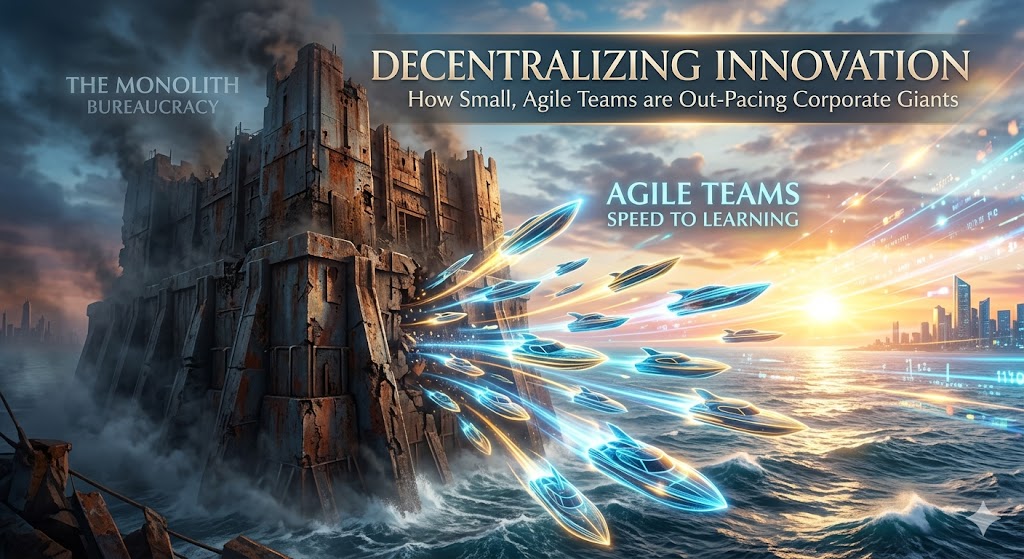
GUEST POST from Art Inteligencia
I. Introduction: The Death of the Innovation Monolith
The Illusion of Scale
For decades, conventional corporate wisdom dictated that market dominance was a direct byproduct of scale. Massive R&D budgets, sprawling campuses, and armies of specialized personnel were viewed as impenetrable moats. However, in today’s hyper-accelerated market, these massive resources frequently transform into anchors. Raw capital and sheer headcount no longer guarantee breakthrough innovation; more often than not, they simply fund bureaucracy.
The Bureaucracy Tax
As organizations grow, they naturally develop a corporate immune system designed to minimize risk and protect the core business. This manifests as a heavy “bureaucracy tax”—multi-layered matrix structures, endless sign-offs, and a culture of risk-aversion. By the time a novel idea navigates the gauntlet of corporate committees, legal reviews, and brand alignment sessions, the market opportunity has often vanished, or the concept has been diluted into irrelevance.
The Thesis
True innovation does not scale linearly with headcount or capital investment. Instead, it thrives in distributed networks of small, highly autonomous, human-centered teams. To out-pace corporate giants, organizations must abandon the monolithic approach and empower nimble units that prioritize speed-to-learning over speed-to-market. The future belongs to those who can iterate, adapt, and connect with human needs at the speed of change.
II. The Architecture of Decentralized Innovation
The “Two-Pizza Team” Reinvented
Amazon famously popularized the concept of the “Two-Pizza Team”—the idea that a team should be small enough to be fed by two pizzas. But in a human-centered innovation ecosystem, we must evolve this metric beyond mere headcount or product features. True decentralized units are structured around a specific human problem or an end-to-end customer experience. When a team owns an emotional outcome rather than a static line of code, their focus shifts from shipping features to solving friction.
Radical Autonomy & Psychological Safety
Speed is a byproduct of trust. To out-pace monolithic competitors, decentralized teams must operate with radical autonomy, shifting from a corporate culture of “permission” to one of “guarded experimentation.” This requires a baseline of absolute psychological safety, where failure is treated as localized data rather than a career liability. When the penalty for an unproven hypothesis is removed, teams can push boundaries and pivot based on real-world evidence rather than political safety.
Cross-Functional Composition
Silos are the death of agility. A decentralized innovation team cannot afford hand-offs or delayed dependencies. From day one, these squads must be cross-functional by design—blending engineering, experience design, change management, and human anthropology into a single, cohesive unit. By embedding diverse perspectives directly into the daily workflow, the team avoids the traditional “throw it over the wall” mentality, ensuring that human desirability, technical feasibility, and business viability are co-created simultaneously.
III. Why Agile Teams Out-Pace Corporate Giants
Compression of the Feedback Loop
In the race to relevance, the winner is rarely the company that launches first; it is the company that learns fastest. Small, agile teams excel at compressing the feedback loop between an idea and real-world validation. Free from bureaucratic latency, these nimble squads can wireframe, prototype, and test an assumption with actual users in a matter of days. Conversely, monolithic corporate structures often spend months merely securing the approvals required to run a local pilot, ceding the market to faster learners.
Failing Forward vs. Falling Behind
The structural design of an organization dictates its relationship with risk. Within a decentralized team, a failed experiment is treated as localized data—an efficient way to eliminate a flawed assumption before heavy capital is deployed. In contrast, the layered hierarchies of corporate giants view failure as a systemic threat and a career liability. This cultural paralyzation forces large enterprises to favor incremental, defensive updates over disruptive breakthroughs, causing them to fall behind as nimble competitors leapfrog them entirely.
Frictionless Experience Design (XD)
Empathy cannot be sub-contracted or automated. Because decentralized teams operate on the front lines, they maintain close, unfiltered proximity to the end-user. This intimacy allows them to practice authentic experience design, capturing the subtle emotional and physical friction points that traditional quantitative data and detached corporate focus groups completely miss. By understanding the human reality behind the metrics, agile teams can fluidly pivot their solutions to solve real, lived problems.
IV. The Human Element: Overcoming Corporate Inertia
The Middle Management Bottleneck
Every mature organization possesses a corporate immune system designed to preserve the status quo and minimize risk. This operational bias typically concentrates in middle management, where traditional Key Performance Indicators (KPIs) prioritize predictability, optimization, and quarterly efficiency over long-term experimentation. When a decentralized team introduces a disruptive concept, it inevitably triggers this organizational defense mechanism. Overcoming this friction requires redesigning incentives so that managers are rewarded for enabling transformation rather than policing compliance.
From Control to Enablement
Decentralizing innovation fundamentally redefines the role of executive leadership. In a traditional corporate hierarchy, leaders act as traffic controllers—approving budgets, directing tactics, and managing execution from the top down. To foster true agility, leaders must transition from a model of strict control to one of radical enablement. This means shifting focus away from tactical micromanagement and toward establishing clear strategic guardrails, securing cross-functional resources, and actively dismantling bureaucratic roadblocks for front-line teams.
Co-Creation with Customers
The era of treating users as passive research subjects is over. Monolithic organizations often rely on sterile focus groups and lagging data pools, distancing themselves from actual human experiences. Small, agile teams maintain a massive advantage by practicing participatory innovation—bringing customers directly into the design sandbox. By treating users as active co-creation partners throughout the entire development cycle, decentralized teams drastically lower development risk, reduce market resistance, and design solutions that map precisely to real-world behavioral needs.
V. How Giants Can Adapt: “Internal Decentralization”
The Skunkworks Model 2.0
To survive, monolithic organizations must learn to incubate disruption within their own walls. This requires evolving the classic “Skunkworks” approach into a modernized framework. Enterprises must establish ring-fenced, autonomous units that are physically and operationally detached from the core business. These squads operate under an entirely different set of rules—unburdened by standard corporate governance, legacy technology stacks, and slow procurement processes—allowing them to match the speed and fluid execution of external startups.
Venture Architecture
Traditional corporate budgeting is the enemy of agility; fixing funding for twelve months based on unproven assumptions guarantees waste or missed opportunities. Forward-thinking enterprises are adopting a “venture architecture” model, treating internal teams like early-stage startups. Instead of relying on rigid annual allocations, project funding is metered and milestone-based. Teams receive initial seed capital to validate a problem, and subsequent funding rounds are unlocked only when they demonstrate real-world human traction and validated learning.
The API-fication of the Enterprise
The greatest advantage a corporate giant possesses is its scale—its vast customer data, distribution networks, regulatory expertise, and capital. However, accessing these assets usually requires navigating a maze of internal politics and red tape. “API-fication” means turning these massive corporate resources into clean, self-service platforms. By treating internal functions (like legal, compliance, or supply chain) as modular services with clear interfaces, small internal teams can leverage corporate scale instantly without being strangled by corporate bureaucracy.
VI. Conclusion: The Future of Innovation is Distributed
Summary of the Shift
The competitive landscape has fundamentally fractured. The historical moat of massive corporate scale has dried up, replaced by an ecosystem where organizational velocity and deep human empathy reign supreme. Innovation is no longer a financial arms race won by the largest R&D budget; it is a learning race won by the most agile networks. The small, decentralized teams outpacing corporate giants are proving that the ability to rapidly sense, adapt, and respond to human needs is the ultimate competitive advantage.
A Call to Action for Leaders
For executive leaders, the mandate is clear: stop attempting to build or manage a monolithic “Innovation Department.” Innovation cannot be compartmentalized into a single silo, nor can it be mandated from a top-down hierarchy. Instead, your primary role must shift to that of an ecosystem architect. You must intentionally design an organizational infrastructure that fosters psychological safety, provides flexible guardrails, and allows a hundred small, decentralized experiments to cross-pollinate and bloom simultaneously.
The Final Word
As we navigate an increasingly complex and fast-moving economy, the gap between bureaucratic planners and human-centered doers will only widen. Large enterprises that cling to rigid, centralized command-and-control structures will find themselves optimized for a world that no longer exists. In the future of business, it will not be the big fish eating the small fish; it will be the fast, human-centered, and deeply connected networks consistently out-innovating the big and the bureaucratic.
Frequently Asked Questions
Why are small teams outperforming large corporations in innovation?
Small teams excel because they lack the “bureaucracy tax”—the multiple layers of management, risk-averse committees, and slow sign-off processes that paralyze corporate giants. This structural freedom compresses their feedback loops, allowing them to test hypotheses, gather data, and pivot in days rather than months.
How can a large enterprise implement “internal decentralization”?
Large organizations can adapt by adopting three key strategies: creating modernized, ring-fenced “Skunkworks” units with separate operational rules; utilizing a “venture architecture” funding model that allocates capital based on milestones rather than annual budgets; and converting corporate assets (like legal, compliance, and data) into self-service, internal APIs that agile teams can access without red tape.
What is the role of leadership in a decentralized innovation model?
In a decentralized framework, leadership shifts from a model of top-down command and control to one of radical enablement. Instead of directing tactics or micromanaging product features, leaders become ecosystem architects who establish clear strategic guardrails, secure cross-functional resources, and actively dismantle bureaucratic roadblocks for their teams.
FutureHacking™ Is Coming
FutureHacking™ is Braden Kelley’s strategic foresight methodology — and a paid download and training program is launching soon. Register your interest now to be the first to know when it’s available, and get early access pricing.
Image credit: Gemini
 Sign up here to get Human-Centered Change & Innovation Weekly delivered to your inbox every week.