Author Archives: Nicolas Bry

About Nicolas Bry

Nicolas Bry is an International Innovation Executive, expert in corporate innovation programs, and innovation labs, designing place where good innovation thrives! He currently helps the 20 innovation managers of Orange Africa to develop their projects locally. Previously he created several open innovation programs: innovation with employees (Orange Intrapreneurs Studio), innovation with consumers (Imagine with Orange), innovation with entrepreneurs (Orange African Toolbox). Consolidating this experience with the ones of 40 corporations, he wrote in 2019 The Intrapreneurs' Factory, a practical guide to leverage intrapreneurship for your company. Passionate speaker (TEDx), Masterclasses lecturer @Google Academy and Tech/Business Schools, ISPIM Prize laureate for innovation management in 2016, Nicolas is writer of the innovation blog RapidInnovation.fr. Follow him at @nicobry.

The Social Intrapreneur Guide

GUEST POST from Nicolas Bry — originally published on Innovation Excellence.

Emmanuel de Lutzel is VP Social Business at BNP Paribas, and an active a social intrapreneur. Based on intrapreneurs interviews and his own experience, he wrote the book ‘Transform your company from the inside: the social intrapreneur guide’, with Valérie de la Rochefoucauld-Drouâs in 2015. He kindly answer our questions about his book, about who social inrapreneurs are, and his personal innovation journey.

Nicolas Bry: Tell us about yourself, your experience, and how you came up with the idea of the book ‘The social intrapreneur guide’, co-written with Valérie de Drouâs? Why is social intrapreneurship an important topic today ?

EdL: My intrapreneurial journey started as a volunteer in 2004: I initiated within BNP Paribas an informal network of volunteers to support micro-entrepreneurs financed by ADIE, the largest European microfinance organization. We were then 10 in France, we now have 600 volunteers working with 40 organisations in 10 countries. IN 2005, I had the intuition that microfinance was not only a matter of volunteering but also a business issue. After meeting individually 40 managers within the bank, I proposed to the Executive Committee of BNP Paribas to finance microfinance institutions in developing countries. It was a personal initiative far away from my official mission (cash management). It was a fully new subject both for me and for the bank. Since then, we have financed more than 40 institutions in 20 countries and broadened the subject in 2013 to social businesses in Europe.

Following this initiative, I had to answer many questions from colleagues and friends: how did you do that, whereas you had no mission, no money and no time for that? I was interviewed by the French magazine l’Express and I discovered that what I did was called intrapreneurship. Thanks to their article, I discovered that I was not the only intrapreneur in the universe, and I started to meet and share my experience with other intrapreneurs.  Since there was no reference book in French about this subject, I decided to gather their stories and lessons learned in order to answer the questions from wannabe intrapreneurs.
For classical companies, social intrapreneurship is important because CSR is entering a new era: after the age of communication and marketing, CSR is now integrated into the business processes. Social intrapreneurs are needed to implement social innovations, speaking both the business language of the company they work for and the language of social businesses they want to support.

metafrique.net

NB: The book targets social intrapreneurship: how would you define a social intrapreneurship project, and how is it compatible with the idea of profitable business?

Emmanuel: There is a misconception about social intrapreneurship : because it is social, it should not be profitable. It is not true. The same rule applies for social business as for classical business.  Intrapreneurs from large companies that I have interviewed (Lafarge, Veolia, Danone, Schneider Electric, Total) insist on this simple rule : a social business needs to be profitable to be sustainable, it cannot accumulate deficits for many years.  Profit or not profit is not the question, the issue is how profit is used : is it reinvested for more social impact or is it distributed to investors who are only interested in financial return ?

Lafarge

Lafarge with their initiative about affordable housing is a good example. Initially, they would sell cement only to construction companies. Since 2011, thanks to a young intrapreneur called Francois Perrot, they became aware of the potential market of millions individual customers in developing countries who would buy 30 kg cement to build a new room in their house. They now distribute cement to this new segment in 18 countries and offer in financing through their partnership with microfinance institutions in 10 countries. This is a totally new business model for a company which has been existing for almost two centuries.

NB: What is the typical profile of a social intrapreneur? What skills do you have to develop? vision and audacity, self-consciousness, resilience, collective & networking mindset, analytical skills, being both passionate & patient, utopist & realistic?

Emmanuel: I often sum up the profile of the social intrapreneur with three “P”: Passion, Patience, and Pirate spirit. He is passionate about his topic and has therefore a strong capacity to convince. He is also patient because he knows the importance of good timing. And he has pirate spirit, he is daring and knows how to overcome rules if they are not appropriate.

ppc.wikia.com

The intrapreneur is both a dreamer and a doer. He has the capacity to imagine the future but also to implement the processes within the company to shape this future. He is like the ambassador to a faraway country: he must speak another language, the language of social business, but he must also understand the other culture to build bridges.

Nicolas Cordier, a social intrapreneur at Leroy Merlin, is a typical illustration. At the beginning of his business career, at a time few people knew about microfinance, he worked for Contigo, a microfinance institution in Chile and he visited Grameen Bank in Bengladesh. 20 years later, after 10 years classical business experience within Leroy Merlin, he started to lobby internally for a cooperation with social businesses. It took him more 2 years and more than 60 individual contacts to get a specific mandate from the top management about this subject.

NB: What hurdles are going to face social intrapreneurs in the accomplishment of their goal? What are the top 3 tools you would recommend to a social intrapreneur on his innovation journey?

Emmanuel: The intrapreneur faces three types of obstacles: inertia, ignorance, and isolation.

  1. Inertia means first personal inertia: why should I launch an initiative whereas nobody asked me for that? What is my legitimacy? Is it not a deviation from my business mission?  Also organizational inertia: everybody believes your idea is a good idea for the company, as far as they are not directly concerned;
  2. Ignorance: when I started to promote microfinance as a business case for BNP Paribas, I was not an expert of the subject, and nobody within the bank knew it properly;
  3. Isolation: when the intrapreneur starts his journey, he is very much alone. To make sure that his disruptive idea is good for the company, he needs to crash-test the idea and find supporters within the company.

Based on the collective experience of my fellow intrapreneurs, I would formulate three recommendations:

  1. Do not stay alone. You need friends to crash-test your ideas with a constructive spirit. You need also experts to support you in complex fields such as law, taxes, finance, product design, etc…
  2. Build a business model, answering all questions in detail : quantity and characteristics of the product, pricing, customers, geography, revenues, costs, suppliers, competitors, etc…
  3. Involve the top management: the more disruptive your idea is, the more support you need from the top. But it is like a gun with only one bullet, you need to use the right arguments at the right moment, when you already have some supporters and the beginning of a business plan.

daniellepilkinpromotionsllc.com

NB: What percentage of the 20 social intrapreneurs you’ve met turn out eventually to be social entrepreneurs, and have initiated their own start-up?

Emmanuel: Two years after the interviews for the book, two out of twenty intrapreneurs have decided to leave their company and to start their own business. This is a very courageous decision. When you are an intrapreneur, as far as you convince the management, you get the support of your employer: mission, time, money, expertise. For example, if you need a specialist about law, taxes or product design, you find it within the company. When you leave the company, whatever your network and your level of expertise, you may feel very alone.

NB: You believe social intrapreneurship changes the company from the inside: how did your personal project on extending micro-financing at international scale, change your company, BNP Paribas?

Emmanuel: The impact is not only what you may see, for example, m€ 600 invested by BNP Paribas in microfinance and social business. It goes much deeper in the company’s culture, that employees feel empowered to make proposals and to be involved in social business. Ten years after my initiative for microfinance, I am amazed to see how many persons within the bank have been supportive, providing time and skills.

Many ask me how to launch such a social business initiative. My answer is always: start with inspiration, what is the social problem which touches you the most, for which you are ready to spend your evenings and weekends? For example if you are sensitive about refugees economic integration, get to know the associations which are involved, and see how you can build a bridge between their problems and your business. Do not expect your employer to give you a clear mandate for your disruptive idea, remember the sentence of Mahatma Gandhi : “be the change you want to see in the world”.

Enregistrer

Enregistrer


Subscribe to Human-Centered Change & Innovation WeeklySign up here to get Human-Centered Change & Innovation Weekly delivered to your inbox every week.

Paris Accenture Innovation Center: Creativity on starting-blocks

GUEST POST from Nicolas Bry — originally published on Innovation Excellence.

What is the Paris Accenture Innovation Center ? In a nutshell, a dizzying innovation team, acting in a tremendous place for creativity!

Albane Liger Belair, Accenture Paris Innovation Center Director, and her deputy, in charge of the program lead, Mathieu Cambe, kindly walked me through this amazing space.

Identity and purpose

Paris Accenture Innovation Center opened in April 2016. Other Accenture Innovation Centers had been developed elsewhere: so their experience fed the Parisian entity. What identity did the Parisian center shaped based on this benchmark?

  • A focus on ideation and bootstrap, giving corporations the possibility to open a creative parenthesis, and leave space for imagination;
  • A flexible and open space, involving bespoke innovation journeys for corporations, based on 4 reference paths (that we will discover below); as a symbol of openness, the Accenture Open Innovation can be found in the Innovation Center: they screen startups for Accenture customers, and initiate joint offerings with companies;
  • Multidisciplinary resources, that can support the whole innovation process from discovery (Sofia Antipolis Accenture Tech Lab providing inspirational insights and R&D showcase), to design (a team of 20 Fjord Design designers are on-site),  and development (Liquid Studio can complete fast prototyping with 15 developers and additional resources in Nantes and Bucharest).

The Paris Innovation Center is facilitated by a small team of 4 enthusiastic people, with the help of consultants detached by the core company, who will be trained, and further propagate the innovation spirit, once back in their industrial unit.

An innovation journey

Let’s get through the different layouts of the Innovation Center that support each step of the innovation process:

  • First is the reception, or as Albane says, the Icebreaker space, a  kind of lounge bar, offering a fantastic view over Paris;
  • The Demo space mobilizes 3D printing and scanner, to print customized objects for the visitor, initiate discussions based on tangible innovations, sometimes far from the usual footprint of the customer, and demystify technologies like 3D printed prostheses;
  • Telepresence space enables connections with Accenture Tech Labs, and especially Sofia Antipolis, whose skills on future Banking, Energy, and Artificial Intelligence are sharp;
  • Immersion space is where the active process starts, with one group of 7 to 10 people engaging on one of the 4 innovation paths; if the participants number extands, different groups are set, that further positively compete;
  • White room is an invitation to cover all the walls with unlimited creative ideas;
  • Analytical space makes a special focus on the use of data, and provides different interconnected video screens to help rebuild the data flow, and streamline the process;
  • Finally, the journey ends with a VR immersion, that lets you feel vertiginous, climbing to new heights.

4 reference paths

Accenture suggest 4 different paths, that can be adapted according to clients’ needs:

  1. Explore: half a day to focus on trending topic, demystify it and assess its impact for the company;
  2. Decide: A one day workshop to align on a strategic commitment. Challenging received wisdom, and orthodoxies, and turning them into opportunities. Having a close look at future jobs: data scientist, chief happiness officer, … Based on the breakthrough workshop methodology developed by Accenture Singapore
  3. Create: 2 to 3 days for a Design Thinking Rumble. Observation stage is performed before the workshop, and graphical design can be squeezed in between 2 workshops;
  4. Develop : fast prototyping with Liquid Studio, in the Lean Startup way. This last stage opens to a project management future.


Subscribe to Human-Centered Change & Innovation WeeklySign up here to get Human-Centered Change & Innovation Weekly delivered to your inbox every week.

Let’s Digitize the Innovation Process!

GUEST POST from Nicolas Bry — originally published on Innovation Excellence.

What if mobile was the right media to support, democratize, and streamline the innovation process?

Moodi Mahmoudi is one of the founders of Collaborne, and thats’ excatly what his startup is trying to achieve. He tells us more about it, while receiving us in their gorgeous premises in Amsterdam.

The innovation management dilemma

Is really innovation a problem companies want to solve? People often explain how much it’s critical, and still they are not satisfied with it. Basically explains Moodi, they face two groups of solutions, both unsatisfactory :

  • Consulting, which doesn’t scale;
  • Ideation software: but innovation doesn’t start with an idea, it thrives with a customer insight!

So this 150 B€ market is merely untapped.

The opportunity

Moodi speaks of a huge opportunity: innovation is on pen and paper, let’s digitalize innovation process! Akin what happened with CRM and ERP for the other corporate processes, innovation can benefit from IT, bringing the best practices on hand, within the range of our mouse. Innovation could actually be the first computerized corporate process to be mobile first. Collaborne pictures itself as the Salesforce.com for innovation, and on mobile!

The value proposition

Collaborne mobile app supports the innovator journey along 4 steps based on Design Thinking for concepting and Lean Methodology for implementing: sensing, visioning, prototyping, and scaling. This path is named ‘Insights to Venture‘ by Collaborne.

With this simple, smart, and sticky tool, Collaborne aims to facilitate participative innovation: every one in the company is a target user. “We need a movement, people outside the innovation entities are to be part of it” claims Moodi.

Collaborne acts as an online innovation coach:

  • Innovation culture knowledge is instilled into the mobile app though short video clip, enticing you to design without knowing design thinking;
  • The mobile app substitutes the coach, the app drives the innovator, and suggests a system of reference to advance the project;
  • and finally the app provides analytics because nobody cares if you can’t measure it!
  • The app makes it collaborative, fostering interactions across the innovation teams.

Clients include Vodafone, World Economic Forum, BNP Paribas, Nationale-Nederland, Nuon, Covéa, Nationale Politie, Port Authority of Rotterdam, City of Amsterdam, AES Energy, Netherlands Ministry of Defense, or global retail giant Auchan.

Some exemplary tools

Let’s pick-up a few tools that support the project milestones:

  • Comprehensive Timeline: sensing, visioning, prototyping, and scaling; with a description of each step of the process (goals and missions);
  • Uncovering needs, capturing market fit, instead of pushing ideas;
  • Venture Canvas: the ultimate outcome, that is enriched all along the process, from conception to implementation;
  • 4 quadrants feedback to iterate your value proposition, based on 4 dimensions: desirable, feasible, viable, and  legitimate (what people expect you to do, and what you should not do);
  • Project organization: Slack and Collaborne complement naturally;
  • Guideline to pitch;
  • Project dashboard: activity / liveliness, process progress, and project performance; measure and monitor;
  • Analytics : per project,  portfolio, user.

A video is provided for every single mission. It’s possible to customize the project or highlight tracks. The team schedules its own tasks, and post the data according to guidelines. Tracks is for deciding about the missions. You add a mission by asking people to join the team.

Game mechanics could be a future feature.

An entry is provided for the boss, while the entry for the team is the Timeline.

A project and a team can be created in a few seconds.

Collaborne covers all dimensions of innovation with ‘innovation tracks’ for transformation projects as well as tracks for core/ incremental innovations letting companies innovate on process, product, and customer experience. A typical timeframe to go down the Collaborne innovation path on Product, Process, or Customer experience domain would be 12 weeks, that could be repeated 3 times a year.

The greater outlook

Collaborne is a transformative tool, to bring every employee on board of the innovation process, from insights to venture.

Moodi says: ‘Innovation is desire for change. Innovation is not a cultural problem, it’s not magic, it’s a science. For now it is reserved to the few people who know what to do: we want to make innovation available to the 99% who don’t have yet access’. How will people handle the innovation process in parallel with their job? ‘The answer is to boil it down in the day to day process’.

In the long run, Moodi foresses: ‘The tool is transformative, every business line should have digital abilities, and every new employee should be a coder. Next generation will have the capabilities, and so, with Collaborne, your company has a war machine’


Subscribe to Human-Centered Change & Innovation WeeklySign up here to get Human-Centered Change & Innovation Weekly delivered to your inbox every week.

Serious Games & Innovation Management: Hélène Michel on Cubification™

GUEST POST from Nicolas Bry — originally published on Innovation Excellence.

Editor’s note: Hélène Michel is a researcher in innovative learning systems and an expert in serious games and gamification. She develops, imagines and experiments the digital tools that will be part of tomorrow’s classrooms. Innovation Excellence contributor, Nicolas Bry, shares his conversation with her.

Hélène Michel is a brilliant professor at Management School of Grenoble, with a Ph.D. in Management, a strong experience in innovation and gamification, and in charge of developing the business school strategy related to serious games. She tells us about her gamification approach for innovation, called Cubification.

1) NB: Can you tell us about your experience, and how you’ve developed your interest for gamification in innovation?

Hélène: I am a Professor in Innovation Management at Grenoble Ecole de Management. 13 years ago, I was finishing a Ph.D. on the topic on e-democracy. The idea was that all the great IT tools such as e-voting or online debates would change radically the way citizens participate in the public decision. And the result of my research was…nothing. In fact, these tools did not impact the way ideas emerge and decisions were made. People were not willing to participate more. At the very same time, a serious game was launched by an agricultural French Region with the aim to improve the image of farming after the mad cow crisis. And more than 500.000 people get involved in that game where you had to breed a cow, develop your crops etc. These people waked up at 5am to get connected to their account and go to the “virtual” market. They improved their knowledge and skills on various complex topics (EU funding etc.). I was so impressed that I decided to understand how game mechanisms impact on people motivation. My objective is to make non-experts participate to the innovation process.

2) NB: What are the key strengths of gamification that enhance the innovation process?

Hélène: Gamification is the use of game mechanisms in non-playful contexts.  We all know situation or tasks that we feel are too complex, too boring or too easy for us. And we don’t want to take any time or energy to do them. Gamification is using emotional mechanisms such as curiosity, competition, personal challenge and role-play to involved people in these types of tasks. In the innovation process, we clearly need new points of view if we want to disrupt our classical models and imagine tomorrow’s ways of life, services or products. To do this many organizations launch open ideation platforms or events such as hackathons to collect ideas from non-experts. However, if nothing is done to make this accessible and engaging, there are few chances to have results. Gamification is therefore very useful to make people start, continue and finish a task, and then encourage others doing the same.

3) NB: You’ve developed an outstanding approach for gamification in innovation called Cubification™, to unearth disruptive concepts: could you describe the main steps?

Hélène: The key idea is to make your innovation challenge tangible in order to manipulate it. So a Cubification session is run face to face, with 10 to 20 participants with one facilitator, during 1 intense day. We start “from scratch” and we finish the day with a roadmap of products and services that the company can launch in the future. To do this we use a specific cube (Let’s say one cube per team of 6 people). The first step is to customize your cube by identifying potential features related to your business model and intended market. This represents your model using 6 different dimensions. This cube represents your initial situation. Then you play: you mix your customized cube to generate combinations that will be the basis for your new offers. Finally, you ideate: you use the combinations presented on the cube faces to imagine different kinds of products, services, or concepts.  The Cubification method empowers people to generate feasible, original and disruptive ideas for their business.

4) NB: Cubification approach is implemented in companies with the help of the consulting agency Opopoï: would you like to introduce them, and present the kind of assignments they complete?

Hélène: As an expert, I have developed this method and validated all the academic points. I am using it regularly in the academic context and I have run several sessions with major companies. I am currently writing a book on the topic. The Opopoï company is in charge of the diffusion of the method with professionals to be sure that participants can live the richest experience during the workshop. Opopoï CEO is my former student Mathias Salanon who found the method so inspiring that he suggested developing its scalability. From the idea to the market!

5) NB: Have you some example of Cubification™ workshops completed for companies?

Hélène: Sure. We have a dozen of references so far. For example, we have worked with Somfy to imagine tomorrow’s housing. It was a one-day session with 20 participants.  We have worked with Capgemini on the Digital Customer Experience (DCX) with 90 participants. We are currently with the United Nations (UNCTAD) to use this method to support social entrepreneurship in developing countries. We think that encouraging entrepreneurship (especially social entrepreneurship) is a way to support growth, create employment and reduce economic and social gaps. We have done the pilot and now we are starting looking for sponsoring: private companies willing to sponsor a Cubification session to support social entrepreneurship in various context. Anyone interested?

6) NB: Cubification is part of a broader scope of service offerings building an Innovation Journey: Generic Cube, Creativity App for creative employees profile, Story juice for ideation, Talent Profiling, matching profiles with projects, and Entrepreneurship programme. Could you briefly describe this comprehensive innovation story?

Hélène: Innovation is a journey. To get all your organization involved, Opopoï has developed a 9 months Innovation Journey. The programme is structured in 5 gamified steps, starting with the top managers during the Cubification session till an Entrepreneurship programme for potential innovators detected amongst the employees.


Subscribe to Human-Centered Change & Innovation WeeklySign up here to get Human-Centered Change & Innovation Weekly delivered to your inbox every week.
Startups Studios: a new kind of startups and innovation accelerators

GUEST POST from Nicolas Bry — originally published on Innovation Excellence.

Startups Studios

Startups Studios are a new kind of accelerators for innovation: instead of accelerating startups previously settled, like traditional incubators and accelerators do, they participate to the set-up of the start-up. A start-up studio is a company that starts companies:

Thus, startups studios are also called startup factories. Year after year, they develop, reuse and optimize an infrastructure (office space, back-office solutions, legal advice, management processes, a multi-disciplinary team, product design, and hosting service) and a know-how in shaping startups teams, and helping them to start their business.

Let’s dig in into two exemplary cases.

eFounders

I had the pleasure to meet with Thibaud Elzière, the brilliant founder of one of the most dynamic startups studio, eFounders.

eFounders generates creative ideas internally, with a focus on SaaS, designing software for mid-size companies with 200 to 2000 employees. The creation process is a follows:

  • Internal ideation, funneling from hundred to a few ideas in 2 months;
  • Recruitment of a CEO or a CTO, who will receive 50% of the startup shares;
  • 18 months of transformation, turning the idea into an independant company; eFounders brings resources to support the set-up, with expert skills in product marketing, design, coding, content, strategy, marketing, …
  • The process is renewed once or twice a year, up to 4 to 5 times a year, and concurrently, resources are staffed to support venture’s coaching;
  • The born-startup is fully autonomous and independant at the end of the coaching.

The flow of candidates is significant: eFounders receives 150 applications monthly, and around 5 are met weekly. eFounders looks for entrepreneurial patterns: keeping morale up even when the weather is bad, facing and fixing issues, being determined up to the end. As Jeff Bezos says, ‘being both stubborn and flexible’.

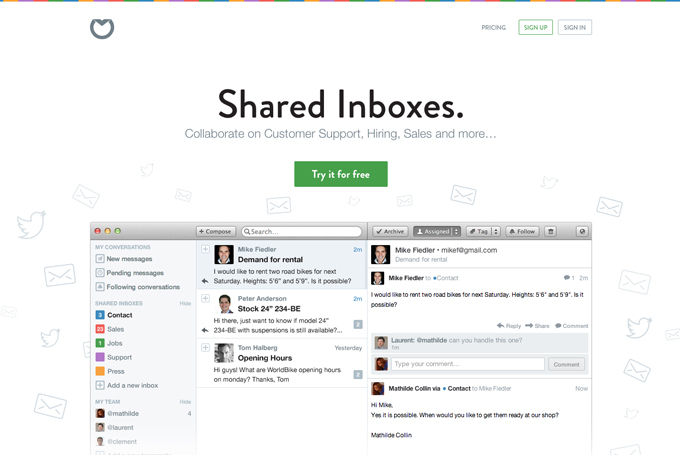
An emblematic success story is Front: Front is a professional email service with workflow and collaborative features. Their founders left for the US, where their main market relies, they were accelerated at Y Combinator, and raised recently $m 10 among investors including Slack’s founder!

FrontApp

Other emerging startups cover cloud emailing (Mailjet), collaborative translation (Text Master), brand monitoring on online media (Mention), instant admin solution for developers (Forest), or corporate credit cards (Spendesk). Cloud telephony & softphone Aircall attended 500 startups accelerator program in San Francisco, and raised $2.75 million with Balderton Capital, FundersClub and business angels. Congratulations!

Digilityx

I’ve known Christophe Pelletier for a long time: he’s one of the most accurate and trustful consultant I worked with. Therefore, I was quite excited when he told me he just founded Digilityx! Digilityx has an original value proposition: it helps corporates turn ideas into real products and services, with the catalyst of startups skills.

Digilityx has been created in 2015 to address one of the most complex challenges traditional companies are currently facing: how to innovate fast in a competitive digital world, and deliver quickly creative projects. Based on the experience of the 3 founders, and the impressive growth of French Tech players, Digilityx is bridging the gap between large companies and agile startups, unfolding enablers and accelerators for digital corporate projects. Digilityx brings its extensive knowledge of tech accelerators ecosystem, and unique know-how, to ensure an effective cooperation between young entrepreneurs, and traditional organizations.

Digilityx’ partners deliver innovative and agile solutions in domains such as big data (datascience, big data as a service), customer experience monitoring (NPS, semantic engine, conversational bots), and IoT (security, IoT data hub). Digilityx sets up occasionally partnership with vertical business solutions on specific use cases (well-being, wearables) for insurance or health industries.

Eat your own dog food!

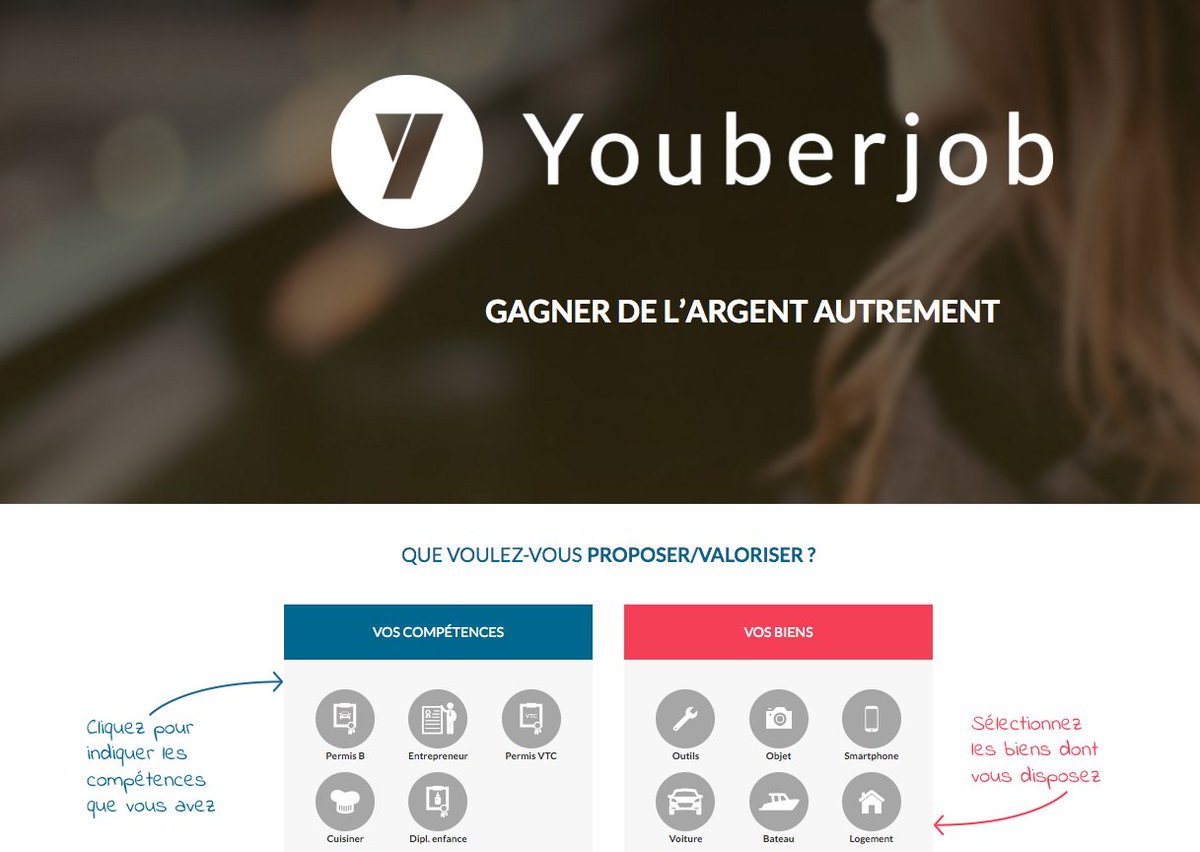
Digilityx worked as well as a team to deliver its own innovative solutions; a first platform, Youberjob.com,was designed in 3 months: it supports jobbers to sort outhow they can earn money thanks to collaborative economy or “uber-like” platforms. Digilityx team members worked then as a start-up using persona, customer journey, MVP, and lean start-up methodologies, great playground to test new concepts and new partners’ solutions. Finally, if the concept is mature enough, Digilityx will propose its team members to invest in a new company created to bring the solution to the next stage.

PS: special thanks to Laurent Allard who raised my attention on the startups studio phenomena, and shared many good links!

image credit: bigstockphoto.com


Subscribe to Human-Centered Change & Innovation WeeklySign up here to get Human-Centered Change & Innovation Weekly delivered to your inbox every week.
Pleasure to Innovate

GUEST POST from Nicolas Bry — originally published on Innovation Excellence.

Stéphane Bernard published with Olivier Pujol ‘Pleasure to innovate‘, finding out the idea, and executing it. He kindly accepted to answer our questions on innovation learnings.

1) NB: You share the exemplary innovation story of Mathieu Dombale in this video, sorting out some key principles for innovation success (listening to and observing users with empathy, transversality, pilot phase, open source, business practices reviews / knowledge sharing, back and forth between experience and theory, students conferences to transfer knowledge). Which principles actually struck you the most in this fantastic story?

SB: This is a systemic history, almost a complete one. In 1816 Mathieu Dombale tackles one of the agricultural issues of his time “improve tillage.” Pragmatic, he will go into the fields to observe the plows work then “tweak” in his studio an improved quirky plow that he will develop. Based on strong performance of his tool, he will engage with obstinacy in its propagation addressing and resolving all questions arising along the way.

All dimensions of innovation are present: his method (observing, experimenting, and back to theory), its ability to address all the issues that came to him (the development of the tool, testing and learning the handling of his plow, the invention of “plows challenges” to leverage opportunities for experimentation and propagation, training and education (he will create the Institute of Rouville), the exemplary (creating the exemplary firm in which he experiences all ideas in the “real and complex system” that represents a farm), creating a tooling factory, and finally the public provisioning of his plans and his experiments whether they have failed or are successful.

He will be remembered as the one who invented and propagated agricultural meetings, formed the personalities who founded the agricultural schools, invented long leases for the rental of farmland. You should know that before him the rentals were concluded for a period of only 3 years, which did not allow farmers to manage crop rotations.

Starting as a chemist, historians of the twentieth century will finally recognize him as the father of active pedagogy. Like shows that we must not be afraid to seek to acquire new know-how.

Man is endearing. At the beginning of this adventure, he’s 40 years old, an elderly man at the time, ruined, damaged by diseases and accidents. But he had a vision to develop a sustainable agriculture which benefits all. He was, I think, inhabited by the spirit of the Age of Enlightenment in which he grew up. His last quality was whether to apply his own advice to himself.

Finally, the most elegant is that eventually he has nothing “invented” again, he just simplified an existing tool: it actually just removed the wheels of the front plows. The approach of simplification is also one of the lessons of this history that we should always keep in mind. He’s an innovative model, more modern than many of us.

2) NB: You identify 4 phases in the innovation process: observation, idea maturation, experimentation / issue resolution, and go to market / roll-out. Where do you think are the most difficult hurdles? Which are the tricky moments?

SB: These four phases are invariant landmarks for innovators. They involve a mix of human qualities and are penalized by contradictions made by our education, and hierarchical modes of operation. What is deeply natural is the observation state (as human beings, we spend our time observing our environment and teaching others what we have discovered). The resolution is also natural in its dimensions of “making together” and “play” in resolving the issues (and to resolve the issue first if possible!). Propagation also has a natural dimension in that we’re all very good at inventing new uses … look younger generations.

In return our “rational” minds and “effective” do not like to consider the little things, marginal or new uses and this phenomenon penalizes the observation phase. For it is in this “little” that hide innovations. By definition, all innovations have started with little things. These same spirits also tend to rush on the first solution they perceive and we know that the first solution is never the right. Moreover the certainty of having the solution frequently prevents us from understanding the true purpose expected by customers. This phenomenon penalizes phases resolution and propagation.
But in my opinion the biggest challenge relies in the maturation phase during which we shall make connections between elements and scattered observations and let our view evolve , our ideas, our … paradigms.

edelman.com


The human mind is naturally formatted to classify elements. These taxonomies supported by Claude Lévi-Strauss are useful but induce stabilization paradigms. Furthermore our social behavior are made to respect that classification. Individuals tend to conform to the opinion of the group, which penalizes the expression, and understanding of different approaches. Hence a real difficulty to “move” the paradigms. First you have to know find what paradigms question, then have the opportunity to express to those who can understand, and finally to co-develop the evolution of that paradigm. And often it is necessary to go back to the “mothers beliefs” that are deeply rooted in our imagination and face many obstacles from our daily practices. The “think differently” proposed by Arthur Schopenhauer is easier said than done!

3) NB: Collaborative and participative are recurrent words in your book: how do you this approach rising nowadays? What are successful use cases that you could share with us?

SB: Reynald Chapuis led at Job Center a remarkable participatory process which was successful enough to touch half the employees of this institution. By participatory we mean the fact of asking employees to contribute with their ideas and proposals on a given theme. Participatory approaches are often the simplest actions to implement and often possible to discover “golden nuggets” quickly useful to organizations. Nevertheless participatory has its limits and should be seen as a medium that can only be the first step of an innovation approach. It is nevertheless a useful way to let the employees express ideas to the institution.

The collaborative is more complex insofar as it comes to co-develop a vision, a solution or approach. Technically it implies the implementation of a set of multiple intelligence. Often these initiatives face many obstacles as egos, forms of intelligence which do not match, the weight of hierarchies, our intellectual training, social behavior, etc … In this implementation it is often ourselves who are our own brakes. That’s why I regularly encourage C-level managers to begin to innovate themselves. The concept of innovation is interesting but it is the practice of innovation that enriches. The opportunity of the current period is that companies and institutions have realized that they must find other ways to do it. This is a major issue for France, which is far from being the best in this type of exercise.

Nevertheless a remarkable example has been developed by the city of Sceaux as part of its program of social economy and solidarity “Sceaux Valley”, piloted by Othmane Khaoua in which the citizens have co-constructed their projects (meeting for once the real needs of the territory) in partnership with an ecosystem of companies and associations set up by the city. The city plays a facilitating role. There are more than 106 projects that are rising… a success.

For France this is a reversal of the mode of administration which moves from an interventionist trend posture to posture in which people can contribute directly to the issues that concern them … a breakthrough innovation for us.


In conclusion, I would like to return to the main paradigms of our time. For my part I am challenged by the paradigm of progress. At the time of Dombasle in 1816, the industrial revolution was in its infancy and many alternative pathways existed, on the modalities of labor, product and the needs of society. The middle of the 19th saw the notion of progress rule as we know it, and since, we now perceive more clearly the consequences on nature and our modern lifestyles. This notion of progress is highly influenced by the technical and technological dimension. In parallel, but more discreetly we witness the remarkable advancement of knowledge in human sciences, understanding of the human brain .., that is to say to ourselves, our operations and our expectations.

I’m not sure that the “progress” and our expectations are completely consistent. In other words what expectations do we have for “progress”? What adjustments of this concept would be needed? I’d like to know what your worldwide readers think about it? You have the chance to contribute to an innovative worldwide community, and I will enjoy the opportunity of this interview to question them in return and ask them what, in their view, are the main paradigms that we should reconsider?

It’s up to you now…

Pleasure to Innovate: Launch conference video


Subscribe to Human-Centered Change & Innovation WeeklySign up here to get Human-Centered Change & Innovation Weekly delivered to your inbox every week.

Creative Expedition at Auchan Superstores

GUEST POST from Nicolas Bry — originally published on Innovation Excellence.

Jean-Yves Maurel is Corporate Innovation Director at Auchan Group, with the particularity of owning a double degree: Engineer Arts et Métiers ENSAM, and Marketing & Product Design at ENSAD.

He tells us about the amazing Creative Expedition process that has been going on for some time now at Auchan.

 Context and objectives

Creative Expedition process is part of Auchan’s participative innovation plan called Creative Attitude, which has been rolled out over 4 countries, France, Spain, Italy, and Portugal, and covers 4 lines of business: ‘Hypermarket’ and ‘Superstore’ for retail, Banking, and Real Estate (related to shopping centres).

Thus, Auchan Group wishes to “strengthen the means for capturing new markets, inventing new services, developing new channels, new ways of selling… and news ways of working within the company”.

Creative Attitude collects ideas, filters them, and match idea’s owners with sponsors. Creative Expedition is a part of it: based on a selection of projects and project leaders profiles, a jury selects 15 ‘high potential’ idea owners, and invites them to spend one week in a learning expedition for innovation. They will work as well on the transformation of their project, in a start-up week-end mode. Project creator becomes a creative player, a ‘Creactor’!

Implementation is one of the key points for participative innovation. The idea owner often lacks a methodology to develop the initial idea, and the creative expedition is a way to balance this.

Creative Expedition framework

Concurrently, 15 senior executives are chosen to participate to the learning expedition week. They are involved in the projects transformation during the second part of the week: mixed teams made up of one senior executive and one idea owner will progress from concept to action plan.

It’s a mutual benefit. Creactor is shaking up the habits of the senior executive: it’s mind-blowing time!

Couples form naturally during the first part of the week. Projects have sufficient leeway, to let executive and idea owner move to a common new step, build a dedicated action plan, and weave a valuable link between the two.

The week starts with a pitch completed by the idea owner, and ends with a pitch handled by the team: creactor, senior executive, and students (see below).

Design Thinking Schools

Creative Expedition also build on collaboration with Design Thinking Schools, which send advanced students to participate: 2 students join each team of two, and work at school premises on the project development. It’s intensive! Mockup, get out on the streets, designing something concrete, the mission’s school is to shake up everyone, and bring a methodological framework with Design Thinking. Last year Creative Expedition took place at Berlin Design Akademie.

Projects Examples

Creative projects tackle various domains:

  • A Spanish project tells the story of meat cutting, shares the know-how of Auchan’s butchers in the matter, and brings reassurance on meat’s origin, all this through a QR code linking to a short movie online;
  • A tapas bar in France lets you taste the things that you can buy: cheese, meats, etc… 2 modes: tasting and catering;
  • In Portugal, a turnkey solution for parties, anniversaries, first communion, etc… a basic offer starting with a cake and adding several options like decoration, party animation, recovery of packaging, etc…
  • One-time payment, by sending a code to the phone of your child, enabling him to pay, with payment guarantee.

Learnings

We all know that the danger of participative innovation is to let the ideas disappear into oblivion.

From idea to implementation, participative innovation requires resilience along the way which can take one year to 18 months. But the team of two mixing executive and idea owner, and the framework of a design school during a learning expedition, are real boosters.

4 countries involved, various languages and occupations within the group, implies limitations to make it cut the mustard. Each country has been fostered to set-up creative expedition of his own, in their ecosystem, for the moment, In Spain and Portugal.

Around 7 creative expeditions have been completed in San Francisco, Stockholm, Amsterdam, and Berlin. The 2 last ones involved a design school: iterating the process allows to improve each time!


Subscribe to Human-Centered Change & Innovation WeeklySign up here to get Human-Centered Change & Innovation Weekly delivered to your inbox every week.
Innov’Up at La Poste (French mail company)

GUEST POST from Nicolas Bry — originally published on Innovation Excellence.

Aude Le Carpentier is in charge of Innov’Up Creativity, in the Service-Mail-Parcel sector of La Poste. She’s a 27 year-old manager of a team of 15 creative people, helping business teams to develop innovative services. She kindly accepted to answer our questions on the story of Innov’Up.

1)  What is ‘the reason why’ for Innov up Creativity? Where does it come from?

Innov’Up Creativity, as known today, had been rebuilt from scratch a year ago. We hired a new team and started innovating. Innov’up Creativity is aimed at helping La Poste be part of the future.

We work on new products, services or processes.

2)  What is the value proposition for your customers? Who are they? What are the deliverables?

Our customers can be either internal or external. We support them from the ideas generation to their implementation on the market with agility by uniting multidisciplinary project teams.

We do not work for our customers; we work with them as a team. They have the knowledge, the expertise about the subject. Moreover, having them in the team make them more implicated in the project. Once our work is done, they keep working on it with motivation.

3)  How does it work to initiate a challenge? Does the business unit have to pay? How long before must it be anticipated?

Usually, a client comes to us with a problem. It could be for example, the fact that the customers of La Poste are not satisfied enough with the services that the mailmen do. After searching for the reasons of dissatisfaction as well as the entire process of delivering mail, we organized four creativity workshop with the client and experts to find out solutions.

We came up with the idea of a Bluetooth earphone, ELSA that helps the mailman in every step of his delivery. When he enters a building, he can ask Elsa if there is any subscription to a service, or if Mr. Dupont still pays for a forwarding. That is the kind of project we work on.

Our approach was composed of 3 steps:

  • Use the design thinking to study the uses and get as many ideas as possible;
  • Unite experts to detect the technological solutions;
  • Do one proof of concept.

Today, we are about to test ELSA on mailmen. Those who helped us develop the product already like to use it, but we have to test it on many others. For this step, the motivation of our client is essential.

4)  What typical framework do you use to coach a challenge? What are the skills of your team to support this framework?

After agreeing on the objective of the challenge, we propose our clients to meet every week. They are the one who decide on the dates. We define the different creativity workshop, and start working. We have three months for the framing, the immersion and the ideation. After three months, the concept is accurate enough, and the next step is experimenting.

The Innov’up creativity team has many different skills from designers to projects managers. We are able to manage a project from the idea to its experimentation only with our team members. Plus, everyone here has a specialty; knowledge in insurance, gamification, communication…

For every project, each one can ask to be part of it and we form a team with a graphic designer, a project manager and a creative designer.

5) What was the most difficult part to achieve? How are the outputs of your innovation sessions transformed into concrete offerings? Do you measure a success ratio?

As I said, we created a brand new Innov’up Creativity a year ago. Having the support of our superior, being known as people doing a good job in innovation was not a piece of cake. Now we have more propositions than we can possibly achieve.

We measure our success on the number of projects people ask us to work on but also on the money La Poste makes with the partnerships we create or the products we develop.

6)  What is your next challenge? The next steps for Innov up?

We just started working with big references such as Carrefour or Auchan. We are delighted to work with new clients on such nice projects. Having a bigger team is a goal we would like to reach in 2017.


Subscribe to Human-Centered Change & Innovation WeeklySign up here to get Human-Centered Change & Innovation Weekly delivered to your inbox every week.

Customer driven innovation at Ricoh

GUEST POST from Nicolas Bry — originally published on Innovation Excellence.

Mike Irvine is the leader of Ricoh’s European Technology Centre. His team is responsible for bridging the gap between Customers business needs and the Ricoh engineering and development teams. He is also a member of Ricoh’s Global Technology Centre leadership where he is responsible for the development of Ricoh’s Global Solutions and Technology standards and capabilities.

Mike’s career has been focused on helping organisations in all major industry sectors to improve their Business’ processes and operations. Prior to joining Ricoh, he worked for a major UK shipbuilding and engineering company and, later with service providers and solutions integrators. Mike is a Chartered Engineer, Chartered IT Professional and Fellow of the British Computer Society.

I met with Mike at Barcelona 3rd Innovation Excellence summit, and was impressed by the presentation he delivered on customer driven innovation, and how Ricoh unfolds various ways to involve customers in its product roadmap. Mike kindly accepted to answer a few questions about it.

1) You’ve presented 4 ways Ricoh involves his customers in its innovation process, could you describe briefly each of them?

Technology Centre Workshops – These workshops are designed to provide assistance in the Technology Centre locations in Staines and Dusseldorf. They focus on the needs of the visiting customer, for example some workshops focus on a customer’s technology challenge, some help the customer develop their own solutions strategies, and others provide a preview of Ricoh’s development plans. All workshops are conducted under a mutual NDA (Non-Disclosure Agreement).
Development and Engineering teams often support the preparation of these workshops by providing demonstration material and identifying areas where feedback is needed. Detailed reports are shared with the Development and Engineering teams from these workshops.

Around 40 workshops are conducted each year in EMEA.

eTAC (European Technology Advisory Conference) – eTAC is a cornerstone event in the Ricoh customer driven innovation cycle. We operate similar events for our development programme members. We will show and discuss developments and concepts which fit in our development portfolios in the Short (<2 years), Medium (2-5 years) and longer term (5 years plus). We will also provide an update on what was done with the customer feedback from the last eTAC.

Each year around 50 customers participate in eTAC. The conference is aimed at CIO and IT Director levels from our Global and National Major Customers.

Innovation Focus Groups – Small groups of customers with a common interest in a product, technology of business need are invited to join focus groups sessions throughout the year. At these sessions the Ricoh researchers and developers work with customers to conduct a deep dive discussion on the focus group topic.

Collaborative Innovation Programme – The collaborative innovation programme facilitates 1-2-1 collaboration between Ricoh and customers. These customers are specifically selected as they have advanced needs which are suitable for other customers.

This programme was developed in response to requests submitted by customers at an eTAC meeting 4 years ago. This is a 2 way engagement. Both the customer and Ricoh must see benefit from the investment that they will make to the programme.

Customers benefit by influencing developments to meet their needs and get access to the solution before other organisations. Ricoh benefits from increased customer feedback and accelerated development time scales.

2) It seems that the TAC event is the tipping point of the year. What do you expect from the coming conference in June?

Due to the sensitivity of the event I am not at liberty to share the content of the conference. This is primarily to protect Ricoh’s competitive edge.

I can confirm that we will share items that will be launched within 2 years and others which are simply concepts.

3) Collaborative innovation is another cornerstone. It seems that continuous collaboration has replaced the linear process. Could you explain this perpetual cycle?

This cyclical approach has been created with a desire to continually embrace improvements from both Ricoh and our customers. We are constantly investigating how we can add more functionality to meet evolving business needs or changing capabilities of technology. In practice when Ricoh and a customer are both reaping the benefits of collaboration both parties are keen to further the process.

4) Customer feedback and expectations fuel Ricoh’ innovation engine in a very impressive way. Has it always been so? Is it linked to progressive Rico’s business switch from products to services and solutions provider? Does it come from Japanese culture?

Focusing on customer needs has been part of Ricoh’s culture since it was formed in 1936.

The creation of Regional Technology Centres to establish the bridge between Ricoh developers and our customers’ businesses dates back to 2003.

This year will be Ricoh’s 10th Annual eTAC event.

As part of the move to services we have leveraged the product Voice of the Customer programmes to provide feedback to teams developing new service offerings.

5) And what about ‘non customers’ as the Blue Ocean book spots them: do you see them as future business opportunities?

Non-customers have been invited to attend eTAC and TC workshops in the past!


Subscribe to Human-Centered Change & Innovation WeeklySign up here to get Human-Centered Change & Innovation Weekly delivered to your inbox every week.

How to Innovate with the Crowd

GUEST POST from Nicolas Bry — originally published on Innovation Excellence.

Emilie Ruiz is a researcher at IREGE, University Savoie Mont Blanc, France. Hereafter she shares some key lessons on how corporations can set-up a crowdinnovation platform, and maximize its benefits, streamlining the adoption of the platform externally and internally through key success factors. Moreover she identifies when the adoption factors matter along the process.

Imagine with Orange was lucky to be one of the platforms sample that she reviewed. This post is based on Emilie’s doctoral studies, a PhD in progress named ‘Crowdsourcing for innovation, communities and product cocreation’, which conducts an empirical study of determinants and their evolution.

Some insights about the adoption of a crowdinnovation platform

A growing number of firms adopt open innovation strategies, especially through crowdsourcing platforms. With the exception of some emblematic cases, such as Connect + Develop (Procter & Gamble), little is known about the factors influencing this adoption process to identify the levers that help firms or the barriers they should anticipate.

What is crowdsourcing for innovation?

In 2006, Jeff Howe, contributing editor at Wired Magazine, published the article “The rise of crowdsourcing”. From that time, the term crowdsourcing (CS) has begun to spread, both in the scientific and managerial community. Howe defines CS as the act of taking a job traditionally performed by a designated agent (usually an employee) and outsourcing it to an undefined, generally large group of people in the form of an open call.

For nearly 10 years, more than 40 definitions have been proposed (for more information see the article “Towards an integrated crowdsourcing definition”, Estellés-Arolas and González-Ladrón-de-Guevara, 2012), allowing us to identify 4 types of CS activities:

Table 1: A taxonomy of CS activities

(from Ruiz, 2015)

CS for innovation is the act of outsource a complex or creative task to the crowd, through an open call on a crowdinnovation platform (Ruiz, 2015).

Editor’s note: more on open innovation platforms by Jean-Louis Liévin

Imagine with Orange: an example of crowdsourcing for innovation

Imagine with Orange is a crowdinnovation platform where anyone from the crowd can share innovative ideas about a specific topic (Smart Agriculture, Womanly Digital, Mobile Money, Connected Family etc.), announced by Orange monthly through the platform.

The ideas that are the most supported by the community can win connected objects or be invited by Orange for an innovation workshop in Paris, to develop their project. Imagine crowdsourcing platform becomes then also a launchpad for entrepreneurs.

Why do firms adopt crowdinnovation platforms?

Several motivations drive firms to adopt a crowdinnovation platform. We suggest focusing on the three main ones:

  • Cost reduction: questioning the crowd has the main advantage to outsource a task to a large number of individuals for free or for a small fee. For instance, Lego (through its platform Lego Ideas) remunerates contributors whose ideas will be produced through a 1% profit on sales.
  • Access the wisdom of the crowd: crowdinnovation platforms allow firms to address many knowledge and resources. On the one hand, this knowledge coming from the crowd is considered as rare and unique. On the other hand, the IT platform tool allows firms accessing quickly to the crowd.
  • Identify client’s need: questioning the crowd means that firm address customers, users, scientists, communities etc., identifying trends and potential new markets. Crowdsourcing lets the voice of the user enter the innovation process from the upstream.

The stages of adoption process

Based on Damanpour (1991) and Helfat and Peteraf (2003) papers, we identify three main stages of the adoption process:

  • Initialization: firms decide to adopt a crowdinnovation platform;
  • Implementation: firms start the implementation of the crowdinnovation platform and adapt both the platform and their organization to each other to find the right organizational balance;
  • Pursuit of implementation: firms try to sustain the crowdinnovation platform.

Factors influencing the adoption process of a crowdinnovation platform

To reach success, we identify through a study (work in progress) different factors that have a strong impact on the adoption process of a crowdinnovation platform. We present then those that seem the most relevant.

  • The importance of cultural factors

Organizational culture, in addition to the motivation expressed upper, will lead firms to adopt crowdinnovation activities. Our study emphasizes that some values (innovation and openness, pattern of circulating ideas, risk taking culture) would drive the process.

Alignment of the crowdsourcing platform with innovation priorities and strategy facilitates its understanding internally, and maximize its impact on innovation roadmap.

But, if organizational culture has an impact on the first stage of adoption, cultural factors have a strong impact on the whole process, and firms should not underestimate this. When firms implement a crowdinnovation platform, it appears that implication of transversal functions, such as marketing, R&D, HR, purchasing, sales etc. would help the implementation. The study shows that in most cases, firms include marketing and/or R&D functions, while a “cross function” strategy seems more relevant.

  • The NIH syndrome

The Not Invented Here syndrome is more active than firms think! The NIH syndrome is a tendency to reject knowledge (ideas, solutions etc.) that comes from outside the firm. In most cases, R&D human resources are affected by this syndrome. Guittard and al. (in Garrigos-Simon and al., 2015) identifies several reasons explaining why some people are affected by the NIH syndrome:

  • Confident people, that believe in their own knowledge;
  • People that see the public revelation of difficulties or needs as a weakness;
  • A threaten to the R&D job, that could be replaced by the crowd.

In most cases, firms think they are not affected, while part of their human resources are skeptical or reluctant to the adoption of a crowdinnovation platform. Firms underestimate the NIH syndrome, by wrongly believing that when they implement the crowdinnovation platform (step 2), they have passed and are no longer confronted with it.

karrierebibel.de

  • A smart organization

The crowdinnovation platform is the tool for implementing a CS for innovation activity, itself included in an open innovation strategy. It is not rare to see firms developing multiple platforms that address for instance different types of crowd. If the logic and the organization of these different platforms is clear for the firm, our study reveals that this could disrupt people forming the crowd.

From the internal perspective, skeptical, reluctant, or even interested people can be lost in too many CS for innovation activities. From the external perspective, for the crowd, too many platforms can be confusing and have an impact on participation.

Firms can develop smart communication to clearly explain both to the crowd and to their HR what are the different platforms for, for whom, what etc. This is the case of Orange, that presents on a single portal 6 platforms, each having a specific purpose and level of user involvement, from ideation to product testing.

  • Manage a community

When firms adopt crowdinnovation platform, they can’t imagine how much they will be asked by the crowd, facing the “crowding” phenomenon (Piezunka and Dahlander, 2015), in other words, receiving too many ideas, solutions etc. As individuals from the crowd are implicated, they are waiting for quick answer from the firms. The quicker is the feedback, the higher is the community’s commitment. Relationships with the crowd, and in most cases with a community, involves transaction costs firms should anticipate.

communitymanagermdccb.blogspot.com

CS for innovation activities can be managed two ways:

  • Make: the crowdinnovation platform is managed by the firm, with internal human resources team;
  • Buy: in the case of scientific of technological challenge, firms can outsource it to an intermediate platform, such as InnoCentive or NineSgma.

These intermediaries can play the role of a filter between the firm and the crowd, but they have a cost. In the first case (make), our study shows that firms should not neglect the community manager function, because without crowd and community, the platform could die.

  • The importance of absorptive capacity to sustain a platform

The last thing that our study points out is the fact that in order to sustain a crowdinnovation platform, firms have to develop absorptive capacity (ACAP). ACAP are the firm’s ability to recognize the value of new information, assimilate it, and apply it to commercial ends (Cohen and Levinthal, 1990). More especially, to go to the third stage of sustainability, firms have to develop the capacity to assimilate and transform external knowledge into new business.

When do these factors have an influence?

The only identification of these factors is not enough to help firms to innovate quickly and successfully with the crowd. They also have to keep in mind that all these factors do not have the same influence on the whole adoption process. For now, our study is based on proposals. Further empirical investigation will illustrate the set of cultural, organizational and epistemic factors identified in the figure below:

Figure 1: synthesis of factors influencing the adoption process of a crowdinnovation platform

(from Ruiz, 2015)

  • Proposal 1: cultural factors influence particularly the first step (decision to adopt) of the adoption process of a crowdinnovation platform.
  • Proposal 2: organizational factors influence particularly the second step (implementation) of the adoption process of a crowdinnovation platform.
  • Proposal 3: knowledge factors influence particularly the third step (sustainability and maturity) of the adoption process of a crowdinnovation platform.

Image credit: trigcreative.com


Subscribe to Human-Centered Change & Innovation WeeklySign up here to get Human-Centered Change & Innovation Weekly delivered to your inbox every week.