Author Archives: Jeffrey Phillips

About Jeffrey Phillips

Jeffrey Phillips thrives at the intersection of strategy, sales, marketing and innovation, and enjoy helping companies grow and find new opportunities or create new products. Jeffrey also teaches part-time at SKEMA US, leading graduate level classes on strategy, new product development and digital marketing and is the author of “Make us more Innovative”, and innovateonpurpose.blogspot.com.

Innovation Is Becoming A Core Competency

GUEST POST from Jeffrey Phillips

If you’ve lived a while as a consultant to corporations, you’ve had the chance to see significant, even tectonic change to the way things work in larger enterprises over the last 20-30 years.  Stuff that would have seemed illogical or inconsequential we now consider imperative, and right now, things that seem incremental or short-lived may rapidly become mission-critical.

When I think of this I am constantly reminded of Gandhi’s saying about change:  first they ignore you, then they laugh at you, then they fight you, then you win.  The history of significant change in larger organizations is exactly this.  Consider, for example, one of the first “waves” of change – the quality movement.

Back in the 70s, the major American manufacturers built fairly good cars and had the customer convinced that he or she should simply trade it in every 3 or 4 years.  This meant plenty of repeat business and a lack of exposure to perhaps some less than stellar quality.  The Japanese entered the market with cars in a lower price point that were good enough for many first time buyers.  Those manufacturers learned from feedback to improve quality, which meant that car buyers held on to cars longer and could compare the Japanese imports and their quality to the American manufacturers.  I remember reading in the late 80s about American manufacturers establishing “quality” review at the end of the manufacturing line.  This struck me then as absurd.  You don’t change quality at the end of the process – you design for it and implement quality throughout the process.  And that’s what eventually happened.  The story of quality is that it at first was laughed at, then bolted on, then it became a core operating principle.

The subsequent waves of management thought pursued much the same methodology.  Concepts like Lean and Six Sigma were at first experiments in small outposts, which were slighted or ignored by the larger organization.  As they proved their worth, these tools were introduced throughout the organization, and have now settled in and become the new normal.  They are now “table stakes” to compete effectively.

But when do we hit the stage of diminishing marginal returns for efficiency and need to shift to a new management philosophy?  I’ve argued here before that that time is now.  Our operating models are working at peak productivity and efficiency.  Concepts like quality, Six Sigma, Lean, downsizing are embedded in the operating model, they aren’t laughed at or bolted on.  But there’s not much more runway or gains to be had from an ever increasing focus on efficiency.

Today, innovation is in the second of Gandhi’s three phases.  We’ve been through the”laughed at” phase where innovation is considered interesting but ultimately childish.  IBM showed us commercials of people “innovating” – lying on the floor in a dark room.  Many organizations have a room with outlandish colors and interesting toys to spark creativity.  But these brief interludes haven’t threatened anything yet.

Innovation needs to declare war on the “status quo” so we can move briskly into the second phase.  Innovation and efficiency are itching for a fight.  One of them will win.  Either efficiency will defeat innovation, and leave innovation as a nice to have, valuable at the fringe, or innovation will win, but do so graciously, recognizing the importance of efficiency and demanding only a return to balance between efficiency and innovation.  They’ve laughed at innovation, now, we need a good fight, because somebody or something has got to win.

My final argument is that regardless of what wins in your organization – innovation or efficiency – the market has already decided.  The market has indicated that efficiency is important, but innovation is vital.  Innovation is vital because of the increasing pace of change, the rapid acceptance and adoption of new products and services, the falling barriers to market entry.  The clockspeed of your market is accelerating, and you can’t compete by becoming more efficient.  This thinking is akin to having a car with ever increasing gas mileage in a drag racing competition.  Your car may be more efficient, but that’s not the competitive advantage any more.

Innovation, like many of the other corporate strategic waves, will simply enter the business model as a “must have” core competency, and take its rightful place alongside quality and Six Sigma and a lot of other management strategies.  The difference is that innovation is a growth strategy and a differentiation strategy rather than a consolidation or efficiency strategy, so its entry into the lexicon may require a different style of thinking and attitudes from senior executives.  The model can’t change until it needs to, and until there are people to shepherd its change.  One day, ten years or so from now, we’ll look back and wonder what all the fuss was about.  Innovation competencies and core capabilities were inevitable for competitive differentiation, we’ll say.  What were they thinking?

Innovation as a core competence is inevitable.  The question is:  can your organization shift quickly enough to adopt innovation as a core competence?  Not to bend innovation to the corporate will, but to bend the corporate will to innovation. Those that do will gain long term success.  Those that ignore or laugh at innovation now will fight a much more difficult fight later – attempting to adopt innovation while fighting for market share with competitors that made the transition earlier.

Subscribe to Human-Centered Change & Innovation WeeklySign up here to get Human-Centered Change & Innovation Weekly delivered to your inbox every week.

Strangers in a Strange Land

GUEST POST from Jeffrey Phillips

One of the issues I’ve often struggled with when leading innovation projects with clients is the sense that I’m a foreigner, speaking a foreign language and imposing foreign rules. Often, when working with clients, I have the sense that they are visiting or touring a foreign country called innovation, where they are enjoying the sites, taking in the scenery, but don’t plan to learn the language or stay longer than they have to. It’s as if innovation is a place of great beauty, great excitement but great danger constantly lurks at the edges. Most people are very happy to visit, accomplish a few rudimentary tasks, and then leave again.

It’s this unfamiliarity and the sense of being a tourist that makes innovation so strange and different. We, for the most part, have carved out our own lands, which are settled, tamed, economical and predictable. Not much happens and when it does we know exactly how to respond. Our friends and neighbors have the same expectations and speak the same language. When challenges occur they are reminiscent of problems from the past, and our tool sets allow us to respond intelligently. We live in artificial worlds of our own making, but they are safe, comfortable and predictable.

Further, we’re aware of another world, or perhaps even another set of worlds, just beyond our comfort zone and imagination. Worlds where people much like us do things in extraordinarily different ways, taking more risks, encountering unimagined obstacles. Those people seem like astronauts cast out into uncharted space. We recoil from those challenges and investments. They aren’t safe or predictable, require new knowledge and skills. But, increasingly, we are forced to enter those worlds to sustain growth and innovation. So we become innovation tourists, strangers in a strange land.

Like Americans abroad, we expect this new land to conform to our expectations, to deliver on our assumptions. It’s disheartening to learn that to work effectively in this new land we need to learn new tools, adopt new language, embrace different and larger risks. Our choices are to visit for short periods, returning to a homeland more predictable and safe, or become pioneers or explorers in the new land, adopting local customs, tools and language. Yet, once you’ve adopted the new perspectives and behaviors, it can be difficult to go home again. Perhaps one can only be a resident of either the efficient, effective business environment or a resident of the other worlds of innovation, but not both. The rules, language, expectations, risk factors, outcomes are so vastly different that few have succeeded in doing both well. We are either tourists who hire experienced guides to take us safely through the uncharted and unfamiliar space, seeking only to return safely home, or we move into innovation space and adopt the thinking necessary to survive.

And don’t kid yourself that you can move into the “innovation space” and tame it, like pioneers of old tamed the American wilderness. Innovation space isn’t static, it doesn’t stand still or adopt to our ways of thinking. It is constantly changing, constantly unpredictable, constantly new. Only pioneers willing to constantly adapt will thrive. You can’t tame the innovation space, you can only hope to adopt its patterns and logic. That’s why true innovators seem so different from the rest of us. They are actually residents of another place, visiting our effective, efficient businesses for a short time, bringing their strange ways that are unusual and unfamiliar. They realize eventually that the nutrients, oxygen and other components that sustain life here are different, and either surrender their citizenship in the more dangerous and fast paced future world to take on the efficient, effective world, or they return to their innovative space, like ET phoning home. And when they leave we are often relieved in the short run, glad to be rid of people who are constantly reminding us of the incredible potential available. In the end, though, we regret the departure of the strangers from the innovation space, and seek their return, or at least guides willing to breech the barrier between our safe existence and the potential worlds just beyond our safe frontiers.

Innovators in business are truly strangers in a strange land. Welcome them, for they are few in number, but have the best capability to take you into the future.

Subscribe to Human-Centered Change & Innovation WeeklySign up here to get Human-Centered Change & Innovation Weekly delivered to your inbox every week.
Innovation – Clockspeed, Commitment and Calendars

GUEST POST from Jeffrey Phillips

In my continuing series of posts about innovation and velocity, I am writing today about the poor understanding and alignment between time and innovation. Your internal timeclocks are both too fast and too slow for innovation. Those timeclocks are the corporate drumbeat, the “clockspeed” of your organization, which have worked well for decades. The problem is that while 33 1/3 RPMs worked well in the past, your markets are moving at 45 RPMs, soon to progress to 78 RPMs. Your internal clockspeeds don’t matter to the market, until they cause your firm to respond far too slowly and cautiously to important change.

There are three issues with internal business time that I want to address today. The first is clockspeed – how quickly the organization works when it is working to the optimized internal operating model. The second is the time allotted to innovation projects, which we’ll argue is often far too little, causing much innovation work to become incremental at best, and often incomplete. The third issue with internal business time is the stubborn adherence to an annual planning cycle, which we adopted when man first planted and harvested grain in the Fertile Crescent in 5000 BC, and for some reason remains the predominant timing and planning cycle almost 7000 years later.

Clockspeed

After 30 years of business process re-engineering, quality, lean, Six Sigma, rightsizing, outsourcing and who knows what other three and four letter acronyms, you have an efficient, effective operating model that sustains your business. It is honed for efficiency and works to an internal drumbeat based on the steps and phases of your methodologies and is timed to 90 day increments, which is an artifact of the external market. The problem is that while you’ve been honing your business model for every greater efficiencies, the external clockspeed has increased. Customer demand has increased, imports have increased, the barriers to entry have decreased. More products and services are available from more competitors, and the internet and its new channels have simply accelerated external clockspeed. This has a negative impact on your organization in several ways. First, even if you have good ideas, you’ll have a difficult time getting them to market to match the evolving needs and market windows. Second, if you fail to get products to market on time, the market doesn’t stand still, it keeps accelerating. You need to innovate your internal processes to make them more nimble, more agile and more adept at keeping pace with the external rate of change.

Commitment

“Pulling the plug” too quickly is a fairly common occurrence in innovation timing. This is the error of timidity and incremental thinking which constantly constrains innovation. Far too many innovation initiatives are started, and once underway the scope of the effort is reduced, the team relieved of its duties and a modest incremental concept is adopted. We provide far too little time for innovation – time in several components. Far too little time for in depth research and analysis of problems, far too little time to understand the challenge and generate interesting ideas, far too little time to prototype and test ideas. This failure to provide enough time and bandwidth is based on poor understanding of what it takes to innovate consistently and well. As Fred Brooks noted in the Mythical Man Month, nine men can’t make a baby in a month, and a constrained team operating in very short timeframes can rarely develop good ideas, unless they are working to a very well defined innovation methodology. Since most innovation work is ad-hoc, almost all innovation work results in unsatisfactory incremental innovation.

Calendar

We are people of the solar calendar, tracking all time based on the earth’s revolution around the sun. This timing made sense when we were primarily an agricultural people, tending crops, but annual planning cycles make little sense in a globally connected world where competitors have different planning cycles, and customers don’t care about your planning cycle at all. An annual planning cycle is too infrequent to matter given the pace of change, and doesn’t look far enough into the future for discovery. By its definition it is meant to predict 12 months into the future in relatively straight line planning. Perhaps the worst impact is that the annual plan locks in spending for the next 12 months, allowing little deviation from investment plans. Innovation doesn’t work this way, and as external clockspeeds and competition increase, linking innovation to an annual planning cycle where funds are provided only once a year, and plans are set in concrete months ago simply hamstrings the product development teams and innovators. Most of us don’t work in agricultural pursuits, and many larger corporations have “follow the sun” work schedules to take advantage of the fact that distributed teams can work continuously on issues or designs. While some components of your business may work well in an annual planning cycle, innovation requires thinking further, planning further, but also more nimbleness in funding the occasional idea that happens out of the annual sequence.

To succeed in the future, innovation must become a core competency, not a bolt on to existing processes. You must increase your corporate clockspeed to at least match what’s happening in your competitive markets and need to find more commitment to longer innovation investments. Perhaps the biggest challenge of all will be to decouple innovation activities from annual planning cycles, which are both too short to spot emerging trends and too rigid when good ideas bubble up.

Subscribe to Human-Centered Change & Innovation WeeklySign up here to get Human-Centered Change & Innovation Weekly delivered to your inbox every week.

What Blocks Speed Blocks Innovation

GUEST POST from Jeffrey Phillips

Over the last few posts I’ve been writing about the relationships between speed and innovation.  What we’ve considered so far is that velocity (speed in a specific direction) is what many firms require, as the pace of change accelerates, customers demand more and product lifecycles become shorter.  If speed is necessary, then firms will need more ideas to become products and services much more quickly.  Innovation is a catalyst and a enabler for speed.

What’s also interesting is that the factors that block an organization from increasing its speed also block innovation from taking root.  There are three factors we’ll examine that stymie a firm from gaining more speed, and that are also barriers to innovation.  Remove or eliminate these barriers and you can increase speed and innovation.

The three barriers are:

  • Lack of clarity about mission and direction
  • Fixed processes that are neither nimble nor agile
  • Internal decision making, attitudes and behaviors that become roadblocks

Let’s look at each of these to define why they are barriers to both speed and innovation.

Indefinite mission/direction

There’s a gap between what executives attempt to communicate and what their teams hear or understand.  In a recent Cap Gemini survey of executives, over 60% felt that the significant barrier to innovation was a lack of an innovation strategy.  Well, who is responsible for creating and communicating strategy?  If your teams lack clear goals, missions and outcomes, they cannot accelerate to higher internal speeds.  If they lack clear goals and missions for established products and services, how can they possibly attempt to create new products and services, whether they are aligned to existing strategies or not?  Speed is about singular focus and executing against that focus with as much energy and enthusiasm as possible.  When focus or strategy is unclear or poorly communicated, a firm cannot act quickly or decisively, and cannot innovate successfully.

Lack of Competency

Many firms have defined workflows that are timed and tailored to a speed or velocity that reflects what was true in their markets years ago.  While the internal pace is comfortable and well-understood, it no longer reflects what’s happening in the real world.  Once a year planning expects that customers will wait for you to fund a new idea on your time schedule.  Slow development processes and poorly equipped innovation teams can’t produce as quickly as nimble entrepreneurs.  Your processes are optimized for a market that doesn’t exist anymore.  You must innovate the way you create, build and launch to keep time with the market, at a minimum.  Locked into a comfortable, defined business process doesn’t help you accelerate, and the existing processes are tuned for efficiency and effectiveness, not innovation.

Internal Barriers

As a firm grows, it codifies the rules, decision making processes, approvals and other activities that grant control to an otherwise unruly process.  While these gates make sense if the issue is control and consistency, they become barriers to speed and innovation.  Further, many firms are organized in a “waterfall” methodology, generating ideas, developing ideas, shifting ideas to product development, then introducing supporting organizations like legal, finance, regulatory and IT, which are overscheduled and overworked.  These teams discover new ideas and products late in the game and are expected to react to the pressure of a new concept while maintaining old decision making processes and rules.  The result is a log jam of new products waiting for the minimal resources and stodgy pace of internal decision making and overworked teams.  If speed and innovation were your goals, you’d never design a process like the ones that exist in most corporations.

Want to increase your internal clockspeed to match the market?  Want more innovation?  Follow these three steps:

1. Work with executives to define clear corporate strategies that innovators and product teams can link to.  Make tradeoffs – a firm cannot be a product leader, operationally excellent and have exceptional customer intimacy.  Focus on being really good at one, or possibly two. Chose to be a leader in some areas, and a fast follower in others.

2. Revise internal processes and build new skills to accelerate your internal clockspeeds.  Seek to cut product development times in half – don’t question the logic, just ask “what would it take for us to cut development time in half?”  Then ask the same question about idea development.

3. Examine every gate, every decision making exercise, every approval.  Do they add value?  Or do they simply block innovation?  Consider your workflows – can you do more in parallel?  Can you borrow ideas from Agile methodologies?  What can you discard that slows your processes while not sacrificing quality?

You simply cannot afford to work at the pace you are working at today, and occasional innovation won’t save your bacon.  With increased innovation comes speed, and increased speed will enable innovation.  It’s a rare corporate twofer!

Subscribe to Human-Centered Change & Innovation WeeklySign up here to get Human-Centered Change & Innovation Weekly delivered to your inbox every week.

Innovation – Speed as an Enabler, Feature, Benefit

GUEST POST from Jeffrey Phillips

Over the last few posts I’ve been writing about the relationship between speed, velocity and innovation. So far we’ve decided that velocity matters (velocity is speed in a specific direction) because the pace of the market is increasing, and as it increases product lifecycles become shorter, meaning new products and services must be introduced more rapidly and more frequently simply to maintain competitive position. Recently, I made some suggestions about how “fast” you should innovate. The idea being that an intentional plan for innovation across a range of outcomes (incremental to disruptive) and product, service, experience and business model types is important. Without an intentional plan, without clear goals, innovation doesn’t happen, and when it doesn’t happen your organization is likely to find itself further and further behind the competition.

The problem with the concept of working “at speed” is that most organizations have a pace or rate at which they like to work and are comfortable working. In fact, as bureaucracy and organizational inertia sets in, speed and velocity take a back seat to meetings, discussions, committees and approval cycles. Most organizations aren’t currently designed or built for speed or velocity. They are highly optimized to deliver a narrow set of products and services they understand very well, but have little ability to pivot and accelerate in new or different directions, and little capability to manage new ideas at speed. My book, Relentless Innovation, describes what I’ll call the tyranny of “business as usual”. Most organizations have reached the pinnacle of efficiency and effectiveness just as innovation, velocity and inventiveness become paramount.

The interesting opportunity that presents itself to any organization willing to increase its velocity through innovation is that speed is an enabler to business objectives, a feature to your clients and customers and provides benefits to your firm as well. While many organizations fear working at a higher speed or velocity, speed can actually improve your results and help your organization sustain its position in the market, if not radically improve it. I should note that I’ve made a distinction between speed and velocity, as velocity is speed in a specific direction, but for the purpose of this post I’ll just stick with speed.

Speed as an enabler

Larger organizations recognize their “need for speed” but fear the transition and consequences. A large organization has a culture and bureaucracy with a mind (and a pace) of its own. Trying to tweak the process for a bit more speed here or there is a significant challenge. Any bureaucracy, firmly established, resists changes. Further, from a distance working at speed looks dangerous. There’s not enough foresight, so firms worry about driving further than their “headlights” can illuminate. Working at speed is risky because we’ll ask the organization to do things at a pace it is unfamiliar with, and that may have impacts on output and quality. On the whole, most organizations will revert to the existing pace. However, adopting a new pace can be an enabler to further opportunities and growth.

Maintaining your existing pace will mean working to a rate that existed as the business matured and as the bureaucracy dictates. However, your internal pace isn’t valuable or interesting to the market, which is constantly speeding up. The market and competition dictate the pace, and firms must struggle to keep up. But speed is an enabler if your organization makes a commitment to speed, through improving internal capabilities, shortening product development cycles and building innovation capabilities to bring new products to market at an increased pace. Speeding up your internal pace doesn’t have to lower quality or create more mistakes – but it will require more research, more insight and more planning. Working at increased speeds means your firm must become far more proactive in the market, rather than reactive to the market, and good innovators are constantly trying to understand and assess needs in the market to predict opportunities, rather than attempt to simply respond to them.

Speed as a feature

As you accelerate your internal capabilities and innovation processes, speed is no longer a risky venture but becomes a feature of your products and services. Your clients and customers grow accustomed to a new level of productivity and a pleasantly surprised by meaningful products and services delivered at an increased rate. You can then market your capability as a firm that delivers at a much higher velocity, which has meaning for your customers, who also understand the pace of change is accelerating.

Speed as a benefit

But we all know that you sell the sizzle, not the steak, and speed isn’t just a feature, but a benefit. As your innovation capabilities and internal product development skills improve, you arrive first to the market, in the right markets, with the right products, at the right time. This means greater market share, more market awareness and more attention paid to what your firm does. Wouldn’t your firm benefit from the free marketing that Apple or Google benefit from? Innovators define markets, and disrupt markets, and benefit from more than their fair share of market coverage and awareness. As your firm gets faster, it becomes a better competitor, with better margins not from excellent efficiencies (although that can’t hurt) but from being able to command higher margins. And, once you can work at higher velocities you force your competitors to change and adapt.

Can innovation really drive these benefits? Yes. Look no further than P&G or 3M if you care not to look at Apple or Google. Innovation creates more market awareness, more visibility to relevant, important ideas that matter, and an improved ability to bring products to market more quickly and effectively. If you want speed, and frankly, who doesn’t, implement a real innovation capability – innovate your product development process and create a viable “front end” innovation capability. The increased innovation capability will deliver greater speed, which will have enormous benefits.

Subscribe to Human-Centered Change & Innovation WeeklySign up here to get Human-Centered Change & Innovation Weekly delivered to your inbox every week.

How Fast Should You Innovate?

GUEST POST from Jeffrey Phillips

In my last two posts I’ve identified the need for speed, or velocity, as an outcome of innovation.  What many firms fail to realize is that the game has changed.  The rate of change in the environment has increased, and to remain “in the same place” as your firm is today – merely to hold serve – you must accelerate your product and service development capabilities.  That means improving your ability to develop and launch good ideas, which will require tweaks to your product development process, and improving your ability to find, develop and rationalize good ideas, which will mean creating a consistent, persistent innovation capability if one doesn’t exist, or improving an innovation workflow if it does exist.

If, as I suggested in my post about Velocity, the adoption rate of new products and services is increasing, then the obsolescence rate of products and services is also likely increasing.  We as consumers become bored quickly, and demand new features.  Not long ago the presence of a camera in a cell phone was an amazing thing.  Then, nothing less than a 4 megapixel camera would do.  Now, in many cell phones we have cameras that challenge many stand alone digital cameras for capability and performance.  It’s possible the small stand alone digital camera will become obsolete in just a few years, replaced by the cell phone.  This increase in expectation and performance is jaw-dropping in its speed, and in its impact.

How fast/often should we innovate?

What it means to your organization is that innovation must accelerate to keep pace with the environment and with customer demands.  When we work with customers we are often asked, “How often/How fast should we innovate”?  My response is always based on the competitive landscape, the rate of change in the market, the position of the firm asking the question (leaders or laggards?).  But inevitably the answer is:  faster than you are doing so today.  And in many cases, along a much broader front than you do so today.

I want to offer a suggestion about the rate of innovation that many firms should consider.  Of course no one recommendation fits all, so take what follows as a baseline, from which you may apply your specific needs and market challenges.  What’s valuable is not that you follow the recommendations exactly, but that you have a strategy or intent for innovation activities and pace.  Defining a strategy, and putting the capabilities in place to accomplish that accelerated innovation demand, will in and of itself create more awareness and more excitement for innovation.

Based on the range of outcomes

Think about the range of innovation outcomes, and your organization’s goals and intent:

  • Incremental innovation – this should be happening almost constantly
  • Disruptive innovation – each business unit or product group should conduct at least one activity a year to determine the “next big thing”

A good yardstick for the range of innovation activities between incremental and disruptive is to consider the “Three Horizon” model, and plan innovation activities in each of three horizons – incremental, breakthrough, disruptive.

These three horizons are based on the knowledge of needs and products, certainty of the need and the impact of the product or service when it hits the market.  Most firms focus only on Horizon 1, neglecting Horizon 2 and Horizon 3.  Given the pace of change, Horizon 3 expectations rapidly find their way into Horizon 1 timeframes.

Based on the strategic goal

But the measures above are simply measures of degree.  Other strategies or goals can be defined:

  • Product innovation – Innovation focused on improving or completely replacing existing products. Incremental innovation should be underway all the time.  Your team should conduct disruptive innovation on a planned cycle, preferably at least once a year
  • Service/Experience innovation.  This is innovation focused on improving customer service or customer experience, from the customer’s perspective.  Again, your teams should be incrementally innovating the service/experience models regularly, and considering disruptive innovation activities for service and experience at least once a year.
  • Business model innovation.  Innovation focused on changing how the firm makes money or competes in its industry.  Clearly a disruptive innovation, but should be considered at least once every three to five years, given the pace of change in the market space.

Conclusion

There’s no one size fits all, but your organization should be pursuing both incremental and disruptive innovation, using the Three Horizon framework as a guide.  This is a question of speed and intent.  Additionally, your teams should be pursuing constant product innovation, and intermittent product, service and business model innovation.  These activities are no longer occasional initiatives but must become carefully planned and executed strategies.  Customer expectations, new competitors and falling barriers mean that the rate of change in the economy is increasing.  Yes, here in 2012 we are in a bit of a recession, but as the economy improves the rate of change will only increase.  Sitting still, treading water is not an option.  Neither is occasional, random innovation activities initiated by reacting to competitors.  Innovation is a persistent threat, which must be answered by persistent, high velocity capabilities.

Subscribe to Human-Centered Change & Innovation WeeklySign up here to get Human-Centered Change & Innovation Weekly delivered to your inbox every week.

Velocity is the Only Innovation Outcome that Matters

Velocity is the Only Innovation Outcome that Matters

Recently I wrote an introductory blog post about the importance of VELOCITY as an innovation outcome. Today I want to drill a little deeper, to examine why velocity is so important to many businesses, and why innovation should be the technique that many turn to to accelerate velocity.

Few people would quibble with the argument that the pace of change is accelerating, and continues to accelerate. If, for example, you could teleport yourself to the Roman empire and examine the living conditions of the average family, you’d find that conditions weren’t overly improved for hundreds of years. New technologies were infrequent and scientific discovery was slow. Fast forward to the early Middle ages, as learning and communication improved, and we see an increasing pace of change. Comparing, say, the 1200s to the 1400s would demonstrate significant gains for the upper class in terms of products, services and technologies. But the pace of change for significant portions of the population was still slow. Consider even the 1950s and 1960s. Much of the world lacked basic infrastructure, communication systems, adequate food, while the “developed” world had all of these factors and more. Today, it’s not unusual to find people in depressed circumstances with access to cell phones, the internet, bank accounts and many of the trappings of a fully modern society. The pace of change has delivered more goods, services and technologies, and distributed them more quickly in the last few decades, than many believed possible.

Factors Driving Pace of Change

What factors drive the increasing pace of change? I’m sure better minds than mine have pondered this question, but a few factors seem relatively obvious. First, better information systems and communication systems. When communication is difficult, it is hard to transfer knowledge and information. As communications systems have advanced, the ability to spread information more broadly has improved the pace of change in many areas. Second, the distribution of education. Today, many of the world’s best universities are resident in the US, the UK, Germany and other “western” countries, but increasingly excellent universities are identified in India, China and other countries. Further, access to education, over the web, over the improved communication channels means that far more people can gain education and build skills. Third, the increasing demand for better living conditions, better lives for our children, more access to more things. Fatalism and the acceptance of a terrible life is a thing of the past. Everyone, everywhere demands a better standard of living, more access to more and better goods and services. These demands create the opportunity for a market, these demands are filled with new and better supply.

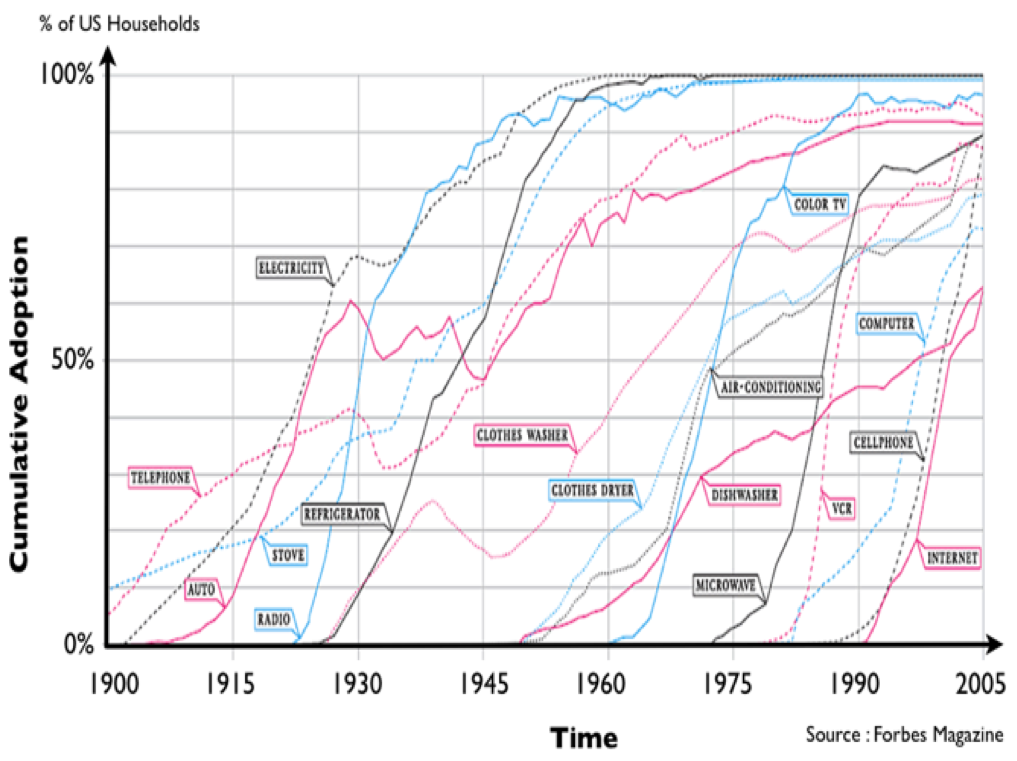
These are factors that I think are driving the increasing pace of change. But you don’t have to accept my assertions, you can see the increasing pace of change for yourself in adoption curves of technology. The “S” curves of technology adoption over the last 100 years demonstrate that it took years for a radio or television to penetrate many households, while newer products like VCRs, cell phone and PCs penetrated very quickly. One reason this is true is that the infrastructure (electricity, communication standards, interactivity) was built, deployed and stabilized. As the infrastructure got better, it became easier and easier to deploy and to use new technologies. See the increasing acceleration of adoption in the “S” curve image below.

Technology Adoption S Curves

Implications of Accelerating Change

The implications of this acceleration should be obvious – the pace of change and rate of acceleration is ever increasing. Individuals who were once satisfied with only one model of product are now more likely to be clamoring for more variety, more choice. This is something that even Henry Ford missed. Simply solving a basic transportation need led to ever increasing demands to satisfy comfort, status and ego needs. For many products and services, life expectancy is decreasing at the same rate as the accelerating pace of change. Few firms can count on long product cycle times.

Why this matters to Innovation

If these assumptions are true, then VELOCITY, as defined as speed in a specific direction, becomes very important for a firm’s ability to grow and compete. Relying on long product life cycles is not an option. Customers will demand new products, new features at an ever increasing rate. Firms can’t simply “dump” older technologies and products into “developing” markets because those market too understand the product/feature acceleration and reject older products. This acceleration means that firms must address the most significant barriers to velocity within their businesses. There are three barriers they must address:

  1. The ability to bring products to market very quickly. Most organizations have well-defined, stage-gate models that use waterfall approaches with many signoffs to reduce risk. These existing processes are long, drawn out affairs designed to prevent mistakes and perfect products rather than systems attuned to customer needs and expectations. One of the first activities many firms should undertake is to innovate their product development cycles.
  2. Few firms have invested in true innovation capabilities. Yes they have some “innovation” teams and perhaps even some systems or processes meant to sustain innovation, but they don’t consider innovation core to their business. Innovation – purposefully creating new, meaningful products and services that clients will want – will increase the organization’s speed, and potentially its velocity. It can increase velocity if…
  3. Executives create clear strategies based on the understanding of the importance of velocity. Innovation can result in more speed, based on improvements in the product development cycle time and in generating new ideas more effectively. But the difference between velocity and speed is intent. Velocity is speed in a specific direction. Executives must provide the demand for speed, combined with the insights that detail specific directions. Innovation needs far more attention from executives, in terms of greater importance and more clarity and focus.

Conclusion

So, hopefully you can see that perhaps the most important outcome innovation can deliver is velocity, that is, corporate speed with purpose. I’ve identified at least two areas where more internal speed is important, if a firm hopes to keep pace with its competitors and its market demands. Executives play an important role here as well. Our corporations become comfortable with our operating models and the internal pace of business. While our internal pace may be valuable, comfortable and well understood, our internal pace is irrelevant if the external pace of change is different. Far too many firms have too many structures that impede speed and velocity, and are too comfortable with a slow pace of change. Why they may believe they need innovation to create new products and services, these firms fail to realize how important it is to accelerate their operations and keep pace, at a minimum, with the market. And, not only is speed important, but velocity. Meaning that while we increase internal speed we do so in important, strategic directions.

In subsequent posts I’ll address the concept of innovation as a catalyst for corporate velocity.

Image credits: Pixabay, Forbes

Subscribe to Human-Centered Change & Innovation WeeklySign up here to get Human-Centered Change & Innovation Weekly delivered to your inbox every week.

Velocity, Speed and Innovation

Velocity, Speed and Innovation

Flying for 12 hours at a stretch can give you a lot of time to think, in between in-flight meals, movies and other on-board entertainment.

The more I thought about the current state of innovation, the more I realized that many of us have it all wrong. We at OVO often talk about innovation as an enabler to strategy, not a strategy itself. But I think there’s something much deeper going on than that. First, we know that many executives WANT more innovation. But they don’t want innovation for its own sake. They want innovation that drives more revenue growth, more differentiation and more creation of compelling products and services than what would otherwise happen. This means that innovation must create solutions with more return than existing methods, with only incrementally greater risk.

Executives want to be Innovative, they don’t want Innovation

In the final analysis, CEOs and senior executives don’t want INNOVATION, they want the benefits and outcomes of well-pursued innovation activities, namely, growth, differentiation, market penetration, disruption of adjacent markets and so forth. If there are easier ways to achieve these outcomes, CEOs and organizations will gladly pursue the alternatives, and forgo the risks that surround innovation. What risks? Because of the investments in management tools, techniques and training to improve efficiency and effectiveness, many businesses have very efficient but very brittle and fragile operating models. Innovation introduces risk, uncertainty and change into organizations and business models honed to avoid these issue. Further, most work teams have been right-sized and down-sized to the point where incremental work is almost impossible to engage. No, what executives want is not innovation per se, but they would like to be viewed as INNOVATIVE and enjoy the benefits of meaningful, valuable new products and services.

Why Velocity is more important than Speed

Perhaps what I’ve come to realize is that what most organizations need more than anything is VELOCITY. Let me explain what I mean by Velocity. My daughter’s physics class was working on the definition of motion and speed. Speed measures how fast an object is moving, so many feet or miles divided by the amount of time it takes to complete the distance. Physics and calculus distinguish SPEED from VELOCITY, by taking the stance that VELOCITY is Speed in a specific direction. Physicists and scientists would say that VELOCITY is a Scalar concept.

When we think about most businesses, VELOCITY is exactly what they need. They need speed to compete with a host of changes occurring in their markets, from increased competition to lowered trade barriers to a rapid increase in the abilities of individuals and firms in developing countries and markets. However, speed isn’t all that valuable if it’s in the wrong direction. VELOCITY is speed in a specific direction, and that’s what many organizations need. They need to be faster, more effective, more innovative, and end up in a place that was intentional.

VELOCITY connotes the idea that the firm is going somewhere that matters. How a firm knows where to go is dependent to some extent on corporate strategy and how well that strategy is communicated. Further, how it knows where to go is dependent on the firm’s ability to assess market trends, develop scenarios and understand customer needs. These final factors are innovation tools, which help describe a range of possible futures and help decipher which ones are relevant and important.

Speed kills, Velocity Wins

Over the next few posts I will write about speed, velocity and their relationship to innovation. Because increasingly innovation is just a method to help a firm increase its speed in a particular direction. Speed will become the new competitive weapon in a highly competitive market, but speed in and of itself is useless without intentional direction and guidance. We’ll look at why speed is ever more important, and how good innovation contributes to speed and velocity.

Another way to think of this is that innovation is a feature, and speed or velocity are the potential benefits. I’m increasingly convinced that velocity in a business sense – getting to the right markets and opportunities faster than others, and doing so intentionally – is the capability that will distinguish winners from losers in the coming years.

Image credit: Pixabay

Subscribe to Human-Centered Change & Innovation WeeklySign up here to get Human-Centered Change & Innovation Weekly delivered to your inbox every week.

How to be More Innovative in 5 Easy Steps

GUEST POST from Jeffrey Phillips

This is one of those posts where the topic feels so large and so poorly defined as to be almost impossible to describe. Yet we get this question all the time – what can we do to be more innovative? Every firm is in a rush to become more innovative, yet few have the time, resource or attention required. I’m going to address in this post how to create an innovation discipline, since we believe that is the only way to sustain competitive advantage.

How to be more innovative, in five easy steps

1. Choose a focus or strategy

Innovation is much easier with a specific target in mind. If your CEO or another executive asks for more innovation, work with that person to define the specific goals or strategies, or simply define what you think that means and pursue it. Without a clear goal, innovation is exceptionally difficult. With clarity, it is only reasonably difficult. Align your innovation activities to specific corporate strategies and goals.

2. Understand the future customer

Your customers today are, more or less, content with what you offer. They will offer at best incremental changes to existing products and services. If you want to become more innovative, you need to understand the wants and needs of two groups – people who aren’t customers today, and people who may be customers in the future. The future is different from today, and your product or service must succeed in that uncertain future, not in today’s market or environment. You must spend time understanding the future customer and their likely wants and needs. Use trend spotting and scenario planning to understand the future, and tools like ethnography to understand unarticulated needs.

3. Define a process or methodology

When I talk to my customers, I tell them that many innovation tools and methods seem simple and obvious, and in many cases they are. I also tell them that the fact that I own a hammer, a saw and a level does not make me an adept carpenter. There’s a difference between owning tools and having competence with the tools. Far too many potential innovators have tools and methods, but don’t know how to deploy them correctly, use them incorrectly or do so in the wrong order or context. There is a method to the madness. Define an innovation method or process that encompasses all of the work you need to do – from problem or opportunity definition to product or service commercialization and launch.

4. Understand your scope and expected deliverables

Your business as usual processes will seek to simplify, reduce and moderate any idea you create. Therefore, it is important to define how disruptive or radical the outcome should be IN ADVANCE so that you can ward off the impending simplification. This is only possible if you have the commitment or permission to pursue really interesting ideas in advance. Otherwise the culture will chip away, simplify and reduce radical ideas into incremental ideas, because those are the ideas that fit within the existing frameworks. Further, you need to define what your potential outcomes look like. Should you create a new product, a new service or a new business model. Without early definition and agreement, all innovation reverts to incremental product development.

5. Bridge the gaps

There are three important gaps to bridge when innovating. The first is between strategic corporate needs and innovation teams. That bridge has to do with strategy, clarity and permission. This bridge ensures that innovators create something that aligns to corporate needs. The second bridge is between insights and ideas. We need to understand customer needs and bridge from the needs to relevant ideas. The final bridge is between ideas and products. Product or service development teams are overworked and unprepared for new, important ideas that must be prioritized. Far too often good ideas end up listed far down the priority stack, where they starve from lack of attention and funds.

No fast, simple method to great innovation. Innovation is a discipline or competency which must be developed. There is no instant innovation, no just add water innovation that will create real value. Any firm can become more innovative following these steps, through commitment, clarity, process definition and skill development. Once you’ve put these five factors into place, run innovation projects or initiatives repeatedly. The more experience your teams and processes have, the more effective they’ll become. These capabilities are often at odds with existing business as usual processes and will diminish quickly if not regularly exercised.

Subscribe to Human-Centered Change & Innovation WeeklySign up here to get Human-Centered Change & Innovation Weekly delivered to your inbox every week.

Why IT Says No to Innovation

GUEST POST from Jeffrey Phillips

Pity the IT manager.  He (or she) is increasingly under pressure from product managers, business line leaders and others who want “innovation”.  Whether that’s more data, or more insight from their data, or perhaps the product manager wants to deploy a new product – innovation is a constant demand.  And while the IT folks would love to support innovation, they more often than not say “no”.  Who, in this day and age, can possibly say “no” to innovation?  Meet what I call the enabling functions:  legal, regulatory, intellectual property, IT and other business functions that are very likely to say “no” to your innovative idea.  Perhaps the more important question is: when everyone is demanding innovation, why are these groups refusing it?

In my new book Relentless Innovation I wrote about the importance of the “enabling” functions to not simply respond to requests to support new ideas but to anticipate and even engage in the identification and development of new ideas.  This would require IT to move from reacting to new innovation requests to become a leader in innovation across the board.  IT would be a critical part of ANY innovation discussion, not just about new servers but focused on how to support new products and new services.

I don’t mean to pick on IT – it’s not as though they are the only ones who have to block, slow or stymie innovation in many firms.  And it’s not uniformly the case that IT is a barrier.  In some firms, with visionary CIOs and CTOs, IT is on the forefront of innovation.  But, more often, IT is the voice crying out “no” when innovation is proposed.  But this isn’t a screed against IT.  No, this is a thoughtful, well articulated article about everything that you – and yes I am looking at you innovators – are doing wrong, forcing these enabling functions to say no.

Innovation in the “real” world

When someone in an organization gets the spark of a new idea, they often form a team to investigate the idea. This team examines market viability, financial opportunities and technical prowess.  They decide that the idea has merit and they prototype and test the idea with customers.  They receive excellent feedback and decide to promote the idea to senior management.  Executives become excited about the possibilities for the idea and call a meeting of all the affected groups. At that point, six months or a year after the idea is first identified, the “enabling” functions become aware of the idea for the first time.

“Enabling” Functions

In every organization there are business functions that perform what I call the enabling functions.  These are teams like legal, regulatory, compliance, information technology and other groups whose job it is to enable the product and service teams to accomplish their goals.  These enabling functions provide two important capabilities. First, they ensure the product or service doesn’t cause damage to clients or to the firm in the legal system, and second they ensure the product or service can be sustained in the marketplace.  But these services and capabilities can’t be delivered overnight.  IT systems alone can take years to build, test and deploy.  So your great idea that’s been in development for six months may not have IT systems to support it for three more years.

But let’s not pick on IT alone. If a legal team or regulatory team isn’t aware of an idea and its impacts early in the discovery phase, you can and will spend time on ideas that aren’t in compliance or would violate someone else’s IP.  Since these enabling functions have both a protective function and a supporting function, they have great weight at the end of the idea development process and the beginning of the commercialization process.  And they can unintentionally stretch out the development of an idea and delay deployment for years.

Thin resources, long cycles

Most enabling functions are thinly staffed and have small budgets.  Most IT budgets, for example, are focused on maintaining existing systems and have few dollars for building new systems.  Even those dollars are often earmarked well in advance.  If your product or service needs information technology in order to get to market, serve a customer or offer support (and which doesn’t), then you need to align your ideas very early with your IT team.  This doesn’t mean that the IT team gets final say – it may be necessary to find external partners or rely on external platforms. But what it does mean is that your idea can’t exist without the blessing of a range of enabling functions, and the worst thing you can do to an enabling function is surprise it with a new, valuable idea.

Further, it’s not as though these enabling functions are sitting around waiting for a new idea to fall in their laps.  They have full time jobs and responsibilities, full agendas with existing priorities.  While your new idea seems very important to you, it is just one of a number of “top” priorities that already exist in the “to do” list.  And many of those other priorities come with funding, with prior approval and have already been staffed.

Want to say yes, have to say no

Most of the people who run enabling functions, like regulatory, legal and IT, want to say yes to your ideas.  In fact most of them want to be more innovative themselves.  But, if they aren’t aware of your idea early, if they aren’t funded to support new ideas, if their resources are stripped back to only support maintenance, they have no choice but to say “no”.

Changing the approach

If you hope to be a Relentless Innovator, you must engage your enabling functions early in the innovation process.  Even then, even if they are more aware of ideas, that doesn’t guaranteed their ability to respond as you’d wish.  They will need more money for unanticipated projects and more people to respond to new requests.  Further, they may need new, trusted partnerships to help them accomodate your requests.  If those relationships are developed and exist as your requests emerge, you can quickly determine which approach is right for you.  If those relationships don’t exist, there is often too much work to focus on maintaining status quo and building new relationships under the gun.

Subscribe to Human-Centered Change & Innovation WeeklySign up here to get Human-Centered Change & Innovation Weekly delivered to your inbox every week.