The Illusion of Scale
GUEST POST from Chateau G Pato
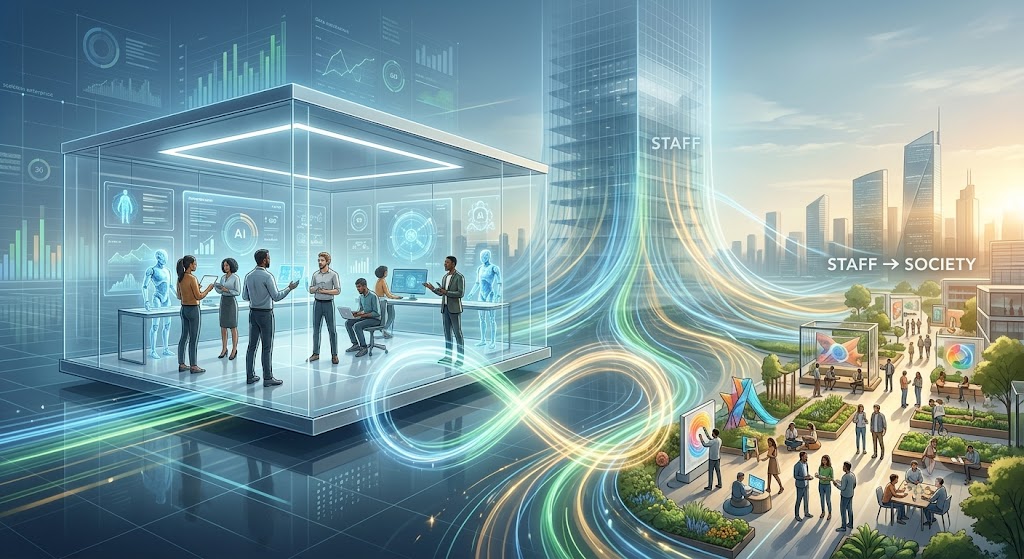
But that equation is breaking down. We are rapidly moving past the era of the industrial behemoth and entering the age of “frictionless scale.” Fueled by advanced AI orchestration, autonomous agentic networks, and hyper-lean digital ecosystems, tomorrow’s market giants will generate exponential value with remarkably small teams. The traditional relationship between revenue and employee numbers is decoupling, allowing organizations to achieve global reach and multi-billion-dollar valuations while maintaining a physical and human footprint that could fit inside a single conference room.
While this shift represents an incredible triumph of operational innovation, it exposes a profound systemic vulnerability. When a corporation no longer requires a vast staff to operate, it effectively divorces itself from its historic role as an economic anchor for society. This brings us to a critical, human-centered question that futurists, innovators, and leaders must confront: What happens to the fabric of local economies, social stability, and human dignity when scale no longer requires staff? How we answer this question and design for this transition will dictate whether this technological leap serves to elevate humanity or systematically fracture it.
Part I: The Anatomy of the Scaleless Enterprise
To understand the depth of this societal shift, we must first look at how the fundamental architecture of the enterprise is being hollowed out and rebuilt from the ground up. The traditional corporate hierarchy — built on layers of middle management, operational specialists, and administrative support — was designed to solve a specific problem: managing complexity and communication at volume. Historically, more customers meant more transactions, which demanded more human hands to orchestrate. Today, that entire structural necessity is evaporating.
From Linear to Exponential Infrastructure
We are witnessing a rapid transition from linear organizational growth to exponential infrastructure. In the past, scaling up required a proportional injection of capital and labor. Today, emerging technology stacks allow a tiny core of human orchestrators to deploy autonomous agentic networks capable of handling thousands of complex, simultaneous processes. These AI agents do not just automate repetitive tasks; they handle contextual decision-making, predictive logistics, and real-time problem-solving. As a result, the operational middle layer of the corporation is vanishing, replaced by fluid, self-optimizing code that scales instantly without hiring a single additional person.
Human-Centered Design in a Low-Human Business
This structural leanest forces us to radically redefine the principles of experience design. When a business operates with minimal human staff, how do we preserve empathy, intuition, and trust? Human-centered design can no longer just be about optimizing employee-to-customer interactions or building slick user interfaces. Instead, it must be embedded directly into the digital DNA of autonomous systems. The challenge for tomorrow’s innovators is to design experiences where the primary interface is completely automated, yet the delivery feels deeply human, respectful, and aligned with human values. Human intervention will cease to be the default operational standard; instead, it will become a rare, high-value premium reserved for moments of profound complexity or emotional nuance.
The Paradox of Value
This evolution culminates in a jarring economic paradox: the complete decoupling of market valuation from civic contribution. For generations, a company’s health was judged in part by its ability to create jobs and support families. In the scaleless enterprise, success is measured by the absolute minimization of friction — which frequently means the absolute minimization of headcount. We are staring down a future where companies can achieve historic market caps and unprecedented global influence while completely divesting from the physical communities that surround them. They will draw immense value out of the global economy through digital channels, but they will no longer return that value through local payrolls, permanently altering the traditional feedback loop of capital and community.
Part II: The Societal Ripples (The Real Human Cost)
The rise of the scaleless enterprise is not a isolated corporate event; it is an economic earthquake with tectonic implications for society. When organizations strip away their physical and operational dependencies, they don’t just change their cost structures — they fundamentally rewrite the rules of local communities. The ripple effects of this contraction stretch far beyond unemployment statistics, striking at the heart of civic stability and human identity.
The Death of the “Company Town” Anchor
Throughout modern history, the physical footprint of a major corporation has served as a vital economic ecosystem. A corporate campus doesn’t just support its own employees; it subsidizes an entire secondary economy of small businesses, commercial real estate markets, public transit systems, and local hospitality workers. Furthermore, large corporate entities have historically been foundational contributors to regional civic infrastructure and local philanthropy. When this physical footprint completely evaporates, it leaves behind an economic void that digital platforms cannot replicate. Without the anchoring presence of physical payrolls spending money locally, municipal tax bases erode, causing a devastating downstream decline in public funding for schools, parks, and essential community services.
The Velocity of Identity Disruption
From a change management perspective, the most dangerous aspect of this shift is not the loss of income, but the loss of meaning. In our current society, human beings are deeply conditioned to tether their personal identity, self-worth, and dignity to their professional utility. The 9-to-5 career has long been the primary vehicle for achieving a sense of societal contribution. If scale no longer requires a workforce, we are not simply facing a structural employment crisis; we are rushing into a profound psychological crisis of human irrelevance. When a workforce is displaced at a velocity that far outpaces the human capacity to adapt and reinvent, the fabric of social cohesion begins to fracture under the weight of widespread existential displacement.
The Polarization of Competencies
This decoupling of staff from scale aggressively accelerates the polarization of the labor market, creating a stark economic divide. On one side are the “orchestrators” — the hyper-valued individuals who possess the rare combination of strategic foresight, design thinking, and technical capability required to architect and steer autonomous systems. On the other side is the massive, rapidly commoditizing pool of traditional knowledge workers and operational staff whose roles have been absorbed by digital agentic networks. This creates a winner-take-all talent landscape where the rewards of exponential growth are concentrated among an increasingly tiny elite, while the barrier to entry for meaningful, middle-class professional advancement becomes devastatingly high.
Part III: Reimagining the Social Contract (Futurology in Action)
To navigate the reality of the shrinking corporate footprint, we cannot rely on yesterday’s economic playbooks. When corporate productivity permanently detaches from human labor, the foundational structures of our society must undergo a parallel evolution. Futurology is not about passively predicting what will happen; it is about actively designing the framework for what *should* happen. We must courageously architect a new social contract that protects human well-being in an era of post-labor scale.
From Corporate Responsibility to Civic Co-Creation
For decades, Corporate Social Responsibility (CSR) was largely viewed as an elective marketing strategy or a supplementary foundation. In a world of scaleless enterprises, this model is completely obsolete. When massive organizations extract immense wealth from a society’s digital infrastructure without returning it through local wages, the burden of funding societal well-being must be fundamentally restated. We must transition to a model of civic co-creation, where the immense dividend of automated efficiency is structurally reinvested into the public commons. This requires innovative public-private mechanisms that channel a portion of algorithmic wealth directly into repairing and funding the foundational human ecosystems — like local healthcare, community spaces, and civic infrastructure — that corporations are leaving behind.
Redefining “Contribution”
If traditional 9-to-5 employment ceases to be the primary mechanism for wealth distribution and social status, society faces a massive philosophical crossroads. We must aggressively decouple a person’s survival and dignity from their commercial utility. This opens up an extraordinary, human-centered opportunity to redefine what it means to “contribute” to society. In a post-labor economy, we have the chance to elevate and economically incentivize the vital human activities that machines can mimic but never genuinely experience: art, philosophy, localized community care, environmental restoration, and deeply empathetic education. By building structures that recognize and reward these deeply human efforts, we can transform a potential crisis of unemployment into an era of unprecedented human expression and community connection.
The Future of Lifelong Adaptation
Our current education and career systems are linear relics of the industrial era — you learn a trade in your youth, and you execute it for forty years. When digital agentic networks can redefine entire industries overnight, this rigid approach becomes a recipe for widespread obsolescence. The future demands fluid, human-centric learning ecosystems built for continuous pivot. Instead of teaching static, repeatable skills, our institutions must prioritize meta-competencies: emotional intelligence, systems thinking, cognitive agility, and the design thinking principles required to orchestrate AI rather than compete with it. Education must transform from a fixed phase of life into a seamless, lifelong utility that empowers individuals to constantly re-author their role in a rapidly changing world.
Conclusion: Designing a Human-First Future
The shrinking corporate footprint is not a distant, speculative scenario; it is an active transformation unfolding across our economic landscape today. Technology and automation are driving an unprecedented era of efficiency, but we must never confuse operational efficiency with societal health. The decoupling of scale from staff presents us with a stark choice. If left unguided, this shift will result in an increasingly fractured world where immense digital wealth is concentrated in fewer hands while physical communities hollow out. But if we approach this transition with intentionality, we can use this newfound abundance to liberate human potential on a scale never before seen.
As innovators, futurists, and experience designers, we must remember a core truth: technology dictates what is possible, but human-centered design dictates what is sustainable. We cannot afford to let the future simply happen to us; we must actively architect it. This means looking beyond short-term corporate margins and designing systems where technological progress explicitly serves to elevate human well-being, protect individual dignity, and reinforce the communities we live in.
The ultimate metric of success for tomorrow’s lean corporate giants cannot simply be their market capitalization, their operating margin, or the speed of their algorithms. The true measure of an enterprise in this new era must be its net-positive contribution to a society that no longer works inside its walls. By aligning our incredible capacity for technological innovation with a deep, unyielding commitment to human-centered design, we can ensure that the age of frictionless scale becomes an age of universal human flourishing.
Frequently Asked Questions
What is a “scaleless enterprise” and how does it differ from a traditional corporation?
A traditional corporation requires a proportional increase in human staff and physical footprint to scale its operations and revenue. A scaleless enterprise leverages advanced technology stacks, such as autonomous AI agents and decentralized digital infrastructure, to achieve massive global market reach and exponential revenue growth while keeping its internal workforce and physical presence incredibly small.
Why does the shrinking corporate footprint pose a threat to local communities?
Historically, large companies acted as economic anchors by providing jobs, subsidizing local ecosystems (like commercial real estate, retail, and hospitality), and contributing heavily to municipal tax bases. When a corporation’s physical footprint disappears, those local revenue streams and community subsidies evaporate, leaving local economies vulnerable and straining public infrastructure funding.
How can society redefine human “contribution” in a post-labor economy?
As traditional employment opportunities contract, society must shift from measuring an individual’s worth solely by their commercial or industrial output. We can establish new public-private mechanisms and social frameworks that value, incentivize, and economically reward uniquely human capabilities that automation cannot replicate — such as community caregiving, artistic creation, civic mentorship, and environmental stewardship.
Bottom line: Futurology is not fortune telling. Futurists use a scientific approach to create their deliverables, but a methodology and tools like those in FutureHacking™ can empower anyone to engage in futurology themselves.
Image credit: Gemini
 Sign up here to get Human-Centered Change & Innovation Weekly delivered to your inbox every week.