How Transient Electronics Will Redefine Human-Centered Innovation
LAST UPDATED: July 3, 2026 at 12:32 PM
GUEST POST from Art Inteligencia
Our Obsession with Permanent Technology
For more than a century, progress in electronics has largely been measured by one characteristic: durability. We celebrate devices that survive drops, resist water, and continue operating for years. Manufacturers compete to extend battery life, strengthen materials, and increase product longevity because permanence has become synonymous with quality.
That mindset has served us well for products like laptops, industrial equipment, and household appliances. But not every problem requires a permanent solution. In fact, designing every electronic device to outlive its usefulness often creates unnecessary complexity, cost, and environmental impact.
Consider a medical sensor that only needs to monitor a patient’s recovery for ten days, or an environmental sensor deployed after a natural disaster to collect data for a single month. Once their mission is complete, these devices frequently become liabilities. Someone must retrieve them, dispose of them responsibly, replace their batteries, or leave them behind as yet another piece of electronic waste.
This assumption that technology should last indefinitely also shapes the experiences we design. Wearable devices can become uncomfortable over time. Temporary medical implants often require additional procedures for removal. Field sensors increase operational costs because they must be recovered from remote or hazardous locations. What begins as a technological solution often ends with a logistical problem.
Human-centered innovation challenges us to ask a different question: What is the ideal lifespan of this technology? The answer isn’t always “as long as possible.” Sometimes the most elegant experience is one in which the technology performs its job flawlessly and then quietly exits the stage, leaving behind only the value it created.
That shift in perspective sets the stage for one of the most intriguing emerging fields in materials science and experience design: transient electronics. Rather than treating permanence as the ultimate goal, these technologies are engineered with an intentional ending, opening the door to products that are not only smarter and more sustainable, but also more closely aligned with the needs of the people who use them.
What Are Transient Electronics?
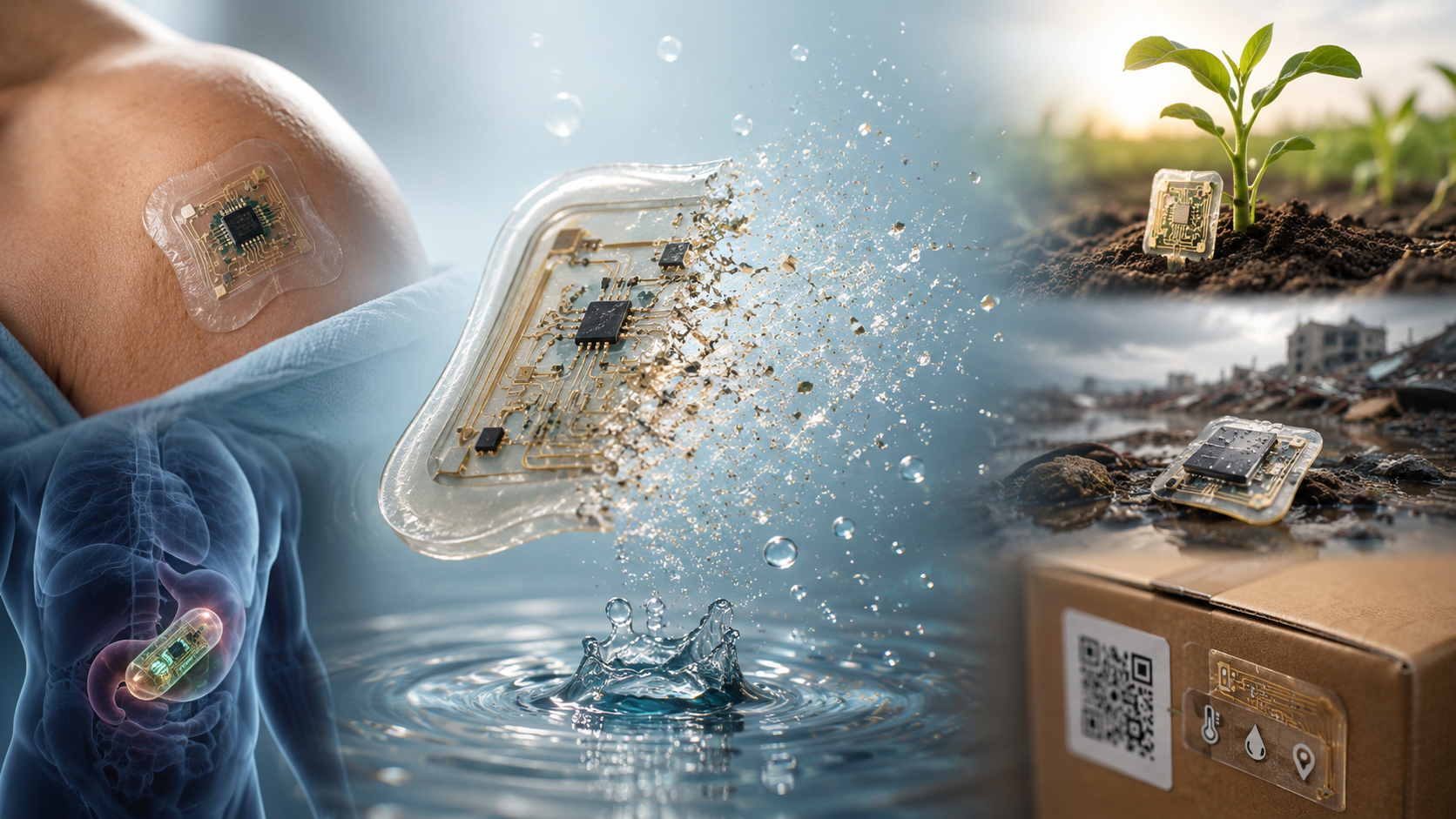
Transient electronics—sometimes called ephemeral bio-electronics or dissolvable electronics—are electronic devices intentionally designed to operate reliably for a predetermined period before safely and harmlessly breaking down. Unlike conventional electronics, which are built to resist the elements for as long as possible, transient electronics are engineered with an expiration date. Once their mission is complete, exposure to triggers such as water, body fluids, heat, changes in pH, or specific biochemical reactions initiates a controlled dissolution process.
The remarkable aspect of this technology is that there is no compromise in performance during its intended lifespan. A transient sensor can collect data, transmit information, or perform diagnostic functions with the same reliability as its traditional counterpart. The difference is that its lifecycle has been intentionally designed from beginning to end, including its safe disappearance.
Researchers are making this possible by developing biodegradable semiconductors, dissolvable conductive materials, transient batteries, and protective coatings that determine precisely when the device begins to degrade. By carefully selecting materials and engineering the surrounding environment, designers can tailor devices to function for hours, days, weeks, or even months before they naturally dissolve.
While the technology may sound futuristic, it addresses a surprisingly practical challenge. Many electronic devices are temporary by nature, even if their materials are not. A post-surgical monitoring patch, a temporary implant, an environmental sensor deployed after a flood, or a smart package tracking temperature during shipment all have a finite purpose. Building them to last decades creates unnecessary waste, recovery costs, and environmental burden.
Transient electronics replace this “build it forever” philosophy with a more thoughtful approach: build it to last exactly as long as it is needed—no longer and no less. That subtle shift transforms the conversation from durability alone to appropriateness, recognizing that the most human-centered solution is often one whose lifespan is carefully matched to the problem it was designed to solve.
Designing for Ephemeral Utility Instead of Permanent Ownership
One of the most profound implications of transient electronics isn’t technological—it’s philosophical. For decades, product designers have operated under an implicit assumption that every device enters a long-term relationship with its owner. Whether it’s a smartwatch, a medical monitor, or an industrial sensor, someone is expected to install it, maintain it, update it, and eventually dispose of it. That entire lifecycle creates friction.
Transient electronics invite us to think differently. Instead of designing products for permanent ownership, we can design them for ephemeral utility—creating technology that exists only for the duration of the value it provides. Once its purpose has been fulfilled, it gracefully disappears, leaving users with the outcome they wanted rather than another object they must manage.
This represents a subtle but significant shift in experience design. Traditional electronics create a series of responsibilities that extend well beyond their primary function. Batteries need charging or replacing. Devices require cleaning, storage, retrieval, recycling, or disposal. In healthcare settings, temporary implants may even necessitate a second procedure for removal. Each of these tasks introduces additional effort, cost, and opportunities for frustration.
Human-centered design has always sought to reduce unnecessary friction. Transient electronics simply extend that principle to the entire product lifecycle. Instead of asking how to make a device easier to maintain, designers can ask whether maintenance should exist at all. Instead of optimizing retrieval processes, they can eliminate the need for retrieval entirely.
This way of thinking encourages organizations to measure success differently. Rather than evaluating products solely by durability or longevity, they can consider metrics such as reduced user effort, lower environmental impact, fewer operational touchpoints, and diminished cognitive load. In many situations, the best experience is the one users never have to think about because the technology quietly completes its task and exits without demanding attention.
Designing for ephemeral utility doesn’t mean designing disposable products in the traditional sense. It means designing complete experiences with intentional beginnings, purposeful lifespans, and graceful endings. As transient electronics mature, one of the greatest opportunities for innovators will be recognizing where permanence adds value—and where it simply adds friction.
Healthcare May Be the First Killer Application
While transient electronics have the potential to transform dozens of industries, healthcare is poised to become their first truly transformative application. Few fields place a higher premium on patient comfort, safety, precision, and sustainability, making it an ideal environment for technologies designed to perform a temporary function before harmlessly disappearing.
Consider the experience of recovering from surgery. Today, temporary sensors may need to be removed once they have collected the necessary data, adding another appointment, another procedure, and another source of anxiety for patients. A transient monitoring device, by contrast, could continuously track healing, detect signs of infection, or monitor vital indicators for a prescribed period before safely dissolving within the body or degrading after removal. The patient benefits from the information without enduring the inconvenience of device retrieval.
The same principle extends to smart wound dressings that monitor healing, temporary cardiac or neurological sensors, and biodegradable drug delivery systems that precisely administer medication before disappearing. Pediatric care may benefit even more, as children could avoid the stress and discomfort associated with removing monitoring devices or temporary implants. In each case, the technology serves the patient rather than asking the patient to continue serving the technology.
The advantages extend beyond the patient experience. Hospitals and healthcare systems could reduce follow-up procedures, lower the risk of infection associated with device removal, simplify clinical workflows, and decrease medical waste. By eliminating unnecessary steps in the care journey, transient electronics have the potential to improve outcomes while simultaneously reducing costs.
Perhaps most importantly, this technology embodies a core principle of human-centered innovation: success should be measured by the quality of the outcome, not the visibility of the solution. Patients don’t want to carry technology for its own sake—they want to heal. If a dissolvable electronic device helps them recover more safely, comfortably, and efficiently before quietly disappearing, it has achieved something far more meaningful than simply demonstrating technological sophistication.
Sustainability Beyond Recycling
Sustainability conversations often focus on what happens after a product reaches the end of its life. Can it be recycled? Can its materials be recovered? Can its environmental footprint be reduced? These are important questions, but transient electronics encourage us to ask an even better one: What if there were little or nothing to recover in the first place?
Electronic waste is one of the fastest-growing waste streams in the world, fueled by billions of devices that eventually become obsolete or abandoned. While recycling programs help, they remain costly, logistically complex, and far from universal. Many devices never make it into recycling systems at all, leaving valuable materials lost and harmful substances entering the environment.
Transient electronics offer a complementary approach by designing products whose end-of-life has been considered from the very beginning. Imagine biodegradable soil sensors that monitor moisture throughout a growing season before harmlessly breaking down, environmental sensors deployed after hurricanes or wildfires that disappear once recovery efforts conclude, or smart shipping labels that monitor temperature-sensitive goods during transit without adding another piece of electronic waste to the packaging stream.
This philosophy is particularly valuable in places where recovering equipment is difficult, dangerous, or prohibitively expensive. Remote forests, agricultural fields, oceans, disaster zones, and other challenging environments could all benefit from temporary sensing technologies that provide valuable data without requiring costly retrieval missions or leaving behind long-term environmental footprints.
For innovators and experience designers, the opportunity extends beyond materials science. It is an invitation to rethink the entire lifecycle of a product. Instead of viewing disposal as an unavoidable consequence of innovation, organizations can begin designing solutions whose environmental impact naturally aligns with the duration of the problem they were created to solve. In that sense, transient electronics represent more than a new class of devices—they represent a new philosophy of responsible innovation, one where the most sustainable technology may be the technology that knows when to leave no trace.
Experience Design for Things That Intentionally Disappear
The engineering behind transient electronics is impressive, but their success will ultimately depend on something equally important: user trust. For generations, we’ve been conditioned to believe that if a device disappears, breaks down, or stops functioning, something has gone wrong. Transient electronics invert that expectation. Their disappearance isn’t a defect—it’s the successful completion of their purpose.
That creates an entirely new set of challenges for experience designers. Users need confidence that a device will remain fully functional throughout its intended lifespan and dissolve only when its work is complete. Building that confidence requires thoughtful communication before, during, and at the end of the product’s lifecycle.
Rather than simply displaying battery life or connectivity status, future interfaces may communicate remaining operational lifespan, completion milestones, or confidence indicators that reassure users everything is proceeding as planned. A medical monitoring patch, for example, might inform a patient that it has collected all required data and will safely dissolve within the next twenty-four hours. Similarly, an environmental sensor could report that its mission has concluded before entering its programmed degradation phase.
Experience designers must also consider the emotional dimension of intentional disappearance. Should a device quietly fade away without drawing attention to itself, or should it provide a sense of closure by confirming that its mission has been accomplished? The answer will vary depending on the context. A consumer product may benefit from explicit confirmation, while a healthcare device may reduce anxiety by making the transition feel effortless and routine.
Perhaps the biggest lesson is that designers must begin treating endings with the same care they devote to onboarding and daily interactions. Every product has a lifecycle, but few experiences intentionally design the final chapter. Transient electronics remind us that the end of an experience is still part of the experience itself. When technology can leave gracefully—without creating confusion, inconvenience, or waste—it demonstrates a deeper understanding of human needs. That is the essence of human-centered design.
Innovation Isn’t Always About Adding More
We often equate innovation with addition. More features. More sensors. More processing power. More connectivity. More intelligence. While those advances have undoubtedly improved countless products, they have also made many technologies more complex to own, maintain, and eventually dispose of. Transient electronics suggest a different path forward—one where innovation is measured not only by what we add, but also by what we can thoughtfully remove.
Human-centered innovation has never been about maximizing technology for its own sake. It is about maximizing value while minimizing friction. If a product can eliminate a follow-up medical procedure, reduce maintenance visits, avoid retrieval costs, or prevent electronic waste simply by being designed with a finite lifespan, then its greatest innovation may be its restraint rather than its sophistication.
This perspective encourages organizations to challenge long-held assumptions during the innovation process. Instead of asking, “How can we make this device last longer?” teams might ask, “How long does it actually need to last?” Rather than designing for every possible future scenario, they can optimize for the specific job the technology is intended to perform and allow everything else to disappear with it.
This philosophy echoes one of the central principles of experience design: every additional step, feature, or responsibility should justify its existence. Complexity is not inherently valuable. In many cases, the most elegant solution is the one that quietly removes work from people’s lives without asking for recognition.
As organizations pursue their next generation of products and services, transient electronics offer a valuable reminder that innovation is not a race to build the most permanent technology. Sometimes the greatest breakthrough comes from designing something that fulfills its purpose completely—and then gets out of the way. By embracing intentional simplicity and finite lifecycles, innovators can create solutions that are not only more sustainable but also more deeply aligned with the people they are meant to serve.
The Business Models That Could Emerge
Like many breakthrough technologies, the true impact of transient electronics may extend far beyond the devices themselves. Throughout history, transformative innovations have created entirely new business models by changing not only what organizations could build, but also how they could deliver value. Transient electronics have the potential to do the same by enabling services and experiences that were previously impractical or prohibitively expensive.
In healthcare, providers could offer temporary diagnostic services rather than permanent monitoring devices. Patients might receive dissolvable sensors tailored to a specific stage of recovery, eliminating the logistics of equipment returns and reducing inventory management. Healthcare systems would shift from managing hardware lifecycles to delivering time-bound clinical insights, creating a more seamless experience for both patients and caregivers.
Other industries could undergo similar transformations. Agricultural companies may deploy biodegradable sensor networks that monitor crops throughout a growing season before naturally decomposing. Logistics providers could incorporate transient smart labels that verify temperature, humidity, or handling conditions during shipment without creating additional waste. Construction firms might embed temporary structural monitoring devices that disappear once a building has passed critical inspection milestones, while environmental agencies could distribute short-term sensing networks following floods, wildfires, or chemical spills.
These applications point toward business models centered on outcomes rather than ownership. Organizations could package temporary sensing, event-based monitoring, compliance verification, or environmental intelligence as services, with the electronics functioning as disposable enablers rather than long-term assets. Customers would purchase the information and confidence the technology provides—not the responsibility of managing another physical device.
For innovation leaders, this represents a valuable strategic reminder. Emerging technologies rarely create value simply because they are technically impressive. They create value by enabling organizations to solve problems in fundamentally new ways. Companies that view transient electronics as an opportunity to redesign customer experiences and rethink how value is delivered—not merely as a new category of hardware—will be best positioned to capitalize on this disappearing act.
The Ethical Questions of Technology That Disappears
Every transformative technology introduces new ethical considerations, and transient electronics are no exception. While the prospect of devices that safely disappear offers compelling benefits for healthcare, sustainability, and user experience, it also raises important questions about trust, accountability, and transparency. Human-centered innovation requires us to address these questions with the same rigor we apply to the underlying engineering.
Reliability is perhaps the most immediate concern. A transient device must remain fully functional for its intended lifespan and dissolve only when appropriate. If a medical sensor were to degrade prematurely or an environmental monitor failed before completing its mission, the consequences could extend far beyond inconvenience. Designers, manufacturers, and regulators will need robust methods for validating performance, communicating expected lifespans, and ensuring users can trust that these devices will behave exactly as intended.
Transparency presents another challenge. When a device intentionally disappears, how can users verify that it has completed its task successfully? Should healthcare providers receive confirmation before a sensor dissolves? Should environmental agencies maintain permanent records of data collected by temporary monitoring systems? Designing for disappearance must not come at the expense of accountability.
There are also broader societal questions to consider. Could dissolvable electronics complicate forensic investigations or regulatory audits if physical evidence no longer exists? How should industries document the use of transient devices in highly regulated environments? As with any emerging technology, thoughtful governance will be essential to ensure that the benefits of intentional impermanence are balanced with appropriate safeguards.
Ultimately, these challenges reinforce an important principle of human-centered design: technology should earn trust, not assume it. Success will depend not only on creating devices that disappear safely, but also on designing systems that leave behind confidence, reliable data, and clear accountability. When innovation anticipates both the opportunities and the ethical responsibilities it creates, it has the greatest chance of improving lives while earning society’s lasting trust.
Frequently Asked Questions About Transient Electronics
What are transient electronics?
Transient electronics, also known as dissolvable or ephemeral electronics, are electronic devices designed to function reliably for a predetermined period before safely breaking down when exposed to triggers such as water, body fluids, heat, changes in pH, or specific biochemical conditions. Unlike conventional electronics, they are engineered with a planned end-of-life that eliminates the need for retrieval or disposal in many applications.
What are the biggest benefits of transient electronics?
The primary benefits include reducing electronic waste, eliminating device retrieval in difficult or hazardous environments, improving patient comfort in healthcare, lowering maintenance costs, and enabling more sustainable temporary monitoring solutions. By matching a device’s lifespan to its intended purpose, transient electronics remove unnecessary friction from both the user experience and the product lifecycle.
Where will transient electronics have the greatest impact?
Healthcare is expected to be one of the first industries to benefit significantly through dissolvable medical sensors, temporary implants, smart wound dressings, and drug delivery systems. Other promising applications include environmental monitoring, precision agriculture, disaster response, logistics, construction, and industrial sensing—especially where recovering equipment is difficult, expensive, or environmentally undesirable.
FutureHacking™ Is Coming
FutureHacking™ is Braden Kelley’s strategic foresight methodology — and a paid download and training program is launching soon. Register your interest now to be the first to know when it’s available, and get early access pricing.
Disclaimer: This article speculates on the potential future applications of cutting-edge scientific research. While based on current scientific understanding, the practical realization of these concepts may vary in timeline and feasibility and are subject to ongoing research and development.
Image credits: Gemini
 Sign up here to get Human-Centered Change & Innovation Weekly delivered to your inbox every week.