How Autonomous Tools Revitalize Community-Centric Economies
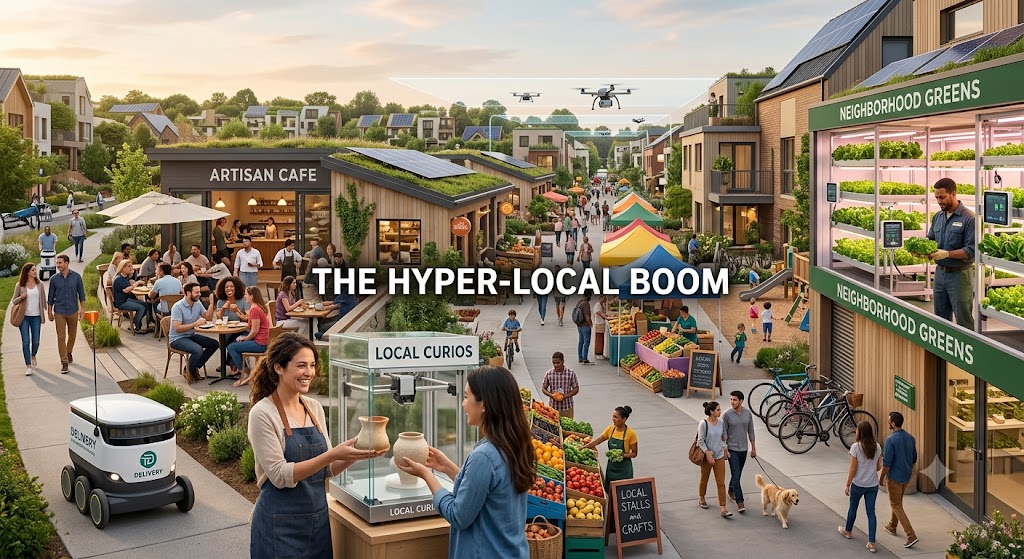
GUEST POST from Chateau G Pato
I. Introduction: The Pendulum Swings Back
The Globalist Peak
For decades, the narrative of progress was defined by hyper-globalization. Massive, centralized platforms and sprawling global supply chains optimized for efficiency, driving down costs at the expense of local economic resilience. While this interconnectedness brought unprecedented access to goods, it simultaneously stripped communities of their unique flavor, hollowed out local marketplaces, and left neighborhoods vulnerable to systemic global shocks.
The Catalyst
Today, we are witnessing a profound structural shift. The convergence of autonomous AI, decentralized manufacturing, and hyper-local logistics is fundamentally rewriting the rules of production and distribution. Technologies once feared as cold or isolating are maturing into the foundational infrastructure for a new era of localized commerce.
The Thesis
Autonomous tools are not isolating us; they are doing the exact opposite. By shifting the economics of production and distribution away from distant fulfillment centers and back to the neighborhood block, automation is enabling a massive, human-centered renaissance of community-centric economies. This is not a step backward into isolationism, but a leap forward into an empowered, self-sustaining future where technology serves to anchor us closer to home.
II. The Architecture of the Autonomous Local Engine
Micro-Production & Decentralized Supply Chains
The traditional model relies on massive, centralized factories pushing goods across vulnerable, thousands-of-miles-long supply chains. The autonomous local engine flips this paradigm to on-demand, decentralized creation. Advanced 3D printing micro-factories, automated vertical farming pods, and localized CNC routing stations are embedding production directly into our neighborhoods. This shifts the focus from economies of scale to economies of proximity, allowing communities to build, grow, and manufacture exactly what they need, the moment they need it, vastly improving local resilience.
Autonomous Micro-Logistics
The “last mile” of delivery has historically been the most expensive and carbon-intensive leg of commerce, often forcing local businesses to rely on monopolistic logistics giants. The introduction of autonomous micro-logistics—sidewalk delivery bots, neighborhood drone networks, and automated local dispatchers — slashes these barriers to near zero. By making neighborhood-to-neighborhood commerce functionally frictionless, we empower local makers and growers to distribute their goods just as efficiently as multinational conglomerates, but with a vastly smaller footprint.
Intelligent Local Marketplaces
Technology must serve as a bridge, not a barrier. As artificial intelligence integrates with hyper-local commerce, we are seeing the rise of intelligent local marketplaces. These are not just digital storefronts; they are dynamic, predictive ecosystems that anticipate community needs and seamlessly match local supply with local demand. By decentralizing the marketplace, AI tools strip away the need for massive corporate middlemen, ensuring that the economic value generated by a community remains within that community, fueling a new era of participatory innovation.
III. Elevating Human Experience (The HX Factor)
From Transactional to Relational
The true value of automation lies not in replacing humans, but in freeing them to do what they do best. When autonomous tools seamlessly absorb the burden of routine backend logistics — handling inventory forecasting, automated billing, and micro-routing — local business owners are liberated from the keyboard and the stockroom. They can redirect their energy toward what truly drives customer loyalty: deep relationship-building, bespoke customization, and genuine empathy. Commerce shifts from a cold, transactional exchange back to a warm, relational experience.
The “New Artisan” Economy
Historically, scaling a business meant taking on massive capital risk, securing complex infrastructure, and giving up creative control. Today, autonomous micro-production and frictionless local logistics drastically lower the barrier to entry. This democratization gives rise to a “New Artisan” economy. Local creators, boutique chefs, and precision builders can leverage automated tools to manage the complexities of production and distribution, allowing them to scale their unique craft sustainably within their immediate geographic region without needing venture capital.
Designing Frictionless Community Spaces
To fully realize this shift, we must rethink the physical spaces where we live and gather. The community hub of the future is an experience-first destination. By moving autonomous fulfillment, micro-storage, and sorting infrastructure quietly into the background — or beneath the floorboards — the storefront is reclaimed. It ceases to be a mere warehouse for boxes and becomes a sanctuary for human connection, sensory engagement, and experiential retail where people come to gather, co-create, and share stories.
IV. Navigating the Change: Friction, Equity, and Adoption
The Human-Centered Transition
Every major technological shift introduces friction, and the hyper-local boom is no exception. As autonomous tools take over the predictable mechanics of retail and traditional logistics, we face a critical transition period. Navigating this change requires a deliberate, human-centered approach to upskilling. We must invest heavily in community-led training programs that empower displaced workers to step into higher-value roles as community experience designers, digital artisans, and local system orchestrators — ensuring that technology serves to elevate human potential rather than sideline it.
Bridging the Digital Divide
Innovation must be participatory; if it only benefits wealthy tech hubs, it has failed. We must intentionally design policies and funding frameworks that deploy autonomous micro-factories, vertical farming pods, and micro-logistics networks into historical food deserts, rural outposts, and underserved urban neighborhoods. True fairness means ensuring that these decentralized economic engines are accessible to all, providing equitable wealth-generation tools where rewards remain relative to local effort, and directly revitalizing communities that the globalist model left behind.
Regulatory & Trust Hurdles
Building the infrastructure for an autonomous neighborhood requires navigating significant regulatory, safety, and psychological barriers. Communities will rightfully push back against a sudden influx of sidewalk delivery bots and low-altitude drones without clear boundaries. Overcoming this social friction means developing clear, community-governed data privacy standards and localized safety frameworks. By bringing residents into the design process early, municipal leaders can foster genuine trust and ensure that autonomous systems respect the physical and digital boundaries of the neighborhoods they are meant to serve.
V. Conclusion: The Future is Homegrown
The Futurist View
If we look forward to the neighborhood of 2035, we do not see a sterile, tech-dominated dystopia. Instead, we see a vibrant, deeply human ecosystem. We see sidewalks reclaimed for outdoor dining and community markets, while quiet, low-profile autonomous bots deliver fresh, vertically-grown produce from a block away. We see thriving local artisans whose businesses are powered by micro-manufacturing tools hidden inside community hubs. Technology, in this future, does not pull us away from our neighbors — it acts as the unseen foundation that allows local relationships and localized wealth to flourish.
The Final Charge
This decentralized, hyper-local future will not happen by accident; it must be designed with intention. It requires urban planners, entrepreneurs, civic leaders, and change agents to actively collaborate on human-centered frameworks. We must ensure that emerging autonomous systems are integrated into our towns and cities as tools of empowerment rather than extraction. The pendulum is swinging away from the distant and impersonal, back toward the close and meaningful. The tools are ready. Now, we must use them to build an economy where the future is proudly, and sustainably, homegrown.
Frequently Asked Questions
How do autonomous tools help local businesses instead of replacing them?
Autonomous tools take over the predictable, time-consuming backend mechanics of a business — such as managing inventory, automated billing, and micro-routing. By absorbing these routine logistical burdens, technology frees local business owners to focus on higher-value, human-centered activities like deep relationship-building, bespoke customization, and delivering an exceptional, empathetic customer experience.
What is the “New Artisan” economy?
The “New Artisan” economy refers to a decentralized market model where local creators, boutique chefs, and precision builders can sustainably scale their craft within their immediate geographic region. By using autonomous micro-production tools (like 3D printers and vertical farming pods) and low-cost micro-logistics networks, small businesses can match the operational efficiency of global conglomerates without needing massive venture capital or sprawling physical infrastructure.
How can communities ensure this technological shift is equitable?
Ensuring equity requires a deliberate, human-centered approach to change. Communities must invest in localized training programs to upskill workers into roles as experience designers and system orchestrators. Additionally, civic leaders must intentionally deploy autonomous infrastructure — like vertical farming and micro-manufacturing hubs — into historically underserved neighborhoods and food deserts to ensure wealth-generation tools are accessible to all.
Bottom line: Futurology is not fortune telling. Futurists use a scientific approach to create their deliverables, but a methodology and tools like those in FutureHacking™ can empower anyone to engage in futurology themselves.
Image credit: Gemini
 Sign up here to get Human-Centered Change & Innovation Weekly delivered to your inbox every week.