What Innovation Leaders Need to Know
Editor’s Note — Braden Kelley
What is the Neuroscience of Creativity?
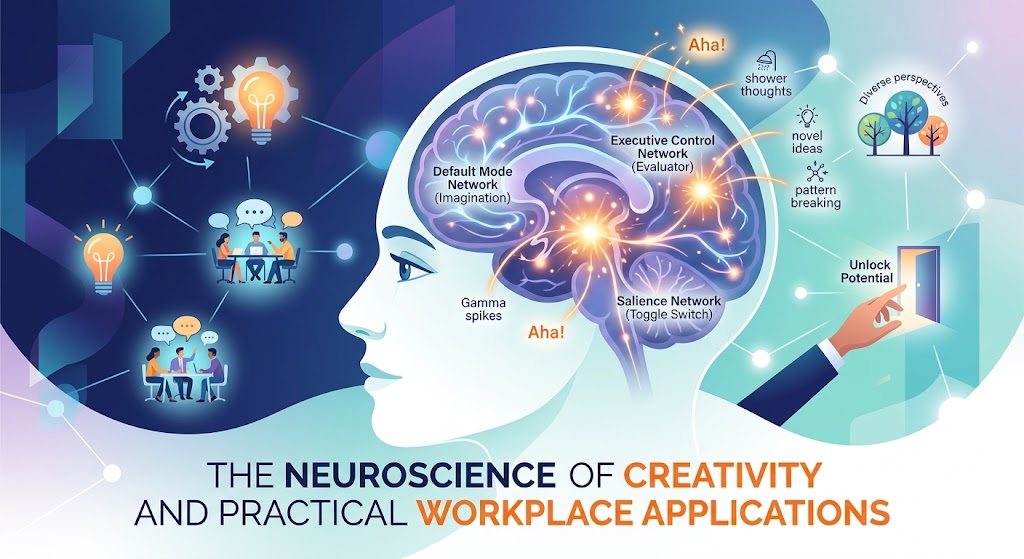
The neuroscience of creativity is the study of the brain processes, neural networks, and biological mechanisms that underlie creative thinking and creative behavior. Neuroscience research has identified that creativity emerges not from a single “creative brain region” but from the dynamic interaction of three large-scale brain networks: the Default Mode Network (DMN), which generates novel associations during open, unfocused thinking; the Executive Control Network (ECN), which evaluates and refines ideas through focused analytical thinking; and the Salience Network (SN), which switches attention between the two.
For innovation leaders, the practical implication is significant: creativity is not a fixed trait — it is a neurological process that can be supported or suppressed by the organizational environment. Chronic stress, lack of psychological safety, and always-on work cultures suppress the brain activity most essential for creative cognition. Organizations that protect time for unfocused thinking, build genuine psychological safety, and cultivate intrinsic motivation are not just following management best practices — they are creating the neurological conditions the creative brain needs to function at its best.
The article below translates the most important findings from creativity neuroscience into practical guidance for innovation leaders — connecting what brain science now confirms about how creative thinking actually works to what you can do to build more creative, more innovative organizations.
by Braden Kelley and Art Inteligencia
Creativity is not a personality trait. It is not a gift that some people have and others don’t. It is a neurological process — a specific pattern of brain activity that can be understood, cultivated, and deliberately supported through the right organizational conditions.
For innovation leaders, this distinction is everything. If creativity is a trait, your job is to hire for it and hope. If creativity is a process, your job is to understand that process and design the organizational environment that enables it. The neuroscience of the past two decades has made the second view definitively clear — and the practical implications for how organizations should be structured, how teams should work, and how leaders should lead are profound.
This guide translates the most important findings from creativity neuroscience into practical guidance for innovation leaders — connecting what we now know about how the creative brain works to what you can actually do to build more creative, more innovative organizations.
What Neuroscience Has Revealed About Creativity
For most of the 20th century, creativity was studied through psychological tests and self-report measures. The rise of neuroimaging — fMRI, EEG, and related technologies — has allowed researchers to observe the creative brain in action for the first time, and the findings have overturned several long-held assumptions.
The Three Brain Networks That Drive Creativity
The most important neuroscience finding for innovation leaders is that creativity is not a function of a single brain region or a single type of thinking. It emerges from the dynamic interaction of three large-scale brain networks that work in specific patterns during creative thought. Researchers have confirmed this through analysis of data from 857 patients across 36 fMRI brain imaging studies, mapping a common brain circuit that underlies creative cognition.
The Default Mode Network (DMN) — The network of brain regions active when we are not focused on a specific external task: the posterior cingulate cortex, medial prefrontal cortex, and temporal regions. The DMN was long dismissed as the “resting state” of the brain. We now know it is the engine of imagination, self-reflection, and spontaneous idea generation. It is most active during mind-wandering, daydreaming, and the mental states we typically try to eliminate from the workplace. This is where novel associations are generated — where the brain makes the unexpected connections between seemingly unrelated concepts that are the hallmark of creative insight.
The Executive Control Network (ECN) — The network responsible for focused, goal-directed thought: working memory, attention regulation, and deliberate cognitive control. The ECN is what we use when we concentrate on a specific problem, evaluate options, and make deliberate decisions. Traditional models of creativity treated divergent (generative) and convergent (evaluative) thinking as opposing modes requiring different people. Neuroscience has shown they are sequential phases of a single creative process — both essential, both neurologically distinct.
The Salience Network (SN) — The network that monitors both the external environment and internal mental states, detecting what is important and switching attention between the DMN and ECN as needed. The salience network is the traffic controller of the creative process — determining when to shift from focused analytical thinking to open associative thinking and back again. High-performing creative individuals show stronger functional connectivity in the salience network, suggesting that the ability to fluidly switch between focused and diffuse thinking modes is a key component of creative capacity.
The implication for organizational design is significant: creative cognition requires the brain to move fluidly between open, associative, internally-directed thinking and focused, evaluative, goal-directed thinking. Organizational environments that only support one mode — typically the focused, task-oriented mode — systematically suppress half of the creative process.
The Role of Incubation and Mind Wandering
One of the most counterintuitive and practically important findings from creativity neuroscience is the role of mind wandering and incubation — periods of unfocused, seemingly unproductive mental activity — in the creative process.
When we step away from a problem and allow the mind to wander, the Default Mode Network becomes highly active. During this activity, the brain continues processing the problem below conscious awareness — making novel associations, exploring tangential connections, and reorganizing information in ways that focused attention actively prevents. This is why creative insights so often arrive in the shower, on a walk, or just before sleep — moments when focused attention is relaxed and the DMN can operate freely.
Research published in 2026 by neuroscientists at Northwestern University showed that dreams can be nudged in specific directions and that sleeping on a problem produces measurable creative benefits — confirming that the incubation effect is not metaphorical but neurological. The brain literally continues working on creative problems during unfocused and sleep states in ways that produce insights that focused work alone cannot.
The organizational implication is direct: environments that schedule every minute, eliminate downtime, and treat unfocused thinking as unproductive are neurologically hostile to the creative process. Building space for mind wandering — breaks, walks, protected thinking time, reduced meeting density — is not a wellness initiative. It is a creativity infrastructure investment.
The Neuroscience of Psychological Safety and Creativity
The amygdala — the brain’s primary threat detection system — plays a critical role in creativity, and not in a productive way. When people perceive social threat — the risk of judgment, rejection, or humiliation for expressing an unconventional idea — the amygdala activates a threat response that directly suppresses activity in the prefrontal cortex, the region most associated with creative and executive function.
This is the neurological mechanism underlying the organizational psychology finding that psychological safety is the strongest predictor of team innovation and creative performance. It is not merely that people choose not to share ideas when they feel unsafe — their brains are literally operating in a state that makes creative cognition more difficult. The threat response that social judgment activates is the same response that would help them escape a physical predator, and it produces the same result: narrowed attention, reduced cognitive flexibility, and suppressed associative thinking.
Creating psychological safety is therefore not just a management practice — it is a neurological prerequisite for the creative brain to function at its full capacity.
Stress, Cortisol, and Creative Performance
Cortisol — the primary stress hormone — has a well-documented inverted-U relationship with cognitive performance. Moderate arousal and mild stress can enhance focus and performance on routine tasks. But high and chronic stress significantly impairs the prefrontal cortex function and DMN activity that creative cognition depends on.
The implications for innovation management are significant: the high-pressure, deadline-driven, always-on work environments that many organizations treat as signals of productivity and commitment are neurologically incompatible with sustained creative performance. Organizations that create chronic stress through unrealistic deadlines, unpredictable workloads, and cultures of constant urgency are paying a creativity tax that never appears on the balance sheet but consistently limits their innovation capacity.
Dopamine and the Reward System in Creativity
The neurotransmitter dopamine plays a central role in creativity through two distinct pathways. The mesolimbic pathway is associated with reward, motivation, and the pleasurable sensation of discovery — the feeling of insight and the intrinsic motivation to explore and create. The mesocortical pathway modulates prefrontal cortex function, influencing cognitive flexibility, working memory, and the ability to make novel associations.
Dopamine is released in response to novelty, unexpected rewards, and the anticipation of reward. This means that environments rich in novelty, intellectual stimulation, and the intrinsic rewards of interesting, challenging work activate the dopaminergic systems that support creative cognition. Environments that are routine, predictable, and driven by extrinsic motivation — compliance, fear of failure, external rewards — provide significantly less dopaminergic fuel for creative thinking.
The practical implication: intrinsic motivation is not just a management preference — it is a neurochemical condition for optimal creative performance. Innovation cultures that rely primarily on extrinsic motivators are working against the brain’s creativity chemistry.
What This Means for Innovation Leaders: Seven Organizational Design Principles
The neuroscience of creativity is not merely academically interesting — it has specific, actionable implications for how innovation leaders should design their organizations, manage their teams, and structure their own creative practice.
1. Design for Cognitive Mode Switching, Not Just Focus
The creative process requires fluid movement between focused, analytical thinking (ECN-dominant) and open, associative thinking (DMN-dominant). Most organizations design exclusively for focused work — open-plan offices, back-to-back meeting schedules, and real-time communication tools that create constant interruption. This design systematically suppresses the DMN activity that generates novel associations and creative insight.
Designing for creativity means creating conditions for both modes: protected time for focused analytical work, and protected time for open, unfocused exploration. This includes building transitions between modes — walks, breaks, sleep — that allow the incubation process to operate. The most creative organizations are not those with the most focused workers; they are those that have learned to alternate between depth of focus and freedom of exploration in productive rhythms.
2. Build Psychological Safety as Infrastructure, Not Culture
Because psychological safety is a neurological prerequisite for creative cognition — not just a cultural nice-to-have — it needs to be treated as infrastructure rather than aspiration. This means designing specific practices that make it structurally safe to share unconventional ideas: anonymous ideation, dedicated devil’s advocate roles, explicit norms against judgment during generative phases, and leadership behaviors that visibly model intellectual risk-taking and curiosity rather than certainty and competence performance.
3. Reduce Chronic Stress Deliberately
Managing organizational stress is a creativity imperative, not just a wellbeing initiative. This means auditing the sources of chronic, creativity-suppressing stress in the work environment: unrealistic deadlines, unpredictable workloads, ambiguous expectations, and cultures of constant urgency. It means making structural changes — not just wellness programs — that reduce the cortisol load on creative workers. The organizations that protect creative time from deadline pressure, that build slack into innovation timelines, and that resist the temptation to fill every available hour with urgent tasks are the ones whose creative workers can actually do their best thinking.
4. Cultivate Intrinsic Motivation
Because dopamine — the neurochemical fuel for creative cognition — is released in response to novelty, intellectual stimulation, and the intrinsic rewards of interesting work, organizational design for creativity must prioritize intrinsic motivation. This means connecting innovation work to meaningful purposes that people care about; giving creative workers genuine autonomy over how they approach problems; ensuring that creative challenges are genuinely challenging — neither too routine nor too overwhelming; and reducing the dominance of extrinsic motivators like performance scores and financial incentives that activate compliance behavior rather than creative exploration.
5. Protect and Leverage Incubation
Building incubation into innovation processes is one of the highest-leverage and most underused tools available to innovation leaders. Structured incubation means deliberately scheduling breaks from active problem-solving — walks, overnight reflection, weekend distance from a stuck problem — and treating this time not as wasted but as a necessary phase of the creative process. Organizations that never leave space for the brain to process problems below conscious awareness are systematically excluding the most powerful part of their creative capacity from their innovation work.
6. Design for Cognitive Diversity
Research confirms that neurodivergent employees — those with ADHD, autism spectrum conditions, dyslexia, and other neurological variations — often show distinctive creative capacities precisely because of how their brains process information differently. Research published in October 2025 revealed that ADHD’s hallmark mind wandering might actually boost creativity — people who deliberately let their thoughts drift scored higher on creative tests. Separately, a study found that neurodivergent employees make up nearly half of the creative industry’s workforce and bring valuable skills that fuel creativity, yet face increasing challenges that hinder their performance at work.
Organizations that design for neurotypical processing norms — open-plan offices that prevent deep focus, meeting cultures that favor verbal quick-thinking over reflective processing, and evaluation systems that favor extroversion — are systematically excluding significant creative capacity. Designing for cognitive diversity means accommodating different processing styles, providing options for different working environments, and evaluating creative contribution on the quality of ideas rather than the confidence with which they are expressed.
7. Use Environmental Design as a Creativity Tool
The physical and social environment directly affects the neurological conditions for creative work. Moderate ambient noise (approximately 70 decibels — the level of a coffee shop) has been shown to enhance creative performance compared to both silence and loud noise, by providing sufficient stimulation to activate associative thinking without overwhelming focused attention. Natural light, exposure to nature, and varied spatial environments have been shown to reduce stress hormone levels and support the cognitive flexibility that creativity requires. Temperature, air quality, and even ceiling height measurably affect creative performance through their effects on physiological arousal and cognitive state.
These are not soft factors — they are neurological inputs that directly affect creative output. Organizations that treat physical environment as a real estate optimization problem rather than a creativity infrastructure investment are leaving measurable performance on the table.
The Neuroscience of Team Creativity
Individual creativity is necessary but insufficient for organizational innovation. What happens when creative individuals work in teams — and how does neuroscience inform team design for collective creativity?
The most important finding for team creativity is that the same psychological safety dynamics that operate at the individual level operate at the team level — but are amplified by group dynamics. A single high-status team member who reacts negatively to unconventional ideas can suppress creative contribution from the entire team by triggering amygdala threat responses in others. The neurological contagion of threat states is real: negative emotional signals are processed rapidly and automatically in ways that shift entire groups from exploratory to defensive cognitive modes.
The inverse is also true. Teams with strong psychological safety, clear shared purpose, and a culture of building on each other’s ideas rather than evaluating them create conditions where individual DMN activity and associative thinking are reinforced rather than suppressed by social context. This is the neurological basis of effective brainstorming and collaborative ideation — not as a technique but as an environmental condition that enables individual brains to do their most creative work in a shared context.
Research on team size consistently shows that smaller teams — two to five people — produce more creative solutions than larger groups for most innovation challenges. This is at least partly neurological: larger groups activate more complex social monitoring demands that consume cognitive resources needed for creative thinking, while smaller groups can develop the trust and familiarity that reduces threat-state activation and enables more free-ranging creative exploration.
Applying Neuroscience to Your Innovation Practice
The practical application of creativity neuroscience for innovation leaders is not about turning your organization into a neuroscience research lab. It is about making better organizational design decisions by understanding the biological mechanisms underlying creative performance.
Start with an honest audit of your current environment against the neuroscience principles above: Does your organization design for cognitive mode switching or only for focused work? Are your innovation teams operating in conditions of psychological safety or threat? Is chronic stress systematically suppressing creative capacity? Are your motivation structures activating intrinsic or extrinsic drivers? Is physical environment designed for creative performance or just operational efficiency?
The gap between where most organizations are on these dimensions and where the neuroscience suggests they should be is typically significant — and closing it does not require large capital investment. The most powerful creativity infrastructure changes are often structural and cultural: protecting thinking time, reducing meeting density, building psychological safety practices, and designing team environments that support rather than suppress the neurological conditions for creative work.
Frequently Asked Questions: Neuroscience of Creativity
What does neuroscience tell us about creativity?
Neuroscience has shown that creativity emerges from the dynamic interaction of three large-scale brain networks: the Default Mode Network (which generates novel associations during mind wandering and open thinking), the Executive Control Network (which evaluates and refines ideas through focused analytical thinking), and the Salience Network (which switches attention between the other two networks). Creative cognition requires fluid movement between these networks — which means that organizational environments designed only for focused, task-oriented work are systematically suppressing half of the creative process. Psychological safety, low chronic stress, intrinsic motivation, and protected time for unfocused thinking are all neurologically important conditions for creative performance.
What part of the brain is responsible for creativity?
Creativity is not localized to a single brain region — it emerges from the interaction of three large-scale networks. The Default Mode Network (including the medial prefrontal cortex, posterior cingulate cortex, and temporal regions) is active during open, associative thinking and generates novel connections. The Executive Control Network (including the dorsolateral prefrontal cortex and anterior cingulate cortex) supports focused evaluation and refinement. The Salience Network (including the anterior insula and dorsal anterior cingulate cortex) regulates switching between the other two networks. Research analyzing 857 patients across 36 fMRI studies has confirmed a common brain circuit for creativity that spans all three networks.
Can creativity be developed or is it innate?
Neuroscience is unambiguous: creativity is a process, not a fixed trait. While individuals show variation in creative capacity — influenced by genetics, early environment, and cognitive style — the neurological networks that support creative cognition are plastic and can be strengthened through practice, environmental design, and deliberate cultivation. The most important implication for organizations is that creative capacity is substantially determined by environmental conditions — psychological safety, stress levels, motivation structures, and time for unfocused thinking — that leaders can actively design for. This shifts the innovation leader’s job from identifying creative individuals to creating the organizational conditions that enable creative performance across the team.
Why does psychological safety matter for creativity?
Psychological safety matters for creativity because the threat of social judgment — the risk of being seen as foolish, wrong, or unconventional — activates the amygdala’s threat response, which directly suppresses activity in the prefrontal cortex and Default Mode Network that creative cognition depends on. When people feel unsafe sharing ideas, they are not merely choosing to stay quiet — their brains are literally operating in a neurological state that makes creative thinking harder. Creating psychological safety is therefore a neurological prerequisite for creative performance, not just a cultural preference. Teams with strong psychological safety show measurably better creative output because their members’ brains can operate in the open, associative mode that generates novel ideas.
How does stress affect creativity?
Chronic stress significantly impairs creative performance through its effect on cortisol — the primary stress hormone. While moderate arousal can enhance performance on routine, analytical tasks, high and sustained cortisol levels impair prefrontal cortex function and Default Mode Network activity — the two neurological systems most critical for creative cognition. Organizations that create chronic stress through unrealistic deadlines, unpredictable workloads, and cultures of constant urgency are paying a significant creativity tax. Managing organizational stress is not just a wellbeing initiative — it is a creativity performance imperative with measurable effects on innovation output.
What is the role of the Default Mode Network in creativity?
The Default Mode Network (DMN) is the set of brain regions — including the medial prefrontal cortex, posterior cingulate cortex, and temporal regions — that become active when we are not focused on a specific external task. Once dismissed as the brain’s “resting state,” the DMN is now understood as the engine of imagination, spontaneous idea generation, and the associative thinking that connects seemingly unrelated concepts. It is most active during mind wandering, daydreaming, and incubation — the mental states most organizations try to eliminate. Protecting time for DMN activity through breaks, walks, and reduced meeting density is one of the highest-leverage and most underused creativity investments available to innovation leaders.
Want to build an organization where the conditions for creative performance are systematically designed in rather than accidentally present? Explore the Human-Centered Change methodology — a practical framework for building the organizational conditions that enable innovation at scale.
Content Authenticity Statement: The topic area, key elements to focus on, etc. were decisions made by Braden Kelley, with a little help from Claude and Google Gemini to clean up the article, add images and create infographics.
Image credits: Google Gemini
 Sign up here to get Human-Centered Change & Innovation Weekly delivered to your inbox every week.