The Collaborative Canvas
GUEST POST from Chateau G Pato
I. Introduction: The Global Alignment Crisis
In the modern corporate landscape, organizations do not suffer from a scarcity of brilliant ideas or a lack of global talent. Instead, they suffer from a crippling friction of alignment. As teams have become increasingly distributed across continents, cultures, and time zones, our methods for connecting them have fundamentally failed to keep pace. We have swapped physical proximity for digital proximity, but in the process, we have lost the contextual fabric that makes human collaboration work.
Today’s remote and global collaboration is plagued by a pervasive “digital fatigue.” Teams find themselves drowning in a sea of fragmented tools—endless email threads, disjointed chat channels, static slide decks, and disconnected spreadsheets. Information is scattered, and worse, context is stripped away. When communication becomes purely transactional and linear, the big picture disappears. People begin working in isolation, optimizing for their local tasks while losing sight of the broader organizational objective.
This is not just an operational challenge; it is a profoundly human one. True innovation and successful organizational transformation require psychological safety and a deeply shared understanding. Both of these cultural pillars suffer when teams lack a physical or contextual “room” to gather in. When people cannot see how their work connects to the whole, engagement drops, miscommunication spikes, and resistance to change hardens. We cannot expect cross-functional, global teams to execute a unified strategy when they are viewing that strategy through fifty different lenses.
To overcome this divide, we must intentionally shift global organizations away from passive communication—where information is simply pushed at people—and toward active, visual co-creation. We need to provide a digital environment that replicates the collaborative energy of a shared physical space.
This is where the concept of the Collaborative Canvas becomes essential. Visual frameworks possess a unique ability to transform abstract, isolated ideas into a unified, spatial reality. By moving strategy out of dense text documents and onto an open, structured visual plain, we create an immediate cognitive bridge across geographic distances. Utilizing structured, human-centered methodologies—such as those introduced in my book, Charting Change, and expanded upon in the upcoming Human-Centered Innovation Toolkit™ — organizations can transcend the limitations of traditional remote work. We can finally turn a fragmented, distributed workforce into a highly synchronized, collaborative unit capable of moving at speed.
II. The Psychology of the Visual Canvas
To understand why visual frameworks are so effective at aligning global teams, we have to look beneath the surface of the software and examine the cognitive mechanics of how humans process information. Traditional business communication relies heavily on text and linear presentations. We write dense, multi-page business cases or flip through thirty-slide decks. The human brain, however, did not evolve to understand complex, interconnected systems through a sequential stream of words. When we force distributed teams to collaborate purely through text, we introduce massive cognitive friction.
Visual frameworks fundamentally alter this dynamic by enabling cognitive load reduction. Text-heavy documents force the brain to process information serially—one word, one sentence, one bullet point at a time. This requires significant working memory to hold previous context while trying to synthesize new data. In contrast, a visual canvas allows for simultaneous, parallel processing. The brain can absorb spatial relationships, color-coded groupings, and structural hierarchies all at once. By mapping out a strategy or a process visually, we help people instantly spot patterns, identify hidden gaps, and see systemic connections that would remain buried in a standard text document. We effectively offload cognitive strain from the individual’s working memory onto the shared workspace.
Beyond the cognitive benefits, a visual canvas serves as a powerful cultural equalizer by leveling the playing field for international collaboration. In global teams, traditional meetings are often dominated by specific dynamics: native fluency in the corporate language, timezone privilege, or simply the loudest, most extroverted voices in the room. Brilliant ideas from quieter teammates or those navigating a language barrier are frequently lost. A visual canvas democratizes participation. When collaboration is anchored around dropping a digital sticky note, voting with a click, or mapping a user journey, the barrier to entry drops significantly. Everyone has equal real estate on the canvas. Ideas can be contributed asynchronously or simultaneously without the need to fight for airtime, allowing the best insights to surface based on merit rather than volume.
Finally, visual frameworks solve one of the greatest challenges of remote work: the lack of a shared environmental context. In a physical office, teams utilize whiteboards and war rooms to anchor their thoughts. When everyone goes remote, that shared physical anchor vanishes. A digital canvas recreates this by establishing a structured “shared workspace” that leverages human spatial memory. Our brains are hardwired to remember where things are located in space. When a global team establishes that “our core customer friction lives in the bottom-left corner” or “our primary experiment metrics are tracked in the top-right quadrant,” it builds a collective mental model. Long after a live workshop ends, team members across Seattle, London, and Tokyo retain a synchronized mental map of the project. The canvas becomes a persistent, living anchor point that transcends geographic distance, ensuring everyone is always looking at the exact same big picture.
III. The Architecture of Alignment: Key Frameworks for Global Co-Creation
Moving global alignment from a theoretical ideal to an operational reality requires more than just an open digital whiteboard; it requires structure. An empty digital canvas can be just as intimidating and paralyzing as a blank sheet of paper. To truly unlock the power of visual collaboration across distributed teams, organizations must deploy purposeful, structured frameworks. These frameworks act as the architecture of alignment, providing the guardrails and common language that cross-functional, global teams need to co-create effectively.
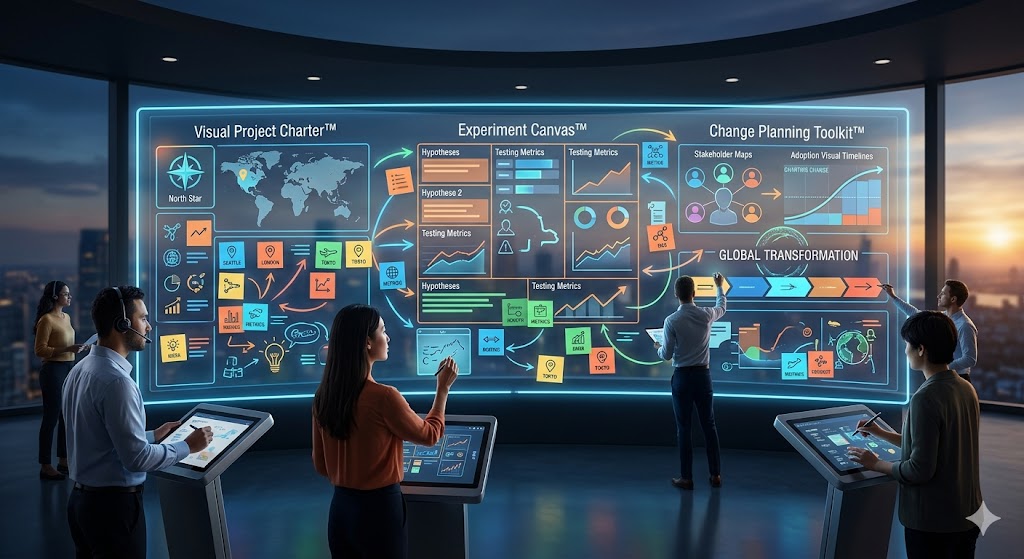
The first step in any global initiative is establishing a unified North Star, and this is where the Visual Project Charter™ becomes invaluable. Traditional project charters are notoriously dense, text-heavy documents filled with legalese and corporate jargon that stakeholders skim but rarely internalize. By collapsing these boundaries into a single-page visual framework, the Visual Project Charter™ forces absolute clarity. Global stakeholders—regardless of their department or native language—can look at a single visual space and immediately align on project scope, strategic goals, roles, and boundaries. It eliminates the dangerous assumptions that often breed in the margins of long text documents, ensuring that every team member kicks off the journey with the exact same destination in mind.
As a project transitions from a static definition into a dynamic, living initiative, managing the human element of transformation becomes the primary challenge. This is the core focus of the Change Planning Toolkit™, a methodology I introduced in my book, Charting Change. When a transformation impacts thousands of employees across multiple global regions, you cannot manage change from a siloed spreadsheet. The visual, collaborative tools within the Change Planning Toolkit™ provide a shared canvas where cross-functional global teams can collectively map out the entire change journey. From identifying stakeholders and cultural friction points to planning communications and tracking adoption, these canvases ensure that change is planned with people, not forced upon them. It transforms change management from a top-down mandate into a highly collaborative, visual, and empathetic process.
Of course, true innovation requires experimentation, which brings inherent risk. In a distributed environment, keeping track of what we are testing, what we are learning, and what we are discarding can quickly descend into chaos. The Experiment Canvas™ solves this by offering an asynchronous visual anchor for validation. Instead of getting bogged down in endless status alignment meetings or waiting for a weekly synchronized call across incompatible time zones, distributed teams can use the Experiment Canvas™ to design, track, and evaluate business experiments in real time. Team members in Seattle can design an experiment layout, colleagues in Europe can execute the test, and a team in Asia can analyze the metrics—all within the same visual framework. It creates a continuous, transparent loop of hypothesis testing and learning that accelerates velocity while drastically reducing organizational risk.
Looking ahead, the need for a unified visual vocabulary will only intensify as business ecosystems grow more complex. This is why I am currently developing the upcoming Human-Centered Innovation Toolkit™. This next-generation toolkit expands our visual framework library, intentionally bridging the gap between deep empathy, experience design, and continuous innovation pipeline management. It will provide global organizations with the visual scaffolding necessary to embed human-centered design principles directly into their scalable innovation workflows. By anchoring global collaboration in these proven and evolving visual architectures, organizations can finally stop talking about alignment and start executing it at scale.
IV. Overcoming the Remote & Asynchronous Divide
The realities of modern global business mean that “same time, same place” collaboration is a luxury of the past. Distributed organizations are structurally fractured by competing time zones, geographic distances, and cultural communication variances. To build true organizational agility, leaders must stop fighting these constraints and instead design workflows that turn distance into an advantage. Visual frameworks serve as the ultimate bridge across this divide, optimizing both the hours teams spend together and the hours they spend working apart.
When global teams do manage to overlap in real time, that synchronous window is incredibly precious. Far too often, organizations squander these rare moments on status updates or passive slide presentations where one person speaks and dozens tune out. We must replace this passive consumption with synchronous magic. By anchoring live workshops around a structured digital canvas on platforms like Mural or Miro, the entire dynamic shifts from “talking at” people to “doing with” people. Instead of watching slides, a cross-functional team immediately rolls up their sleeves to co-create. Because the framework provides explicit boundaries and prompts, it maximizes participation and condenses hours of debate into minutes of highly focused, visual decision-making.
However, live collaboration is only half of the equation. The true power of a collaborative canvas lies in its ability to enable asynchronous continuity. A visual framework is not a temporary workshop artifact; it is a persistent, living ecosystem. It allows global teams to seamlessly pass the baton across time zones without losing contextual momentum. For instance, a product team in Seattle can map out a series of hypotheses on an Experiment Canvas™ before they log off for the evening. When the European team logs on a few hours later, they don’t need a summary email or a recorded sync call; they can visually trace the logic, view the sticky notes, and immediately begin executing the tests. By the time Asia-Pacific teams start their day, they can update the results directly within the same framework. This visual trail of progress eliminates the need for midnight status alignment calls, turning a multi-timezone structure into a 24-hour innovation engine.
Beyond the logistics of time, visual collaboration eleganty navigates the delicate landscape of cultural nuance. Different global regions possess deeply ingrained communication styles, ranging from high-context, indirect feedback cultures to low-context, intensely direct ones. In standard verbal meetings, these differences can inadvertently create political friction, misunderstandings, or psychological discomfort. A visual canvas acts as an objective, neutralizing canvas. It shifts the focus from conversational politics and hierarchy to the structural placement of ideas. When feedback is structured visually—such as placing a risk sticky note into a designated “Obstacles” box on a canvas from the Change Planning Toolkit™—it depersonalizes the critique. The framework allows diverse global minds to collaborate intensely on the problem itself, ensuring that cultural friction is minimized and creative friction is maximized.
V. Best Practices for Facilitating on a Digital Canvas
Transitioning from traditional, text-heavy business operations to a visual-first collaborative culture requires more than just distributing access to digital whiteboard software. It requires a fundamental shift in how we facilitate human interaction. An unguided group on a digital canvas can quickly descend into visual noise, while a poorly structured environment will stifle the exact organic creativity it was meant to unleash. To unlock the true potential of these toolkits across global teams, facilitators must master three core practices.
The first critical balance to strike is between structure and freedom. An empty canvas triggers the digital equivalent of writer’s block, leaving teams paralyzed by the infinite possibilities of a blank space. Conversely, a framework that is too rigid leaves no room for unexpected insights or serendipitous connections. The visual frameworks within the Change Planning Toolkit™ and the upcoming Human-Centered Innovation Toolkit™ are intentionally designed to solve this paradox. They provide rigid structural constraints—such as predefined boxes, flows, and categories—to establish focus and prevent cognitive overwhelm. Yet, within those bounded boxes, teams possess absolute freedom to express ideas, challenge assumptions, and sketch possibilities. The architecture guides the thinking process without dictating the outcome.
This structural balance alters the role of the facilitator. In a traditional meeting, the leader or facilitator often acts as a presenter, lecturer, or scribe, controlling the flow of conversation from the front of the room. On a collaborative canvas, the facilitator must transition into a visual “space-maker.” Your job is no longer to deliver content, but to manage collective attention, energy, and psychological safety. This is achieved by utilizing the tactical toolsets of modern digital whiteboards—leveraging features like anonymous voting to eliminate hierarchy, deploying built-in timers to maintain momentum, and using laser pointers or “summon” features to guide distributed eyeballs to the same quadrant of a Visual Project Charter™. The facilitator acts as a conductor, orchestrating the global team’s interactions with the canvas itself.
Finally, a collaborative canvas must be treated as a dynamic journey rather than a static destination, requiring a commitment to documenting the evolution of the work. Too often, teams treat a workshop canvas as a throwaway artifact—a digital whiteboard to be wiped clean or ignored once the meeting concludes. In contrast, tools like the Experiment Canvas™ are explicitly built to capture historical context over time. Facilitators must ensure that the canvas serves as a living, breathing record of the team’s co-creation journey. By preserving early iterations, archival sticky notes, and historical voting rounds, global team members who join a project late can visually trace the decision-making history of the initiative. The canvas becomes the single source of truth, documenting not just what the strategy is today, but exactly how and why the global team evolved it to get here.
VI. Conclusion: The Canvas as a Cultural Catalyst
Ultimately, visual frameworks are far more than a collection of operational templates or tactical productivity tools—they are profound cultural enablers. They provide global organizations with something that standard corporate communication completely lacks: a visual, human-centered baseline for empathy, clarity, and shared purpose. By anchoring distributed teams around a unified spatial layout, we dismantle the invisible silos that geographic distance naturally creates, replacing fragmented isolation with a vibrant culture of open, continuous co-creation.
Throughout this exploration, we have seen how these methodologies fundamentally change the anatomy of global work. From the initial strategic alignment forged by a Visual Project Charter™, through the deep behavioral synchronization driven by the Change Planning Toolkit™ and the principles in Charting Change, to the agile, decentralized validation cycles enabled by the Experiment Canvas™, the impact is undeniable. As we look toward the future with the upcoming Human-Centered Innovation Toolkit™, the organizations that thrive will be those that actively cultivate a unified visual vocabulary. They will treat collaboration not as a series of disparate operational handoffs, but as a continuous, human-centered journey.
The imperative for leadership is clear. It is time to challenge the outdated status quo of the legacy workplace. I invite you to ditch the next fifty-page text brief, cancel the passive status alignment meeting, and retire the standard bulleted slide deck. Instead, hand your global teams a digital marker, step back, and invite them to co-create, align, and innovate on a collaborative canvas. The future of global transformation is visual—and the canvas is yours to design.
Frequently Asked Questions
What is a Collaborative Canvas, and how does it differ from a standard digital whiteboard?
A standard digital whiteboard provides an open, blank space for sketching or writing, which can often lead to visual chaos or participation paralysis for distributed teams. A Collaborative Canvas applies intentional structure and human-centered frameworks (like the Visual Project Charter™ or Experiment Canvas™) to that space. It provides specific guardrails and a shared visual language that guides focus, reduces cognitive load, and enables meaningful asynchronous and synchronous co-creation across global teams.
How do visual frameworks help overcome language and cultural barriers in global teams?
Traditional text-heavy and verbal meetings often favor native language speakers or dominant corporate cultures. Visual frameworks level the playing field by shifting the focus from conversational politics to the objective, spatial placement of ideas. Contributing via digital sticky notes, matrix sorting, and visual voting allows every team member to participate equally and simultaneously, depersonalizing critiques and minimizing cultural communication friction.
Can these visual tools be used effectively when teams cannot collaborate at the same time?
Yes. While visual frameworks create high-engagement live workshops, they are designed as persistent, living environments for asynchronous continuity. Because canvases from methodologies like the Change Planning Toolkit™ leave a clear, spatial trail of progress and context, global teams can seamlessly “pass the baton” across time zones. A team in Seattle can map out an initiative, and a team in Europe or Asia can instantly understand the context and pick up exactly where they left off without needing a midnight alignment call.
Image credit: Gemini
 Sign up here to get Human-Centered Change & Innovation Weekly delivered to your inbox every week.