GUEST POST from Chateau G Pato
The Illusion of Connectedness
We are currently living through a profound modern paradox. Organizations have deployed more collaboration tools, video platforms, and asynchronous communication channels than at any other point in human history. Yet, despite this hyper-connectivity, digital workforce burnout, isolation, and disengagement have reached all-time highs. The mistake many leaders make is assuming that a well-stocked technology stack automatically equates to a connected culture.
The Misconception of Digital Transformation
True digital transformation fails when it is treated merely as an IT project. When organizations optimize strictly for technical implementation — focusing on software deployment, cloud migration, and uptime metrics — they completely miss the human experience happening on the other side of the glass. Technology is simply the conduit; the actual workplace is a complex web of human emotions, cognitive loads, and social dynamics. To build a digital workplace that actually works, we must shift our focus from rigid implementation to intentional design.
The Paradigm Shift: Engagement Design
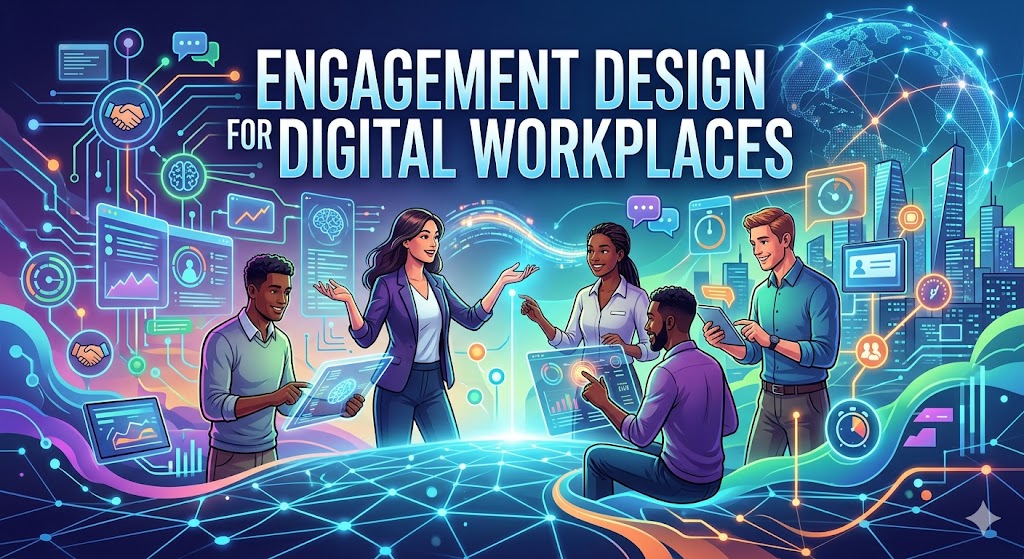
To survive and thrive in an accelerating digital economy, organizations must move past traditional, top-down change management. We need to embrace Human-Centered Change and the practice of Engagement Design. This means consciously constructing digital ecosystems around empathy, organizational agility, and the human side of work. We must design digital workspaces where employees do not just log in to survive a series of fragmented notifications, but plug in to actively collaborate, create value, and thrive.
The Core Pillars of Human-Centered Engagement Design
To design an engaging digital workplace, we must fundamentally shift our perspective. We are no longer managing physical real estate; we are architecting cognitive environments. Every piece of software, every communication protocol, and every digital workflow must be intentionally designed for the human being sitting on the other side of the screen. Human-centered engagement design rests on three non-negotiable pillars.
1. Empathy-First Architecture
Organizations routinely map out external customer journeys, yet they rarely apply the same rigor to their own workforce. Empathy-first architecture requires us to actively map the “Day in the Life” of our digital workers. By analyzing the employee journey, we can identify and eliminate the immense cognitive friction, context-switching penalties, and tool fatigue that plague the modern professional. Design must prioritize focus over fragmentation, creating digital workspaces that respect human cognitive limits rather than exhausting them.
2. Equity and Meritorious Fairness
A significant risk of the distributed or hybrid digital workplace is proximity bias — the tendency for leaders to favor those they see more often. True engagement design counters this by baking equity and meritorious fairness into the organizational fabric. Fairness does not mean equal outcomes regardless of effort; it means creating equitable structures where every individual has the clear visibility, modern resources, and objective paths needed to achieve outcomes based on their contributions. Digital spaces must be intentionally designed to democratize recognition, ensuring that impactful work speaks louder than physical presence or digital loudness.
3. Psychological Safety in Digital Spaces
Innovation and engagement cannot exist in an environment of fear or hyper-surveillance. In a digital workplace, psychological safety must be actively engineered into our communication norms. This means fostering cultural and platform dynamics where workers feel entirely safe to experiment, share half-baked ideas, collaborate transparently, and voice constructive dissent asynchronously without fear of reprisal or misinterpretation. When people feel safe behind the screen, they shift from passive compliance to active, creative contribution.
Overcoming the Pitfalls of the Digital Workplace
Building a successful digital workplace requires more than just deploying the right tools; it demands an active awareness of the systemic traps that digital environments naturally create. If left un-managed, these pitfalls erode company culture, stifle creativity, and push talent into passive disengagement. To design an effective workplace, we must consciously identify and dismantle three primary barriers.
1. The Fragmentation of Focus and the Creative Contraction
The modern digital professional is under constant assault from a barrage of pings, push notifications, and multi-channel alerts. This persistent interruption fragments attention, making it nearly impossible to sustain the deep, uninterrupted focus blocks required for complex problem-solving. When an entire workforce is forced into a state of continuous, reactive context-switching, a dangerous organizational phenomenon occurs: a severe contraction of creative, forward-looking thought. Engagement design requires us to establishing strict guardrails around focus time, treating an employee’s undivided attention as the organization’s most valuable, finite asset.
2. Moving Beyond “The Conscript”
In Braden Kelley’s Nine Innovation Roles framework, we observe what happens when people are forced into organizational functions that do not align with their strengths or passions. In many digital transformations, employees are treated as The Conscript — forced to adopt rigid new platforms, mandated workflows, and invasive tracking tools without clear context or personal upside. This approach breeds resentment and malicious compliance. Human-centered design shifts this dynamic by creating digital experiences that naturally invite people to step into their power as The Magic Maker. We must design tools and workflows that inspire voluntary adoption through obvious value, utility, and creative freedom.
3. The Trap of Equal vs. Equitable Experience
A common mistake in remote and hybrid management is conflating equality with equity. Handing every employee the identical corporate laptop and standard software bundle represents equality — it treats a highly diverse workforce as a monolith. However, a truly engaging workplace prioritizes equity. This means designing customizable digital experiences and asynchronous workflows that actively accommodate differing cognitive styles, unique geographic realities, varying domestic situations, and distinct operational needs. True fairness recognizes that different individuals require different digital support structures to achieve maximum impact and maintain their well-being.
Designing the Digital Employee Experience (EX) Lifecycle
A truly human-centered digital workplace cannot be built on ad-hoc solutions or isolated software patches. It requires a holistic, systemic approach that deliberately maps and designs every digital touchpoint an individual encounters throughout their tenure. From the very first day of virtual onboarding to the moment an employee transitions into an alumnus, the digital employee experience (EX) must be treated as a continuous, living journey.
1. The Digital Onboarding Journey
Traditional onboarding in a digital or hybrid environment often degenerates into an exhausting, bureaucratic compliance exercise — a barrage of automated password setups, legal forms, and dry training videos. To build early engagement, we must redesign this phase into an immersive, culture-rich digital welcome. The onboarding journey should be intentionally structured to introduce the organization’s core values, connect the newcomer with cross-functional peers, and clearly map out their personal ecosystem of support. The goal is to build immediate connection and psychological comfort before they dive into their day-to-day deliverables.
2. Asynchronous Collaboration as a Culture
True operational agility in a distributed workplace requires a fundamental shift in how we view time. Treating real-time, synchronous video meetings as the default method of communication is a recipe for fatigue and calendar gridlock. Instead, engagement design treats synchronous meetings as a scarce, premium resource reserved for complex brainstorming, relationship building, or high-stakes alignment. For daily operations, we must design a robust asynchronous culture. This involves establishing clear norms for documentation, utilizing collaborative digital whiteboards, and setting explicit expectations around response times so that workers across various time zones can collaborate deeply without sacrificing their focus blocks.
3. The Digital Watercooler
One of the greatest losses in the shift away from centralized physical offices is the death of serendipity — the casual, unstructured encounters in hallways or breakrooms that historically sparked organic, cross-departmental innovation. In a digital ecosystem, these moments will not happen by accident; they must be engineered. Designing the “digital watercooler” means creating dedicated, low-stakes virtual spaces and structural prompts that encourage spontaneous socialization, shared interest groups, and informal knowledge sharing. By intentionally fostering these casual networks, we maintain the social fabric and cultural glue that keeps a distributed workforce feeling like a unified community.
Unleashing Innovation in a Distributed Ecosystem
A beautifully designed digital workplace does more than just sustain daily operations — it serves as a catalyst for continuous improvement and forward-looking growth. When an organization transitions away from centralized physical infrastructure, it gains a unique opportunity to completely reinvent how ideas are captured, nurtured, and scaled. Unleashing collective intelligence requires us to deliberately design platforms and processes that turn geographic distribution into a competitive advantage.
1. Democratizing the Flow of Ideas
In traditional, co-located office environments, the best ideas frequently belong to the loudest voices in the conference room or those with the closest physical proximity to senior leadership. A digital workplace allows us to fundamentally shatter these invisible barriers. By utilizing transparent, centralized digital platforms to capture insights, we effectively flatten organizational hierarchies. Ideas can be evaluated based on their intrinsic merit, data, and alignment with strategic goals, rather than the job title or geography of the person who proposed them. This democratization ensures that valuable innovations from frontline workers or quiet creators are never lost in corporate silos.
2. Co-Creation and Structured Crowdsourcing
True human-centered change relies on shifting employees from passive observers to active participants in the company’s evolution. Rather than pushing down top-down mandates, engagement design focuses on building continuous, two-way feedback loops. Organizations should intentionally design structured digital ideation challenges and cross-functional co-creation sprints. By inviting the workforce to collaboratively solve pressing operational bottlenecks, design new customer experiences, or brainstorm future product lines, leaders foster a deep, enduring sense of shared ownership and purpose across the entire distributed ecosystem.
3. Tracking and Auditing Digital Maturity
We cannot optimize what we do not measure, but traditional IT metrics like software login rates or message volume are poor indicators of a healthy culture. High activity often masks severe tool fatigue and impending burnout. To truly understand the state of your distributed ecosystem, organizations must adopt a holistic, diagnostic approach to auditing digital maturity. This means moving beyond vanity metrics to assess deep behavioral indicators: Are teams collaborating effectively across functional silos? Is psychological safety present in asynchronous threads? Are focus blocks being respected? Consistently auditing these human-centered dimensions allows leaders to determine whether their digital workplace is truly mature, or merely hyper-connected.
The Future of Work is a Design Challenge
The digital workplace is not a static destination, nor is it a project with a defined IT completion date. It is a living, breathing ecosystem that requires continuous, intentional cultivation. When organizations fail to treat the digital work environment with the same strategic rigor they apply to external customer experiences, they default to environments of fragmentation, fatigue, and cultural decay. True digital transformation demands that we stop asking human beings to bend to the whims of rigid software, and instead start designing software and workflows around the fundamental needs of human beings.
The Choice Before Us
As we navigate an accelerating economic landscape increasingly shaped by automation, distributed teams, and shifting social contracts, the stakes could not be higher. Organizations have a distinct choice to make. They can continue down the path of hyper-connection — treating employees as digital conscripts managed by surveillance and algorithmic metrics — or they can embrace the principles of human-centered change to build a mature, resilient, and deeply collaborative enterprise.
The Final Thought
If we want our organizations to survive and thrive in the future, we must commit to intentional engagement design. Let us build digital workplaces that actively honor psychological safety, democratize the flow of innovation, and fiercely protect the cognitive focus of our people. The goal is simple yet profound: we must design workspaces where people do not merely log in to survive the day, but plug in to unlock their potential, find deep purpose, and truly thrive.
Frequently Asked Questions
What is Engagement Design for digital workplaces?
Engagement Design is the practice of intentionally structuring digital work environments, communication norms, and workflows around human needs. Rather than focusing strictly on IT software deployment, it prioritizes empathy, psychological safety, and organizational agility to eliminate tool fatigue and foster genuine collaboration.
How does Engagement Design differ from traditional change management?
Traditional change management often focuses on top-down compliance, driving tool adoption, and managing resistance to technical implementations. Engagement Design employs a Human-Centered Change approach, inviting voluntary contribution by actively co-creating workflows with employees, removing friction from their “Day in the Life,” and ensuring meritorious fairness.
What are the indicators of a mature digital workplace versus a hyper-connected one?
A hyper-connected workplace relies on vanity metrics like high message volumes and constant software logins, which often mask employee burnout and deep-work fragmentation. A mature digital workplace measures human-centered dimensions, such as the strength of asynchronous collaboration, the presence of cross-functional psychological safety, and the protection of uninterrupted focus blocks.
Image credit: Gemini
 Sign up here to get Human-Centered Change & Innovation Weekly delivered to your inbox every week.