GUEST POST from Pete Foley
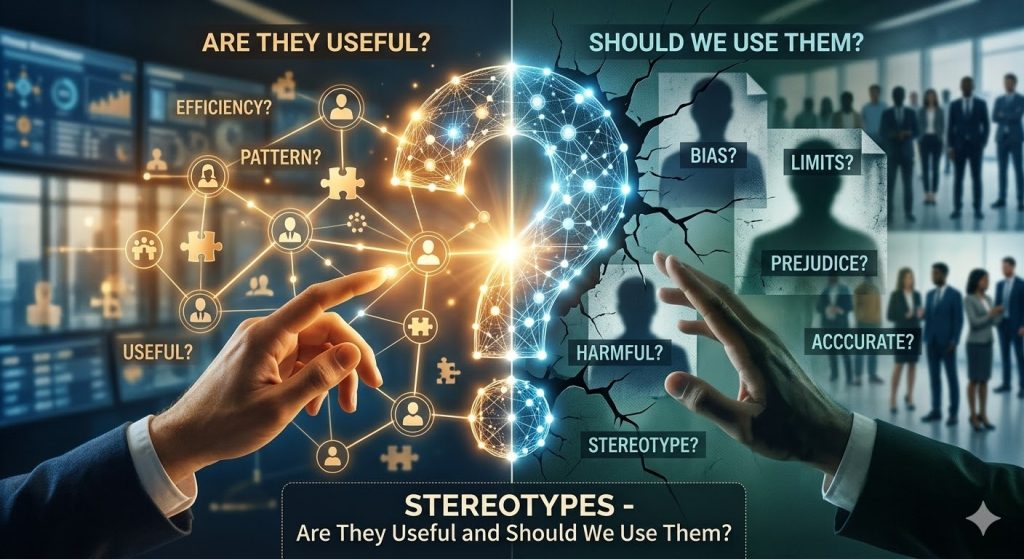
I recently got a call from an ex colleague looking to staff up a technology innovation organization. She was looking for suggestions for potential candidates, and when I asked her for a bit more more information, her first criteria was that she was looking for a ‘Gen Z’. This triggered an interesting conversation around how useful generational and other stereotypes are.
At one level, they are almost invaluable. We use stereotypes, categorization and other grouping strategies all of the time, both consciously and unconsciously. Grouping things together is a pragmatic part of how we as humans deal with large numbers of anything, whether it’s people, tasks, objects or pretty much anything, and are often a key tool in prediction. They are not always accurate or precise, but they are often a first step in how we distill large amounts of data or choices down to more manageable numbers, and/or how we begin to understand something unfamiliar. If a stranger were to point an unfamiliar gun at us at a stop sign, we can quickly determine that they are probably dangerous, likely a criminal, and that the gun is likely deadly. That kind of categorization and stereotyping might be the difference between life and death.
But these grouping strategies can also mislead us, especially if we don’t use them effectively. For example, in the case of generational stereotypes, when dealing with large numbers of people, it can be useful to break them down into generational groups. A targeted marketing campaign may benefit from knowing that people over a certain age are more likely to use different social media platforms than people under 20. Or a physician and patient may benefit from knowing certain age groups are more likely to face certain health issues and need screening for certain diseases. Stereotypes can also address fundamental differences in life experiences between generations. For example, Gen Z grew up immersed in a digital world, whereas earlier generations grew up acquiring digital skills, perhaps changing how we design interfaces for Medicare versus home schooling?.
But the key lies in the phrase ‘large groups of people’. There are times when its really useful and beneficial to make approximations on when dealing with large groups. But as tempting as it can be when having to make a quick judgement, or to quickly filter a large number of people, as in my friends original question, applying them to individuals is often misleading, and risks throwing the baby out with the bathwater.
No matter what grouping strategy we apply, we need to be really careful about applying them at an individual level. And there are of course many different ways to group things, whether it’s categorization, archetypes, stereotypes, sensory cues or many others, depending upon context and goals. I’ve deliberately blurred the lines between these, because in reality, people tap into different ones depending upon goals, contexts, personal experience or personal knowledge. And to a large degree, similar principles apply to all of them. That leads to a couple of concepts, which while pretty obvious, I think are worth sharing or reiterating:
1. Stereotypes can be useful when applied to large groups of people, but judging an individual through that lens is disingenuous in both directions. Take gender as an example. There are distinct, scientifically measured differences between men and women if we look at them at the large group level. These differences can be physical, behavioral or both. Perhaps the least controversial is that ON AVERAGE, men are taller and stronger than women. But importantly there is also massive overlap between genders, and there are many, many individual women who are taller and stronger than individual men. We intuitively get that, and nobody would recruit for a job that requires hard physical labor by ruling out women. But conversely, if we are designing a clothing line, we’d be foolish to ignore those average differences when developing sizing options and inventory. Gender differences are potentially useful when dealing with large numbers, but potentially highly misleading on an individual basis
Similarly, using generational stereotypes to target ‘digital natives’ for a tech job may superficially sound reasonable, as it did to my friend. But it risks ignoring strong candidates who may reside outside of that category. Even if Gen Z as a whole may arguably have a more intuitive understanding of tech, there are many individual Millennials, X’ers and Boomers who are more technically savvy than individual Z’ers. Designing software targeted at large groups of specific age groups may benefit from group categorization, but choosing who to write it on that basis is a lot less effective, if at all.
2. Grouping is how we often manage complex decisions. Faced with more than a few individual choices, pragmatically, we often have to find some way to narrow choice to manageable numbers. For example, in Las Vegas we have 2,500 restaurants. When deciding where to eat, we cannot consider each one individually. We instead use grouping filters like location, cost, cuisine, familiarity or ratings. It’s not perfect, it’s often not a conscious strategy, and we may miss a great restaurant, but it beats the alternative of starving while we cross reference 2500 individual options. Recruitment these days is similar. Most job openings get multiple candidates that we must narrow to manageable numbers. But we need to be careful that we carefully select criteria that benefit us and candidates. Those may vary by context. But especially as we defer screening and decision making to AI and automation, it’s so important that we really understand what those criteria are, and how they benefit our search. I’d argue that generational stereotypes are a particularly ineffective filter in narrowing our choices for many things, especially for recruiting or career management.
3. Not all stereotypes or categories are accurate. Even if they feel intuitively right, they may be neither accurate or predictive. In part this is because they are often based on (superficial) correlation, instead of causation. For example, historically a common stereotype was that women were considered less able at math and science than men. It was true that for a long time men were better represented in these fields. But the stereotype that men were were more skilled was fundamentally inaccurate. We now know there is no gender difference in that innate ability. But a mixture of social factors, and a feedback loop created by a self fulfilling stereotype created an illusion of meaningful difference. Conversely, men were considered less empathic than women. The actual science is far less clear on this, and there may be some small innate gender differences. But if they exist, they are sufficiently small that it’s hard to separate whether this is due to self reporting biases, socialization, or meaningful differences in biology. But certainly the difference is too small to preclude men from careers that require a high level of empathy, a stereotype that existed for quite some time in, for example, fields such as nursing, which were long dominated by women.
Even today, only 13% of registered nurses in the US are male, and only 31% of engineers are women Self fulfilling stereotypes can be particularly hard to see through, let alone break, because they reinforce their own illusion.
But all of this said, some stereotypes can still be useful. Take the stereotype that the Swiss are punctual, organized and ‘on time’. If you are planning on catching a train for an important flight, nearly 95% of trains in Switzerland arrived on time in 2025. In Italy, the number was less than 75%. That of course doesn’t guarantee than the Swiss train will be on time, or the Italian one won’t. But it does make it prudent to add a bit more padding into an Italian travel itinerary, or at least research back up options!
And then there are examples like the tomato. No matter how you pronounce it, the tomato is technically a fruit. But it is commonly used as a vegetable. So is it more practically useful to categorize it as a fruit or vegetable? I’d argue vegetable.
In conclusion, stereotype, categories, grouping and similar mechanisms are a fundamental part of the way we as humans deal with large amounts of data. And at least at one level, as the amount of data we are exposed to explodes, we are going to need those filters more than ever. But they can also be highly misleading, especially when applied to individuals, so we need to understand when and how to use them, and treat them with a lot of caution.
Image credits: Google Gemini
 Sign up here to join 17,000+ leaders getting Human-Centered Change & Innovation Weekly delivered to their inbox every week.
Pingback: Top 10 Human-Centered Change & Innovation Articles of March 2026 | Human-Centered Change and Innovation