
GUEST POST from Geoffrey A. Moore
In Silicon Valley, we are in love with disruptive innovations, largely because we make a lot of them and have profited exceedingly well from so doing. But for anyone on the receiving end, the relationship is not so rosy. Yes, the potential for gain is extraordinary, but the path to getting there is strewn with attempts that have fallen far short of the hype. How can one engage responsibly with this sort of opportunity? Here’s a framework that can help.
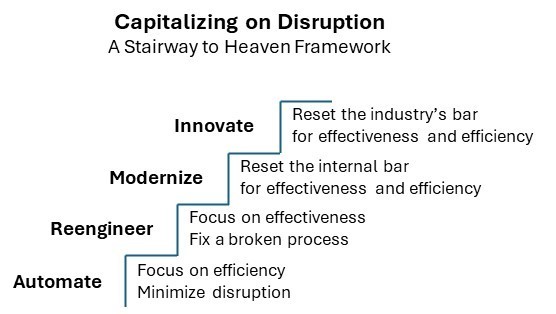
There are four proven ways to capitalize on disruptive innovation, and they are organized here in terms of escalating risk and reward. Each stair appeals to a different persona in the Technology Adoption Life Cycle, the bottom one attracting conservatives, the second, pragmatists in pain, the third, pragmatists with options, and the fourth, visionaries. Each stair can be managed to its targeted reward, but it is very hard indeed to manage two or more stairs in tandem. Most failures occur because management is not decisive about which gains it is committed to achieving and in what priority order it should be served. Needless to say, there is a better way.
The first use of this framework is to explore the possibilities of each stair for your enterprise. That is, if you were to prioritize this stair, what would success look like, how would you expect to measure it, and what costs and risks would be entailed? You want to talk this through as a team, ensuring everyone gets heard. Specifically, you want to make sure that the adoption personas of the most powerful people in the room do not dominate this part of the dialog. They are likely going to make the call in the end, but it is critical that they hear everyone out before they do.
Let’s try this out with everyone’s latest favorite example—generative AI. Imagine you are a member of the executive team at a pharmaceutical corporation, and you have charged your IT team to come up with a GenAI strategy. Wisely, they have come back to you with an array of options, arranged in a stairway to heaven. Here’s what they might say:
- Automate. There is a whole series of regulatory compliance obligations that today we outsource overseas to be serviced by a lower-waged workforce. Not only would automating these tasks reduce our costs, it would also lower the error rate and continuously improve performance as more and more machine learning is put to work. This is a low-risk, modest-return option. There would be no disruption to any of our other operations, and we in IT could learn a lot about a technology that is mutating far faster than anything we have ever seen before.
- Reengineer. Our proteomics research scientists are having a real problem with the combinatorial explosion of all the possible 3D configurations a given 2D sequence of amino acids might adopt. By focusing our generative AI models on just this one problem, we can vastly accelerate our discovery phase, transforming our problem set from completely intractable to continuously improving. This is a medium-risk, high-return opportunity that is confined to a single department, thereby minimizing disruption to the rest of our value chain.
- Modernize. Our go-to-market teams are competing for smaller and smaller slices of time from the physician offices they call upon. We need relevant messaging to get the appointment and highly personalized content to get buy-in from both the doctors and the nurses. Today we rely on experience and anecdotal data, which works OK for our long-tenured members but makes recruiting, onboarding, and ramping a nightmare. By focusing our Large Language Model on all the data in our CRM systems, combined with all our data from the labs, clinical trials, patent submissions, as well as the patient records we have access to, we can arm our GenAI with more information than any one human could process. We still will have humans in the loop to monitor and adapt this material throughout the sales process, but they will be much better equipped to compete than ever before. This is a high-risk, high-return opportunity that will impact a large portion of our workforce, so we plan to stage the implementation to capture learnings as we go.
- Innovate. Deep Mind’s AlphaGo program taught itself to play go at the highest level by playing against itself millions and millions of times. We think we can take a similar approach to drug discovery. It’s a moon-shot idea, and our data scientists are still in their own discovery phase, but this could be a game-changer for the industry. We’d like to take a VC approach to funding this effort, ring-fencing the funding across several years, but holding ourselves accountable to meeting material milestones along the way.
As you can see, there is a case to be made for each stair, but there is only so much time, talent, management attention, and working capital to go around, so it is critical that the executive team prioritize these four options and sequence them appropriately. Different teams will come up with different priorities. You are not looking for the “right answer.” You are looking for the one that will yield the best risk-adjusted returns for your enterprise under current conditions.
That’s what I think. What do you think?
Image Credit: Geoffrey Moore, Google Gemini
 Sign up here to join 17,000+ leaders getting Human-Centered Change & Innovation Weekly delivered to their inbox every week.