
Exclusive Interview with Oscar Amundsen
Leaders aspire to create a “dream organization” not merely for the sake of prestige or profit, but because they recognize that a deeply aligned, human-centered culture is the ultimate multiplier of potential. In a dream organization, the traditional friction between individual aspiration and corporate objective vanishes, replaced by a shared sense of purpose and psychological safety that allows innovation to flourish naturally. These leaders understand that when employees feel truly seen, valued, and empowered to contribute their best work, the organization becomes antifragile — capable of navigating uncertainty with a level of agility and commitment that cannot be bought or mandated. Ultimately, the quest for a dream organization is an investment in a sustainable future where the workplace acts as a catalyst for both professional excellence and personal fulfillment.
Today we dive deep into what it takes to create a “dream organization” through a dialogue with our special guest.
Helping Leaders Build Their Dream Organization
 I recently had the opportunity to interview Oscar Amundsen, a full Professor of Organization Studies at the Norwegian University of Science and Technology.
He has extensive experience in researching various industries and businesses. His work is focused on change and innovation in organizations. This includes related topics such as leadership, culture, trust, motivation, and organizational development. In these fields, he has published numerous books and scientific articles.
Amundsen’s goal is to develop research-based knowledge AND at the same time make the research concrete and accessible. The point is to make the knowledge useful for creating better organizations. Whether the enterprise is in the public, voluntary or private sector.
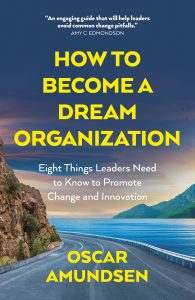
Below is the text of my interview with Oscar and a preview of the kinds of insights you’ll find in How to Become a Dream Organization: Eight Things Leaders Need to Know to Promote Change and Innovation presented in a Q&A format:
1. What does it take for an organization to break its own practices and develop new ones?
Organizations can be seen as ‘organisms’ that develop habits. And we all know that habits are not easy to break. But organizations can also be seen as ‘tools for achieving goals’. Since the world around the organization changes, the organization itself must also change to remain a suitable tool for the (changed) tasks that need to be solved.
As a leader, you must have the ability to identify the need for change. This means you need to look both ‘outward and inward’: What is required of us in a changing environment? And what does this mean for how we work within this organization?
Many leaders overlook that the latter question requires deep knowledge of what is happening inside the organization. Therefore, you should consult with employees who are close to the core tasks of the organization. You don’t know everything yourself, and you need some knowledge from the ‘foot soldiers’ to make the organization better.
I would also add that ‘breaking away’ is precisely a hallmark of all innovation. If you are going to do things in new ways, you have to break with what is established (in a market, in a practice, etc.). However, all such breaks require a willingness to take risks. You can never know with one hundred percent certainty how it will turn out, even though you should of course avoid taking reckless chances with your business. But you must accept that things can go wrong from time to time in order to achieve something new.
2. What are the keys to promoting the ability to both change and innovate?
This is precisely the question that the book answers. I present a research-based model with eight keys to strengthening the ability for change and innovation. The book is therefore structured around eight chapters, each addressing one of these keys. The point is to show how these eight mechanisms influence the capacity for change and innovation. This knowledge gives you the opportunity to build and develop an organization that not only solves its tasks smarter and better, but also becomes an attractive place to be for both leaders and other employees.
3. Why do people resist sharing new practices?
If you have an organization where people are afraid of making mistakes and trying new things, much will happen in secret. In the book, I write about an employee who comes up with a new and efficient way of working but keeps it hidden from both colleagues and managers because she fears her solution deviates from established procedures. She knows the solution is both sound and sensible. It is only when a researcher visits the organization that she (anonymously) shares her new way of working. Her lack of trust in leadership means that a new practice remains with her, even though it could have spread (and been improved) if it had been openly discussed among employees and managers. This organization misses out on the resource that ordinary employees represent for improving and renewing the business.
4. What are the keys for leaders to manage that determine whether trust or mistrust dominates?
Let me first say that trust is worth its weight in gold in this context. The reason is that trust in an organization is absolutely fundamental to building its ability to innovate. In the book I highlight five aspects that explain why and how trust influences the organization’s ability to change and innovate.
As a leader, you should understand these aspects, because only then can you say something meaningful about the state of trust within the organization.
Practicing trust requires a certain degree of courage. Trusting someone always (in principle) involves some risk: You can never be 100 percent certain that the trust you show will be honored. It may sound strange, but despite this, I recommend a more trust-based leadership approach because it has so many positive effects.
Concretely, you should reflect on the signals you personally send out, but may be even more important: You should examine the control systems used in your organization. Is there more control than necessary in some areas? What is the purpose of that control? Is it to ‘catch’ people making mistakes, or is it to learn from mistakes?
5. Why is autonomy so important to employees?
There is solid research evidence to support the claim that autonomy is, in fact, a fundamental human need (along with mastery and belonging). All people function better when they have some influence over their own situation – of course within the goals and frameworks set by the organization. In the book, I discuss how autonomy strengthens people’s motivation and drive – and (not least) increases their willingness to contribute constructively within an organization. It is well-established knowledge from innovation research that autonomy, within good boundaries, is positive for innovation.
6. Why is it important for organizations to have positive vibes and how is this different from optimism?
 Optimism is good, but it can actually become a ‘straitjacket’. In the book, I illustrate this through a case where I explain the spectacular fall of mobile phone manufacturer Nokia. At the turn of the millennium, they were the world’s largest mobile phone producer. But a culture developed within the company where it was ‘not allowed’ to raise objections or criticize the strategy. Management only wanted to hear good news. The short version of this story is that Nokia was therefore unprepared when the iPhone entered the market, and gradually disappeared until the remnants were bought up some years later.
On the other hand: Having positive feelings toward your own company, is of great value to the organization. This is something completely different from a demand for pure optimism. Research suggests that such positive feelings influence your relationship with colleagues and the organization. The point is that a positive atmosphere makes you more:
- Helpful: The mechanism is ‘feel good – do good’. Things flow more smoothly, including knowledge sharing.
- Engaged: You become willing to make sacrifices and go the extra mile.
- Protective: You ‘speak proudly’ about the company externally and help prevent dangers and trouble.
- Constructive: You are more likely to come up with constructive suggestions.
The last point directly impacts an organization’s ability to change and innovate, while the first three strengthen that ability indirectly.
7. What do tolerance of failure and diversity look like in practice?
Tolerance for mistakes is essential for achieving innovation. In a ‘zero-error culture,’ you will struggle to innovate simply because people are afraid to experiment, to try and fail. Although mistakes will always happen, it is useful to distinguish between different types of mistakes: What you want to encourage (and have more of) are what can be called ‘intelligent mistakes.’
These are mistakes that occur when you deliberately try something new. The goal is to learn so that you can move forward with what you are trying to develop. Other types of mistakes can be called basic or complex. These are the ones you want as few of as possible, but you cannot say they should never exist. Research shows that if you have zero tolerance for mistakes, they will be hidden, and you lose the opportunity to learn from them.
When it comes to diversity, I write in the book about how different types of perspectives and knowledge are valuable for innovation. I emphasize that leaders should demonstrate a certain level of humility and recognize that they need others’ insights to make good decisions.
8. What is practical anchoring and why is it so important?
Practical anchoring is essentially about involving the right employees in change processes. The point is that you need knowledge of actual practice to carry out sensible change work. People in the organization should see the benefit of the changes you are planning if you want them on board when changes are implemented. This makes sense not only for engagement and motivation but also to ensure you don’t create a less efficient organization with duplicate work and potential obstacles to doing a good job.
9. Why does fear play such a big role in organizations’ ability to change & innovate?
This is a broad topic, which I dedicate an entire chapter to in the book. The short version is that fear leads employees to avoid participating and contributing with their knowledge and experience. We are social beings who generally want to avoid the risk of offering an original contribution or asking a critical or fundamental question if there are potential negative consequences. In the Nokia case, we also see that people became tactical regarding their own career opportunities within the organization: They eventually learned that those who asked critical (but necessary) questions lost opportunities in the company. This caused engineers to drift to the sidelines – even on strategic technical issues.
10. Getting 100% participation is always a good thing, right?
There are many benefits to involving people in both innovation and change efforts. The point is to make the best use of the knowledge resources you have within the organization for the benefit of the organization. In addition, you become a more attractive employer if you allow people to participate in development. Modern employees actually expect to have some influence over their work situation and to use their knowledge in ways that benefit both themselves and the organization.
That said, I still emphasize in the book that there is a balance here: It’s not as if everyone should have an opinion on everything and participate in every possible process. That would only create chaos and overload for people in key roles. In the book, I use the term ‘participation satisfaction’ to describe this. People have different needs for involvement—both personally and, most importantly, based on the role they have. Conclusion: Not “the more participation, the better,” but balanced according to need.
11. Any question I didn’t ask that you want to answer?
Well, you haven’t asked me about the title of the book. I want to underline that “the dream organization” is not meant as a utopic situation. Rather, it’s meant more like a goal image. A goal image for those who want to build and become stronger in change and innovation. So, the book is about improving the organization – and at the same time making it attractive to be a part of – as a leader and as an employee.
So, the title of the book is an invitation to raise your gaze a little and ask something like: “What steps could I take to build a better organization? How can I develop a workplace where people like to work – and where change and innovation are a natural part of working?” That’s the kind of organization I want to help make reality with this book.
Thank you for taking the time for me and my book!
Conclusion
Thank you for the great conversation Oscar!
I hope everyone has enjoyed this peek into the mind of the man behind the insightful new title How to Become a Dream Organization: Eight Things Leaders Need to Know to Promote Change and Innovation!
Image credits: Oscar Amundsen, Anne Line Bakken, ChatGPT
 Sign up here to join 17,000+ leaders getting Human-Centered Change & Innovation Weekly delivered to their inbox every week.
Pingback: Sustainability Daily Podcast 01/19/2026 - Silk Logic
Pingback: Trust is a Gold Mine for Organizations, but it Takes a Bit of Courage | Human-Centered Change and Innovation