
GUEST POST from Geoffrey A. Moore
In 2023 we simply could not stop talking about Generative AI. But in 2024 the question for each enterprise became (continuing to today) — and this includes yours as well — is What are we going to do about it? Tough questions call for tough frameworks, so let’s run this one through the Hierarchy of Powers to see if it can shine some light on what might be your company’s best bet.
Category Power
Gen AI can have an impact anywhere in the Category Maturity Life Cycle, but the way it does so differs depending on where your category is, as follows:
- Early Market. GenAI will almost certainly be a differentiating ingredient that is enabling a disruptive innovation, and you need to be on the bleeding edge. Think ChatGPT.
- Crossing the chasm. Nailing your target use case is your sole priority, so you would use GenAI if, and only if, it helped you do so, and avoid getting distracted by its other bells and whistles. Think Khan Academy at the school district level.
- Inside the tornado. Grabbing as much market share as you can is now the game to play, and GenAI-enabled features can help you do so provided they are fully integrated (no “some assembly required”). You cannot afford to slow your adoption down just at the time it needs to be at full speed. Think Microsoft CoPilot.
- Growth Main Street (category still growing double digits). Market share boundaries are settling in, so the goal now is to grow your patch as fast as you can, solidifying your position and taking as much share as you can from the also-rans. Adding GenAI to the core product can provide a real boost as long as the disruption is minimal. Think Salesforce CRM.
- Mature Main Street (category stabilized, single-digit growth). You are now marketing primarily to your installed base, secondarily seeking to pick up new logos as they come into play. GenAI can give you a midlife kicker provided you can use it to generate meaningful productivity gains. Think Adobe Photoshop.
- Late Main Street (category declining, negative growth). The category has never been more profitable, so you are looking to extend its life in as low-cost a way as you can. GenAI can introduce innovative applications that otherwise would never occur to your end users. Think HP home printing.
Company Power
There are two dimensions of company power to consider when analyzing the ROI from a GenAI investment, as follows:
- Market Share Status. Are you the market share leader, a challenger, or simply a participant? As a challenger, you can use GenAI to disrupt the market pecking order provided you differentiate in a way that is challenging for the leader to copy. On the other hand, as a leader, you can use GenAI to neutralize the innovations coming from challengers provided you can get it to market fast enough to keep the ecosystem in your camp. As a participant, you would add GenAI only if was your single point of differentiation (as a low-share participant, your R&D budget cannot fund more than one).
- Default Operating Model. Is your core business better served by the complex systems operating model (typical for B2B companies with hundreds to thousands of large enterprises for customers) or the volume operations operating model (typical for B2C companies with hundreds of thousands to millions of consumers)? The complex systems model has sufficient margins to invest professional services across the entire ownership life cycle, from design consulting to installation to expansion. You are going to need deep in-house expertise to win big in this game. By contrast, GenAI deployed via the volume operations model has to work out-of-the-box. Consumers have neither the courage nor the patience to work through any disconnects.
Market Power
Whereas category share leaders benefit most from going broad, market segment leaders win big by going deep. The key tactic is to overdo it on the use cases that mean the most to your target customers, taking your offer beyond anything reasonable for a category leader to copy. GenAI can certainly be a part of this approach, as the two slides below illustrate:

In the complex systems operating model, GenAI should accentuate the differentiation of your whole product, the complete solution to whatever problem you are targeting. That might mean, for example, taking your Large Language Model to a level of specificity that would normally not be warranted. This sets you apart from the incumbent vendor who has nothing like what you offer as well as from other technology vendors who have not embraced your target segment’s specific concerns. Think Crowdstrike’s Charlotte AI for cybersecurity analysis.
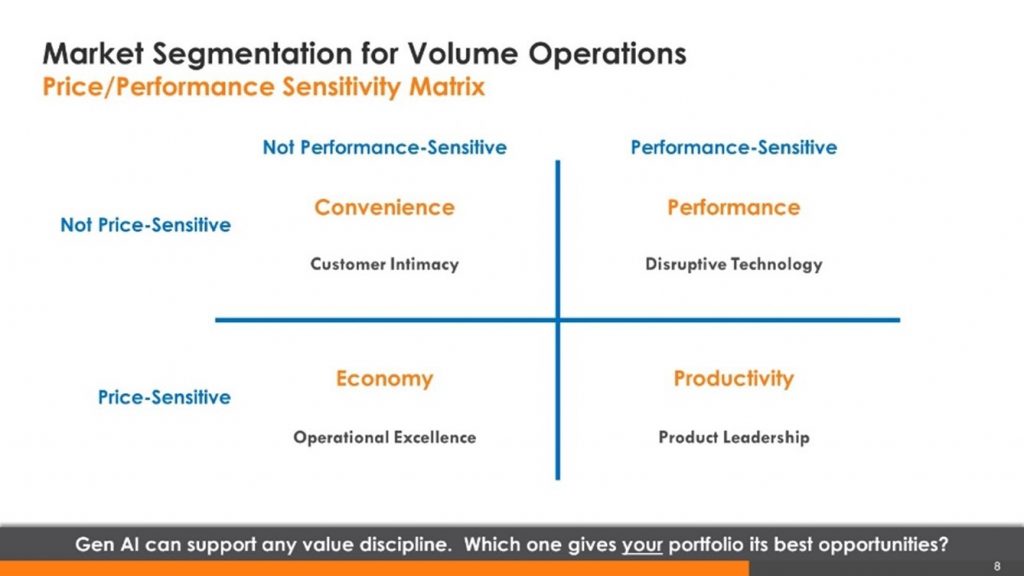
In the volume operations operating model, GenAI should accentuate the differentiation of your brand promise by overdelivering on the relevant value discipline. Once again, it is critical not to get distracted by shiny objects—you want to differentiate in one quadrant only, although you can use GenAI in the other three for neutralization purposes. For Performance, think knowledge discovery. For Productivity, think writing letters. For Economy, think tutoring. For Convenience, think gift suggestions.
Offer Power
Everybody wants to “be innovative,” but it is worth stepping back a moment to ask, how do we get a Return on Innovation? Compared to its financial cousin, this kind of ROI is more of a leading indicator and thus of more strategic value. Basically, it comes in three forms:
- Differentiation. This creates customer preference, the goal being not just to be different but to create a clear separation from the competition, one that they cannot easily emulate. Think OpenAI.
- Neutralization. This closes the gap between you and a competitor who is taking market share away from you, the goal being to get to “good enough, fast enough,” thereby allowing your installed base to stay loyal. Think Google Bard.
- Optimization. This reduces the cost while maintaining performance, the goal being to expand the total available market. Think Edge GenAI on PCs and Macs.
For most of us, GenAI will be an added ingredient rather than a core product, which makes the ROI question even more important. The easiest way to waste innovation dollars is to spend them on differentiation that does not go far enough, neutralization that does not go fast enough, or optimization that does not go deep enough. So, the key lesson here is, pick one and only one as your ROI goal, and then go all in to get a positive return.
Execution Power
How best to incorporate GenAI into your existing enterprise depends on which zone of operations you are looking to enhance, as illustrated by the zone management framework below:
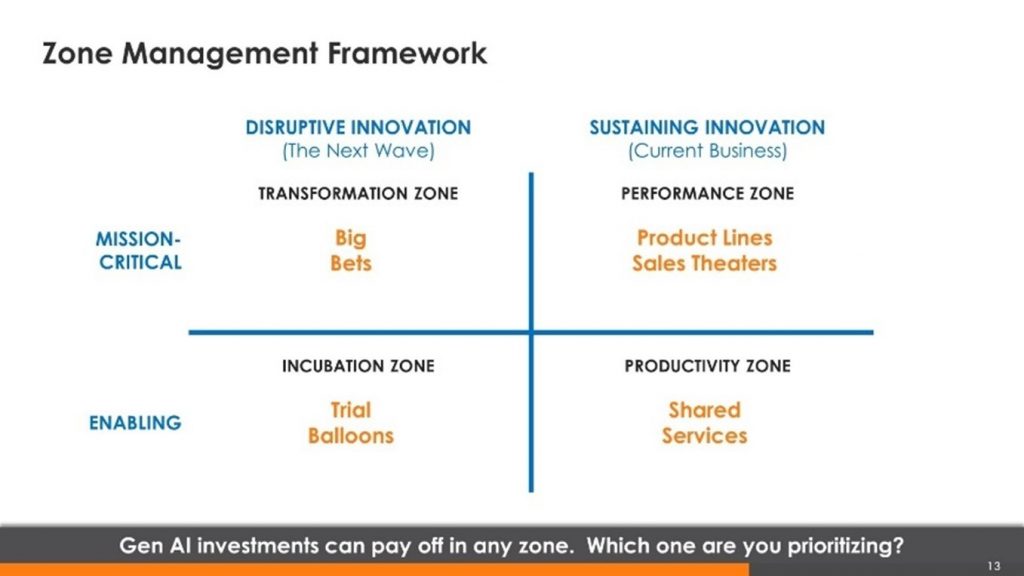
If you are unsure exactly what to do, assign the effort to the Incubation Zone and put them on the clock to come up with a good answer as fast as possible. If you can incorporate it directly into your core business’s offerings at relatively low risk, by all means, do so as it is the current hot ticket, and assign it to the Performance Zone. If there is not a good fit, consider using it internally instead to improve your own productivity, assigning it to the Productivity Zone. Finally, although it is awfully early days for this, if you are convinced it is an absolutely essential ingredient in a big bet you feel compelled to make, then assign it to the Transformation Zone and go all in. Again, the overall point is manage your investment in GenAI out of one zone and only one zone, as the success metrics for each zone are incompatible with those of the other three.
One final point. Embracing anything as novel as GenAI has to feel risky. I submit, however, that in 2025 not building upon meaningful GenAI action taken in 2024 is even more so.
That’s what I think. What do you think?
Image Credit: Pexels
 Sign up here to join 17,000+ leaders getting Human-Centered Change & Innovation Weekly delivered to their inbox every week.
Pingback: Top 10 Human-Centered Change & Innovation Articles of January 2026 | Human-Centered Change and Innovation