LAST UPDATED: December 10, 2025 at 12:12PM
GUEST POST from Chateau G Pato
Innovation is inherently messy, uncertain, and challenging. To navigate this complexity, our brains rely on cognitive shortcuts – heuristics — to save time and energy. While these shortcuts are useful for avoiding immediate danger or making routine decisions, they become the primary internal roadblocks when attempting to generate or evaluate truly novel ideas. These shortcuts are our anchors and biases, and they consistently pull us back to the familiar, the safe, and the incremental.
In the context of Human-Centered Innovation, we must shift our focus from just generating innovation to protecting it from these internal threats. The key is to recognize the most common biases that derail novel concepts and build specific, deliberate processes to counteract them. We must unlearn the assumption of pure rationality and embrace the fact that all decision-making, especially concerning risk and novelty, is tainted by predictable cognitive errors. This recognition is the first step toward building a truly bias-aware innovation ecosystem.
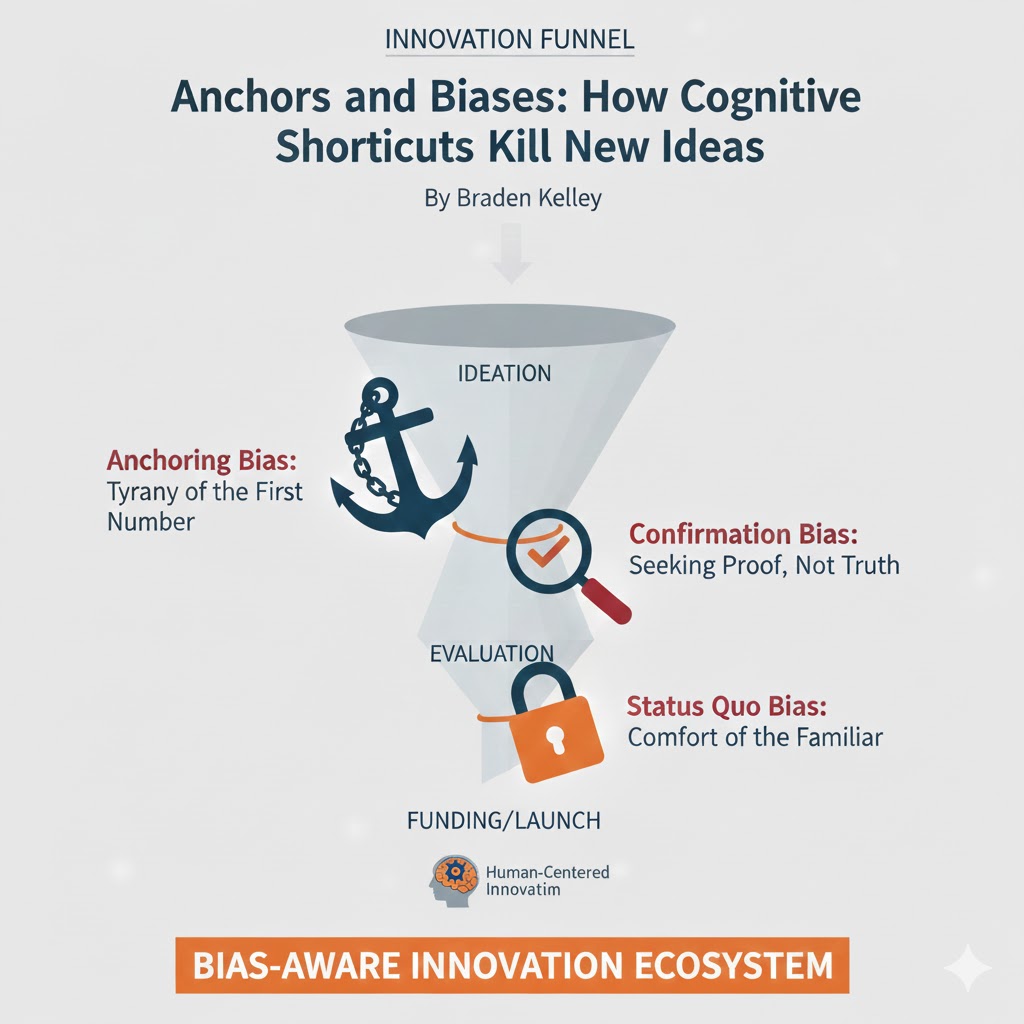
Visual representation: A diagram illustrating the innovation funnel being constricted at different stages (Ideation, Evaluation, Funding) by three key cognitive biases: Anchoring, Confirmation Bias, and Status Quo Bias.
Three Innovation Killers and How to Disarm Them
While hundreds of biases exist, three are particularly lethal to the innovation process:
1. Anchoring Bias: The Tyranny of the First Number
The Anchoring Bias occurs when people rely too heavily on the first piece of information offered (the “anchor”) when making decisions. In innovation, the anchor is often the budget of the last project, the timeline of the most recent success, or the projected ROI of the initial idea submission. This anchor skews all subsequent analysis, making it nearly impossible to objectively evaluate ideas that fall far outside that initial range.
- The Killer: A disruptive idea requiring a tenfold increase in budget compared to the anchor will be instantly dismissed as “too expensive,” even if the potential ROI is twentyfold.
- The Disarmer: Use Premortem Analysis (imagining the project failed and listing the causes) before assigning any financial figures. Also, use Three-Point Estimates (optimistic, pessimistic, and most likely) to establish a range, preventing a single number from becoming the dominant anchor.
2. Confirmation Bias: Seeking Proof, Not Truth
The Confirmation Bias is the tendency to search for, interpret, favor, and recall information that confirms or supports one’s prior beliefs or values. In innovation, this leads teams to design market research that validates their pet idea and ignore data that challenges it. This results in the pursuit of solutions nobody wants, but which the team believes they want.
- The Killer: A team falls in love with a solution and only interviews customers who fit their narrow ideal profile, ignoring a critical segment whose objections would save the project from failure.
- The Disarmer: Institute a Red Team/Blue Team structure. Assign a dedicated “Red Team” whose only job is to rigorously critique the idea and actively seek disconfirming evidence and data. Leadership must reward the Red Team for finding flaws, not just for confirming the status quo.
3. Status Quo Bias: The Comfort of the Familiar
The Status Quo Bias is the preference for the current state of affairs. Any change from the baseline is perceived as a loss, and the pain of potential loss outweighs the potential gain of the new idea. This is the organizational immune system fighting off innovation. It’s why companies often choose to incrementally improve a dying product rather than commit to a disruptive new platform.
- The Killer: A new business model that could unlock 5x revenue is rejected because it requires decommissioning a legacy product that currently contributes 10% of profit, even though that product is in terminal decline. The perceived certainty of the 10% trumps the uncertainty of the 5x.
- The Disarmer: Employ Zero-Based Budgeting for Ideas. Force teams to justify the existence of current processes or products as if they were a new idea competing for resources. Ask: “If we didn’t offer this product today, would we launch it now?” If the answer is no, the status quo must be challenged.
Case Study 1: The Anchor That Sank the Startup
Challenge: Undervaluing Disruptive Potential Due to Legacy Pricing
A B2B SaaS startup (“DataFlow”) developed an AI tool that automated a complex, manual compliance reporting process, reducing the time required from 40 hours per month to 2 hours. The initial team, anchored to the price of the legacy human labor (which cost clients approximately $4,000/month), decided to price their software at a conservative $300/month.
Bias in Action: Anchoring Bias
The team failed to anchor their pricing to the value delivered (time savings, error reduction, regulatory certainty) and instead anchored it to the legacy cost structure. Their $300 price point led potential high-value clients to view the product as a minor utility, not a mission-critical tool, because the price was too low relative to the problem solved. They were competing on cost, not value.
- The Correction: External consultants forced the team to re-anchor based on the avoided regulatory fine risk (a $100k-$500k loss). They repositioned the product as an insurance policy rather than a software license and successfully raised the price to $2,500/month, radically improving their perceived value, sales pipeline, and runway.
The Innovation Impact:
By identifying and aggressively correcting the anchoring bias, DataFlow unlocked its true market value. The innovation was technical, but the success was achieved through cognitive clarity in pricing strategy.
Case Study 2: The Confirmation Loop That Killed the Feature
Challenge: Launching a Feature Based on Internal Enthusiasm, Not Customer Need
A social media platform (“ConnectAll”) decided to integrate a complex 3D-modeling feature based on the CEO’s enthusiasm and anecdotal data from a few early-adopter focus groups. The development team, driven by Confirmation Bias, only sought feedback that praised the technical complexity and novelty of the feature.
Bias in Action: Confirmation Bias & Sunk Cost
The internal team, having invested six months of work (Sunk Cost Fallacy), refused to pivot when the initial Beta tests showed confusion and low usage. They argued that users simply needed more training. When the feature launched, user adoption was near zero, and the feature became a maintenance drain, detracting resources from core product improvements.
- The Correction: Post-mortem analysis showed the team needed Formal Disconfirmation. The new innovation process mandates that market testing must include a structured interview block where testers are paid to actively try and break the new feature, list its flaws, and articulate why they wouldn’t use it.
The Innovation Impact:
ConnectAll learned that the purpose of testing is not to confirm success, but to disconfirm failure. By forcing teams to seek and respect evidence that contradicts their initial beliefs, they now kill flawed ideas faster and redirect resources to validated, human-centered needs.
Conclusion: Bias-Awareness is the New Innovation Metric
The greatest barrier to radical innovation isn’t a lack of ideas or funding; it’s the predictability of human psychology. Cognitive biases like Anchoring, Confirmation Bias, and Status Quo Bias act as unconscious filters, ensuring that only the incremental and familiar survive the evaluation process. Organizations committed to Human-Centered Innovation must make bias-awareness a core competency. By building systematic checks (Premortems, Red Teams, Zero-Based Thinking) into every stage of the innovation pipeline, leaders transform cognitive shortcuts from fatal flaws into predictable inputs that can be managed. To innovate boldly, you must first think clearly.
“The mind is not a vessel to be filled, but a fire to be kindled — and often, that fire is choked by the ashes of old assumptions.” — Braden Kelley
Frequently Asked Questions About Cognitive Biases in Innovation
1. What is the difference between a heuristic and a cognitive bias?
A heuristic is a mental shortcut used to solve problems quickly and efficiently — it is the process. A cognitive bias is a systematic pattern of deviation from norm or rationality in judgment — it is the predictable error resulting from the heuristic. Biases are the consequences of using mental shortcuts (heuristics) in inappropriate contexts, such as innovation evaluation.
2. How does the Status Quo Bias relate to the Sunk Cost Fallacy?
The Status Quo Bias is a preference for the current state (a passive resistance to change). The Sunk Cost Fallacy is the resistance to changing a current course of action because of resources already invested (an active commitment to past expenditure). Both work together to kill new ideas: the Status Quo protects the legacy product, and Sunk Cost Fallacy protects the legacy project that failed to deliver.
3. Can AI help eliminate human cognitive biases in decision-making?
Yes. AI can be a powerful tool to mitigate human bias by acting as an objective “Red Team.” AI can be prompted to ignore anchors (e.g., “Analyze this idea assuming zero prior investment”), actively seek disconfirming data, and simulate scenarios free of human emotional attachment, providing a rational baseline for decision-making and challenging the human team’s assumptions.
Your first step toward mitigating bias: Before your next innovation meeting, ask everyone to write down the largest successful project budget from the last year. Collect these, then start the discussion on the new idea’s budget by referencing the highest and lowest numbers submitted. This simple act of introducing multiple anchors diffuses the power of any single number and forces a broader discussion.
Extra Extra: Because innovation is all about change, Braden Kelley’s human-centered change methodology and tools are the best way to plan and execute the changes necessary to support your innovation and transformation efforts — all while literally getting everyone all on the same page for change. Find out more about the methodology and tools, including the book Charting Change by following the link. Be sure and download the TEN FREE TOOLS while you’re here.
Image credit: Pexels
 Sign up here to get Human-Centered Change & Innovation Weekly delivered to your inbox every week.