What Miles Davis teaches us about the art of innovation
GUEST POST from John Bessant
Summertime – and, as the song says, the living is easy. Relaxing, recharging mental batteries and absorbing plenty of sunshine. Moments of golden pleasure.
One of which for me is the joy of listening to the ‘Proms’. The famous series of concerts started a century ago by Henry Wood and Robert Newman which aimed to bring serious music to the ears of everyone. Their vision was the ‘promenade’ style of concert, one which allowed people to stand, walk around, and enjoy the music casually instead of sitting in formal, quiet rows. For a long time this wonderful experience was confined to the Royal Albert Hall in London, but when the BBC took over running these events it opened up the concerts to the world via the magic of broadcasting. Democratizing and diverse, bringing all sorts of music to the attention of millions.
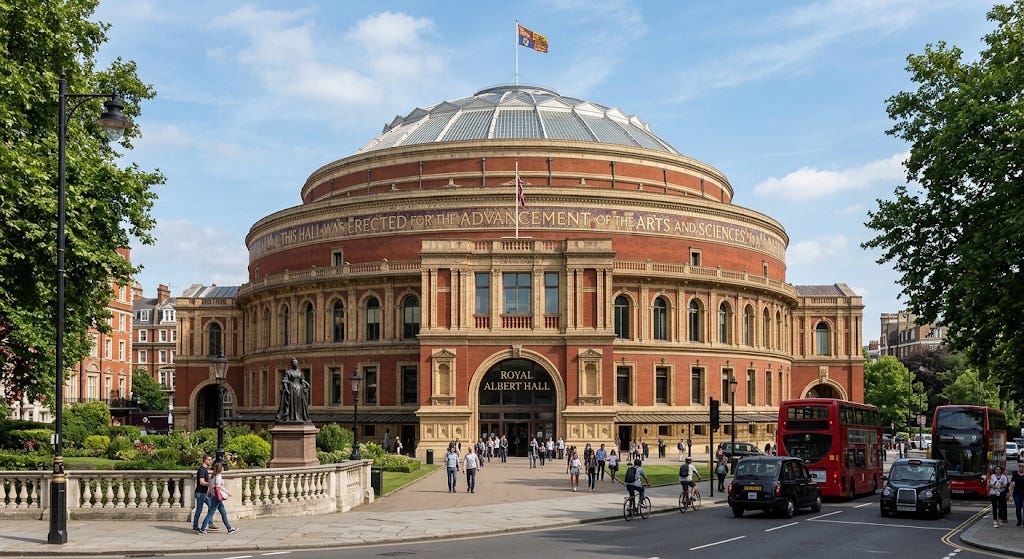
Including people like me, sitting and watching the sunset with a soundtrack. And right now I’m listening to a particularly appropriate piece to accompany Helios as he sinks slowly behind gold-topped hills. A young trumpeter working his skillful way around Gil Evans’ famous arrangement of George Gershwin’s haunting song ‘Summertime’ from the musical Porgy and Bess.
Closing my eyes – and getting shivers down my spine.
Which is an entirely appropriate if you’ve just seen (or in my case, heard) a ghost.
The specter in question would have celebrated his 100th birthday this year and this Promenade concert is being staged to remind us of the huge contribution he made as a musical innovator.
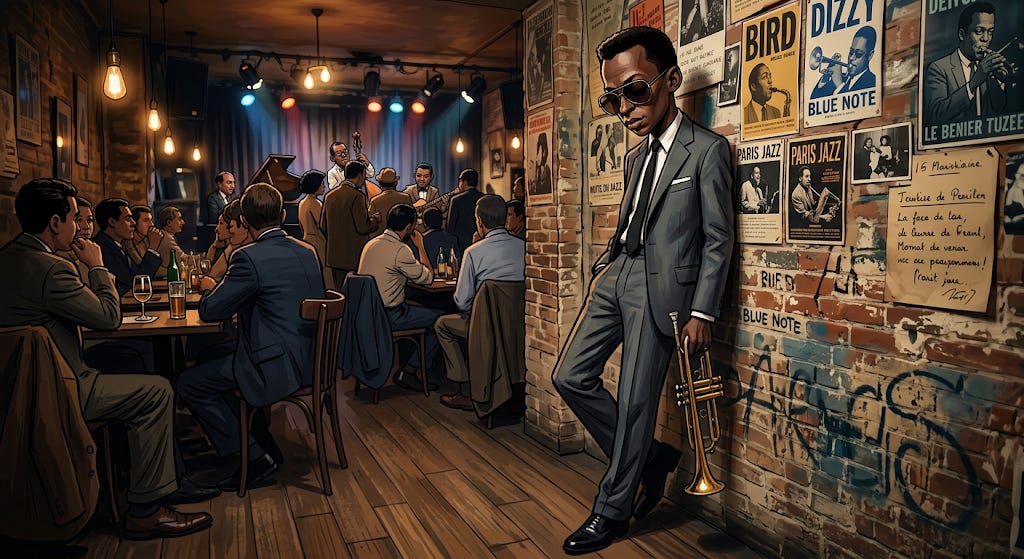
Miles Davis, born 26th May, 1926; by the time he died he’d rewritten many of the rules of the musical game. Someone whose spirit lives on in the style and approach taken by artists around the world today.
What he knew about making something new – innovation – hasn’t dated at all.
It’s easy to see him as the stereotype of the jazz musician – leaning against a wall, sunglasses worn inside, trumpet dangling loosely from his fingers. Reflecting and radiating an idea which he’d done so much to create – the birth of the cool. The moment when the frenzied and sometimes chaotic energy of jazz moved into a calmer, more meditative kind of exploration. Trying out new combinations of instruments, playing with textures, making use of space.
But it’s what’s behind the image, the way in which he actually worked, which carries the real impact. Because there was undoubted method in his madness, a pattern which we can see recurring from his earliest days.
And it’s a pattern which still has a lot to offer our thinking about innovation
Here are five ‘inspirations’ ….
1. The power of improvisation – create out of what isn’t there, reach for the unknown.
Paris, 1957, coming up on Christmas and Miles is about to go into the recording studio with four musicians with whom he’s not played before. His famous quintet couldn’t make the tour due to other commitments so the hastily assembled quartet are musically competent but comparative strangers. The session is to record film music for a young French director, Louis Malle who has just finished shooting ‘L’ascenseur sur l’echafaud‘ (Elevator to the scaffold). He’s a young man in a hurry, wanting to submit the film for a competition the following autumn. Miles has never made film music before but has agreed to give it a shot; he’s only seen the film once yet the new band are surprised by how he’s calmly approaching the session as if he knows exactly what to do.
Their challenge was the classic blank canvas, being tasked to find something that wasn’t there. Louis Malle explicitly told them not to try and interpret what they saw on the screen but instead try to find a counterpoint to the images. They never saw the film in total, only short excerpts of twenty to thirty seconds on which Davis encouraged them to improvise freely, giving them a minimum of guidance or structure. It was all about atmosphere.
The whole session lasted less than four hours; from it fifty minutes of music emerged, eighteen of which was used for the film. But they were enough; the film went on to win the Prix Louis-Delluc and the soundtrack received its own award the following year, the prestigious Grand Prix du Disc of the Académie Charles-Cros.
It’s good practice for what comes next. By now Miles has refined and developed this style into a trademark approach. Two years on and in a studio in New York a different group of musicians, a sextet this time, are assembled for another recording session. They’re a mixed group in terms of styles; pianist Bill Evans, John Coltrane and Julian (Cannonball) Adderley on saxophones, Paul Chambers on bass and drummer Jimmy Cobb. (Pianist Wynton Kelly joined to replace Evans on one track). Many of the same dynamics were involved; little instruction or preparation beyond the basic challenge of improvisation. Bill Evans described the process in the liner notes on the album sleeve; Davis gave them a few brief instructions and minimal sketches of scales and melody lines on which to improvise.
Recorded at Columbia’s 30th Street Studio in two sessions on March 2 and April 22, 1959, ‘Kind of blue’ is regarded as possibly the greatest jazz album of all time. It is certainly one of the best-known and had enormous influence; it was one of fifty recordings chosen in 2002 by the Library of Congress for the inaugural year of the National Recording Registry, being deemed “culturally, historically, or aesthetically significant”.
The waves it created spread out widely over time and space; many rock musicians directly acknowledge its impact on their thinking in bands as diverse as the Allman Brothers, Pink Floyd, Radiohead, the Velvet Underground, Brian Eno, Steely Dan and the Red Hot Chilli Peppers.
What lay – and still lies – behind the approach which they took was much more than individuals playing around with different notes. One way to describe it might be ‘enabled exploration’ – the chance to find and follow ideas which emerge, discovering places you didn’t know were there, confident in the rest of the band supporting you on that journey. And in turn that depends on two key elements – active listening, being acutely aware of what you’re hearing and where the music seems to be pointing next. And a ‘yes- and…’ mindset which accepts the direction and goes with the flow.
Actors and comedians would recognize this – it’s at the heart of ‘improv’ theater and comedy, a process not just of making it up as you go along but doing so in a way which builds on high levels of trust and psychological safety. And it emerges in countless stories of how radical innovations emerge, by having the space and support to explore in unexpected new ways.
Miles is almost as famous for his quotable sayings as his music and one phrase captures this improvisation approach well.
‘You don’t make bad notes… the note next to the one you think is bad corrects the one in front….’
Herbie Hancock, who joined Davis’s band as a young pianist had direct experience of this early in his life with the band. He played a chord which didn’t work, ‘hanging there like a rotten piece of fruit’ as he put it, and he waited for the inevitable crash which would follow. But Miles didn’t stop; his response was to pick up on what had just happened and then create a run of notes which somehow bent around the ‘wrong ‘chord to make it work. Hancock says it took him years to really absorb this lesson – that there’s no such thing as a wrong note in isolation, only a wrong note nobody responds to.
There’s a lesson there for any innovator and it speaks to more than just platitudes about embracing failure as opportunity. It suggests the discipline and openness needed to bring that to life.
2. Creativity loves constraints
Part of the magic behind Miles’s approach lay not only in working within constraints, like time pressures, availability of musicians and unhelpful physical stages. He’d actively embrace them and seek to restrict his band still further, squeezing them into uncomfortable situations – like the deliberate lack of instruction or preparation behind the studio work for the above projects. This drew on a deep sense that constraints and pressure can sometimes force surprising directions and creative responses; the most unpropitious circumstances can act as a trigger for innovation.
He understood something which runs through so many accounts of surprising flashes of inspired creativity in the least promising situations. Not least the experience of pianist Keith Jarrett, arriving late afternoon to prepare for a concert at the opera house in Cologne. He was tired after a long drive, feeling feverish and would happily have cancelled the solo performance he was contracted to deliver. What he found on the stage was the perfect excuse – instead of the high-quality concert piano he’d specified a mix-up had meant that he was supposed to perform on a rehearsal instrument in need of some major maintenance. This one had pedals which stuck, a weak bass end and a thin top register. And it was out of tune.
It was only the impassioned pleading from the teenage promoter, Vera Brandes, that persuaded him to go on stage and do the show. A good job that she did; Jarrett somehow built an inspired performance out of the very constraints which the instrument threw at him. It was his trademark improvisation but cranked up to build on the flaws, creating driving, percussive left-hand figures standing in for the sustain and depth the instrument didn’t have. The recording, The Köln Concert, became the best-selling solo piano album, and the best-selling solo jazz album, in history.
Others have used this same approach in deliberate fashion. Producer Brian Eno collaborated with the painter Peter Schmidt in the mid-1970s to develop a set of cards which they called Oblique Strategies. Each was printed with an instruction, vaguely phrased but designed to introduce a constraint and force a different action or style. Things like honor thy error as a hidden intention, use an unacceptable color. Every time a recording session became stuck they would draw a card at random. The cards were designed to force a different approach, view the challenge form a different angle.
Film maker Lars von Trier used something similar in his film ‘The five obstructions’ in 2003, made with his friend and mentor, Jørgen Leth. Von Trier’s favorite film is ‘The Perfect Human’ by Leth and in this film he deliberately challenges Leth to remake the film five times, each with a different “obstruction” (or obstacle) imposed by Trier. The resulting film was voted one of the 30 best films of the 2000s in a poll for ‘Sight and Sound’ magazine.
3. Diversity makes a difference
By its nature jazz has always been a mixture; its origins are particularly associated with New Orleans where the ‘cradle of jazz’ was home to a vibrant mix of cultures. Jazz combines elements of blues, ragtime, spirituals, work songs, folk traditions, and marching band music and its different styles cover swing rhythms, blue notes, polyrhythms and call-and-response patterns. And it is delivered by individuals converging for temporary collective work before moving on and regrouping elsewhere.
Viewed through this lens the band Miles put together for the ‘Kind of Blue’ sessions was typically diverse – and deliberately chosen to be so. The aim was for creative friction rather than smooth fit. The range was wide, from Bill Evans’s classical harmonic piano to Cannonball Adderley’s blues-infused gospel, with John Coltrane’s tenor pushing against both of them. It was precisely their diversity of styles that allowed the improvisational space to be filled with so many fresh ideas.
It was an idea Miles knew from his early days in the basement apartment where he and Gil Evans rehearsed the tracks which when compiled would yield albums like ‘The birth of the cool’ and ‘Sketches of Spain’. These arrangements featured an unusual nine-piece ensemble (nonet) that included a French horn and a tuba, creating rich, classical-leaning brass textures. Aiming to break away from the ‘heat’ of the bebop big band era and explore something different.
And it was something he was doing decades later, recruiting funk and soul, rock and other craftsmen to his different ensembles. It was a deliberate choice, constantly trying to refresh and challenge; for example the quintet which created key albums like ‘Bitches’ Brew’ was built from a fusion of older experience players with the fresh angle from a drummer, Tony Williams, who was only seventeen when he joined the band.
It’s an approach which has served other artists well; Paul Simon’s reinvention of his style to embrace African rhythms and melodies owes a great deal to his deliberate recruitment of local musicians, in particular Ladysmith Black Mambazo.
Much of the power of diversity has its roots in the idea of the ‘jam session’, an informal and often after-hours coming together of players who don’t normally play together but who exchange ideas and tricks. Like the night back in 1966 when a 23 year old guitarist asked if he could sit in with Cream during a gig at the Regent Street Polytechnic. An intrigued Eric Clapton agreed and was treated to a version of Howlin’ Wolf’s “Killing Floor” played at massively accelerated speed and accompanied by a whole repertoire of flashy techniques. It prompted him to say to Chas Chandler, the manager of the then-unknown Jimi Hendrix ‘you never told me he was that f***ing good!’
This kind of jamming isn’t unusual; it’s widely recognized as a crucible from which innovation can occur. But it depends on ‘acceptable accidents’ – an approach which allows the space for it to occur. Embracing uncertainty, allowing difference to create.
4. Reinvention – deliberate (creative) destruction
A look back across half a century of making music reveals another aspect of Miles’ creative approach – his deliberate dismantling of groups while they were often still at the height of their popularity. With almost rhythmic precision he’d take apart a sound which critics and audiences had come to love every five years or so. His changes – from the frenzied bebop sounds with which he began, through the cool jazz of the fifties, to the electric rock sprawl of Bitches Brew and beyond – ran like waves of ‘creative destruction’ across his music. It wasn’t a case of him running out of ideas; it was a constant search for new space to explore.
Again he’s in good company with such an approach. Picasso did the same thing across painting, his phases now neatly labelled in galleries and museums. Blue, Rose, Cubist, Neoclassical, and so on. David Bowie did it within a single decade, discarding Ziggy Stardust to become the Thin White Duke, then jettisoning that persona as he moved to Berlin to make electronic records with Eno.
Reinvention of this kind isn’t a response to a failing output; instead it’s about riding the waves of success and then deliberately choosing to jump away to retain the element of surprise.
5. Space as an enabling structure
So much of what Miles practiced links back to the idea of space – allowing somewhere for ideas to emerge and be explored. This was clear in his instructions to musicians, reminding them that ‘the most important part of music is the silence between the notes’.
A concept not lost on John Coltrane; early on he complained that he didn’t know how to end his solos to which Miles drily responded ‘take the horn out of your mouth, John!’
But the underlying concept mattered; Coltrane’s own impressive career repeatedly references the way in which he learned to find the space within which he could create his famous sheets of sound.
It’s easy to see this as just another reflection on improvisation which builds on active and attentive listening. But it’s also something which Miles learned and refined in his early work in Gil Evans’s basement, working with large ensembles. A piece like the haunting version of the ‘Concierto d’Aranjuez’ on the ‘Sketches of Spain’ album doesn’t emerge from letting musicians find their own way; it depends on careful orchestration to simultaneously allow structure and carefully sheltered space within which improvisation becomes possible.
As he famously explained his memorable treatment came to him by allowing the melody to occupy the space Evans had created; ‘….. so strong that the softer you play it, the stronger it gets, and the stronger you play it, the weaker it gets’.
Working in this way poses challenges very much like those of a large organization trying to retain an entrepreneurial heart inside a well-oiled and structured machine. Too much improvisation space – and there’s a risk of serious disruption; too little and the drift to sterility emerges. It’s a delicate balancing act – the kind of ambidexterity which organization theorists often talk about.
Αnd it’s that piece – the lovely adagio with its breathy tones, the fluttering of castanets and the shimmering of strings like desert heat rising from the Spanish plains – which I’m currently enjoying as a perfect accompaniment to my sunset.
A great way to rekindle some innovation inspiration.
All images public domain or generated by Gemini AI unless otherwise indicated
You can listen to a podcast of this story here
And watch a video version on my YouTube channel here
If you’d like more songs, stories and other resources on the innovation theme, check out my website here
And if you’d like to learn with me take a look at my online courses here
 Sign up here to join 17,000+ leaders getting Human-Centered Change & Innovation Weekly delivered to their inbox every week.