by Braden Kelley and Art Inteligencia
Every January, I watch the same ritual play out inside otherwise well-run organizations. Leadership spends weeks, sometimes months, building a strategic plan for the year ahead: a single narrative about where the market is going, what the company will do about it, and how success will be measured twelve months from now. By the time Q2 closes, half of that plan is already quietly out of date, and everyone in the room knows it. Nobody says so out loud, because saying so would mean admitting the process itself is the problem, not the plan.
The plan was never wrong. It was just singular.
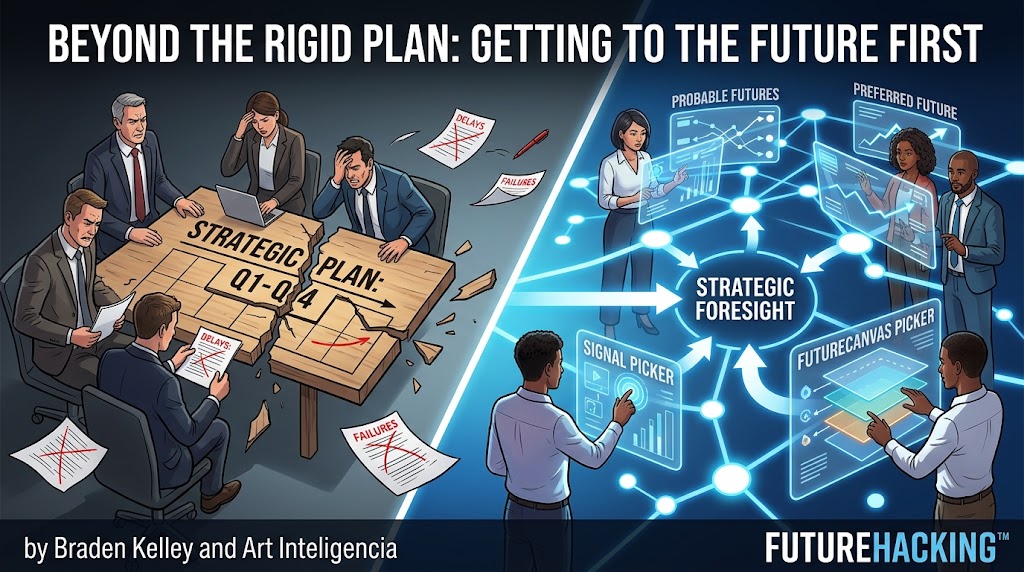
Here’s what I’ve learned after two decades of helping organizations navigate exactly this moment: the plan usually wasn’t badly built. The people in the room were smart, the research was real, the logic held together. The failure isn’t in the thinking, it’s in the structure. A traditional strategic plan describes one future and commits real budget, real headcount, and real organizational attention to it. When that one future doesn’t materialize exactly as modeled, and it never does, not exactly, the plan doesn’t bend. It breaks, quietly, and everyone starts working around it instead of updating it.
Strategic planning and strategic foresight are not the same discipline
This is the distinction most planning processes skip entirely. Strategic planning asks: given what we believe about the future, what should we do? Strategic foresight asks a prior question: what do we actually know, and don’t know, about the future we’re planning for? Skip that second question, and you’re not really planning for uncertainty, you’re planning for a single scenario and hoping it holds. Most organizations skip it not because they don’t value it, but because nobody on the team has been trained to do it, and hiring a dedicated foresight function feels like a luxury reserved for companies with a research budget most teams don’t have.
Why I built FutureHacking™
That gap, real demand for foresight, no accessible way to practice it, is exactly what I built FutureHacking™ to close. It’s not a framework that asks your team to become professional futurists. It’s a structured, visual, collaborative methodology that takes a cross-functional leadership team from raw signals in the market, through the trends those signals suggest, to a set of genuinely possible futures — and from there, to identifying which future is most probable and building a real path toward the future you’d actually prefer. “FutureHacking™ is the art and science of getting to the future first” isn’t a tagline I use lightly. It’s the whole point: the organizations that see a shift coming, and start moving before it’s obvious to everyone else, are the ones who get to shape what happens next instead of reacting to it after the fact.
Where to start before your next planning cycle
 If your team has never run a structured foresight exercise, the fastest way to feel what this actually looks like is with the free FutureHacking Signal Picker — it walks you through identifying and prioritizing the real signals worth watching, the first and most foundational step in the whole methodology, at no cost. Run it before your next planning offsite, and bring the output into the room instead of starting from a blank whiteboard.
Something new I’m building
I’m also putting the finishing touches on a second tool, the FutureCanvas Picker, that goes a step further than signal identification. It’s designed to give planners a genuine taste of the full arc: moving from signals, to the trends they suggest, to a real set of possible futures, then narrowing to your most probable future, and finally mapping the path to the future you’d actually prefer to build. It’s the clearest, fastest way I’ve built yet to feel what FutureHacking™ makes possible in a single sitting.
I’m not opening this one to everyone right away. I’m looking for a select group of strategic planners, CSOs, and leaders running planning processes right now to get early access before it’s broadly available — partly because I want real feedback from people doing this work under real deadline pressure, not from a general audience. If that’s you, and you’d like to be considered for early access, reach out and let me know — I’ll be following up personally with the select few who get in first.
The organizations that get to the future first aren’t the ones with the biggest planning budgets. They’re the ones who stopped mistaking a single confident narrative for genuine foresight, and built a process that can hold more than one future at a time.
Image Credits: Gemini
Content Authenticity Statement: The topic area, key elements to focus on, etc. were decisions made by Braden Kelley, with a little help from Claude to clean up the article.
 Sign up here to get Human-Centered Change & Innovation Weekly delivered to your inbox every week.