GUEST POST from Art Inteligencia
Executive Summary: The Strategic Illusion of Tech Accretion
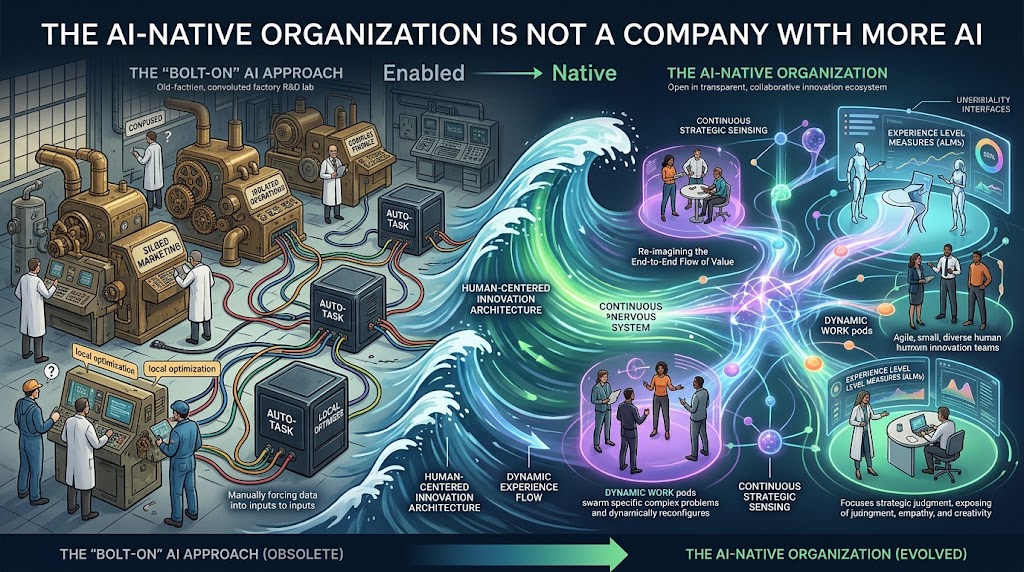
Most enterprise leaders approaching artificial intelligence today are making a fundamental strategic error: they are deploying cutting-edge technology to optimize legacy operating models. By injecting AI agents into existing departmental silos and automating task-level friction, organizations achieve localized efficiency gains while leaving their core structural bottlenecks completely intact.
True AI-native transformation is not an exercise in software accretion—it is a comprehensive redesign of value creation, human-centered experience design, and organizational architecture. An AI-native enterprise does not simply execute old work faster; it fundamentally reimagines how decision-making, innovation, and value flow when machine intelligence is ambient, continuous, and systemic.
Key Strategic Shifts for Leadership:
- From Point Automation to Structural Redesign: Shifting focus from automating legacy workflows to architecting end-to-end adaptive value streams.
- Unified Experience Architecture: Integrating employee experience (EX) and customer experience (CX) into a singular model evaluated by Experience Level Measures (XLMs) rather than transactional unit costs.
- Human-Centered Augmentation: Aligning distributed human talent and synthetic agents to reduce cognitive complexity and elevate human judgment, empathy, and strategic vision.
“The ceiling of your AI capability is not defined by your tech stack—it is bounded by your human-centered change readiness and organizational architecture.”
I. The Strategic Illusion: Acceleration vs. Architecture
The primary mistake enterprise leaders make during technological shifts is treating revolutionary tools as simple efficiency layer-ons. Injecting AI into existing enterprise workflows doesn’t create an innovative organization—it simply executes legacy processes with slightly less latency.
The “More AI” Trap
When organizations focus on tech accretion—buying more copilot licenses, deploying disparate AI agents, and scaling departmental LLM experiments—they default to local optimization. This tactical focus creates localized pockets of speed while simultaneously compounding organizational complexity, magnifying data silos, and causing cognitive fatigue across teams.
The Paving-the-Cow-Path Phenomenon
When legacy structures adopt AI without changing their underlying architecture, they engage in modern “cow-path paving.” Instead of asking why a business process exists or how value should uniquely flow in a digitally continuous environment, companies use AI to automate steps that shouldn’t exist in the first place.
Defining the Strategic Spectrum
To build an enterprise capable of sustained relevance, leadership must recognize the structural distinction between simple enablement and true native integration:
- AI-Enabled (Tactical Acceleration): Existing organizational structures, workflows, and functional silos remain intact, with point-solution automation layered on top to reduce task-level friction and unit costs.
- AI-Native (Architectural Transformation): Purpose, dynamic workflows, decision rights, governance, and end-to-end experience design are rebuilt from the ground up under the assumption that continuous machine intelligence is an foundational operational primitive.
II. Reimagining Experience Design: Beyond Efficiency to Human Flourishing
When artificial intelligence is treated merely as a cost-cutting engine, organizations default to measuring transactional speed. True experience design in an AI-native organization shifts the focus from simple task elimination to expanding human capability, agency, and value realization.
The Unified Experience Engine (CX & EX Integration)
Customer Experience (CX) and Employee Experience (EX) can no longer be designed or managed in operational silos. In an AI-native architecture, synthetic intelligence acts as a two-sided mediator—simultaneously shaping employee workflows and customer interactions. Disruptions or friction on the internal employee side directly degrade the external customer experience, requiring a singular, integrated experience management framework.
Evolving to Experience Level Measures (XLMs)
Legacy Service Level Agreements (SLAs) focus on operational throughput, such as handle time or cost-per-ticket. AI-native organizations elevate their measurement architecture toward Experience Level Measures (XLMs) that track qualitative and strategic outcomes:
- Cognitive Load Reduction: Measuring how effectively AI removes administrative drag and decision fatigue from human team members.
- Capability Expansion: Assessing how machine intelligence enhances an individual’s ability to solve complex, non-routine problems.
- Value Realization Speed: Tracking the time it takes for a customer to achieve their desired outcome, rather than simply measuring contact resolution speed.
Designing Human-Machine Collaboration
Rather than positioning synthetic intelligence as a human replacement or reducing employees to passive monitors of automated outputs, human-centered experience design places AI in an supportive context. The goal is intentional symbiosis: machines process continuous patterns and scale routine execution, freeing human judgment, empathy, and strategic creativity to drive meaningful differentiation.
III. The Nine Innovation Roles in an AI-Native World
As continuous intelligence becomes embedded across the enterprise, the dynamics of team collaboration fundamentally shift. Building high-performing teams in an AI-native organization requires re-evaluating how key innovation roles operate when human strengths are augmented by synthetic agents.
Evolving the Talent & Role Landscape
Traditional job descriptions are far too rigid for dynamic, AI-enabled environments. Leveraging the Nine Innovation Roles™ framework (9roles.com)—comprising the Revolutionary, Conscript, Connector, Artist, Customer Champion, Troubleshooter, Judge, Magic Maker, and Evangelist—allows organizations to map human strengths, behaviors, and contributions dynamically alongside AI tools.
Key Role Transformations
- The Customer Champion: Rather than relying solely on lagging surveys or periodic interviews, The Customer Champion leverages continuous sentiment streams and real-time behavioral models to synthesize latent needs and keep the customer at the center of every AI-driven initiative.
- The Revolutionary & The Artist: As synthetic agents automate routine output generation, The Revolutionary challenges incremental assumptions while The Artist focuses on higher-order problem framing, imaginative boundary-pushing, and original value creation.
- The Troubleshooter & The Judge: As machine intelligence scales rapid scenario simulations, The Troubleshooter identifies hidden operational friction while The Judge applies critical, ethical evaluation to synthetic recommendations before committing enterprise capital.
- The Evangelist, Connector, Magic Maker & Conscript: The Connector and Evangelist build cross-functional momentum and buy-in across human networks, while the Magic Maker turns abstract capabilities into seamless experiences and the Conscript is thoughtfully engaged to turn passive participation into active ownership.
Mitigating the Complexity Tax
Adding autonomous AI agents to cross-functional human teams without clear role alignment creates noise and coordination drag—a heavy “complexity tax.” AI-native leaders explicitly align these nine natural roles with synthetic capabilities, ensuring technology amplifies individual strengths rather than creating organizational confusion.
IV. Human-Centered Change: Preparing the Enterprise Mindset
Technological capability rarely dictates the success of digital transformation—human adaptability does. While technology accelerates exponentially, human organizations absorb change linearly. Bridging this gap requires moving beyond rigid, project-based change management toward a continuous human-centered change methodology.
Overcoming Psychological and Operational Resistance
Resistance to AI integration rarely stems from anti-technology sentiment; it arises from perceived loss of agency, cognitive exhaustion, and fear of role obsolescence. Organizations that treat change as a top-down mandate amplify friction. Human-centered change actively involves employees in co-designing their transformed workflows, turning passive adoption into active ownership.
Building Emotional Agility for Continuous Market Chaos
When operational cycles collapse from years to weeks, uncertainty becomes the steady state. Leadership development must prioritize emotional agility—training executives and managers to respond thoughtfully to disruption rather than reacting defensively. Leaders who cultivate emotional resilience create teams that view market turbulence as a catalyst for innovation rather than an existential threat.
Culture as the True Enterprise Infrastructure
Your technology stack sets your theoretical potential, but your organizational culture determines your actual output velocity. AI-native enterprises cultivate three non-negotiable cultural foundations:
- Psychological Safety: Employees must feel safe to experiment, report synthetic errors, and challenge automated decisions without fear of penalty.
- High Trust & Transparency: Clear visibility into how AI models are utilized, evaluated, and governed across internal processes.
- Ethical Boundaries: Explicit guardrails that protect human dignity, customer privacy, and organizational integrity above short-term efficiency gains.
V. The Architecture of the AI-Native Enterprise
To fully capitalize on ambient intelligence, organizations must move beyond rigid functional hierarchies. An AI-native structure is designed for dynamic adaptation, continuously reconfiguring teams, workflows, and strategic priorities in response to real-time market signals.
Fluid Organizational Design
Static org charts with rigid, multi-layered hierarchies create latency and slow execution. AI-native enterprises replace static structures with fluid, project-based networks. Cross-functional human talent pairs with synthetic agents on demand, forming dynamic pods that swarm specific challenges and re-assemble as organizational priorities evolve.
Continuous Horizon Scanning & Trend Audits
Annual strategic planning cycles are ill-suited for rapidly moving markets. By leveraging ambient signal identification and continuous trend detection frameworks, leadership can monitor macro shifts, customer behaviors, and technological inflections as they emerge. Strategy becomes an ongoing, real-time sensing function rather than a once-a-year retreat.
The Experiment Canvas for AI Interventions
Before deploying machine intelligence across value streams, AI-native leaders utilize a structured evaluation framework to ensure alignment with strategy and human needs:
- Intentional Placement: Defining precisely where and why synthetic interventions add value, avoiding technology deployment for its own sake.
- Hypothesis-Driven Testing: Running rapid, small-scale experiments to evaluate efficacy, human satisfaction, and operational friction before scaling.
- Systemic Impact Assessment: Measuring upstream and downstream effects on cross-functional teams and customer touchpoints to prevent unintended complexity.
VI. Executive Call to Action: The Diagnostic Readiness Test
Becoming an AI-native organization is not a capital expenditure challenge—it is a leadership mindset shift. To determine whether your enterprise is architecting true native capability or merely paving cow paths with faster technology, leadership teams must confront three critical diagnostic questions.
Strategic Audit Questions for Leadership
- Are we automating an existing bottleneck, or eliminating the step entirely?
If your AI initiatives simply speed up legacy handoffs between functional silos, you are compounding tech debt and organizational complexity rather than architecting dynamic value streams. - How does our change methodology evolve when technology outpaces learning cycles?
When software iterations occur continuously, static 18-month change management plans fail. Success requires building organizational agility, emotional resilience, and real-time feedback loops. - What unique human value are we unlocking with freed-up capacity?
Efficiency gains without purpose lead to headcount reduction or empty busywork. True AI-native leaders redirect saved time toward strategic foresight, deeper customer empathy, and breakthrough innovation.
The Strategic Roadmap Forward
Shift your focus and resources from enterprise software licensing toward experience architecture, culture building, and human capability expansion. The future belongs to organizations that treat artificial intelligence not as a bigger engine for old work, but as the foundation for entirely new ways of thinking, serving, and creating value.
Braden Kelley is a human-centered change, innovation, futurology, and experience design thought leader, author of Charting Change and Stoking Your Innovation Bonfire, and creator of the Change Planning Toolkit™ and Nine Innovation Roles™.
Frequently Asked Questions
What is the difference between an AI-enabled and an AI-native organization?
An AI-enabled organization layers point-solution automation onto existing operational silos to speed up legacy processes. An AI-native organization fundamentally redesigns its enterprise architecture, workflows, experience models, and decision-making assuming continuous machine intelligence is an essential operational baseline.
Why do traditional Service Level Agreements (SLAs) fail in AI-native transformations?
Traditional SLAs focus strictly on transactional metrics like handle time or cost-per-ticket. AI-native transformations require Experience Level Measures (XLMs) that track qualitative outcomes such as cognitive load reduction, capability expansion, and customer value realization speed.
How does team collaboration change when synthetic agents join human workflows?
Instead of static job descriptions, teams adapt using dynamic behavioral frameworks like the Nine Innovation Roles™. Human professionals elevate their focus toward strategic problem framing, continuous sensing, and scenario evaluation while synthetic agents handle rapid pattern recognition and execution.
EDITOR’S NOTE: Braden Kelley’s Problem Finding Canvas can be a super useful starting point for doing design thinking or human-centered design.
“The Problem Finding Canvas should help you investigate a handful of areas to explore, choose the one most important to you, extract all of the potential challenges and opportunities and choose one to prioritize.”
Image credit: Gemini
 Sign up here to get Human-Centered Change & Innovation Weekly delivered to your inbox every week.