How AI Synthetic Likenesses, Estate Licensing, and the Experience Economy Are Disrupting the Talent Ecosystem
GUEST POST from Art Inteligencia
I. Executive Summary & Thesis
The Paradigm Shift: Generative AI and real-time neural rendering are fundamentally decoupling an actor’s craft and visual identity from their physical body, availability, and natural lifespan. Cinema is transitioning from a discipline constrained by human logistics to an unconstrained digital canvas.
The Core Thesis: In the emerging era of AI-generated full-length feature films, the estates of deceased cultural icons—unencumbered by living human limitations, scheduling conflicts, or creative resistance—are uniquely positioned to lead the charge in licensing synthetic likenesses for entirely new cinematic roles.
The Macro Impact: This transition extends far beyond Hollywood production budgets. It represents a fundamental restructuring of the creative talent ecosystem:
- Talent Ecosystem Disruption: Living performers will no longer compete solely against current peers, but against a century of cinematic legends performing at their peak aesthetic and charismatic influence.
- Strategic Career Pressures: Mid-tier and emerging actors face extreme wage deflation as synthetic legacy assets provide predictable, risk-mitigated alternatives for studios.
- Likeness Securitization: A high-yield financial marketplace—directly mirroring the multi-billion-dollar music catalog acquisition booms—will emerge to monetize, package, and trade post-mortem digital likeness rights as long-term yield assets.
II. Introduction: The Arrival of the Synthetic Cinema Era
The Friction of Change: For decades, visual effects relied on heavy post-production labor to achieve incremental milestones—de-aging an aging star for a brief flashback or rendering a digital double for high-risk stunt work. Today, generative neural rendering and real-time motion synthesis have crossed a critical threshold. We are shifting rapidly from post-production touch-ups to full-synthesis cinematic creation, where generative models can power entire lead performances across full-length feature films with hyper-realistic emotional fidelity.
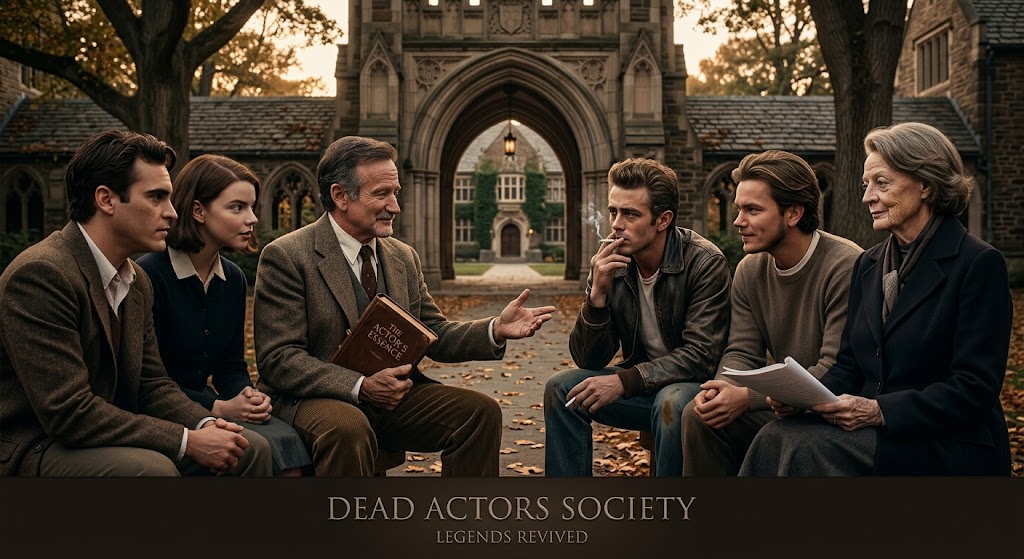
The “Dead Actors Society” Phenomenon: As production costs drop and synthetic rendering capability matures, a new content category is taking shape: the deliberate, high-budget revival of iconic performers in entirely original narratives. This is not about re-editing archival footage or stitching together outtakes. This is the era of the Dead Actors Society—a dynamic marketplace where legendary figures from film history return to headline original screenplays, cross-genre experiments, and modern franchises decades after their passing.
The Human-Centered Lens: From an experience design perspective, human beings do not connect merely to high-resolution pixels; we connect to narrative resonance, archetypal familiarity, and shared cultural memory. In an increasingly fragmented media landscape, iconic stars carry immediate emotional context and built-in trust. For studios navigating rising development risks, leveraging synthetic legacy talent offers a powerful mechanism to derisk major film slates while tapping directly into deeply ingrained audience nostalgia.
III. Why Estates Will Lead the Licensing Charge
Incentive Alignment (Frictionless Talent): Unlike living performers who manage complex personal brands, physical constraints, and evolving artistic ambitions, estate management operates primarily as an intellectual property enterprise. For estate trustees, licensing a digital likeness eliminates traditional production friction: there are no onset delays, travel requirements, physical exhaustion, or behavioral liabilities. The actor becomes a predictable, high-performing digital asset capable of infinite deployment.
Algorithmic Consistency & Archetypal Clarity: Iconic stars of cinema’s Golden Age—such as Humphrey Bogart, Marilyn Monroe, or James Dean—possess clearly defined, universally understood cultural archetypes. Because their screen legacies are static, generative models can synthesize their specific charismatic signatures, vocal cadence, and emotional range with remarkable precision. Studios gain access to instant brand recognition and established storytelling shorthand that requires zero audience warm-up.
Economic Incentive for Heirs: For heirs and asset managers, passive ownership of legacy rights often faces diminishing returns over time as catalog titles recede from active streaming discovery. Transitioning static IP into active, synthetic licensing models transforms dormant archives into dynamic, high-margin revenue streams. Through royalty-per-frame or box-office participation models, estates can capture continuous commercial value across future generations of media.
IV. The Squeeze on Living Talent: Pressures and Disruption
The “Infinite Competition” Problem: Throughout cinema history, living actors competed primarily against their contemporary peers for coveted roles. In the synthetic cinema era, that competitive arena expands infinitely backward across time. Emerging and established talent will find themselves auditioning not just against current box-office leads, but against a century of screen legends preserved at their peak aesthetic, physical, and charismatic influence—available to perform on demand without fatigue or scheduling conflicts.
Bifurcation of the Acting Profession: The economic pressures of synthetic competition will restructure the performer labor market into two distinct tiers:
- The Ultra-Elite Tier: A small upper crust of living megastars whose commercial value relies on genuine human presence, active cultural commentary, live press tours, and authentic real-world fan connections.
- The Squeezed Middle and Entry Level: Character actors, supporting talent, and working professionals who face severe wage compression and diminishing opportunities as studios opt for cost-effective, risk-mitigated synthetic legacy models for mid-tier roles.
The Experience Value Proposition: As synthetic performances achieve technical parity with human delivery, experience design forces a critical question for creators and audiences alike: What is the intrinsic value of human vulnerability in art? While mass-market entertainment may readily accept polished synthetic performances, a premium live-action market may emerge, marketing the deliberate imperfection, unpredictability, and lived experience of authentic human performers.
V. The Financialization of Likeness: Wall Street Meets Hollywood Catalog Sales
The Music Industry Blueprint: Over the past decade, financial institutions and private equity firms created a multi-billion-dollar asset class by purchasing the publishing rights and master recordings of legendary musicians—from Bob Dylan to Bruce Springsteen. The core thesis was simple: predictable, long-term cash flows from enduring cultural IP. Synthetic cinema opens the exact same financial playbook for screen performance, transforming an actor’s visual and vocal identity into an yield-bearing financial asset.
Likeness Securitization & Valuation Models: As generative models require clean, high-density training data, an actor’s digital archive becomes quantifiable. Wall Street valuation models will price an actor’s “Synthetic Future Cash Flow” based on three core variables:
- Training Data Quality: The depth, resolution, and emotional range captured in their historic filmography.
- Archetypal Demand: How universally their persona maps to high-converting narrative genres.
- Cross-Generational Longevity: The projected retention of their cultural relevance across global markets.
Pre-Mortem Rights Offloading & Likeness Royalties: Living actors will not wait for death to monetize their synthetic value. We will see performers offload their post-mortem rights—or even license mid-career synthetic clones—early in life to private equity funds for immediate lump-sum liquidity. This will give rise to complex likeness royalty structures, fractionalized ownership of synthetic talent libraries, and secondary derivative markets trading on the future performance of digital personas.
VI. Strategic Foresight: Governance, Ethics, and Experience Design Challenges
Human-Centered Change Management for Hollywood: Navigating the synthetic era requires robust governance frameworks that balance creative freedom with ethical stewardship. Labor unions like SAG-AFTRA, estate trustees, and legislative bodies will be forced to continually redefine right-of-publicity laws, digital consent boundaries, and posthumous labor rights to prevent non-consensual exploitation while enabling legitimate commercial innovation.
Audience Fatigue & Experiential Saturation: From an experience design perspective, over-relying on familiar digital ghosts carries significant narrative risk. When iconic faces become ubiquitous across cheap spin-offs, interactive media, and localized ad campaigns, “nostalgia overload” sets in. This erosion of scarcity dilutes the actor’s original cinematic legacy and risks numbing audience emotional engagement through synthetic repetition.
Authenticity vs. Convenience: As synthetic content generation accelerates, experience designers and filmmakers must intentionally craft the boundary between efficiency and artistry. The challenge will not be technical feasibility, but human resonance—ensuring that synthetic revival serves a genuine artistic purpose rather than functioning merely as a frictionless, algorithmically optimized cash grab.
VII. Conclusion: Framing the Future of Talent
Summary of the New Landscape: The arrival of synthetic feature films does not spell the end of human performance, but it marks the definitive end of its monopoly. Cinema is entering a hybrid era where living performers, purely synthetic AI-generated entities, and licensed digital revivals of historic legends co-exist within the same creative ecosystem. Success in this environment will require a fundamental shift in how studios, managers, and audiences conceptualize talent, IP, and performance art.
Call to Action for Leaders and Creators: As leaders in media, technology, and human-centered innovation, our responsibility is to guide this transition with intentionality. We must build business models and governance frameworks that honor human legacy without stifling artistic evolution. By prioritizing authenticity, ethical consent, and meaningful experience design over mere algorithmic convenience, we can ensure that synthetic cinema expands the horizons of human storytelling rather than cheapening it.
Frequently Asked Questions
Why are the estates of dead actors more likely to license AI likenesses than living actors?
Estates operate primarily as intellectual property enterprises focused on asset maximization without the physical, emotional, or ego-driven constraints of living performers. Unlike living actors, deceased legends face zero physical friction—there are no set scheduling limits, press junket obligations, physical aging, or behavioral liabilities, making them predictable, high-performing digital assets for studios seeking to derisk major film investments.
How will the rise of synthetic legacy actors impact living performers?
Living actors will no longer compete solely against current peers, but against a century of film history preserved at peak aesthetic and charismatic performance. This will likely bifurcate the talent market: an ultra-elite tier of living megastars whose value lies in authentic human presence and live connection, and a severely squeezed middle tier of character and entry-level actors facing wage compression as studios adopt cost-effective, risk-mitigated synthetic models.
Will AI actor likenesses generate a financial market similar to music catalog sales?
Yes. Just as financial institutions transformed musician song catalogs into multi-billion-dollar yield-bearing assets, Wall Street will monetize actor likenesses based on training data quality, archetypal demand, and historic box office impact. Living actors and estates will offload post-mortem rights to private equity funds for immediate liquidity, creating a robust secondary market for likeness royalties and fractionalized talent libraries.
Image Credits: Gemini
 Sign up here to get Human-Centered Change & Innovation Weekly delivered to your inbox every week and to be alerted when the guidebooks and DIY tools to implement this discipline locally are available.