(And What Real Innovators Do Instead)
by Braden Kelley and Art Inteligencia
What Is Innovation Theater? (Short Answer)
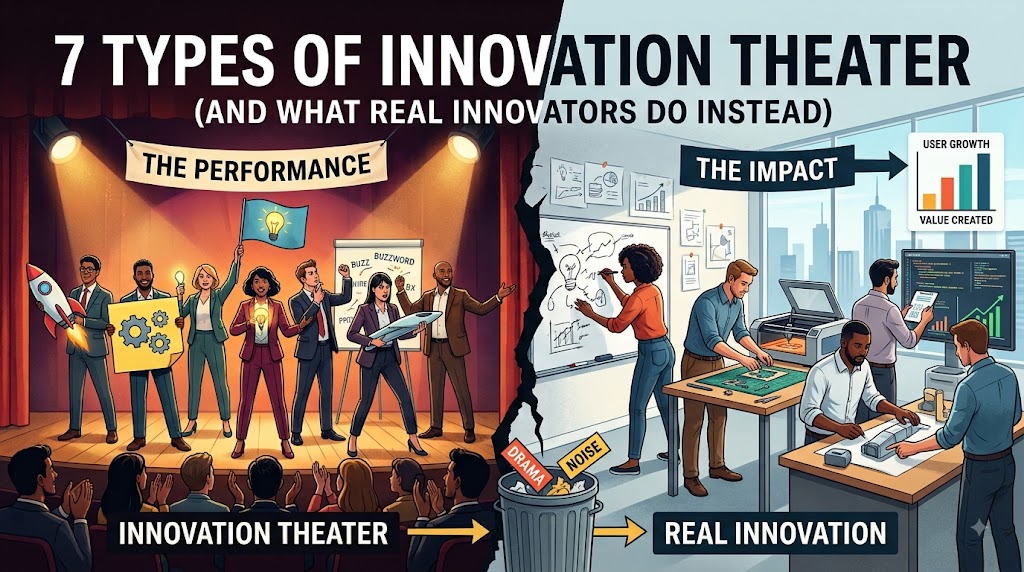
Innovation theater is activity that looks innovative — labs, idea contests, perpetual pilots, AI demos, vanity metrics — while failing to change power, process, customer outcomes, or the operating model. It prioritizes the appearance of progress over impact that lands with humans.
The seven common types are: (1) Idea Cemetery, (2) Lab as Lounge, (3) Pilot Purgatory, (4) Innovation Cosplay, (5) Metric Mirage, (6) AI Annex Theater, and (7) the Hero Inventor Myth. Real innovators replace each with ownership, adoption, and measured human impact — not costume.
Why Innovation Theater Gets Funded
Theater thrives because organizations often need the appearance of momentum more than they need the risk of change. Leaders want proof they are “doing innovation.” Teams want psychological safety without political danger. Vendors want logos on walls. Photographable activity becomes a substitute for impact that lands with humans.
Real innovators are not allergic to labs, design thinking, or pilots. They refuse to let those tools become costumes. Below are seven types of innovation theater — with the signs to watch and what human-centered innovators do instead.
| Type | Common sign | What real innovators do instead |
|---|---|---|
| 1. Idea Cemetery | Ideas collected, never decided | Sponsors, kill criteria, portfolio of few bets |
| 2. Lab as Lounge | Beautiful space, weak P&L link | Embed next to real constraints; measure adoption |
| 3. Pilot Purgatory | Forever demos, no scale path | Design for scale; clear go/no-go |
| 4. Innovation Cosplay | Methods without decision rights | Match method to mandate |
| 5. Metric Mirage | Activity vanity metrics | Behavioral and business outcomes |
| 6. AI Annex Theater | Tools on broken work | Redesign jobs first; free judgment time |
| 7. Hero Inventor Myth | Lone genius storytelling | Team-sport innovation; reward change work |
1. Idea Cemetery — When Innovation Contests Never Ship
What it is: Idea cemetery (or suggestion-box theater) is when organizations collect ideas through portals and contests, then never fund, own, or kill them.
The theater: Innovation portals and idea contests that collect brilliance, then bury it. No owners. No funding path. No kill criteria. Just a growing graveyard of good intentions and a leader who can still say, “We listen to our people.”
What real innovators do instead: They run a small portfolio of bets, not a museum of submissions. Every idea that advances has a sponsor, a question to answer, a budget band, and a date when it either graduates, pivots, or stops. Listening without a decision system is extraction dressed as engagement.
2. Lab as Lounge — Innovation Spaces Without Impact
What it is: Lab-as-lounge theater is when the innovation real estate and brand experience outrun any adopted outcome on a customer or employee journey.
The theater: Beautiful innovation space. Modular furniture. Logo wall. Inspiration quotes in sans-serif. Tours for executives and visitors. Meanwhile, the teams who own revenue, service recovery, and operations still cannot change a form field without a twelve-week ticket.
What real innovators do instead: They embed innovation next to real constraints — the call floor, the store, the claims process, the onboarding flow. Square footage is not a capability. Adopted outcomes on a named journey are. If the lab’s best KPI is visitor compliments, you have built an experience center for yourselves.
3. Pilot Purgatory — Forever Demos That Never Scale
What it is: Pilot purgatory is endless pilot projects that look like learning but avoid the hard work of scale, ownership, and replacing the old way of working.
The theater: Perpetual pilots. Forever demos. “We’re learning.” Sometimes true. Often a holding pattern that avoids data plumbing, workflow ownership, incentives, training, and the political decision to stop the old way.
What real innovators do instead: They design for scale on day one. Who owns the workflow if this works? What breaks if volume multiplies by ten? What is the go/no-go threshold? A pilot without an adoption plan is a science fair project with a corporate badge.
4. Innovation Cosplay — Methods Without Mandate
What it is: Innovation cosplay is using design thinking, agile, or “sprints” as costume when teams lack authority to change policy, budget, metrics, or process.
The theater: Methods without mandate. Design-thinking stickers on a process no one is allowed to change. Agile ceremonies that report status while governance remains waterfall. Sprints that cannot touch the actual levers of value.
What real innovators do instead: They match method to decision rights. Before the workshop, they ask: What are we empowered to decide, ship, or stop? If the honest answer is “nothing structural,” cancel the sticky notes and fix the mandate. Facilitation without power is entertainment with markers.
5. Metric Mirage — Measuring Innovation Activity, Not Value
What it is: Metric mirage is managing innovation by vanity and activity metrics — ideas filed, hackathons held, prototypes built — instead of human and business outcomes.
The theater: Dashboards of activity. Patents filed. Hours facilitated. Sometimes an “innovation NPS” that measures enthusiasm in the room rather than value in the world.
What real innovators do instead: They measure behavioral and business outcomes on a chosen journey: adoption, cycle time, retention, cost-to-serve, conversion, employee effort, revenue quality. Activity metrics can support the story; they cannot be the story. If you cannot name the human behavior that changes when you “win,” you are managing theater lighting.
6. AI Annex Theater — Tools on Broken Work
What it is: AI annex theater (a form of innovation washing) is bolting chatbots and copilots onto unbroken chaos, then calling speed alone a transformation.
The theater: Chatbots and copilots bolted onto broken work. More answers, same confusion. Faster drafts, denser interruptions. Automation that accelerates noise and gets declared transformation because the deck has gradients.
What real innovators do instead: They redesign the job, the handoff, and the decision before they celebrate the tool. AI should absorb fragmentation so humans can spend larger blocks on insight, empathy, problem definition, and judgment — a soft landing, not denser busyness. If nobody has protected deep-work capacity, you did not free people. You refilled their calendar.
7. Hero Inventor Myth — Lone Genius Over Team Sport
What it is: The hero inventor myth is when organizations celebrate a lone visionary while the people who adopt, integrate, and scale the change remain invisible.
The theater: The keynote founder of the internal startup. The genius in the corner whose idea becomes brand myth — until the next reorg erases the team that made it real.
What real innovators do instead: They treat innovation as a team sport. They reward insight and change — the unglamorous work of making something real for customers and employees. Human-centered innovation is rarely a flash of individual brilliance. It is a system that lets many people contribute and a few important things survive.
How Do You Stop Innovation Theater?
You stop innovation theater by forcing every initiative to answer five questions before the next pilot, lab ribbon-cutting, or AI annex:
- Who owns this after the applause? No named operator, no real initiative.
- What human behavior must change for this to count as success? If you only move a vanity metric, stop.
- What is the kill criteria? Endless learning without stop-rules is luxury consumption.
- What changes in the operating model if this works? If nothing structural can move, you have cosplay.
- Who loses if we stop pretending? Follow the incentives. Theater always has beneficiaries.
Innovation does not fail primarily because companies lack creativity. It fails when activity is allowed to impersonate progress. Real innovators optimize for impact that lands with humans — not for activity that photographs well in the annual report.
Frequently Asked Questions About Innovation Theater
What is innovation theater?
Innovation theater is activity that looks innovative — such as labs, idea contests, perpetual pilots, or AI demos — while failing to change power, process, customer outcomes, or the operating model. It prioritizes the appearance of progress over impact that lands.
How do you identify innovation theater?
Look for photographable activity without owners, kill criteria, operating-model change, or measurable behavior change. Common signs include idea programs that never ship, labs optimized for tours, endless pilots, methods without decision rights, vanity innovation metrics, AI tools on broken workflows, and lone-genius storytelling.
Why do companies do innovation theater?
Companies often fund innovation theater because the appearance of momentum feels safer than structural change. Theater provides career and brand insurance, satisfies stakeholders who want visible “innovation activity,” and avoids political risk — while real adoption would require new owners, incentives, and stop decisions.
What are the types of innovation theater?
Seven common types include the idea cemetery, lab as lounge, pilot purgatory, innovation cosplay (methods without mandate), metric mirage, AI annex theater, and the hero inventor myth. Each substitutes spectacle or activity metrics for adoption and value.
How do real innovators avoid innovation theater?
Real innovators assign owners and kill criteria, embed work in real constraints, design pilots for scale, match methods to decision rights, measure behavioral and business outcomes, redesign work before adding tools, and treat innovation as a team sport focused on human impact.
Image credits: Google Gemini
Content Authenticity Statement: The topic area, key elements to focus on, etc. were decisions made by Braden Kelley, with a little help from Google Gemini and Cursor to clean up the article, add images and create infographics.
 Sign up here to get Human-Centered Change & Innovation Weekly delivered to your inbox every week.