Why Your Best Ideas May Already Be on Your Payroll
GUEST POST from John Bessant
‘With every pair of hands you get a free brain!’
That’s the promise of high involvement innovation (HII) – engaging everyone in the organization in the innovation mission. And it’s got a lot to offer.
Take the case of Denny’s shipyard in Dumbarton, Scotland. They introduced a simple HII scheme to encourage anyone in their 350-strong workforce to make suggestions on how they could improve the company’s performance. Within their first year they’d managed to cut the time to build a warship from six months to four while also improving quality, adding new features and reducing waste.
Impressive stuff – but also a reminder that HII isn’t new. That story comes from 1871! Nor is theirs an isolated case; organized HII was happening at least a hundred years before that. The 8th Shogun of Japan, Yoshimuni Tokugawa, tried it out in 1721 with his “Meyasubako”, a box placed at the entrance of the Edo Castle for written suggestions from his subjects.
And the British navy pioneered a similar scheme in 1770, asking its sailors and marines for their ideas — significantly reassuring them that such suggestions would not carry the risk of punishment!
From pioneering efforts like John Patterson’s attempt to harness what he called ‘the hundred headed brain’ in the National Cash Register company in 1892 (eagerly imitated by the Eastman Kodak company in 1896) through to Toyota’s famous Kaizen commitment in the 1970s which mobilized over 50 million suggestions and helped put them at the forefront of productivity performance in the global car industry.
The evidence is clear – HII works. Building on ideas from across the organization can contribute significant competitive advantage and deliver multi-million dollar savings. As companies as diverse as Haier, Conoco-Philips, Liberty Global, Fujitsu or Nokia continue to attest.
Right now there’s great emphasis on looking outside – the world of open innovation in which ‘not all the smart guys work for us’ is recognized and driving a search to find those smart guys out there with whom we could connect. Whilst this is undoubtedly a rich source of inspiration we shouldn’t forget the internal world of employees and their ideas.
It’s one of the paradoxes of modern management that we have the key resource of creativity fitted as standard equipment in every person we employ – yet many organizations fail to recognize or manage to tap into this. In fact, according to the Gallup State of the Global Workplace 2026 report, global employee engagement has plummeted to just 20%—its lowest level since 2020. This is not merely a human resources issue, it’s a massive innovation drain.
One of the fathers of modern quality management, Joseph Juran, famously called this internal potential “the gold in the mine”. He argued that every pair of hands comes with a “free brain”—a reality we often ignore in our search for the next external breakthrough. Our challenge today is not just about finding more talent; it is about finding up-to-date and effective ways to extract the mineral of creativity already sitting in our offices, factories, and remote hubs.
But it’s not a magic trick. These results only emerge from an organizational culture which makes contributing to innovation a key part of ‘the way we do things around here’.
It’s not a one-off initiative; it’s a pattern of behavior which has become reinforced to the point that it’s a routine. Like professional dancers who have learned and rehearsed their intricate steps to the point where they don’t think about it; they just dance.
And it’s worth doing. Organizations which invest in creating a HII culture can reap impressive rewards. For example:
- ConocoPhillips: Their “Doing things better” program saved over $100 million in a single year. By focusing on “winterization” in their Canadian operations, just three implemented ideas provided exactly the process optimization they needed.
- Liberty Global: Their “Spark” program generated a €25 million return on investment over ten years, largely through “KISS” (Keep It Smart and Simple) campaigns.
- BAE Systems: Their “Empower” program has been so consistently valuable in terms of generating savings and improvements that the innovation team now has its own $1 million budget to fund employee ideas, expecting a return of five to ten times that investment.
It’s all about finding ways to bring the ‘hundred-headed brain’ to bear on the challenges facing the organization. Trouble is we sometimes forget this potential. In one financial services organization a single idea from a long-serving (17 years) employee helped save £250,000in its first year alone. When he was asked why he waited 17 years to share his thoughts, he simply replied: “Nobody’s ever asked me before!”.
So if we want the benefits that HII clearly has to offer we need to understand just what behaviors we are talking about and how they might move from being unfamiliar faltering new steps to become embedded routines.
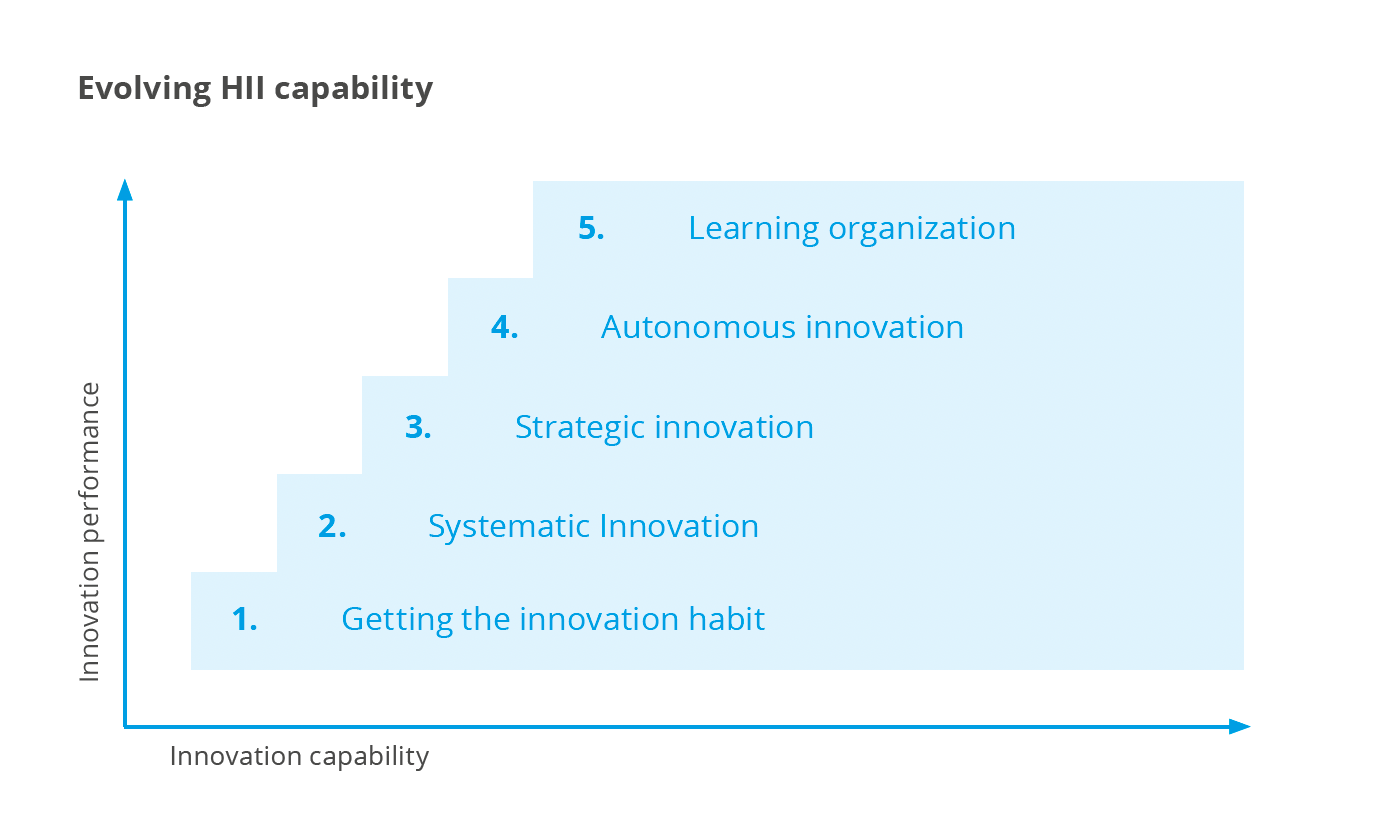
Back in the mists of time (the late 1990s) we began a research program trying to understand this question, working with a wide range of organizations, large and small, in manufacturing, services and not-for-profit. And a pattern gradually began to emerge; although what they all shared was a desire to embed HII in their organizations the real challenge was in changing the culture, introducing and then reinforcing new ways of behaving. It involved a journey where progress was measured not in terms of time or money invested but in how well the organization learned and mastered key behaviors.
It’s worth looking a little more closely at what each of these stages in evolving maturity looks like – and the challenges posed in moving to the next level of capability.
Level 1 might be described as ‘getting the innovation habit’. Organizations at this level are often newcomers to the idea, playing around with it and exploring before fully committing themselves. Their activities involve small-scale pilots and their impact is limited, picking up some low-hanging fruit but not really engaging with big challenges. Support and sponsorship for the approach is often limited and of a temporary nature – there’s little or no long-term commitment from the top.
The big risk in this is that early users will be turned off because nothing seems to happen with their ideas – it’s just been another of those ‘interesting initiatives’ which go nowhere. There’s little or no training provided so most learning comes about by doing; at best facilitation and support is provided by someone inside the organization doing it on a part-time basis or else from external consultants doing it on a temporary basis.
The focus is on local-level issues with little cross-functional or interdisciplinary activity. Knowledge management is rudimentary – perhaps a simple spread sheet on which to record ideas coming into the system. And there’s little in the way of a reward/recognition scheme, not much in the way of motivation to keep going.
By contrast an organization at level 2 would be much more systematic in its approach. It takes HII seriously and has made the decision to invest – not just in an enabling platform but in providing facilitation and encouraging people to participate. This is not just an initial wave of enthusiasm; people join in with their ideas but also with comments, refinements, improvements – a collaborative innovation activity. There’s an idea management system in place to enable ideas to move from initial suggestion, through refinement and improvement to downstream implementation and different pathways for implementation have been identified.
And there is more evidence of support from senior leadership, in terms of both commitment of resources and active sponsorship for the program. But this still takes the form of overall umbrella support rather than directly linked to the line or operating structure of the organization. And the targets for ideas are still mostly bottom-up suggestions; there is little in the way of linkage to the strategic goals of the organization.
Some consideration has gone into the motivation question – there is some form of reward and recognition coming back to people in return for their engagement. Training is provided to help people learn to use the platform and develop their skills and understanding around innovation.
Knowledge management is on a more organized basis now but is still mostly around capturing and storing information – for example recording suggested ideas.
Level 3 brings in the strategic dimension, hooking up the innovation engine which has been built in level 2 and driving it in a particular direction. Campaigns are clearly identified and explained, they are sponsored from a high enough level to communicate that this is an important direction for the organization to move in. And there is a clear owner, interested in the innovations which emerge because they’ll help move the organization forwards. With clear targets comes the possibility of measuring progress against those strategic objectives – something which helps justify the costs (in terms of time and other resources) invested in HII by the organization.
By their nature many of the campaigns cut across organizational boundaries and so the platform increasingly engages people from different parts – there may even be scope for working with external players like suppliers or customers in key campaigns.
At this level the underlying structure for HII is in place and working well. There is extensive facilitation, perhaps involving more than one person working full-time to review and improve the system and help develop it further. Participation rates are higher, appropriate to the nature of the challenge, and spreading out across the organization and people are regularly engaged in the full spectrum of activity on the platform, from ideation through comment and refinement, judging and helping focus and supporting implementation of the strongest ideas. In particular the selection/judgment phase now has clear criteria against which to assess ideas, and many people can help bring ‘the wisdom of crowds’ to this process.
People are experienced in using the platform and continue to be trained in innovation-related skills. In particular the organization has a growing library of tools and techniques available to support the innovation process and the role of facilitators has moved to include a core training, coaching and development one.
Knowledge is now not only being created and stored in the form of ideas – it is being recombined and deployed, key lessons from one area being available to others to use. As a result there is less re-invention of the wheel, more sharing of good ideas and practices.
Level 4 builds on this but also starts to provide an environment in which bigger ideas can be explored alongside the steady stream of campaign-focused innovations. Participation is now at a high level, broadly spread across the organization and engaged in ideation, judgment and implementation. In addition there is now encouragement of highly committed internal entrepreneurs – ‘intrapreneurs’. Teams of people form around these major projects and work off-line to develop them further to create detailed business cases and models. To support this there is extensive training and skills development in key areas such as business planning, project management and financing plus the allowance of time and other resources to the team to support their efforts. People by this time are learning to use the innovation process autonomously – enacting entrepreneurship.
The nature of both campaigns and team-driven entrepreneurial ideas increasingly moves the organization towards cross-functional engagement, linking up across various boundaries and even to outside organizations such as suppliers.
When the ideas have matured they are presented in a ‘pitching’ session to senior management for possible further development and adoption within the organization’s major innovation portfolio. This places a challenge on senior management, not only now to provide support and encouragement but also to commit to seeing the ideas that fit their need through. Just like the role of sponsors as ‘owners’ in the campaign-led route this stage requires active leadership.
Knowledge management at this level operates in sophisticated fashion, not only capturing and storing ideas in a ‘knowledge warehouse’ but also actively searching and using the knowledge to support a wide range of projects. In particular it allows for recombination and redeployment across different areas; the role of supporting and enabling this becomes one of significance. Organizations begin to think about ‘knowledge curation’ as a key activity.
Level 5 involves the strategic use of HII capability, spreading it widely. It is about building and growing innovation communities – with clients, with the external crowd, with suppliers. In a sense the organization becomes increasingly ‘borderless’, operating several parallel innovation activities with these communities but ensuring they remain aligned and focused. There is extensive use of the online functionality in the platform but a growing parallel offline organization of active entrepreneurial groups.
Knowledge management becomes central to the organization, harvesting, processing and redeploying a wide range of knowledge assets and engaging increasingly in open innovation fashion with a wide range of players and stakeholders. The platform becomes the intelligent infrastructure on which a community of sharing co-creators operate.
So how do we climb the staircase – how to build a high involvement culture?
Most organizations start at level 1 – getting the innovation habit —where the biggest risk is turning people off by doing nothing with their ideas. The turning point comes at level 3 – strategic innovation – where the innovation engine finally connects to the organizations actual goals. And the vision is level 5 , a connected but borderless organization where innovation is a way of life. It’s a journey – but at its heart its about changing the culture – ‘the way we do things around here…’
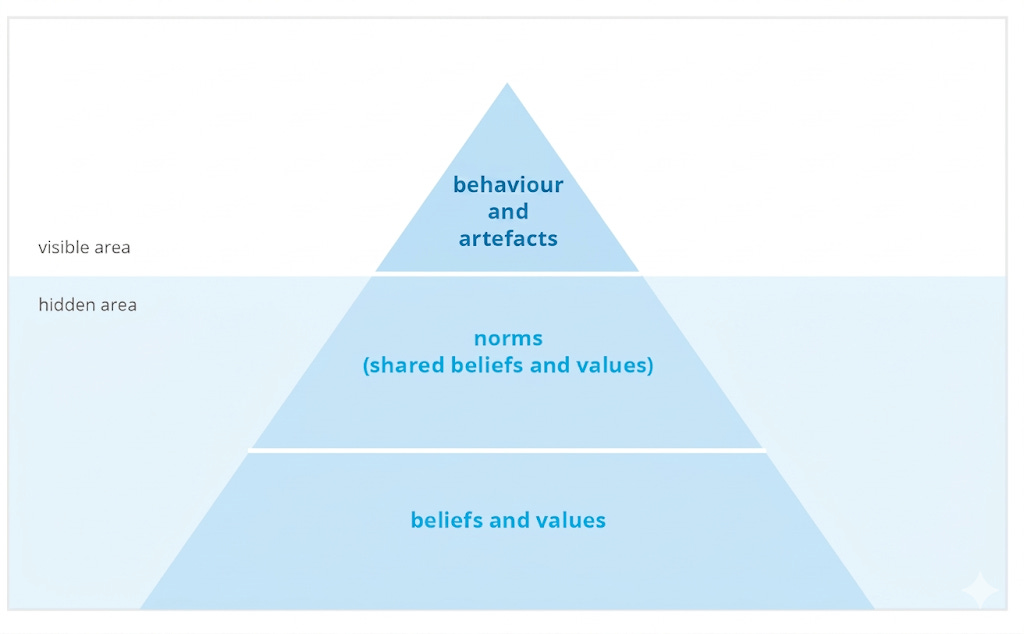
Cultures don’t just happen – they’re built up in a hierarchical way. At the base we have individual values and beliefs – the things which matter to us and which shape the way we think about the world. We share these with others and arrive at some common views – norms – which shape how we behave alongside each other in our organizations.
Over time these patterns of behavior are rehearsed and repeated to the point where we no longer think consciously about them. Eventually they become ‘hard-wired’ into our organization’s processes and procedures, its rules and structures.
Building a high involvement innovation culture
What are the underlying values and beliefs we need to build? Our research identified ten key building blocks; in a high involvement culture we’d expect to find evidence that reflects the belief that:
1. ideas from everyone matter – everyone is capable of contributing to innovation
2. HII needs a core enabling process – it’s not about sudden flashes of inspiration but a systematic process for listening to, sharing and taking good ideas forward. And allowing time and space for it to operate
3. Ideas are not the problem – enabling them to create value is the key. We need an idea management system which gives recognition, feedback and ways to take them forward
4. People can learn how to innovate – innovators are made, not born. But they need support in the form of training and development, tools and techniques to help them become more effective innovators
5. Leadership matters – people who believe the HII story and enable the narrative, providing guidance, direction and support
6. Ideas have real impact when they are strategically directed, HII works when bottom up capability meets top down clear direction about where and why improvements matter
7. HII needs a supporting structure – facilitation, coaching, training, etc. And this structure needs continuous review and development, updating it to provide the scaffolding for the future
8. Knowledge lies at the heart of innovation and people are key carriers of it
9. Knowledge is distributed across the organization so HII needs to enable inclusiveness, openness and free flow of knowledge across boundaries
10. Motivation matters – people need an incentive to share their ideas. This is less about money than about recognition, feeling listened to, empowered, enabled to contribute
Where do we start?
The good news is that we now have some powerful new enabling technologies and a wealth of shared experience to draw upon to help us build such a culture. We’ve come a long way from the simple days of the suggestion box – but HII won’t happen by waving a magic wand and pronouncing the high involvement spell. The conclusions from our research are simple; organizations need to work on four things:
· Articulate what we want to see people doing, and hear them saying as they go about their work? What stories do they tell about success – and failure – in innovation, and what behaviours underpin that?
· Enable those behaviors. Put in place mechanisms to help people learn and practice these behaviors. This might involve training them in specific skills, such as problem finding and solving or using design thinking. It might include providing structures to support and guide the behaviors – the policies and procedures to follow. It may be creating an enabling platform – for example, using a collaboration platform to provide a way to share and build on ideas, collecting and deploying them.
· Reinforce them – If these behaviors are to become ‘the way we do things around here’ then we need to reinforce them through feedback, rewards, and incentives. For instance, celebrate innovation achievements, recognize teams and individuals who make a contribution, and above all make sure that people who take risks or move outside the expected don’t get punished or blamed if they fail!
· Review, reflect and pivot. For a resilient HII culture, we also need the capacity to review and adapt. It’s a learning journey, a continuous process of adapting, adjusting and occasional major resetting.
In today’s turbulent world the need to extract the “gold in the mine” has never been greater. The good news – which we’ve known about for hundreds of years – is that engaging the ‘hundred-headed brain’ can and does work. Today’s resilient organizations are those which have moved past the “faltering new steps” of a pilot program to reach the higher levels of maturity where innovation is a strategic, autonomous engine.
This transformation is not a “magic trick” or a one-off initiative; it is a dedicated learning journey.
More details on the original research and the HII maturity model which we developed can be found here – you can also use the tool to assess your organization’s progress on the HII journey
You can find my podcast here and my videos here
And if you’d like to learn with me take a look at my online courses here
And subscribe to my (free) newsletter here
All images generated by Substack AI unless otherwise indicated
 Sign up here to join 17,000+ leaders getting Human-Centered Change & Innovation Weekly delivered to their inbox every week.