(Even When They “Believe” in It)
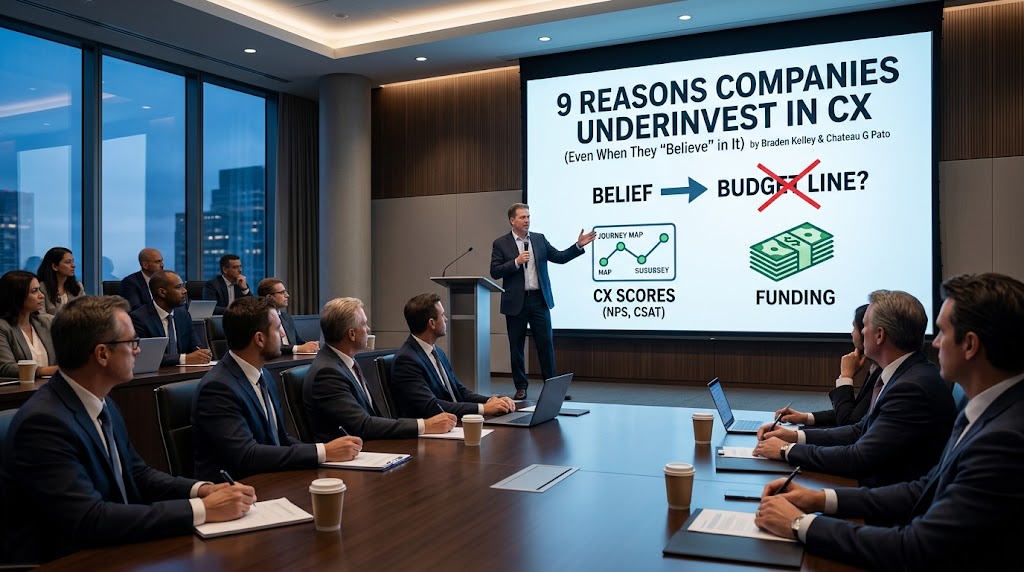
by Braden Kelley and Chateau G Pato
Why Do Companies Underinvest in CX If They Believe in It? (Short Answer)
Companies underinvest in customer experience even when they “believe” in it because belief is not a budget line. CX often arrives at the funding table with scores and journey maps; competing asks arrive with dollars. Leaders nod at loyalty, then fund what they can defend on a spreadsheet.
Nine common reasons: (1) nobody can price it, (2) scores are treated as the strategy, (3) CX is a department not an operating system, (4) the front line is accountable without authority, (5) cost cuts win because loyalty lags, (6) green SLAs hide red experiences, (7) no one owns the journey after the workshop, (8) listening is cheap and acting gets cut, and (9) the truth would require tradeoffs nobody wants.
Belief Is Not a Budget Line
I have sat in enough leadership rooms to recognize the pattern by the coffee cups. Someone says customer experience is a priority. Heads nod. A journey map appears that could win a design award. Then finance asks the only question that counts in that room: What is this worth?
The conversation that felt strategic starts to sound like a philosophy elective. Marketing shows pipeline. Product shows release velocity. Sales shows bookings. CX shows a score — and hopes the room will emotionally translate “up and to the right” into money.
Hope is not a business case. Companies rarely underinvest because they hate customers. They underinvest because experience is treated as a belief, a metric, or a department — not as a priced operating system with owners, incentives, and frontline power.
| Reason | What “belief” looks like | What to do instead |
|---|---|---|
| 1. Unpriced impact | NPS slides, no dollars | Metric → behavior → money → intervention |
| 2. Score as strategy | Managing the number | Fund the why and the loop |
| 3. Department sidecar | CX team, no levers | Journey owners with rights |
| 4. Accountable, powerless | Front line absorbs anger | Fund enablement at the moment of truth |
| 5. Loyalty lags | Cuts win this quarter | Show the lag; protect key journeys |
| 6. SLA-green theater | Uptime hides struggle | Human success on the scorecard |
| 7. Maps without owners | Workshop, then drift | Name the Tuesday operator |
| 8. Listen, don’t act | VoC tools survive; recovery doesn’t | Budget hear → act → confirm |
| 9. Tradeoff avoidance | Symbolic CX everywhere | Fund fewer journeys fully |
1. Nobody Can Price It
What it is: Underinvestment because CX impact never gets translated into finance-ready estimates of retained revenue, avoided acquisition cost, or lower cost-to-serve.
The pattern: Customer experience speaks NPS, CSAT, and CES. The budget speaks dollars. The proposal that speaks fluent finance gets funded. The proposal that speaks fluent satisfaction waits another year.
What to do instead: Use a simple value chain — experience metric → customer behavior → financial outcome → named intervention. Start with your churn, revenue per customer, and cost per contact. Model a conservative-to-optimistic range. Say what is estimated. Transparency survives a CFO. False precision does not.
2. Scores Are Treated as the Strategy
What it is: Managing the survey number as if it were the customer relationship.
The pattern: Teams chase points on a dashboard while the journeys that produce loyalty stay underfunded. Scorekeeping without sense-making. When response rates collapse, the “strategy” gets thinner and the belief gets louder.
What to do instead: Demote scores to signals. Fund the why — conversational listening, journey repair, closed loops — not another instrument that asks people to perform unpaid labor for a brand that will not change.
3. CX Is a Department, Not an Operating System
What it is: Belief lives on the org chart. Investment does not follow the work.
The pattern: A CX team owns maps, research, and the annual summit. It does not own policy, product sequencing, staffing, or incentives. So “we believe in experience” becomes a sidecar to the real operating model.
What to do instead: Give journey owners decision rights. Treat customer experience as how the enterprise runs — handoffs, recovery, promises — not as a department that comments after the fact.
5. Cost Cuts Win Because Loyalty Lags
What it is: Savings show up this quarter. Churn, effort, and brand damage show up later — so the impatient P&L always has the better story.
The pattern: Headcount, knowledge, and recovery get trimmed because the harm is delayed. By the time loyalty moves, the cut already looks like “discipline.”
What to do instead: Make the lag visible. Protect a few high-leverage journeys from efficiency that is actually extraction. Pair any cost takeout with the human behaviors you are betting will not change — and watch those behaviors like a hawk.
6. Green SLAs Hide Red Experiences
What it is: Managing by cold service metrics while humans still fail the job.
The pattern: Uptime, response time, and handle time look healthy. Customers repeat their story. Employees run workarounds. The dashboard is green; the relationship is not. Belief in “service excellence” funds the SLA stack and starves experience-level measures.
What to do instead: Put human success on the same review as reliability. A green SLA should not close the meeting if effort is high, trust is low, or people cannot finish in one attempt. SLAs keep the lights on. They should not get to pretend they are the whole truth.
7. No One Owns the Journey After the Workshop
What it is: Maps and research get funded. The operating owner of a broken handoff does not.
The pattern: Belief photographs well in a workshop. Then Monday returns the work to silos. Nobody is empowered to change the seam between “marketing promised” and “operations delivered.”
What to do instead: Name a durable journey owner before the next offsite — someone who can change the path, not only present it. If the map has no Tuesday operator, you funded theater.
8. Listening Is Cheap; Acting Is What Gets Cut
What it is: Voice-of-customer tools, surveys, and dashboards survive budget cycles. Recovery staffing, redesign, and closed loops do not.
The pattern: Organizations get very good at collecting opinions and very timid about spending to change the thing people complained about. Customers notice. So do employees who asked for input and watched nothing move.
What to do instead: Budget the loop — hear, understand, act, confirm — as one investment, not a listening layer plus a vague “we’ll take it back to the business.” Reciprocity is what makes the next conversation possible.
9. The Truth Would Require Tradeoffs Nobody Wants
What it is: Real CX investment would expose turf, pet channels, understaffing, and brand promises operations cannot keep — so “belief” stays safer than choice.
The pattern: Symbolic experience everywhere; funded experience nowhere that hurts. Another journey map. Another principle. No decision about what you will stop doing so a few moments can actually work.
What to do instead: Surface winners and losers. Fund fewer journeys fully rather than every journey symbolically. Belief that refuses tradeoffs is not strategy. It is branding for the annual report.
How Do You Get Customer Experience Funded?
Turn belief into an investable ask. Do not take the next CX proposal to finance until you can answer these:
- What is this worth in our numbers — retained revenue, cost-to-serve, regrettable attrition — not an industry slogan?
- Which customer or employee behavior must change for the investment to count as success?
- Who owns this journey on a normal Tuesday after the workshop ends?
- What old path or SLA-only definition of winning will we stop treating as success?
- What frontline power — staffing, tools, recovery authority — are we actually funding?
Belief gets you the slide. A priced human outcome gets you the line item. If you want companies to stop underinvesting in customer experience, stop asking leaders to have more faith — and start giving them a case the budget can recognize without translating it into a foreign language.
Frequently Asked Questions
Why do companies underinvest in CX even when they believe in it?
Because belief is not a budget line. Customer experience often arrives with scores and maps while competing investments arrive with dollars. Underinvestment follows when impact is unpriced, scores substitute for strategy, CX lacks operating power, the front line has accountability without authority, cost cuts beat lagging loyalty, SLAs hide poor experience, journeys lack owners, listening is funded without action, and real tradeoffs are avoided.
Why isn’t believing in customer experience enough?
Belief produces slides, principles, and workshops. Funding requires a priced outcome, a named owner, incentives that match the new behavior, and frontline power to deliver the promise. Without those, “we believe in CX” is branding, not investment.
How do you get CX funded in a budget meeting?
Translate an experience metric into a customer behavior and a dollar outcome tied to a specific intervention. Use internal numbers where possible, show a range, name the journey owner, and include the frontline enablement required to make the change real.
What are the main reasons companies underinvest in customer experience?
Nine common reasons are unpriced impact, treating scores as strategy, CX as a powerless department, frontline accountability without authority, short-term cost cuts beating lagging loyalty, green SLAs hiding red experiences, maps without journey owners, listening without funded action, and unwillingness to make tradeoffs.
How does underinvesting in CX affect employees?
When experience is underfunded, frontline people are often still held accountable for customer outcomes they cannot deliver. That gap drives frustration, burnout, and regrettable attrition — so the company pays twice: weaker customer loyalty and higher cost to replace the humans who knew how to save the moment.
Image credits: Google Gemini
Content Authenticity Statement: The topic area, key elements to focus on, etc. were decisions made by Braden Kelley, with a little help from Google Gemini and Cursor to clean up the article, add images and create infographics.
 Sign up here to get Human-Centered Change & Innovation Weekly delivered to your inbox every week.