LAST UPDATED: February 12, 2026 at 10:40 AM
by Braden Kelley and Art Inteligencia
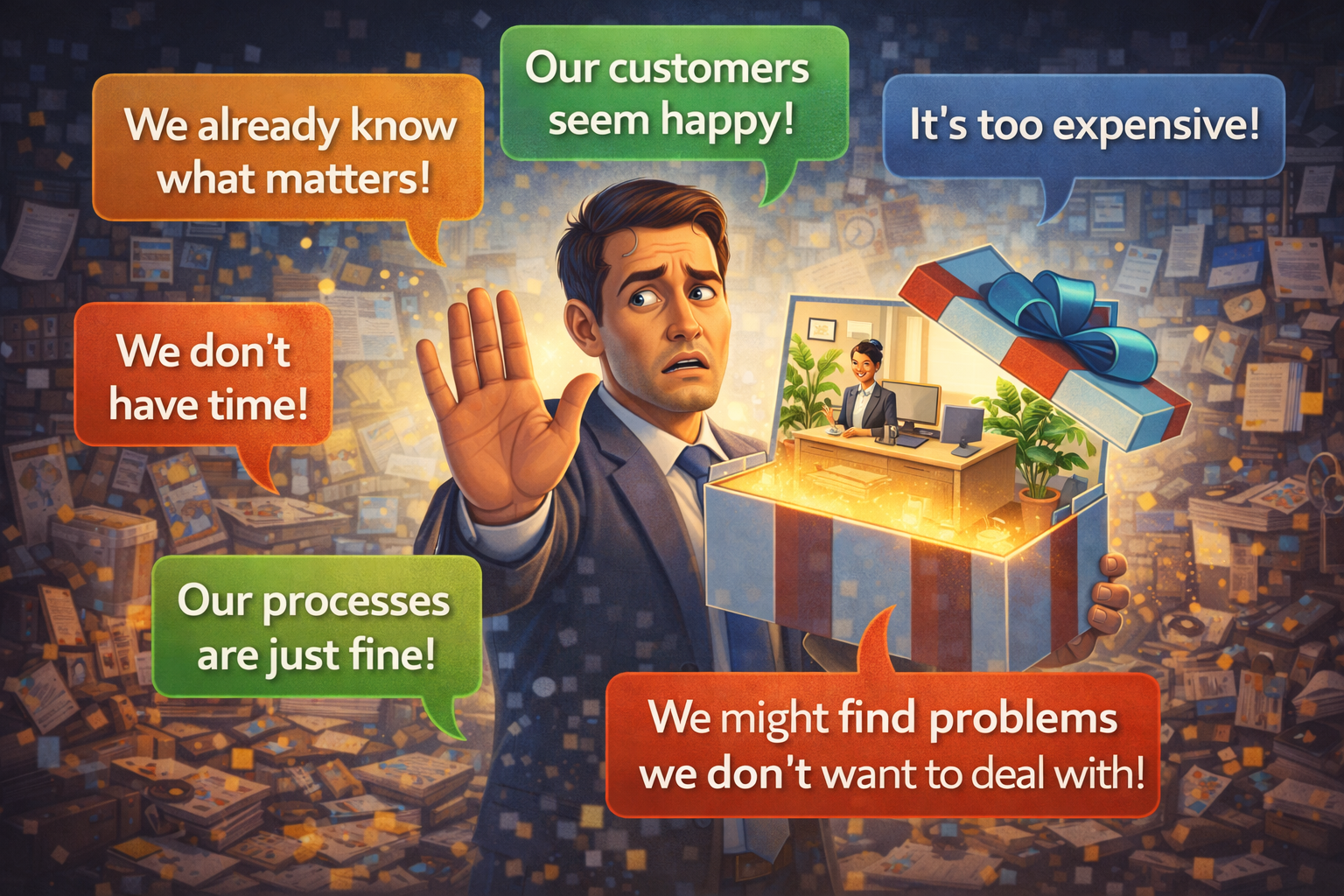
In the high-stakes theater of modern business, many leaders have developed a remarkable talent for a dangerous form of “experience narcissism.” They stand in boardrooms, surrounded by glowing dashboards and rising Net Promoter Scores (NPS), convincing themselves of a comforting delusion: that they already know exactly what it feels like to be their customer. They assume that because the machine is running, it must be well-oiled. But as a champion of Customer Experience Audits (aka Customer Experience Risk and Revenue Leakage Diagnostic), I have seen far too many organizations fail not because they lacked a great product, but because they lacked the courage to look in the mirror.
The refusal to conduct regular, rigorous customer experience audits is rarely a matter of resources; it is a defensive reflex. It is the Corporate Antibody Response protecting the status quo. Leaders tell themselves that their digital analytics tell the whole story, or that “if it were truly broken, we’d hear about it.” These are the lies that create Invisible Friction — the silent, compounding drag that prevents an invention from ever reaching its potential as a true innovation.
When we avoid the audit, we aren’t just saving time; we are actively choosing to ignore the hurdles that drive customers into the arms of more agile competitors. We treat the customer journey as a static map we drew five years ago, rather than a living, breathing, and often messy reality. To be a leader in the age of Purpose-Driven Innovation, you must be willing to trade your comfortable assumptions for the uncomfortable truth.
1. The Lie of “We Already Know Our Customers”
The first, and perhaps most seductive, lie that leaders tell themselves is the myth of the “Static Persona.” This is the belief that because the leadership team spent six months on a deep-dive research project three years ago, they now possess a permanent, intuitive understanding of their customer’s psyche. They treat customer knowledge as a milestone to be reached rather than a perishable asset. Competitors change the baseline for “convenience,” global events shift priorities, and technology alters how customers view value. Without a regular audit, leaders are effectively navigating today’s stormy seas using a map of a coastline that has already eroded.
This lie often manifests as “Experience Narcissism,” where executives assume their own personal interactions with the brand are representative of the average user’s journey. They use the latest flagship hardware on a high-speed corporate network and wonder why the front-line customer, using a three-year-old device on a spotty cellular connection, is frustrated. They confuse their authority with empathy. A rigorous audit acts as a necessary “ego-check,” stripping away the polished executive view to reveal the Invisible Friction that customers face every single day.
Furthermore, leaders frequently mistake “Customer Data” for “Customer Truth.” They point to demographic reports and purchase histories as proof of their intimacy with the market. But data tells you the what, while an audit tells you the why. You might know that a customer abandoned their cart, but without an audit of the experience, you won’t know if they left because of a technical glitch, a confusing shipping policy, or a sudden moment of brand distrust. To ignore the audit is to choose to lead from a spreadsheet rather than from the soul of the customer journey.
2. The Lie of “Digital Analytics Tells the Whole Story”
The second great deception is the worship of the “Dashboard Delusion” — the belief that a green arrow on a conversion chart is synonymous with a satisfied customer. Leaders often hide behind quantitative data because it feels objective, safe, and controllable. They see a steady flow of traffic and a predictable checkout rate and conclude that the Value Access path is clear. However, digital analytics are purely evidentiary; they show you where the footprints are, but they never show you the “ghosts”—the thousands of potential customers who looked at your landing page, felt a subtle pang of confusion or distrust, and vanished without leaving a single data point behind.
An audit is required because analytics cannot measure what didn’t happen. They don’t capture the frustration of a user who successfully completed a task but vowed never to return because the process was emotionally draining. They don’t show the Invisible Friction of a customer who had to open a separate tab to search for an explanation of your jargon. When leaders skip the audit, they are essentially trying to understand a symphony by looking at a spreadsheet of decibel levels; they see the volume, but they completely miss the dissonance.
Furthermore, relying solely on digital metrics often leads to “Local Maxima” thinking. You might optimize a button color or a headline to increase a click-through rate by $2\%$, but an experience audit might reveal that the entire feature is redundant or misaligned with the customer’s actual goal. Analytics tell you how to do the wrong thing more efficiently, while auditing tells you if you are doing the right thing at all. As I often emphasize, true Value Translation happens in the heart of the user, a place where Google Analytics has no login credentials.
3. The Lie of “We’ll Hear About It If It’s Broken”
The third lie is perhaps the most comfortable, and therefore the most catastrophic: the “Silence is Golden” fallacy. Leaders often operate under the assumption that their customers act as a free, 24/7 quality assurance team. They believe that if a friction point were truly detrimental to the brand, it would trigger a flood of support tickets or a viral social media outcry. This creates a false sense of security that I call the Reactive Trap. In reality, the vast majority of customers do not have the time, energy, or desire to help you fix your business. When they encounter a broken experience, they don’t complain — they simply evaporate.
This silence is not a sign of health; it is the sound of Silent Churn. For every one customer who takes the time to write a detailed email about a confusing interface or a lackluster service interaction, there are dozens more who quietly moved their business to a competitor who made the “Value Access” feel effortless. By the time a problem is “loud” enough to reach the executive suite without an audit, the organization has likely already lost significant market share. An audit is a proactive hunt for these silent killers, allowing for Human-Centered Change™ before the damage becomes irreversible.
Relying on complaints also skews a leader’s perspective toward “extreme” failures while ignoring the “death by a thousand cuts” that truly defines a brand’s reputation. A customer might not complain about a slightly slow load time, a mildly confusing confirmation email, or a repetitive form field, but the cumulative Cognitive Load of these micro-frictions erodes trust over time. As an innovation speaker, I frequently remind my clients that “no news” is often just a polite way of saying “I’ve found someone better.”
4. The Lie of “It’s Too Expensive and Time-Consuming”
The fourth lie is a classic case of “Accounting Myopia” — the belief that a customer experience audit is a discretionary expense rather than a fundamental investment in Value Creation. Leaders often look at the price tag of a comprehensive audit or the internal hours required to map a journey and immediately relegate it to the “maybe next year” pile. They view the audit as a cost center, a luxury to be indulged only when the budget is flush. What they fail to realize is that they are already paying for the audit every single day — not in invoices, but in the “Friction Tax” of lost conversions, increased support costs, and skyrocketing customer acquisition fees.
When you refuse to audit, you are essentially pouring expensive marketing “water” into a leaky bucket. You might spend millions on a new brand campaign, but if your Value Access path is riddled with Invisible Friction, a significant portion of that investment is being wasted. I’ll argue that if you think an audit is expensive, you haven’t calculated the cost of the “Experience Void” — the revenue left on the table by customers who encountered a hurdle and walked away. An audit doesn’t cost money; it recovers stolen profit.
Furthermore, the “Time-Consuming” argument is often a mask for a lack of organizational agility. Leaders fear that an audit will uncover a mountain of technical debt or procedural flaws that they aren’t prepared to fix, so they avoid the diagnosis to avoid the surgery. But in the age of Purpose-Driven Innovation, time is your most precious commodity. Every month you spend operating with a flawed experience is a month you give your competitors to build a better relationship with your audience. Let’s be honest: “You don’t have time not to audit.” You can either spend the time now to fix the journey, or spend the time later explaining to the board why your market share has evaporated.
5. The Lie of “Our NPS Score is Great”
The final, and perhaps most insidious, deception is the “Metric Shield” — the belief that a high Net Promoter Score (NPS) is a definitive certificate of health that renders a customer experience audit unnecessary. Leaders often cling to this single, shiny number as a way to soothe their egos and pacify the board. They argue that if the “score is up,” the customers must be happy. However, as any customer experience practitioner knows, NPS is a trailing indicator that is notoriously easy to manipulate and dangerously void of context. It tells you the temperature of the room, but it doesn’t tell you if the air is toxic.
When leaders use NPS to bypass an audit, they are choosing to prioritize a vanity metric over Value Translation. An NPS score can be high simply because your customers have no better alternative at the moment, or because your team has learned to “game” the survey by sending it only after successful interactions. It fails to capture the Invisible Friction of the silent majority who were too frustrated to even take the survey. An audit, by contrast, dives into the “Why” behind the number. It reveals the cracks in the foundation that a single-digit score is designed to cover up.
Relying on NPS without an audit is like checking your heart rate and assuming you’re fit for a marathon without checking if your legs are broken. You might have “Promoters” who love your brand’s mission but are secretly exhausted by your checkout process. These are “Fragile Promoters” who will defect the moment a competitor offers a lower Cognitive Load. Often the most dangerous place for a leader to be is standing on top of a high NPS score, refusing to look down at the crumbling experience beneath their feet.
Conclusion
The greatest threat to your organization’s future isn’t a lack of vision or a shortage of capital — it is the comfort of your own assumptions. Every lie you tell yourself about the state of your customer journey acts as a Corporate Antibody, attacking the very innovation you claim to champion. By avoiding the regular, rigorous mirror of a customer experience audit, you are essentially choosing to drive a high-performance vehicle with the windshield blacked out, relying solely on a GPS map that hasn’t been updated in years. True leadership requires the humility to admit that what you think you know about your customer is likely outdated, and what your dashboards are telling you is likely incomplete.
The path to success in 2026 is paved with the friction you choose to remove today. If you are ready to stop hiding behind “Experience Narcissism” and vanity metrics, you must treat auditing not as a chore, but as a strategic competitive advantage. For those ready to take the first step toward a clearer perspective, I encourage you to explore my deep-dive guide in Customer Experience Audit 101 or understand the shifting landscape in Why a Customer Experience Audit is Non-Negotiable in 2026. The wilderness of the market is moving fast, and only those who constantly tend to their “customer garden” will survive.
I have spent my career helping leaders turn their Invisible Friction into visible opportunity. Don’t wait for your customers to tell you it’s broken by leaving; be proactive and reclaim the experience excellence they deserve. Do you need help conducting a transformative customer experience audit?
Let’s work together to ensure your innovation doesn’t just look good on paper, but feels incredible in the hands of your customers.
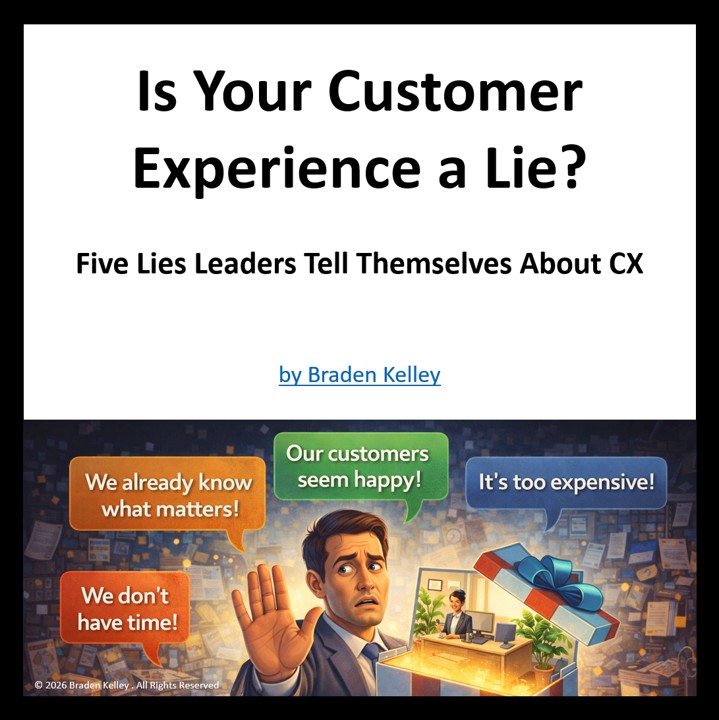
Download the Five Lies Leaders Tell Themselves About CX Flipbook as a PDF by clicking the link or the image above.
Image credits: ChatGPT
Content Authenticity Statement: The topic area, key elements to focus on, etc. were decisions made by Braden Kelley, with a little help from Google Gemini to clean up the article and add citations.
 Sign up here to get Human-Centered Change & Innovation Weekly delivered to your inbox every week.
Pingback: Why It Matters WHO Conducts Your Customer Experience Audit | Human-Centered Change and Innovation
Pingback: Top 10 Human-Centered Change & Innovation Articles of February 2026 | Human-Centered Change and Innovation