GUEST POST from Art Inteligencia
I. Introduction: The Paradox of Abundant Innovation
For decades, the primary barrier to innovation was cost. Building a prototype required significant capital, testing a market required dedicated research teams, and scaling a solution required institutional muscle. Today, that economic equation has been inverted. Generative intelligence, low-code infrastructure, and distributed digital tools have dramatically lowered the financial and technical friction required to build something “new.” Ideation and initial execution have effectively been commoditized.
Yet, an elementary economic law remains unbroken: when a key input becomes cheap and abundant, the complementary assets required to make it valuable suffer sudden, acute scarcity. As the cost of creating ideas drops toward zero, we encounter a new crisis—not a lack of ingenuity, but an overwhelming abundance of noise.
When anyone can launch a concept in an afternoon, the bottleneck shifts entirely. The fundamental question for modern leadership is no longer “How do we generate more ideas?” but rather, “When innovation gets cheap, what actually becomes scarce?”
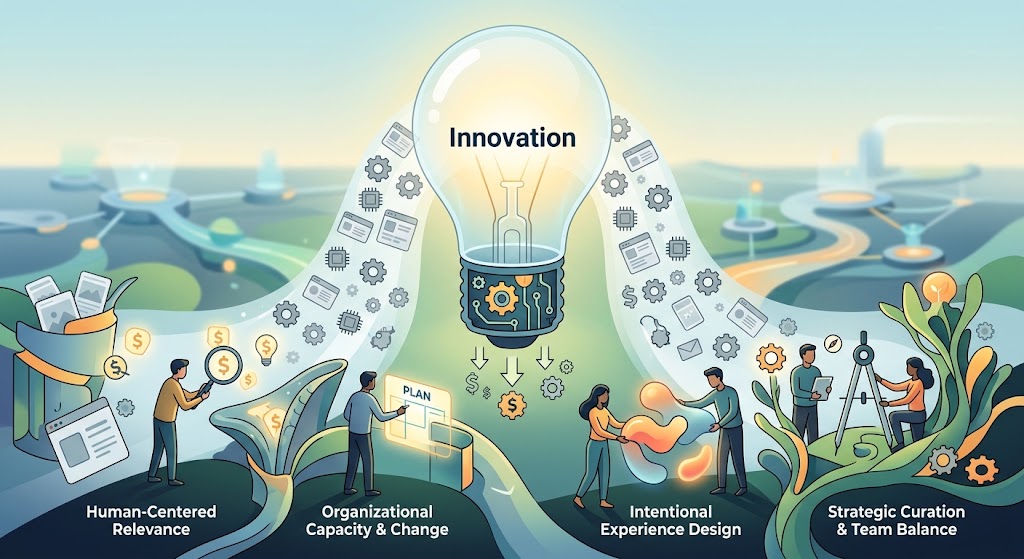
True competitive advantage has migrated away from raw invention. In an era of commodity ingenuity, scarcity centers on human-centered change capabilities, intentional experience design, rigorous curation, and the organizational capacity to absorb transformation. Winning today requires moving past the fascination with cheap execution and mastering the human assets that turn rapid output into lasting value.
II. Scarcity #1: Human-Centered Relevance (Discerning Signal from Noise)
The immediate byproduct of cheap innovation is a torrential flood of “junk innovation”—solutions looking for problems, features engineered simply because the code was effortless to generate, and products launched without deep market validation. When the cost of creation drops, the market becomes saturated with shallow concepts that obscure genuine progress.
In this high-volume landscape, automated data collection and algorithmic trend-spotting are no longer differentiators; they are baseline utilities. What becomes exceedingly scarce is Human-Centered Relevance—the rare ability to look past surface-level metrics and surface the nuanced, unarticulated friction points that real people experience daily.
Cheap tools can output volume, but they cannot replace qualitative empathy. To filter signal from noise, organizations must double down on deep human-centered inquiry:
- Moving Beyond Superficial Analytics: Big data reveals what users are doing, but only empathetic engagement reveals why they are struggling or where value truly resides.
- Solving for Friction, Not Just Novelty: The goal shifts from asking “Can we build this quickly?” to “Does this meaningfully alleviate a human pain point?”
- Establishing a Human-Centered Lens: Ensuring that every digital capability or automated workflow serves an explicit human outcome, protecting customers and employees from feature overload.
When execution is trivial, discernment is priceless. The organizations that thrive will not be those that launch the most concepts, but those that demonstrate the deepest empathy and highest precision in selecting what deserves to exist.
III. Scarcity #2: Organizational Capacity for Change
While technology enables teams to deploy new initiatives at breakneck speed, human organizations do not scale their adaptability at the speed of software updates. When the supply of innovation accelerates dramatically, it strikes a hard physical ceiling: the human capacity to absorb change.
Generating ten times as many concepts does not mean an enterprise can execute ten times as many transformations. Instead, uncoordinated micro-innovations trigger compounding friction across operations, resulting in severe change fatigue, fragmented focus, and burnout.
In a low-cost innovation environment, Change Capacity becomes one of the rarest strategic assets. Managing this scarcity requires moving away from reactive, heroic efforts and embedding structured change frameworks directly into the organizational operating system:
- Mitigating Cognitive Overload: Pacing transformations deliberately to respect employee cognitive bandwidth and preserve core operational stability.
- Mapping Cross-Functional Impact: Identifying hidden dependencies across departments, technology stacks, and workflows before launching new capabilities.
- Visualizing the Change Journey: Leveraging collaborative planning tools—such as the Change Planning Canvas™—to align leadership, map impacted stakeholder groups, and establish shared clarity across the enterprise.
An idea’s value is zero until it is successfully adopted. Organizations that master the human dynamics of change will consistently outperform those that merely generate high-speed output without the capacity to integrate it.
IV. Scarcity #3: Intentional Experience Design (CX/EX)
When software, digital interfaces, and automated workflows can be generated in seconds, functional utility ceases to be a competitive differentiator. When everyone has access to the same underlying creation engines, products and services risk falling into a trap of total functional homogenization—looking, feeling, and operating identically.
In this environment of uniform capability, Intentional Experience Design emerges as a supreme point of scarcity. Moving beyond basic usability or transactional convenience, the true value lies in architecting cohesive, emotionally resonant Customer Experiences (CX) and Employee Experience (EX) ecosystems that foster genuine loyalty and trust.
Crafting intentional experiences in an automated era requires prioritizing depth over rapid deployment:
- Designing the “Moments That Matter”: Identifying high-stakes human touchpoints—where customer trust is built or employee frustration peaks—and intentionally engineering clarity, empathy, and ease into those specific interactions.
- Harmonizing Customer and Employee Ecosystems: Recognizing that superior CX is impossible without an aligned EX. Disjointed back-office processes and fragmented employee tools inevitably spill over into poor customer interactions.
- Conducting Rigorous Experience Audits: Moving past surface-level journey maps to audit the actual emotional and operational friction across the end-to-end lifecycle, identifying revenue leakage and experience gaps before deploying new technology.
Cheap execution makes it easy to build things fast, but intentional experience design ensures those things are worth engaging with. In an automated world, the human touch remains the ultimate luxury and differentiator.
V. Scarcity #4: Balanced Team Architecture and Strategic Curation
Rapid execution often masks underlying structural weaknesses. When the technical friction of building drops, organizations frequently rush ideas straight to market without the balanced perspective required for sustainable growth. Velocity without strategic alignment simply accelerates failure.
In a world saturated with easily generated concepts, Balanced Team Architecture and Strategic Curation become critical points of scarcity. Innovation is never a solo sport, nor is it driven purely by idea generators; it requires a balanced ecosystem of distinct organizational roles working in harmony to shepherd ideas from inception through evaluation to commercialization.
Building a resilient innovation capability requires moving beyond mere ideation to master team balance and strategic foresight:
- Activating The Nine Innovation Roles™: Instead of expecting everyone to be a “Revolutionary” (the high-volume idea generator), teams must deliberately activate complementary roles across the entire value chain. This includes engaging “Conscripts” whose hidden insights need surfacing, leveraging “Artists” to refine and iterate concepts, and empowering “Troubleshooters” to overcome critical implementation roadblocks before judging viability.
- Focusing on Execution and Alignment: Ensuring that “Customer Champions” continuously validate genuine human needs, “Judges” rigorously evaluate commercial viability, “Magic Makers” align resources to make concepts real, and “Evangelists” build internal and external movement around the value of the solution.
- Elevating Curation and Connection: Utilizing “Connectors” to bridge cross-functional silos and shifting leadership priorities from demanding more raw ideas to empowering systematic curation—ensuring weak concepts are killed early and viable ones are properly resourced.
- Applying Strategic Foresight (FutureHacking™): Stress-testing cheap innovations against plausible future scenarios to ensure short-term tactical efforts align with long-term strategic positioning rather than chasing fleeting trends.
Cheap innovation makes anyone an originator. Strategic curation and cross-functional harmony ensure that only the right concepts reach maturity, supported by the balanced human roles needed to turn rapid output into lasting enterprise value.
VI. Executive Action Plan: Thriving in the Era of Low-Cost Innovation
To navigate a landscape where creation is cheap but adoption is costly, business leaders must fundamentally recalibrate their strategy, resource allocation, and organizational culture. Thriving in this era requires shifting focus from the production of ideas to the cultivation of organizational readiness and human connection.
Executive leaders can build a resilient, high-impact innovation capability by focusing on three strategic imperatives:
- Shift Capital Allocation from Ideation to Enablement: Divert resources away from redundant ideation platforms and spend instead on change management capabilities, experience design talent, cross-functional training, and change enablement tools that accelerate actual adoption.
- Clear the Innovation Bonfire: Systematically identify and eliminate internal bureaucracy, legacy friction points, and operational complexity before introducing new initiatives. Adding speed to a cluttered environment only generates heat, not light.
- Transition from Volume Metrics to Impact Metrics: Replace vanity metrics like “number of concepts generated” or “speed to initial launch” with meaningful indicators centered on human adoption rates, net experience improvement (CX/EX), and sustained value creation.
By aligning executive focus around enablement, friction reduction, and adoption impact, organizations can harness low-cost creation without succumbing to high-cost organizational noise.
VII. Conclusion: The Human Imperative
The democratization of innovation tools marks one of the most remarkable shifts in modern business history. Technical barriers continue to fall, execution speeds accelerate, and the financial cost of testing new ideas hovers near zero. Yet, technology only solves the equation of supply; it does not solve the human dynamics of demand, absorption, or emotional resonance.
As creation becomes effortless, true enterprise value shifts entirely to what cannot be easily automated: deep human empathy, strategic clarity, intentional experience architecture, and the organizational discipline to guide people smoothly through change. Technology makes execution accessible, but human connection makes it meaningful.
The call to action for modern leadership is clear: stop competing on the volume of what you can build, and start building the human capabilities that allow rapid output to turn into lasting value. In an era where innovation is cheap, mastering the scarce human assets is the ultimate competitive advantage.
Frequently Asked Questions
When innovation gets cheap, what actually becomes scarce?
When the cost of generating ideas and building prototypes drops toward zero, scarcity shifts to complementary human and organizational assets. Specifically, true value moves to human-centered relevance (discerning genuine signal from noise), organizational capacity to absorb change, intentional customer and employee experience design (CX/EX), and strategic curation across balanced teams.
Why is organizational change capacity a major bottleneck in an automated era?
While software and automated creation engines scale instantly, human organizations adapt at a much slower, measured pace. Uncoordinated micro-innovations create severe change fatigue, cognitive overload, and operational friction. Without structured visual change planning and careful pacing, high-volume innovation output yields diminished enterprise value and workforce burnout.
How should executive leadership shift their metrics when creation is commoditized?
Leaders must transition away from vanity metrics focused on volume—such as the number of ideas submitted or speed to initial prototype. Instead, capital allocation and performance measurement should focus on adoption impact: human adoption rates, friction reduction, net experience improvement, and long-term cultural alignment.
EDITOR’S NOTE: Braden Kelley’s Problem Finding Canvas can be a super useful starting point for doing design thinking or human-centered design.
“The Problem Finding Canvas should help you investigate a handful of areas to explore, choose the one most important to you, extract all of the potential challenges and opportunities and choose one to prioritize.”
Image credit: Gemini
 Sign up here to get Human-Centered Change & Innovation Weekly delivered to your inbox every week.