Ecosystem Toolkits
GUEST POST from Chateau G Pato
We spent 20 years learning how to scale innovation inside the organization. The next 20 will be about scaling it across the ecosystem.
For two decades, we have focused on building internal innovation capability. We built labs, installed stage gates, trained design thinking facilitators, and curated idea management platforms. And it worked, until it did not.
Here is what I see repeatedly in the field: a brilliant breakthrough dies not because the idea was weak, but because the value chain was not ready. It dies in the handoff to a supplier who cannot prototype fast enough. It dies in the channel partner who does not understand how to sell an outcome instead of a product. It dies in the customer who cannot adopt what you built.
We optimized the nodes. We forgot to design the flows.
Innovation is no longer a competitive advantage within a value chain. It is a collaborative capability of the value chain. And that requires a fundamentally different approach: ecosystem toolkits.
Why Internal Capability Hits a Ceiling
If you map where innovation actually slows down, it is rarely inside your four walls. It is in the white space between companies.
I call this the Value Chain Tax. Every organizational handoff costs you about 30 percent of intent. Your sprint is their disruption. Your minimum viable product is their risk exposure. Your customer obsession is their margin pressure.
Three patterns show up everywhere:
- The Language Problem: Without shared language, there is no shared learning. One company’s discovery is another company’s distraction.
- The Empathy Gap: We obsess over end-customer journey maps, but we almost never map the ecosystem journey. What does it feel like for a supplier, a logistics partner, or a distributor to try to innovate with you?
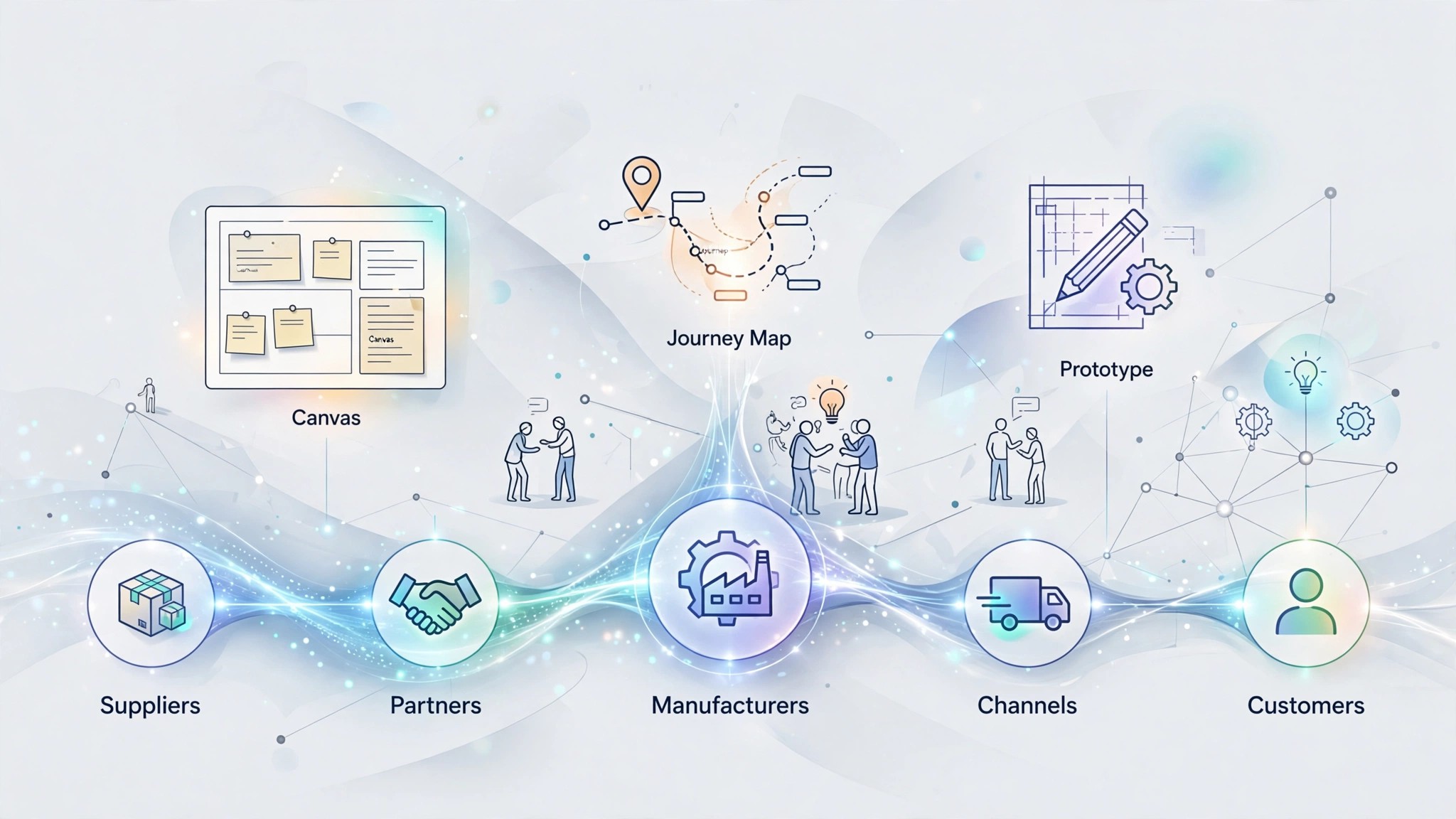
- The Tool vs. Toolkit Trap: A single tool, like a Business Model Canvas or a journey map, can solve a problem for one team. It cannot build capability across five companies with different incentives, clockspeeds, and cultures.
A tool solves a problem. A toolkit builds capability. Ecosystems need the latter.
What an Ecosystem Toolkit Actually Is
An ecosystem toolkit is not a bigger toolbox. It is a shared operating system for co-innovation.
It is a curated, human-centered, modular set of principles, practices, and artifacts that allow disparate organizations across a value chain to discover, co-create, experiment, and scale together.
The best toolkits have three characteristics:
- Low friction to adopt: A supplier in Penang and a channel partner in Phoenix can use it on Tuesday morning without a certification.
- High fidelity to intent: It carries the why, not just the how, so it does not degrade into theater as it spreads.
- Designed for asymmetry: It works even when partners have unequal power, resources, and digital maturity.
Think less like a corporate standard and more like a musician’s fake book. Same chords, endless local improvisation.
The Human-Centered Foundation
We keep treating toolkit adoption as a deployment challenge. It is a human change challenge.
In my work on human-centered change, I have learned that people support what they help create, and that remains true across company boundaries. You cannot mandate an ecosystem toolkit. You have to co-design it.
Before any tool works across the value chain, three human conditions must be met:
1. Empathy precedes alignment. Partners cannot align on opportunity until they feel each other’s constraints. A procurement lead’s risk model and an engineer’s iteration model can both be rational. We have to make that visible.
2. Identity matters. If your suppliers see themselves as order takers, not co-innovators, no canvas will change that. The toolkit must help people adopt a new identity.
3. Experience shapes behavior. How you invite a partner to co-innovate, how you handle conflict when an experiment fails, how you celebrate a shared win, those moments design the culture far more than any charter.
The Ecosystem Toolkit Stack: Five Layers
After working with organizations trying to scale capability beyond their walls, I see five layers that consistently matter. You do not need all five on day one, but you need to design for all five.
Layer 1: Shared Language and Purpose
Every ecosystem needs a shared definition of what value means and what innovation means for us, together.
Core tools:
- Ecosystem Innovation Charter: One page that answers: Why are we innovating together? What kinds of innovation matter here? How do we behave when it gets hard?
- Value Chain Lexicon: A simple glossary. What do we mean by experiment, prototype, scale, and customer in this ecosystem?
Without this, every collaboration becomes a translation exercise.
Layer 2: Empathy and Insight Tools
We must move from customer-centric to ecosystem-centric insight.
Core tools:
- Ecosystem Journey Mapping: Map the journey of an idea or a value proposition as it moves from raw material to customer outcome. Where does it stall, degrade, or get enriched?
- Value Chain Empathy Map: For each key partner, what are they hearing, seeing, feeling pressure from, and being measured on?
- Customer’s Customer Interview: Go one step downstream from your direct customer. The deepest insights often live there.
The goal is to make invisible friction visible and shared.
Layer 3: Alignment and Co-Creation Tools
This is where shared intent becomes shared work.
Core tools:
- Ecosystem Opportunity Map: Visualizes where value is created, where value leaks, and where new value could be co-created.
- Shared Constraints Canvas: Instead of hiding constraints, we put them on the table. IP boundaries, regulatory constraints, capacity limits. Constraints are design material.
- Multi-Org Co-Creation Sprint: A sprint designed for participants from 3 to 4 companies, with explicit roles for orchestrator, builder, validator, and scaler.
Layer 4: Experimentation and Learning Infrastructure
This is the hardest layer to scale, and the most important. Ecosystems do not fail for lack of ideas. They fail for lack of shared learning loops.
Core tools:
- Distributed Experiment Board: A single view of what we are testing across the chain, who is learning what, and how learnings connect.
- Ecosystem Prototype: Do not just prototype the product. Prototype the handoff. Prototype the data share. Prototype the support model.
- Shared Learning Log: A ritual and template for capturing what we learned, not just what we built.
Futurology note: AI is becoming the shared experimentation substrate. Synthetic customer panels, digital twins of the value chain, and generative simulation let ecosystems experiment together without moving physical goods. The toolkit of 2028 will have AI co-pilots at every layer.
Layer 5: Scaling, Governance, and Value Sharing
Great pilots die without a path to scale that feels fair.
Core tools:
- Ecosystem Scaling Canvas: What needs to be true for this to scale across 10 partners, 100 locations, or 1,000 customers? What breaks?
- Value Sharing Agreement: Early, lightweight agreement on how upside and learning will be shared. Not a 40-page legal document. A one-page fairness principle.
- Innovation Capability Health Score: A simple scorecard: speed of joint learning, number of partners actively experimenting, reduction in cross-company rework.
Scaling Across the Chain: Upstream, Midstream, Downstream
The same five layers show up differently depending on where you are in the chain:
Upstream, with suppliers and materials: The focus is on early material innovation, transparency, and resilience. How do we co-innovate on sustainable inputs without triggering IP fear? The toolkit here needs strong empathy and value-sharing tools.
Midstream, with manufacturing, logistics, and operations partners: The focus is on process innovation and interface innovation. Most breakthroughs here are not new products but new ways of connecting processes. Prototype the interface.
Downstream, with channels, customers, and customer’s customers: The focus is on adoption and outcome innovation. This is where experience design shines. Are we designing the channel experience and the adoption experience as intentionally as we design the product experience?
Designing the Ecosystem Experience
Innovation is an experience before it is a process. Ask yourself: What does it feel like for a first-time supplier to join your co-creation sprint? Is it welcoming and clear, or is it insider jargon and politics?
Design these five touchpoints intentionally:
- The Invitation: How do you invite partners in as co-creators, not contractors?
- The Onboarding: What is the first 90 minutes like? Does it create psychological safety across companies?
- The First Co-Win: How quickly can the ecosystem see that working this way creates value none could create alone?
- The Failure Moment: When an experiment fails, do you debrief across companies or retreat into blame?
- The Celebration: Do you celebrate in ways that make all contributors visible?
Reduce cognitive load. Increase relational trust. Every tool in your toolkit should answer one question: What do I do Tuesday morning?
The Implementation Playbook: Seed, Don’t Roll Out
Do not roll out an ecosystem toolkit. That is firm-centric thinking in ecosystem clothing. Seed it.
Step 1: Map one critical value stream end-to-end with two or three willing partners. Not the whole ecosystem. One flow that matters.
Step 2: Co-design a Minimum Viable Toolkit. Three tools maximum, usable in 90 days. One from Layer 1, one from Layer 2, one from Layer 4.
Step 3: Run one shared experiment that creates shared evidence. Evidence persuades where slides do not.
Step 4: Codify the learning ritual, not just the result. How will you learn together weekly?
Step 5: Invite the next ring. Let proof pull the ecosystem. Momentum is a better strategy than mandate.
How We Know It Is Working
Move beyond patents and pipeline. If you are building ecosystem capability, measure capability.
Leading indicators:
- Speed of cross-company learning loops
- Number of partners actively proposing and running experiments
- Reduction in cross-company rework and handoff errors
Lagging indicators:
- Time from joint idea to joint value in market
- Percentage of innovations that scale beyond a single node
- Ecosystem Net Promoter Score: Would partners recommend innovating with you?
Human-centered indicator: Do partners describe themselves as co-innovators? Language reveals identity.
Failure Modes to Avoid
1. Toolkit Theater: Beautiful canvases, zero behavior change. Antidote: Tie every tool to a real decision or handoff in the next two weeks.
2. Orchestrator Dominance: One company dictates the toolkit and the ecosystem disengages. Antidote: Co-design credits visible on every artifact. Shared ownership from day one.
3. Tool Hoarding: IP anxiety kills sharing. Antidote: Start with pre-competitive problems and a clear value-sharing principle before you touch core IP.
4. Pilot Purgatory: Endless co-creation, no scaling mechanism. Antidote: Design Layer 5 at the same time as Layer 3. Always ask, if this works, how would we scale it fairly?
Closing: From Company-Centric to Ecosystem-Capable
The future does not belong to the most innovative company. It belongs to the most innovation-capable value chain. The value chains that learn faster together will outcreate, outadapt, and outlast those that try to innovate alone.
So the question shifts. It is no longer, how innovative is your company? It becomes, how innovation-capable is your ecosystem?
This week, try three questions with your team and one key partner:
- Where does our best innovation die in our value chain?
- Who across our ecosystem do we wish were more innovation-capable?
- What is the smallest shared toolkit we could co-design in the next 30 days to change that?
Start small. Learn together. Scale what works. That is how you build ecosystem capability that lasts.
Bottom line: Futurology is not fortune telling. Futurists use a scientific approach to create their deliverables, but a methodology and tools like those in FutureHacking™ can empower anyone to engage in futurology themselves.
Image credit: Meta.ai
 Sign up here to get Human-Centered Change & Innovation Weekly delivered to your inbox every week.