Participatory Innovation
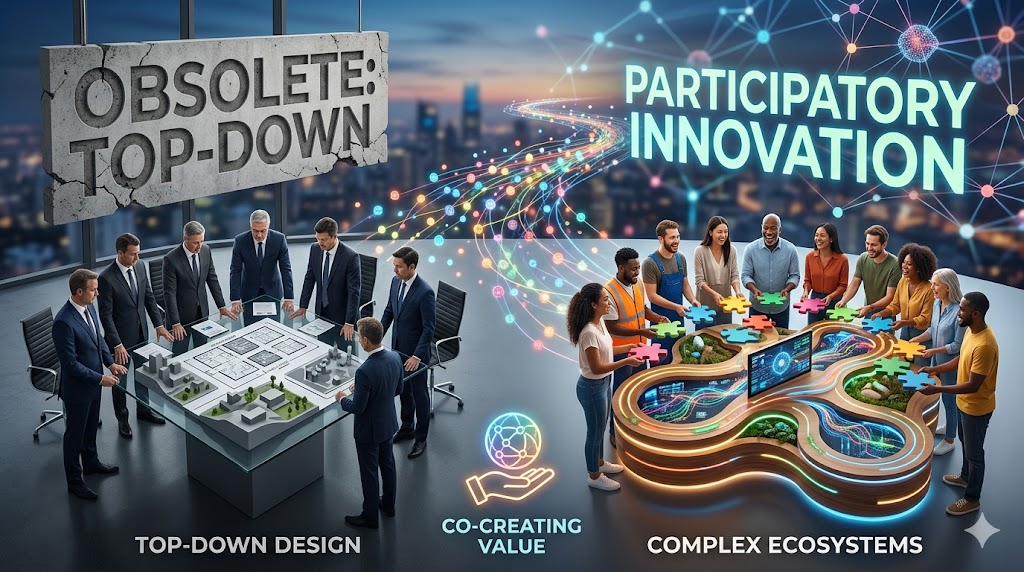
GUEST POST from Chateau G Pato
The Death of the Dictated Solution
For decades, the corporate world has fallen prey to the myth of the lone genius. We have operated under the assumption that a select group of executives, elite strategists, or isolated designers hidden away in a boardroom can perfectly predict, design, and mandate solutions for an entire organization. We map out linear plans, package them beautifully, and push them down the ladder, expecting seamless adoption.
But in today’s hyper-connected world, that approach is dead on arrival. The environments we operate in are no longer just complicated — systems like a watch or an engine that can be dismantled and fixed with linear logic. Instead, they are complex ecosystems. They are living, breathing, unpredictable networks of humans, technologies, and shifting behaviors. When you attempt to force a rigid, top-down design into a complex ecosystem, the system naturally rejects it like a foreign object.
In a complex ecosystem, value is never truly delivered; it must be co-created. Top-down design builds friction, but participatory innovation builds ownership.
When we design for people instead of with them, we miss the vital nuances known only to those on the front lines. To build experiences, products, and organizational changes that actually stick, we must fundamentally shift our approach. It is time to retire the dictated solution and embrace Participatory Innovation — democratizing the creative process to harness the collective intelligence of the entire ecosystem.
I. The Anatomy of Complex Ecosystems
To understand why traditional, linear planning fails, we have to stop viewing organizations and markets as machines. Machines are predictable; you turn a gear, and you get a specific output. Modern businesses, customer bases, and communities don’t work that way. They operate as living organisms — vibrant, interconnected, and highly sensitive to change.
The Hidden Networks
Every organization has two structures: the formal org chart printed on paper, and the informal, hidden network of relationships, trust, and influence that actually gets things done. Innovation doesn’t travel down formal reporting lines; it flows through these organic pathways. When a top-down mandate ignores these social fabrics, it inadvertently tears at the trust required to make change successful.
The Cascade Effect
In a complex environment, components never exist in isolation. A single, well-intentioned decision made at the executive level can trigger a cascade of unintended consequences across the entire ecosystem. For example, optimizing a digital interface to make life easier for the customer might inadvertently double the administrative workload for frontline customer service agents. Without an ecosystem-wide view, top-down design solves one problem by creating three new ones elsewhere.
Information Asymmetry
There is a fundamental truth that every modern leader must humble themselves to accept: the people closest to the problem always possess the insights that leaders lack. Executive leadership views the organization from 30,000 feet, which is great for seeing the horizon but terrible for seeing the ground. The frontline employees, the daily users, and the customers are the ones navigating the friction points every single day. If they aren’t actively designing the solution, the design is based on incomplete data.
II. Why Top-Down Design Fails (The Friction Points)
When leadership relies strictly on authority to push a new design, product, or process into the wild, they inevitably collide with human psychology and operational reality. Forced compliance creates an illusion of progress, but beneath the surface, friction points quickly stall or dismantle the initiative entirely.
The “Not Invented Here” Syndrome
It is a fundamental piece of human psychology: people naturally resist change when they feel it is being done to them rather than with them. When a beautifully polished solution descends from corporate headquarters, the immediate reaction from the ground floor is often skepticism or outright rejection. Because the people affected had no hand in shaping it, they have no emotional investment in its success. They don’t see it as their solution; they see it as someone else’s burden.
The Danger of Averages
Top-down design relies heavily on aggregate data, leading creators to design for a mythical “average user.” In a complex ecosystem, however, the average user does not exist. There are only individuals with highly nuanced, context-specific needs. By flattening these unique realities into a single generalized profile, corporate initiatives end up producing solutions that are mediocre for everyone and exceptional for no one. It satisfies the spreadsheet, but fails the human test.
The Speed Gap
Traditional top-down structures operate on a lag. Information must travel up the chain of command, be analyzed by committees, turn into a strategic plan, and slowly filter back down. By the time a top-down solution is finally deployed, the real-world dynamics on the ground have already shifted. This structural inertia makes it impossible to compete in fast-moving, complex environments where agility and real-time adaptation are the prerequisites for survival.
III. The Core Principles of Participatory Innovation
Moving away from the top-down model requires more than just changing our processes — it requires changing our fundamental beliefs about where value and wisdom reside. To successfully navigate a complex ecosystem, organizations must anchor their collaborative efforts in three foundational pillars.
Radical Inclusivity
True participatory innovation demands that we shift the role of the designer from “expert-led” to “facilitator-led.” Instead of gathering a homogenous group of like-minded strategists, we must actively bring diverse voices into the room from day one. This means inviting frontline staff, end-users, and crucially, the vocal skeptics. The people who point out why a system will fail are often your most valuable assets; their critiques act as early stress-tests for your ideas, saving months of misdirected effort.
Psychological Safety as Infrastructure
You cannot have co-creation without vulnerability, and you cannot have vulnerability without safety. If frontline stakeholders fear that sharing a flawed idea or pointing out a corporate blind spot will damage their career, they will remain silent. Leaders must treat psychological safety not as a soft human resources initiative, but as critical infrastructure. We must design environments where experimentation is celebrated, failures are treated as data, and challenging the status quo is viewed as an act of loyalty.
Continuous Feedback Loops
In a living ecosystem, the concept of a static “launch date” is an obsolete relic of industrial-age thinking. Complex environments change too quickly for a single, final rollout. Participatory innovation relies on continuous, iterative feedback loops. We build small, test quickly, and refine our designs in real-time alongside the people using them. The goal is to move away from rigid, multi-year master plans and move toward continuous, evolutionary adaptation.
IV. From Intent to Impact: The Framework for Co-Creation
Transitioning from a top-down mindset to participatory innovation requires more than good intentions; it demands a structured, deliberate approach to collaboration. To successfully harness the collective intelligence of your ecosystem, you need a repeatable framework that translates co-creation into measurable impact.
Mapping the Ecosystem
Before you can design with your community, you must truly understand who populates it. This step goes far beyond analyzing an organizational chart or standard customer demographics. We must map the entire living web of stakeholders—including the hidden influencers, the frontline operators, and the marginalized users who are often left out of the conversation. By understanding these relational dynamics early on, we ensure that the right voices are driving the design from the very beginning.
The Shared Canvas
To democratize innovation, you must give people a common language. When you bring diverse groups together — such as software engineers, frontline managers, and end-users — they often talk past one another. Utilizing highly visual, collaborative toolkits and open innovation canvases levels the playing field. These shared frameworks strip away corporate jargon, allowing everyone to visualize the ecosystem’s friction points, map out human experiences, and co-design solutions on equal footing.
Decentralizing Decision-Making
The ultimate failure point of many corporate “innovation programs” is that while ideation is collaborative, the final decision-making power remains tightly bottlenecked at the top. True participatory innovation requires decentralizing that authority. We must empower the local communities and cross-functional teams to vote on, rapidly prototype, and stress-test ideas within their own environments. By shifting from executive sign-off to real-world validation, the ecosystem itself determines which solutions survive and scale.
Conclusion: The Leader as a Facilitator, Not a Dictator
The realization that top-down design is obsolete shouldn’t panic leaders; it should liberate them. For generations, corporate culture has placed an unsustainable burden on executives, expecting them to possess a god-like omniscience — the ability to sit at the apex of an organization and accurately predict the future, solve every operational crisis, and perfectly design every human experience.
In a complex ecosystem, that is a mathematical impossibility. The new leadership mandate requires a profound shift in ego. True innovators must transition from being the person with all the answers to being the person who asks the best questions. They must stop acting as dictators and start serving as facilitators — architects who design the collaborative playing fields, hold the space for psychological safety, and provide the toolkits that unlock the brilliance already latent within their teams.
The true measure of a modern leader is no longer the brilliance of their own ideas, but their capacity to orchestrate the collective intelligence of their entire ecosystem.
When you fully embrace participatory innovation, the ultimate payoff isn’t just a better product, a smoother customer journey, or a more efficient process. The real transformation is cultural. By inviting people into the creative process, you dissolve the natural friction of change and replace it with a deep sense of shared ownership. You stop building brittle, top-heavy structures that fracture under pressure, and instead cultivate a living, breathing organization that is naturally adaptive, fiercely resilient, and inherently ready for whatever the future brings.
Frequently Asked Questions
Does participatory innovation mean we operate by pure consensus, and won’t that slow us down?
No, participatory innovation is not about absolute consensus or design-by-committee, which can lead to watered-down ideas. Instead, it is about inclusive contribution and transparent synthesis. Leaders and facilitators still steward the strategy and make definitive choices, but those choices are informed by deep, real-world insights from the frontline rather than executive assumptions. By investing time in co-creation upfront, you eliminate the massive, costly friction and resistance that typically drags down top-down rollouts later, making the overall execution significantly faster.
How do you get vocal skeptics or disengaged employees to actively participate?
You don’t win skeptics over with a slick presentation; you win them over by giving them a pen. Skeptics are often just passionate employees who have been burned by poorly executed top-down mandates in the past. To engage them, give them a formal role in stress-testing prototypes on a shared canvas. When they see that their critiques are being treated as valuable diagnostic data rather than insubordination, their resistance transforms into deep engagement. For broader teams, using visual, low-barrier collaboration tools lowers the stakes and makes participation feel safe and intuitive.
What is the very first step a traditionally top-down organization should take to transition?
Start small and localize. You do not need to restructure your entire enterprise overnight. Pick a single, contained friction point — such as a specific frontline workflow issue or a distinct customer touchpoint — and run a cross-functional co-creation workshop. Bring together the executives, the frontline operators, and the users, and use a shared canvas to map out the problem together. Document the rapid wins from this pilot to prove the ROI of collaboration. Showing that a co-created solution worked better and faced zero adoption resistance is the best way to build a mandate for broader cultural change.
Image credit: Gemini
 Sign up here to get Human-Centered Change & Innovation Weekly delivered to your inbox every week.