LAST UPDATED: April 26, 2026 at 1:08 PM
GUEST POST from Art Inteligencia
I. Introduction: The Velocity of Change vs. The Friction of Bureaucracy
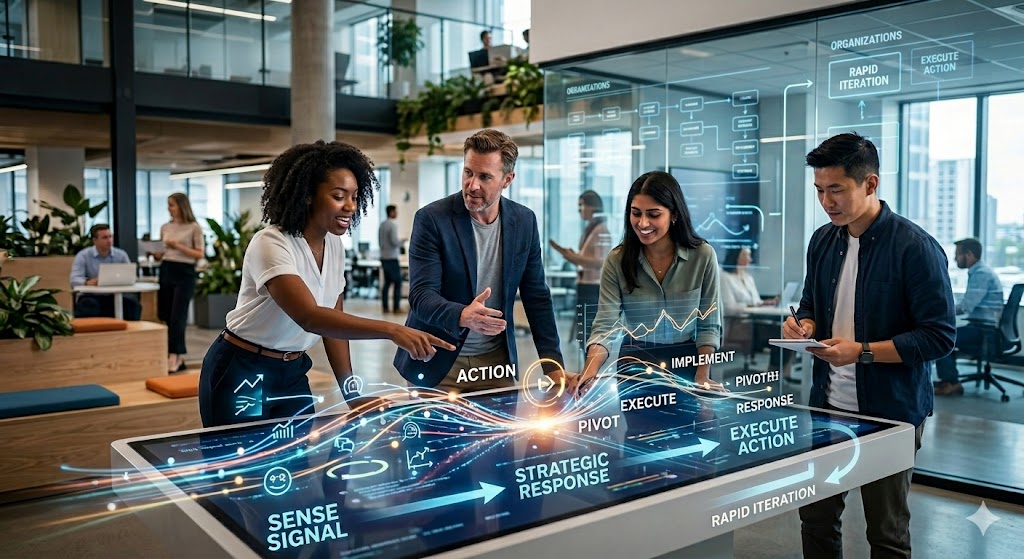
In the modern business landscape, the competitive frontier has shifted. It is no longer enough to possess superior data; the true advantage lies in the Signal-to-Action Gap — the critical window of time between perceiving a market shift and executing a meaningful strategic pivot.
Traditional organizations often fall victim to “wait-and-see” inertia. In contrast, visionary, human-centered organizations recognize that long-term sustainability requires a move away from rigid, multi-year roadmaps toward a continuous sensing and response architecture. This transition is not merely operational; it is a fundamental redesign of how the organization breathes and moves.
To future-proof the enterprise, we must identify and dismantle the internal friction points — whether they be cultural, hierarchical, or analytical — that prevent us from turning foresight into immediate, impactful reality. The goal is to move from a linear decision-making process to an integrated, low-friction loop that keeps the organization in sync with the pace of the world outside its walls.
II. Identifying the Signals: Beyond the Noise
To shorten the loop, we must first refine how we listen. In a visionary organization, sensing at the edge is the primary defense against obsolescence. This means empowering the people closest to the customer — the frontline employees, service designers, and support teams — to act as the organization’s nervous system, flagging shifts in behavior or sentiment before they ever reach a spreadsheet.
However, the challenge in a hyper-connected world is not a lack of data, but an abundance of it. Separating signal from noise requires a human-centered lens. We must distinguish between “fads” (surface-level spikes in interest) and “trends” (fundamental shifts in human needs or environmental constraints). By applying experience design (XD) principles, we can evaluate signals based on their potential impact on the human experience rather than just their statistical volume.
Finally, developing futures literacy across the workforce is essential. When teams are trained in futurology — the ability to recognize and interpret “weak signals” — the organization gains the lead time necessary to act. We move from a reactive posture to a proactive one, identifying the building blocks of the future while they are still malleable.
III. Assessing the Loop: Where Visionary Orgs Often Stall
Even the most forward-thinking organizations encounter internal “gravity” that slows the transition from insight to execution. One of the most prevalent barriers is the Analysis Paralysis Trap. When organizations over-rely on legacy KPIs and historical data to validate future-facing decisions, they inadvertently stifle innovation. In a visionary context, waiting for 100% certainty often means the opportunity has already passed.
Communication Silos act as another major point of friction. When a signal is detected at the edge, it often has to climb through multiple layers of vertical hierarchy for approval before it can be addressed horizontally across departments. This “up-and-over” movement creates a lag that can turn a revolutionary insight into a late-to-market footnote.
Lastly, we must confront Cognitive and Organizational Bias. The “Not Invented Here” syndrome and status quo bias lead teams to dismiss uncomfortable signals that challenge existing business models. To shorten the loop, leaders must foster a culture that prizes “unlearning” as much as learning, ensuring that the organization remains intellectually plastic enough to act on what the signals are actually telling us, rather than what we wish to hear.
IV. Strategies for Compression: Accelerating the Response
To effectively shorten the signal-to-action loop, organizations must move beyond mere observation and into structural agility. The first lever is Decentralized Decision-Making. By pushing authority down to the nodes where the signal is strongest, we eliminate the “permission bottleneck.” When the people who sense the change also have the agency to respond to it, the organization gains a near-instantaneous reflex.
Furthermore, we must implement Agile Governance. Traditional annual budgeting is the enemy of visionary speed. Instead, we should adopt rolling allocations and “venture-style” funding models that treat innovation as a series of experiments. This allows resources to flow toward emerging signals in real-time, rather than being locked into a rigid plan conceived twelve months prior.
Finally, we utilize Experience Design (XD) as a Catalyst for speed. By employing rapid prototyping and service design, we can visualize and test potential actions in low-fidelity environments. This “fail-fast, learn-faster” approach allows us to validate a response with minimal risk, ensuring that when we do scale an action, it is already refined by human-centered feedback. This turns the response phase from a gamble into a calculated, high-velocity evolution.
V. Building a Culture of Responsive Innovation
Structural changes only succeed if they are supported by a resilient cultural foundation. The cornerstone of a shortened loop is Psychological Safety. For an organization to act on signals, those signals must be reported honestly and early — especially when they indicate that a current strategy is failing. When employees feel safe to deliver “bad news,” the organization gains the lead time necessary to pivot before a ripple becomes a wave.
This shift requires a fundamental evolution in leadership. We must move from the “Command and Control” archetype toward Curation and Coaching. As a speaker and advisor to visionary teams, I emphasize that a leader’s role is no longer to have all the answers, but to curate the environment where the best signals can emerge and to coach teams through the friction of rapid change.
Ultimately, we are striving for a state of Continuous Learning. In a visionary organization, there is no “end state” — only a perpetual motion machine where every action taken is treated as a new probe. Each response generates fresh data, which feeds back into the sensing mechanism. This creates a virtuous cycle where the organization doesn’t just react to the future, but actively learns its way into it.
VI. Conclusion: The Future is Real-Time
The transition to a shortened signal-to-action loop is the definitive hallmark of the modern visionary organization. In an era where disruption is the only constant, the ability to harmonize sensing and doing is no longer a luxury — it is a survival requirement. We are moving toward a state of Strategic Harmony, where the artificial boundaries between “strategy” and “execution” dissolve into a singular, unified organizational heartbeat.
By dismantling bureaucracy, fostering psychological safety, and leveraging the tools of experience design, we do more than just increase efficiency; we increase our relevance. We ensure that our organizations remain vibrant, human-centered, and capable of delivering value that resonates with the actual needs of the world as it exists today, not as it was imagined yesterday.
The journey begins with a simple audit: Look at your current processes and identify where the “drag” exists. Start small, remove the first three points of friction you find, and begin the work of turning your organization into a responsive, living entity. The future isn’t waiting for a five-year plan — the future is happening in real-time. It’s time our organizations did the same.
Frequently Asked Questions
What is the “Signal-to-Action Loop”?
It is the duration between an organization detecting a significant market or behavioral shift (the signal) and the moment it implements a strategic response (the action). Minimizing this lag is essential for maintaining relevance in volatile markets.
How can human-centered design improve organizational agility?
By using experience design (XD) and prototyping, organizations can test small-scale responses with real users quickly. This reduces the risk of failure and allows for rapid refinement, turning “big bets” into a series of fast, validated learnings.
What is the biggest barrier to shortening this loop?
The primary barrier is often hierarchical friction — the requirement for signals to travel through multiple layers of management for approval. Decentralizing decision-making is the most effective way to remove this “drag.”
Image credit: Google Gemini
 Sign up here to get Human-Centered Change & Innovation Weekly delivered to your inbox every week.