LAST UPDATED: March 11, 2026 at 3:07 PM

GUEST POST from Chateau G Pato
The Myth of the Cold Inventor
In the popular imagination, innovation is often depicted as a clinical, solitary endeavor—a “Eureka!” moment occurring in a vacuum of pure logic and white lab coats. We celebrate the scaffolding of science and the precision of the data, yet we frequently overlook the heartbeat behind the breakthrough. The reality is that innovation is a messy, deeply human process driven as much by gut feeling and interpersonal dynamics as by any spreadsheet.
The Innovation Fallacy
There is a persistent fallacy that if the data is rigorous enough, the innovation will naturally succeed. However, data does not advocate for itself, and technology does not implement itself. Without the ability to navigate the human “immune response” to change, even the most scientifically sound projects are destined to remain mere hallucinations. To move from a dream to a realized product, we must acknowledge that logic makes people think, but emotion makes them act.
Defining EQ in the Innovation Ecosystem
When we discuss Emotional Intelligence (EQ) as a core driver of success, we aren’t just talking about “being nice.” In the context of organizational change, EQ is a strategic toolkit consisting of:
- Self-Awareness: Recognizing how our own biases and fears of failure influence the pivot-or-persevere decisions.
- Empathy: The primary tool for uncovering the latent, unspoken needs of the end-user.
- Relationship Management: The ability to build the social capital necessary to lead a team through the “Valley of Change.”
The Thesis: Resilience Over Specs
High-performing innovation teams are not defined solely by their technical expertise. Instead, their success is predicated on emotional resilience. While the technical specifications provide the boundaries, it is the EQ of the team that allows them to withstand the friction of collaboration, the sting of failed experiments, and the exhaustion of the long-form innovation cycle. To master innovation, one must first master the human element.
Empathy: The Starting Line of Every Breakthrough
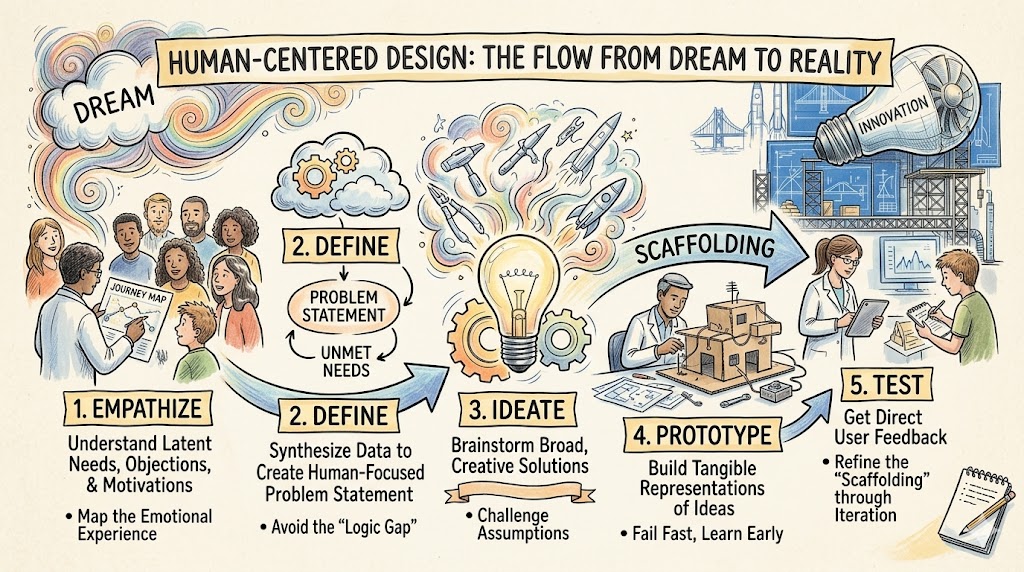
If science provides the scaffolding, then empathy is the compass that tells us where to build it. Too often, organizations begin the innovation journey with a solution in search of a problem. They look at market share, demographic data, and technical feasibility before they ever look into the eyes of the person they are trying to serve. True innovation doesn’t start in a lab; it starts with a deep, emotional understanding of human struggle.
Beyond “User” Data to Human-Centered Design
In the world of human-centered innovation, we must move past treating people as “users” or “data points.” Data tells you what is happening, but empathy tells you why. High-EQ innovators use empathy to uncover “unmet needs”—those latent frustrations that a customer might not even be able to articulate in a survey. By mapping the emotional journey of a person, we find the friction points where innovation is actually required.
The Art of Deep Observation
Empathy in innovation is an active, rigorous discipline. It requires “getting out of the building” to observe how people interact with their world. It involves:
- Immersive Observation: Watching for the “workarounds” people create to bypass flawed systems.
- Active Listening: Hearing the emotion behind a complaint to identify the core value proposition.
- Perspective Shifting: Temporarily discarding our own expertise to see the product or service through the eyes of a novice or a frustrated skeptic.
Case Study: Solving the “Logic” Gap
Consider the redesign of a hospital’s pediatric imaging room. From a logical standpoint, the “innovation” might focus on faster scan times or higher resolution. However, an empathetic approach revealed that the true barrier was the terror felt by the children. By using empathy to redesign the experience—turning the MRI machine into a “pirate ship” or “space station”—the need for sedation dropped significantly. The technical specs didn’t change, but the innovation succeeded because it addressed an emotional reality that logic had missed.
The Risk of the “Empathy Gap”
Without empathy, we fall into the trap of “hallucinatory innovation”—building brilliant solutions for problems that don’t actually matter to anyone. When a team lacks the emotional intelligence to connect with their audience, they build monuments to their own technical vanity rather than tools for human progress. To ensure your scaffolding supports something meaningful, you must start with the human heart.
Psychological Safety: The Scaffolding for Risk
Innovation is inherently a high-risk activity. It requires individuals to stand up and propose ideas that might sound ridiculous, challenge the status quo, and—most terrifyingly—fail. Without psychological safety, the “scaffolding” of science has no one brave enough to climb it. Emotional intelligence is the bedrock upon which this safety is built, transforming a culture of fear into a culture of experimentation.
Rebranding Failure as Iteration
In low-EQ environments, failure is a stigma—a mark of professional inadequacy. In high-innovation cultures, leaders use their emotional intelligence to reframe failure as data collection. When a team feels safe, they don’t hide their mistakes; they dissect them. This transparency is vital because the most rigorous data often comes from what didn’t work. If your team is afraid to look foolish, they will only present safe, incremental ideas that lead to stagnation.
Silencing the Inner Critic
The greatest barrier to ideation isn’t a lack of creativity; it’s the internal “hallucination” of judgment. High-EQ leaders facilitate sessions where the focus is on “Yes, and…” rather than “No, because…” This emotional management allows for:
- Cognitive Diversity: Encouraging the quietest voices to contribute their unique perspectives.
- Rapid Prototyping: Building “ugly” versions of products early to test assumptions without fear of embarrassment.
- Radical Candor: Providing the kind of honest feedback that saves a project from its own blind spots.
The Data Connection: Safety Drives Accuracy
There is a direct correlation between emotional safety and data integrity. In a “fear-based” hierarchy, data is often massaged to please the person at the top. When psychological safety is present, the data remains rigorous and honest. Teams that feel safe are 3x more likely to share actionable data that could potentially “kill” a project early, saving the organization millions in wasted R&D spend. Safety isn’t just a “soft” benefit; it is a hard-edged financial safeguard.
Building the Safety Net
To lead the future of innovation, managers must become masters of the “safety net.” This involves actively modeling vulnerability—admitting when they don’t have the answer and celebrating the lessons learned from failed sprints. When the leader demonstrates that their ego is second to the mission, the team follows suit, providing the emotional stability needed to support world-changing breakthroughs.
Navigating the “Valley of Change”
Every great innovation eventually hits the “Valley of Change”—that treacherous gap between the excitement of the initial “dream” and the reality of full-scale implementation. It is here that the human “immune response” is strongest. People naturally fear what they do not understand, and without high Emotional Intelligence (EQ), even the most brilliant scientific scaffolding will be dismantled by those it was meant to help.
Managing the Organizational Immune Response
Organizations, like biological organisms, have built-in mechanisms to reject foreign objects. A new idea is often seen as a threat to established power structures, budgets, or personal comfort. Navigating this requires a leader to use EQ to anticipate resistance before it becomes sabotage. It involves:
- Anticipatory Empathy: Identifying who loses influence or comfort because of the innovation and addressing those fears directly.
- Transparent Communication: Moving past technical jargon to explain the “why” in a way that resonates with personal and professional values.
- Co-creation: Bringing the “skeptics” into the process early so they feel a sense of ownership rather than a sense of imposition.
Emotional Regulation in Times of Crisis
Innovation is rarely a linear path to success; it is a series of pivots and setbacks. When a high-stakes experiment fails, the emotional temperature of the room rises. A leader with high EQ maintains the rigorous testing mindset by regulating their own stress and that of the team. They prevent the “hallucination” of despair by keeping the team focused on the data, ensuring that a temporary setback doesn’t lead to a permanent abandonment of the vision.
The Persistence Quotient: EQ as Fuel
Technical skills might get a project started, but it is emotional stamina that gets it finished. The “Valley of Change” is exhausting. EQ provides the fuel for long-term project persistence by:
- Celebrating Small Wins: Breaking the long journey into emotionally manageable milestones to maintain morale.
- Burnout Monitoring: Recognizing the signs of emotional fatigue in the team before it leads to a breakdown in collaboration.
- Purpose Alignment: Constantly reconnecting the team’s daily “scaffolding” work to the larger “dream” to maintain intrinsic motivation.
Surviving the Dip
The difference between a failed “hallucination” and a successful innovation often comes down to who can survive the emotional dip of the implementation phase. By prioritizing EQ, we ensure that our innovators are as resilient as the structures they are building. We don’t just build better products; we build teams capable of bringing those products to life in a resistant world.
Collaborative Intelligence: Breaking the Silos
Innovation is a team sport, but most organizations are built like a series of isolated islands. While science provides the scaffolding, that scaffolding must often span across departments—from R&D to Finance, and from Marketing to Legal. Collaborative Intelligence, powered by social awareness and relationship management, is the bridge that connects these silos and prevents great ideas from being lost in the gaps.
Social Awareness: Reading the Organizational Room
High-EQ innovators possess a “political empathy” that allows them to understand the hidden drivers of different departments. They recognize that a CFO views innovation through the lens of risk and ROI, while a designer views it through the lens of aesthetics and usability. By reading these emotional and professional frequencies, an innovator can tailor their message to align with the specific values of each stakeholder.
Influence vs. Authority
In a modern, matrixed organization, you rarely have formal authority over everyone needed to make an innovation successful. You must lead through influence. EQ allows you to build social capital long before you need to spend it. This includes:
- Conflict as a Catalyst: Using EQ to ensure that disagreements remain “task-oriented” rather than “relationship-oriented.” Healthy debate over data is vital; personal friction is fatal.
- Active Stakeholder Management: Identifying “blockers” early and using social awareness to turn them into “partners” by addressing their underlying concerns.
- Narrative Building: Moving beyond the “hallucination” of a pitch deck to create a shared story that every department can see themselves in.
The Power of Creative Friction
When diverse minds meet, friction is inevitable. Low-EQ teams view this friction as a sign of failure and seek to avoid it, resulting in “groupthink” and mediocre outcomes. High-EQ teams embrace creative friction. They have the emotional stability to hold space for conflicting ideas without taking offense. This tension—between the dreamer and the tester, the artist and the scientist—is exactly where the most rigorous and transformative innovations are born.
Bridging the Execution Gap
The “Execution Gap” is where most innovations die, usually because of a breakdown in communication between the “dreamers” (ideation) and the “doers” (implementation). Collaborative intelligence ensures that the handoff is not a collision, but a seamless transition. By fostering a culture of mutual respect and emotional transparency, we ensure the scaffolding remains strong enough to carry the dream all the way to the finish line.
Conclusion: Leading the Future of Innovation
As we look toward the horizon of the next industrial era, the tools of science and data will only become more sophisticated. Yet, as the technical scaffolding grows taller, the human element becomes more—not less—critical. To lead in this environment, we must undergo a fundamental leadership shift. The innovators of tomorrow must realize that technical brilliance is the baseline, but emotional intelligence is the breakthrough.
The Rise of the “Chief Empathy Officer”
The traditional role of the Chief Innovation Officer (CINO) is evolving. It is no longer enough to manage a pipeline of patents or a portfolio of R&D investments. The next generation of leaders must act as “Chief Empathy Officers,” specialized in the human dynamics of change. They must be as comfortable navigating a team’s emotional fatigue as they are navigating a balance sheet. This isn’t “soft” leadership; it is the hardest work there is, and it is the only way to ensure that “The Dream” survives the rigors of reality.
The ROI of Emotional Intelligence
Ultimately, the marriage of EQ and innovation is about ROI. When we invest in the emotional health of our teams, we see:
- Reduced “Innovation Waste”: Fewer resources spent on projects that fail due to internal politics or a lack of user empathy.
- Increased Speed-to-Market: Faster cycles driven by high psychological safety and rapid, honest iteration.
- Sustainable Talent: The ability to attract and retain the world’s best “dreamers” and “builders” by providing an environment where they can thrive.
From Hallucination to Realization
We return to the core truth: While art defines the dream, science provides the scaffolding. But it is the human heart that decides to climb. Without the emotional resilience to face failure, the empathy to understand the user, and the social intelligence to break down silos, our innovations will remain mere hallucinations. By placing Emotional Intelligence at the core of our innovation strategy, we provide the stability necessary to turn our most ambitious dreams into tangible, world-changing realities.
A Call to Action for Innovators
I challenge you to audit your innovation strategy. Do not just look at your software, your lab equipment, or your patents. Look at your people. Are you building the emotional scaffolding necessary to support your technical dreams? The future belongs to those who can master the data and the soul. Let’s stop hallucinating and start building.
Frequently Asked Questions
Why is Emotional Intelligence (EQ) considered a driver of innovation?
Innovation is a human process that requires navigating risk, uncertainty, and resistance. EQ provides the emotional resilience needed to handle failure, the empathy required to identify genuine user needs, and the social skills to bridge organizational silos. Without EQ, technical “scaffolding” lacks the human support to succeed.
How does psychological safety impact data-driven innovation?
Psychological safety ensures that data remains rigorous and honest. In environments where people fear failure, data is often manipulated to avoid conflict. When a team feels safe, they are more likely to share “negative” results early, allowing for faster iterations and preventing the organization from wasting resources on “hallucinatory” ideas.
What is the “human immune response” to innovation?
The organizational immune response is the natural tendency of people and departments to reject change to protect established power structures, budgets, or comfort zones. High-EQ leaders anticipate this reaction and use transparent communication and co-creation to turn potential blockers into partners.
Image credits: Gemini
 Sign up here to join 17,000+ leaders getting Human-Centered Change & Innovation Weekly delivered to their inbox every week.