An exploration of how rising costs of living reduce cognitive surplus, suppress innovation, and limit organizational and societal progress.
LAST UPDATED: January 19, 2026 at 4:43 PM
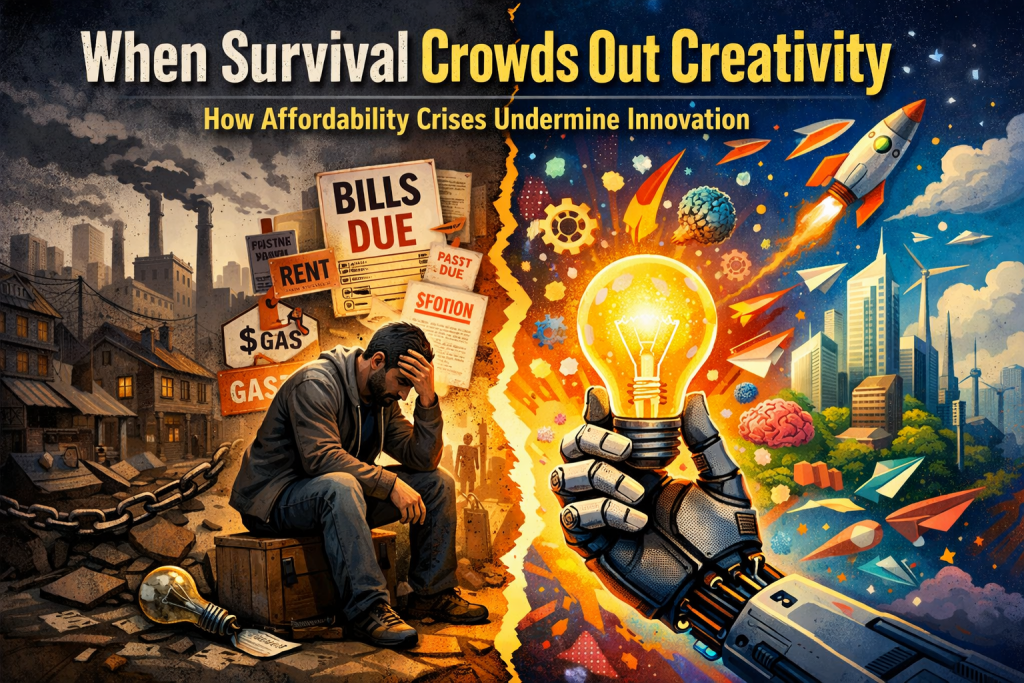
GUEST POST from Art Inteligencia
I am frequently asked about the ingredients of a successful innovation ecosystem. We talk about venture capital, high-speed internet, patent laws, and university partnerships. But we rarely talk about the most fundamental requirement of all: human physiological and psychological security.
Innovation is not a purely intellectual exercise; it is an emotional and biological one. It requires a specific state of mind — one that is open, curious, and willing to embrace the possibility of failure. However, when a society faces systemic affordability challenges — skyrocketing rents, food insecurity, and the crushing weight of debt — we are effectively taxing the cognitive bandwidth of our greatest resource: people.
“Innovation is not a luxury of the elite, but a byproduct of a society that provides its citizens enough stability to dream. When we price people out of their basic needs, we price ourselves out of our future.” — Braden Kelley
The Cognitive Tax of Scarcity
To understand why affordability kills innovation, we must look at how the human brain functions under stress. Human-centered innovation is rooted in the idea that people solve problems when they have the mental “slack” to do so. When an individual is constantly calculating how to cover a 30% increase in rent or skipping meals to pay for childcare, they are operating in survival mode.
In survival mode, the brain’s prefrontal cortex — the center for higher-order thinking, long-term planning, and creative synthesis — takes a backseat to the amygdala. We become more reactive, more short-term focused, and significantly more risk-averse. You cannot disrupt an industry when you are terrified of an eviction notice.
This “scarcity mindset” creates a hidden drain on productivity and creativity. It is a form of Innovation Debt that we are accruing as a society, where the interest is paid in ideas that were never born because the potential innovators were too exhausted to think of them.
In organizations, this manifests as:
- Employees avoiding bold ideas for fear of failure
- Reduced participation in innovation programs
- Higher burnout and turnover among creative talent
- A preference for incrementalism over experimentation
“Innovation requires slack — slack in time, money, attention, and emotional safety. When survival becomes the primary occupation, imagination is the first casualty.” — Braden Kelley
Case Study 1: The Silicon Valley “Talent Flight”
The Situation
For decades, Silicon Valley was the undisputed epicenter of global innovation. However, by the early 2020s, the median home price in the region exceeded $1.5 million. While established tech giants could afford to pay engineers high salaries, the support ecosystem — the teachers, the artists, the junior researchers, and the “garage tinkerers” — could not.
The Innovation Impact
Innovation thrives on cross-pollination. When only the wealthy can afford to live in a hub, the diversity of thought collapses. We began to see a “homogenization of innovation,” where new startups focused almost exclusively on problems faced by high-income individuals (e.g., luxury delivery apps) rather than solving systemic human challenges. The high cost of living created a barrier to entry that effectively barred the next generation of “scrappy” innovators who didn’t have a safety net or venture backing.
The Result
Data showed a significant migration of talent to “secondary” hubs like Austin, Denver, and Lisbon. While this decentralization has benefits, the initial friction and lost momentum in the primary hub represented a massive opportunity cost for breakthrough research that requires physical proximity and intense collaboration.
The Death of the “Garage Startup”
The “garage startup” is a cherished myth in innovation circles, but it relies on a very real economic reality: the availability of low-cost, low-risk space. Hewlett-Packard, Apple, and Google all started in spaces that were relatively cheap to rent or own.
In today’s urban environments, that “low-risk space” has vanished. When every square foot of a city is optimized for maximum real estate yield, there is no room for the inefficient, messy work of early-stage experimentation. We are replacing “maker spaces” with luxury condos, and in doing so, we are dismantling the physical infrastructure of the Fail Fast philosophy. If the cost of your “lab” (your garage or basement) is $3,000 a month, you cannot afford to fail. And if you cannot afford to fail, you will never truly innovate.
Case Study 2: Food Insecurity in the Academic Pipeline
The Situation
A 2023 study of graduate students in North America revealed that nearly 30% experienced some form of food insecurity. These are the individuals tasked with the most rigorous scientific and social research — the literal “R” in R&D.
The Innovation Impact
Graduate students are the primary engine of university-led innovation. When these researchers spend their nights worrying about calorie counts instead of quantum counts, the quality of research suffers. The persistence required to push through a failed experiment is diminished when physical health is compromised.
The Result
Universities noted a decline in “high-risk, high-reward” thesis topics. Students began gravitating toward “safe” research areas with guaranteed funding or clear paths to corporate employment to pay off student loans and eat. The “Failure Budget” for these young innovators was effectively zero, leading to a stifling of the very exploratory research that historically leads to major scientific breakthroughs.
Case Study 3: A Manufacturing Firm’s Productivity Paradox
A mid-sized manufacturing company invested heavily in digital transformation and innovation training, yet saw minimal improvement in idea generation or experimentation. Leadership initially blamed culture and skills.
A deeper assessment revealed a different root cause: nearly 40 percent of the workforce was experiencing food or housing insecurity. Employees were working second jobs, skipping medical care, and managing chronic stress.
The company shifted strategy. It introduced wage stabilization, subsidized meals, and emergency financial support. Within twelve months, participation in continuous improvement programs doubled, and frontline innovation proposals increased by over 60 percent.
Innovation did not fail due to lack of tools. It failed due to lack of breathing room.
Why Affordability Shapes Risk Appetite
Innovation requires people to take risks that may not pay off immediately. But when the margin for error is razor-thin, risk becomes reckless rather than courageous.
Employees who fear eviction or medical debt are far less likely to:
- Challenge entrenched assumptions
- Experiment with unproven ideas
- Advocate for long-term investments
- Speak candidly about systemic flaws
Affordability challenges quietly turn organizations into compliance machines rather than learning systems.
Conclusion: A Call for Human-Centered Policy
If we want to maintain a competitive edge in a rapidly changing world, we must view affordability as an innovation policy. Rent control, affordable housing, student debt relief, and food security are not just “social issues”; they are the foundational layers of a healthy innovation funnel.
We need to create “slack” in our systems. We need to ensure that the next great thinker is not working three gig-economy jobs just to keep the lights on. As leaders, we must advocate for a world where people are free to use their entire brain for the work of change, rather than wasting half of it on the math of survival.
True innovation starts with a simple human truth: A mind preoccupied with where to sleep cannot dream of how to fly.
Frequently Asked Questions
Q: How do high housing costs impact an organization’s innovation potential?
A: High housing costs force talent to relocate or spend a disproportionate amount of cognitive energy on survival. This reduces “cognitive bandwidth,” making employees more risk-averse and less likely to engage in the creative problem-solving or “intrapreneurship” required for organizational growth.
Q: What is the “Cognitive Tax” of affordability challenges?
A: The cognitive tax is the mental drain caused by financial stress. When individuals are worried about basic needs like food and rent, their prefrontal cortex — the area responsible for complex decision-making and creativity — is overwhelmed by the stress of survival, effectively lowering their functional IQ and creative output.
Q: Can innovation survive in an environment of economic scarcity?
A: While scarcity can occasionally breed “frugal innovation,” systemic affordability challenges generally stifle breakthrough innovation. Breakthroughs require “slack” — time, resources, and mental space — to experiment and fail. Without basic economic security, individuals cannot afford the risk of failure.
Disclaimer: This article speculates on the potential future direction of society based on current factors. It is hard to predict whether commercial, political and charitable organizations will respond in ways sufficient to alter the course of history or not.
Image credits: ChatGPT
 Sign up here to get Human-Centered Change & Innovation Weekly delivered to your inbox every week.