GUEST POST from Art Inteligencia
I. Introduction: The Death of the Idea Bottleneck
For decades, the dominant narrative across boardrooms and executive suites was that companies were starving for great ideas. Organizations poured millions into hackathons, suggestion boxes, skunkworks labs, and open innovation platforms to unlock the next breakthrough product or service. Generating ideas was treated as the ultimate engine of growth—and for a long time, it was.
Today, that dynamic has completely inverted. We live in an era of unprecedented option saturation. AI, market insights, emerging technologies, and global connectivity have made ideas cheap, abundant, and instantly accessible. The scarce resource in modern business is no longer ideation; it is absorption.
This creates a painful operational paradox: organizations find themselves drowning in high-potential opportunities, valid customer insights, and powerful technology stacks, yet their strategic execution remains sluggish or completely stalled. The friction isn’t occurring at the point of imagination—it’s occurring at the point of adoption.
The primary constraint to innovation in the modern era has shifted from **idea generation** to **organizational adaptability**. Brilliant concepts mean nothing if your human ecosystem lacks the bandwidth, agility, and psychological readiness to absorb, execute, and scale them. Until leaders reframe adaptability as a core capability rather than an afterthought, even the most transformative ideas will continue to die inside the friction of the enterprise.
II. The Anatomy of Organizational Resistance
When innovative initiatives stall, leadership frequently diagnoses the failure as a lack of discipline, poor project management, or individual reluctance to embrace new tools. In reality, modern organizational resistance is rarely an issue of individual defiance. It is the natural, systemic friction produced when dynamic new ideas collide with legacy operating architectures built for static efficiency.
The Structural Friction of Legacy Architectures
Most mid-market and enterprise organizations were engineered around twentieth-century principles: risk mitigation, predictability, and localized domain mastery. These structural foundations create distinct operational friction points when forced to adapt quickly:
- Siloed Functional Ownership: Breakthrough customer and employee experiences depend on seamless end-to-end integration across product, marketing, technology, and operations. Yet organizational structures incentivize domain optimization at the expense of cross-functional velocity.
- Budgetary and Governance Rigidity: Traditional annual planning cycles treat resource allocation as a fixed event rather than a continuous, dynamic signal-driven process.
- Risk-Averse Performance Metrics: While executives preach experimentation, operational key performance indicators (KPIs) often penalize small failures, encouraging managers to protect existing baselines rather than test scalable improvements.
The Human Capital Bottleneck: Friction at the Frontline
Beyond structural barriers, the human dimension of change represents the single greatest point of vulnerability in any transformation effort. When adaptability is treated as an infinite resource rather than a cultivated capability, organizations suffer predictable systemic failure modes:
Change Fatigue and Capacity Limits: Employees do not resist change simply because it is new; they resist because they are exhausted. Layering continuous technology rollouts, strategic pivots, and restructuring initiatives on top of day-to-day operational duties creates severe cognitive overload. Without explicit operational offramps or intentional workload prioritization, adaptability rapidly degrades into compliance fatigue.
The Strategy-Execution Gap: Executives operate in the realm of strategic intent, viewing transformation through the lens of long-term value creation. Frontline teams operate in the realm of daily workflow realities. When leaders communicate the what and the why without actively designing the employee experience required to deliver the how, resistance becomes the default defense mechanism for overburdened teams.
III. Reframing Adaptability as a Design Discipline
To overcome systemic friction, leaders must recognize that organizational adaptability cannot be commanded into existence through top-down mandates or executive directives. Adaptability is not a top-level decision; it is a human-centered capability that must be intentionally architected. Reframing adaptability means shifting from traditional change management—which often focuses on forcing compliance—to change design, where the internal transition experience is crafted with the same rigor, empathy, and iteration applied to customer experience.
Human-Centered Change: Designing the Employee Transition Experience
For too long, organizations have treated change as something done to employees rather than with them. When new strategies or digital transformation tools are pushed down without regard for the daily workflow reality of frontline teams, friction is guaranteed. Human-centered change puts the people expected to adopt the innovation at the center of the design process.
By mapping employee pain points, identifying cognitive friction, and understanding the emotional journey of adoption, leaders can design transitions that respect human bandwidth and leverage intrinsic motivation rather than institutional coercion.
Visualizing Transformation with Collaborative Frameworks
One of the largest obstacles to adaptability is alignment. Strategic visions often remain locked in dense slide decks or abstract manifestos, leading to fragmented interpretations across departments. Effective change design utilizes visual, collaborative tools—such as visual project charters and change canvases—to establish a shared mental model for transformation.
When cross-functional teams visually map out purpose, scope, resource constraints, human impacts, and success measures together, they achieve clarity and buy-in upfront. Visual tools demystify complex organizational transitions, enabling teams to move with unified velocity.
Psychological Safety and Co-Creation
True adaptability requires experimentation, and experimentation requires psychological safety. If employees fear penalty for temporary productivity dips or early-stage testing failures during a transition, they will naturally default to legacy behaviors.
Furthermore, agency drives adoption. When leaders engage teams in the co-creation of solutions—giving them direct influence over how operational processes evolve—resistance transforms into active ownership. People rarely destroy what they help build. By fostering psychological safety and empowering frontline participation, organizations transform adaptability from a strategic burden into a sustainable competitive advantage.
IV. Building an Adaptable Organizational Architecture
To sustain adaptability as a core capability, organizations must build flexible, resilient architectures that accommodate continuous evolution. Adaptability cannot remain an abstract ambition; it must be operationalized through structural mechanics, dynamic resource allocation, and repeatable organizational capabilities.
Flexible Systems over Rigid Plans
Traditional multi-year strategic plans often assume a degree of market stability that no longer exists. Modern organizational design requires shifting from rigid, linear roadmaps to dynamic operating frameworks built for continuous recalibration.
- Modularity in Workflow Design: Decouple core operational processes so teams can update or swap out specific systems without causing enterprise-wide disruption.
- Short Feedback Loops: Establish real-time telemetry and employee experience signals to identify adoption bottlenecks early, allowing rapid adjustments before friction compounds.
- Hypothesis-Driven Execution: Treat strategic initiatives as testable hypotheses, validating assumptions through small-scale pilots before committing to broad rollouts.
Dynamic Resource Allocation
Static annual budgeting cycles represent one of the greatest structural barriers to adaptability. When capital, talent, and executive attention are locked into 12-month commitments, teams cannot respond effectively to emerging opportunities or shifting constraints.
Adaptable organizations implement rolling resource allocation mechanisms. By funding initiatives iteratively based on milestone progression and real-world signals—similar to venture capital stages—leaders ensure high-potential opportunities receive rapid backing while underperforming efforts are gracefully redirected.
Developing Repeatable Change Capability
Adaptability must become an institutional muscle rather than an episodic crisis response. Building a repeatable change capability across every business unit requires embedding human-centered principles directly into the enterprise operating culture:
- Shared Toolkits and Language: Standardize practical visual frameworks across teams to streamline cross-functional alignment and accelerate project kickoff cycles.
- Empowered Local Leadership: Train middle managers as change facilitators, equipping them to support their teams through transitions rather than merely relaying top-down directives.
- Continuous Capability Auditing: Regularly evaluate organizational change readiness, workload capacity, and friction metrics to protect human bandwidth and sustain momentum.
V. Conclusion & Actionable Call to Leadership
The era of treating innovation as a mere ideation challenge is officially over. In a business landscape defined by technological abundance and rapid market shifts, the primary bottleneck to sustainable growth is no longer what an organization can imagine, but what its human ecosystem can absorb, execute, and scale.
To unlock true capacity for innovation, modern leaders must fundamentally reframe their roles. The call to leadership today demands a shift from acting as traditional “architects of strategy” to becoming active curators of organizational adaptability. This transition requires moving away from top-down mandates and embrace change design—building the structural flexibility, visual clarity, and psychological safety necessary for teams to thrive amid continuous evolution.
Ultimately, an organization’s ultimate competitive advantage isn’t the brilliance of its next idea—it is the speed, empathy, and grace with which its people can bring that idea to life. Those that master adaptability as a human-centered discipline will not only survive perpetual market friction, but actively define the future of their industries.
Frequently Asked Questions
Why is organizational adaptability replacing ideation as the primary constraint to innovation?
Ideas and emerging technologies are no longer scarce; they are abundant and highly accessible. The bottleneck has shifted to an organization’s human capacity—its ability to absorb, execute, and scale changes across workflows without triggering change fatigue or operational resistance.
How does change design differ from traditional change management?
Traditional change management focuses primarily on driving top-down compliance and managing reactions to forced changes. Change design applies human-centered experience design and visual collaborative tools to co-create transitions with employees, reducing cognitive friction and building intrinsic ownership.
What steps can leaders take to build an adaptable organizational architecture?
Leaders can foster adaptability by replacing rigid annual planning with dynamic resource allocation, utilizing modular workflow structures, establishing short feedback loops, and cultivating psychological safety so teams can experiment and recalibrate without fear of penalty.
EDITOR’S NOTE: Braden Kelley’s Problem Finding Canvas can be a super useful starting point for doing design thinking or human-centered design.
“The Problem Finding Canvas should help you investigate a handful of areas to explore, choose the one most important to you, extract all of the potential challenges and opportunities and choose one to prioritize.”
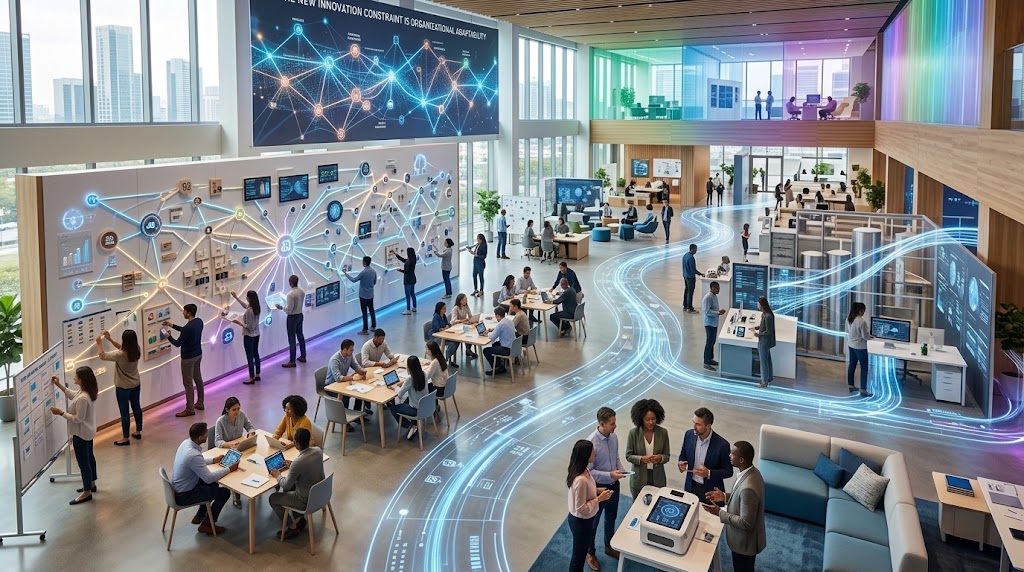
Image credit: Gemini
 Sign up here to get Human-Centered Change & Innovation Weekly delivered to your inbox every week.