LAST UPDATED: March 29, 2026 at 11:31AM
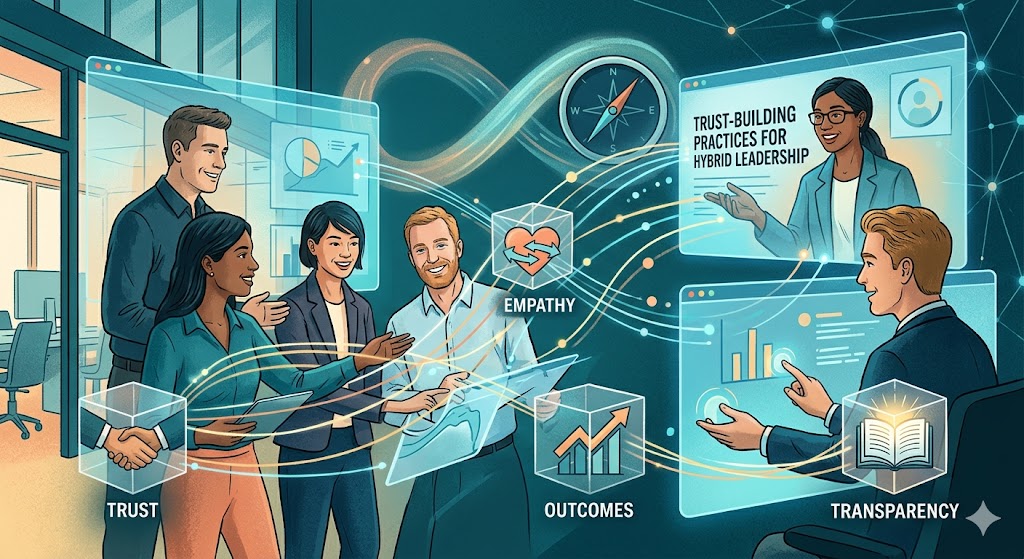
GUEST POST from Art Inteligencia
The New Currency of the Hybrid Era
For decades, leadership was anchored in the physical realm. We relied on “management by walking around” — the ability to gauge productivity by the hum of the office and the sight of heads at desks. But the shift to distributed work has fundamentally fractured that model, creating what I call the Proximity Paradox: the more we try to “see” our employees through surveillance and micromanagement, the less we actually see of their true potential and engagement.
In this new landscape, trust is no longer a “soft” cultural perk or a byproduct of shared coffee breaks. It has become the foundational infrastructure of the modern organization. Without it, the friction of distance leads to burnout, silos, and a slow decay of innovation. To lead effectively today, we must move beyond simply “monitoring” presence and embrace a human-centered framework where trust is designed into the very fabric of our digital and physical interactions.
“In a hybrid world, trust isn’t granted by default; it must be intentionally designed into the daily cadence of leadership through radical transparency and psychological safety.”
The Shift from Presence to Purpose
Traditional leadership often conflated activity with achievement. In a hybrid environment, that correlation collapses. Human-centered innovation requires us to stop asking “Are they working?” and start asking “Do they have what they need to succeed?” This requires a shift in the leadership mindset from being a gatekeeper of tasks to being an enabler of outcomes.
- Intentionality: Trust must be a proactive choice, supported by clear systems rather than left to chance.
- Transparency: Information must flow symmetrically to prevent the formation of “in-office” vs. “remote” hierarchies.
- Empowerment: High-performing teams are built on the autonomy to execute within a framework of shared values and goals.
By treating trust as a strategic asset, leaders can bridge the physical gap between team members, fostering a culture that is resilient, adaptable, and — most importantly — human-centered.
II. Intentional Visibility: The End of the “Black Box”
In a traditional office, visibility was passive — a byproduct of shared physical space. In a hybrid environment, visibility must become a deliberate, human-centered design choice. Without intentionality, remote team members often feel like they are operating in a “black box,” where their contributions are invisible and their access to leadership is filtered. Conversely, leaders may fall into the trap of “digital hovering,” seeking constant status updates that erode autonomy.
1. The Power of “Working Out Loud”
To build trust, we must normalize the sharing of the process, not just the product. Working Out Loud is the practice of narrating your work in progress. This isn’t about reporting every minute of your day; it’s about making the workflow observable. When a leader shares an “ugly first draft” or a half-formed idea in a collaborative channel, it signals that perfection isn’t the prerequisite for engagement. This transparency reduces the “anxiety of the unknown” for the team and invites early-stage innovation.
2. Designing the Digital Watercooler
We often hear that hybrid work kills the “spontaneous collisions” that drive culture. However, relying on chance encounters in a hallway is a fragile strategy. We must create structured yet informal spaces for non-task-related connection. This might include:
- Open Office Hours: Dedicated blocks where a leader is available on a video link for anyone to drop in, no agenda required.
- Asynchronous Rituals: Shared channels for “wins of the week,” personal milestones, or “the struggle bus” — a space to safely admit when a project is hitting a wall.
3. Predictable Availability vs. Constant Surveillance
Trust is built on predictability. Leaders must establish clear protocols for when they — and their team members — are available. This moves the culture away from the “always-on” expectation (which leads to burnout) and toward a model of Communication Symmetry. By defining focus hours versus collaborative hours, you provide the team with the certainty they need to do deep work without the fear that their “away” status will be misinterpreted as “slacking.”
“Visibility in a hybrid world shouldn’t feel like a spotlight of scrutiny; it should feel like a lighthouse of guidance, providing clarity and direction regardless of where the team is docked.”
Key Practice: The Status Protocol
Instead of manual check-ins, implement a simple, team-wide status protocol. Use collaborative tools to indicate not just location, but mental state (e.g., “Deep Work – Do Not Disturb” vs. “Open for Quick Questions”). This simple act of making one’s cognitive load visible is a powerful human-centered practice that respects individual boundaries while maintaining team cohesion.
III. Outcomes Over Hours: Shifting the Yardstick
The most significant friction point in hybrid leadership is the lingering attachment to “presenteeism.” In a human-centered innovation framework, we must dismantle the industrial-era notion that hours logged equals value created. To build a culture of high trust, leaders must stop acting as time-keepers and start acting as outcome-orchestrators.
1. Transitioning to Experience Level Measures (XLMs)
While traditional Service Level Agreements (SLAs) measure technical outputs and response times, they often fail to capture the actual value delivered to the human at the other end. In hybrid teams, we should prioritize Experience Level Measures (XLMs). This shifts the focus from “Did you stay at your desk from 9 to 5?” to “Did your contribution move the needle on the customer or employee experience?” When people are measured by the impact they make rather than the minutes they spend, they feel empowered to bring their most creative selves to the work.
2. The Autonomy Agreement: “Commander’s Intent”
Trust is fueled by clarity. One of the most effective tools for hybrid leaders is the concept of Commander’s Intent — borrowed from military strategy but applied through a human-centered lens. It involves defining the “What” and the “Why” with absolute precision, while leaving the “How” entirely to the individual.
- The Goal: What does success look like in tangible terms?
- The Boundary: What are the non-negotiables (budget, ethics, deadlines)?
- The Freedom: Give the team the agency to navigate the path to the goal in a way that fits their unique hybrid life.
3. Creating Psychological Safety Across the Distance
In an office, a leader can see a frustrated face or a slumped posture. In hybrid work, these cues are often lost. Trust-building requires creating a high level of psychological safety so that employees feel safe raising a hand to say, “I’m stuck” or “I made a mistake,” without the fear that their physical absence will be used against them. We must proactively counteract the “out of sight, out of mind” anxiety by rewarding vulnerability and celebrating the lessons learned from “fast-fail” experiments.
“If you don’t trust your employees to work from home, you didn’t have a location problem — you had a hiring and leadership problem. Outcome-based management is the ultimate litmus test for organizational health.”
Key Practice: The “Impact Check-In”
Replace the standard “status update” meeting with a bi-weekly Impact Check-In. Instead of listing tasks, team members share one thing they did that moved a key project forward and one obstacle they encountered. This reinforces the idea that the organization values momentum and problem-solving over mere activity.
IV. Radical Transparency and Communication Symmetry
The greatest threat to trust in a hybrid model is the Information Silo. When a subset of the team is physically together, informal “hallway decisions” can inadvertently alienate remote colleagues, creating a tiered culture of “insiders” and “outsiders.” To lead a cohesive team, we must practice Communication Symmetry — ensuring that the flow of information is equitable, regardless of a team member’s coordinates.
1. Eliminating the “In-Room” Advantage
In-office side conversations are natural, but they become toxic when they lead to undocumented decisions. To counter this, I advocate for a “Digital First” communication rule: If a decision is made in a hallway, it doesn’t exist until it is documented in the shared digital workspace. This ensures that the “Why” behind a pivot is accessible to everyone, preventing the resentment that builds when remote employees feel they are the last to know.
2. Building a “Single Source of Truth”
Innovation thrives on context. Leaders must move beyond buried email threads and embrace collaborative platforms that serve as the Single Source of Truth. This includes:
- Open Documentation: Maintaining live project dashboards and wiki-style pages that capture the current state of play.
- Asynchronous Decision Logs: A simple, chronological log of key decisions made, who was involved, and the rationale behind them.
- Meeting Equity: When even one person is remote, everyone should join the video call from their own laptop. This levels the playing field, ensuring everyone has an equal “square” on the screen and equal access to the chat and hand-raising features.
3. Continuous, Two-Way Feedback Loops
Radical transparency isn’t just about pushing information down; it’s about pulling insights up. In a hybrid setting, the annual performance review is an obsolete relic. Trust is maintained through continuous, bite-sized feedback loops. These should be two-way streets where leaders actively solicit feedback on their own hybrid leadership efficacy. By being transparent about your own growth areas as a leader, you model the vulnerability required for a high-trust culture.
“Transparency is the antidote to the ‘proximity bias’ that often plagues hybrid teams. When information is shared equitably, influence is earned through contribution, not just presence.”
Key Practice: The “Meeting Wrap” Protocol
At the end of every hybrid meeting, assign a “Symmetry Champion” — someone whose role is to summarize the key takeaways and post them immediately to the team’s shared channel. This ensures that those who couldn’t attend due to time zone differences or deep-work blocks are never more than five minutes away from the current state of the project.
V. Empathy as a Strategic Competence
In a human-centered innovation framework, empathy is not a “soft skill” — it is a strategic necessity. In a hybrid environment, the natural social cues that facilitate understanding are muffled by screens and distance. Leaders must therefore develop a more muscular form of empathy, one that proactively seeks to understand the unique “context of one” that every team member brings to their remote or office workspace.
1. The “Human-First” Check-In
High-trust leaders resist the urge to dive straight into the agenda. Every interaction, whether a 1:1 or a team huddle, should begin with a Human-First Check-in. This is the practice of acknowledging the person before the project. By asking, “What is one thing outside of work that is taking up your ‘RAM’ today?” you create space for people to bring their whole selves to the digital table. This builds a psychological safety net that allows for more honest communication when business challenges inevitably arise.
2. Combatting Proximity Bias through Equitable Recognition
One of the quietest killers of hybrid trust is Proximity Bias — the unconscious tendency to favor and reward those we see more often. To lead with empathy, we must intentionally audit our recognition patterns.
- Proactive Appreciation: Make a conscious effort to call out the contributions of remote team members in public forums.
- Developmental Parity: Ensure that mentorship opportunities and high-visibility projects are distributed based on merit and XLMs, rather than who happened to be in the breakroom when the idea was born.
3. Co-Creating the Team Agreement
Empathy is best expressed through agency. Rather than imposing a top-down “Hybrid Policy,” human-centered leaders co-create a Team Agreement with their people. This living document outlines the group’s collective norms:
- Which meetings are “Video-On” vs. “Video-Optional”?
- What are our “protected hours” for deep work where we agree not to ping one another?
- How do we celebrate wins when we aren’t in the same room?
When a team designs its own boundaries, they are more likely to respect them, and trust in the leader — as a facilitator rather than a dictator — grows exponentially.
“Empathy in hybrid leadership is about closing the ‘distance’ between us, even when we cannot close the ‘gap.’ It’s about ensuring that every voice is heard at the same volume, regardless of where the speaker is sitting.”
Key Practice: The “Energy Audit”
Once a month, hold an Energy Audit during your 1:1s. Instead of discussing task progress, ask the team member to rate their current engagement and energy levels on a scale of 1-10. If the number is low, treat it as a design challenge: “What can we remove from your plate or change about our workflow to get you back to an 8?” This demonstrates that you value their long-term sustainability over short-term output.
VI. Conclusion: Leadership as a Service
As we navigate the complexities of this distributed era, we must recognize that the role of the leader has undergone a permanent transformation. We are no longer the “command and control” centers of an office; we are the architects of an ecosystem. Trust is the air that this ecosystem breathes. When trust is high, communication is fluid, innovation is rapid, and the “distance” between us becomes a mere geographical detail rather than a strategic deficit.
The Infinite Loop of Trust
Building trust in a hybrid environment is not a one-time project with a “done” state. It is an infinite loop of three critical behaviors:
- Vulnerability: The leader’s willingness to admit what they don’t know and to share the burdens of the transition.
- Reliability: The consistent delivery of support, resources, and clarity to the team, regardless of their location.
- Competence: The ability to move the organization toward Experience Level Measures (XLMs) and human-centered outcomes.
A Call to Action for the Modern Leader
My challenge to you is simple but profound: Stop looking for better tracking software and start looking for better ways to empower your people. The tools of surveillance only provide the illusion of control while dismantling the reality of engagement. True leadership in the hybrid era is about service — serving the needs of the human beings who have chosen to bring their talents to your mission.
“Hybrid leadership isn’t a challenge of coordinates; it is an opportunity for human-centered innovation. When you build a culture where people are trusted to do their best work wherever they are, you don’t just build a better team — you build a more resilient future.”
Final Thought: The Innovation Dividend
When you master these trust-building practices, you earn what I call the Innovation Dividend. This is the extra capacity, creativity, and commitment that employees give when they feel seen, heard, and trusted. It is the ultimate competitive advantage in a world of constant change. The future of work isn’t about where we sit; it’s about how we show up for one another.
Frequently Asked Questions
To ensure these human-centered principles are accessible to both your leadership team and digital knowledge systems, the following FAQ addresses the core shifts required for hybrid success.
How do Experience Level Measures (XLMs) differ from traditional SLAs in a hybrid setting?
Traditional SLAs (Service Level Agreements) often focus on binary, technical metrics like “uptime” or “response time.” In contrast, XLMs (Experience Level Measures) focus on the human outcome. While an SLA might tell you a ticket was closed in two hours, an XLM measures whether the employee felt supported and empowered to resume their work. In hybrid leadership, XLMs are superior because they track the quality of the connection and productivity rather than just the quantity of activity.
Does “Working Out Loud” lead to information overload for distributed teams?
Information overload is usually caused by irrelevant data, not transparency. “Working Out Loud” is about making the process observable. When executed correctly through structured channels, it actually reduces the need for disruptive status-update meetings and “quick ping” interruptions. It provides a searchable, asynchronous narrative of a project’s evolution, allowing team members to consume context at their own pace.
How can leaders identify and mitigate “Proximity Bias” in real-time?
Proximity Bias is an unconscious cognitive shortcut. To mitigate it, leaders must move to a “Remote-First” mindset for all critical functions. This means if one person is remote, the entire meeting is treated as a digital event. Leaders should also perform regular “Recognition Audits,” intentionally checking if praise, stretch assignments, and promotions are being distributed based on documented impact (outcomes) rather than physical visibility in the office.
Image credit: Google Gemini
 Sign up here to get Human-Centered Change & Innovation Weekly delivered to your inbox every week.