Beyond the Pivot
LAST UPDATED: February 24, 2026 at 5:22 PM

by Braden Kelley and Art Inteligencia
I. Introduction: The Agility Imperative
Beyond Reactive Maneuvering toward Proactive Orchestration
The Stability Paradox
In my work with global enterprises, I often observe a recurring struggle: The Stability Paradox. Legacy organizations often possess the “fixedness” required for massive scale but lack the fluidity to respond to market shifts. Conversely, startups possess “flexibility” in spades but often collapse under their own weight due to a lack of foundational structure.
Defining True Agility
Many leaders mistake speed for agility. Speed is simply high-velocity movement in a single direction. True Agility is the architectural capability to change direction at speed without destroying the engine. It is the move from “reactive maneuvering” — constantly putting out fires — to “proactive orchestration,” where the organization anticipates the flame and adjusts its posture before the heat is even felt.
Thesis: Organizational agility is not about being liquid or formless; it is about strategic architecture. It requires knowing exactly which parts of your foundation must remain fixed to provide a stable spine, so that the rest of the enterprise can remain infinitely flexible.
II. The Human Side of Agility (Human-Centered Change)
Fueling the Adaptive Machine with Mindset and Culture
Psychological Safety as a Fuel
An agile architecture is useless if the people within it are too terrified to move. Psychological safety is the essential fuel for change. If employees fear that a “failed” experiment or a missed pivot will result in professional retribution, they will default to the status quo every time. To be truly agile, the organization must celebrate the learning gained from failure as much as the success of a win.
Shifting the Mindset: Adaptability Over Efficiency
For decades, management science focused on “Efficiency-First” — doing things right through rigid optimization. In a volatile world, we must pivot to “Adaptability-First” — ensuring we are doing the right things as the market shifts. This requires a cultural “unlearning” where we value the ability to pivot just as highly as the ability to execute.
Radical Transparency and Communication Loops
Agility requires that the “edges” of the organization — the people talking to customers and witnessing market friction — have a direct line to the “center.” By creating radical transparency and shortened communication loops, we ensure that institutional knowledge flows at the speed of the internet, allowing for collective intelligence rather than top-down bottlenecks.
The Human Truth: You cannot mandate agility; you can only design an environment where it is safe to be agile. Change doesn’t happen in the boardroom; it happens in the hearts and minds of the people on the front lines.
III. The Braden Kelley Organizational Agility Framework™
Navigating the Strategic Tension Between Flexibility and Fixedness
Introduction to the Framework
In my research and consulting, I developed the Organizational Agility Framework™ as a diagnostic tool for the modern enterprise. It moves away from the idea that everything in a business should be “fluid.” Instead, it focuses on identifying the necessary friction and structural integrity required to support rapid movement.
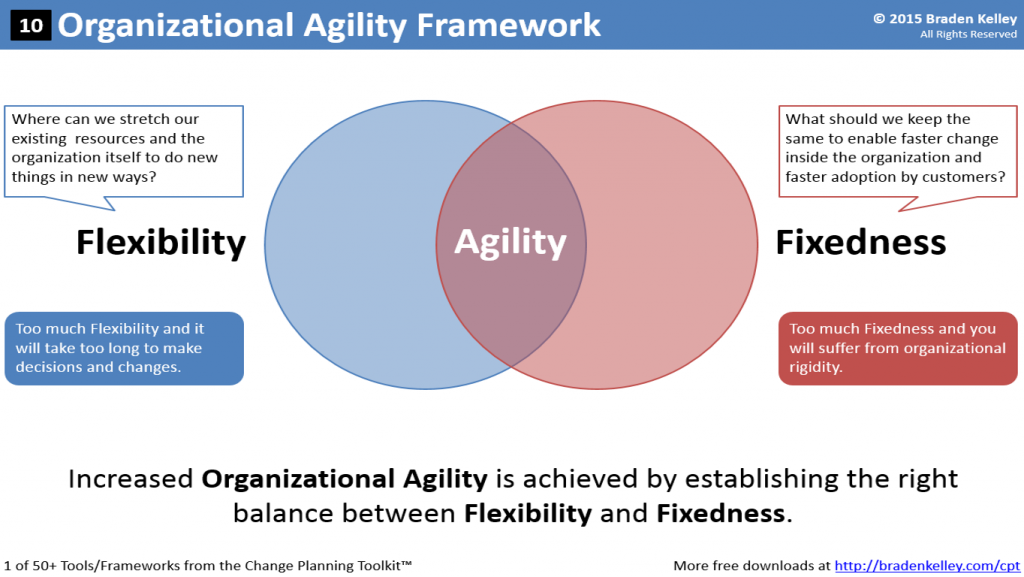
The Core Tension: Flexibility vs. Fixedness
The secret to sustained agility lies in the deliberate management of two opposing states:
- The Fixed: These are your non-negotiables. They include your core values, organizational purpose, and essential guardrails. These elements provide the “stable spine” and the psychological certainty employees need to take risks.
- The Flexible: These are your “modular” components. They include business processes, resource allocation models, and team structures. These must be designed to be disassembled and reconfigured in real-time as market conditions evolve.
Managing the Equilibrium
The framework teaches leaders how to prevent “Fixedness” from decaying into Rigidity (where you become a dinosaur) and how to prevent “Flexibility” from dissolving into Chaos (where you lose your brand identity). Agility is the active, daily management of this equilibrium.
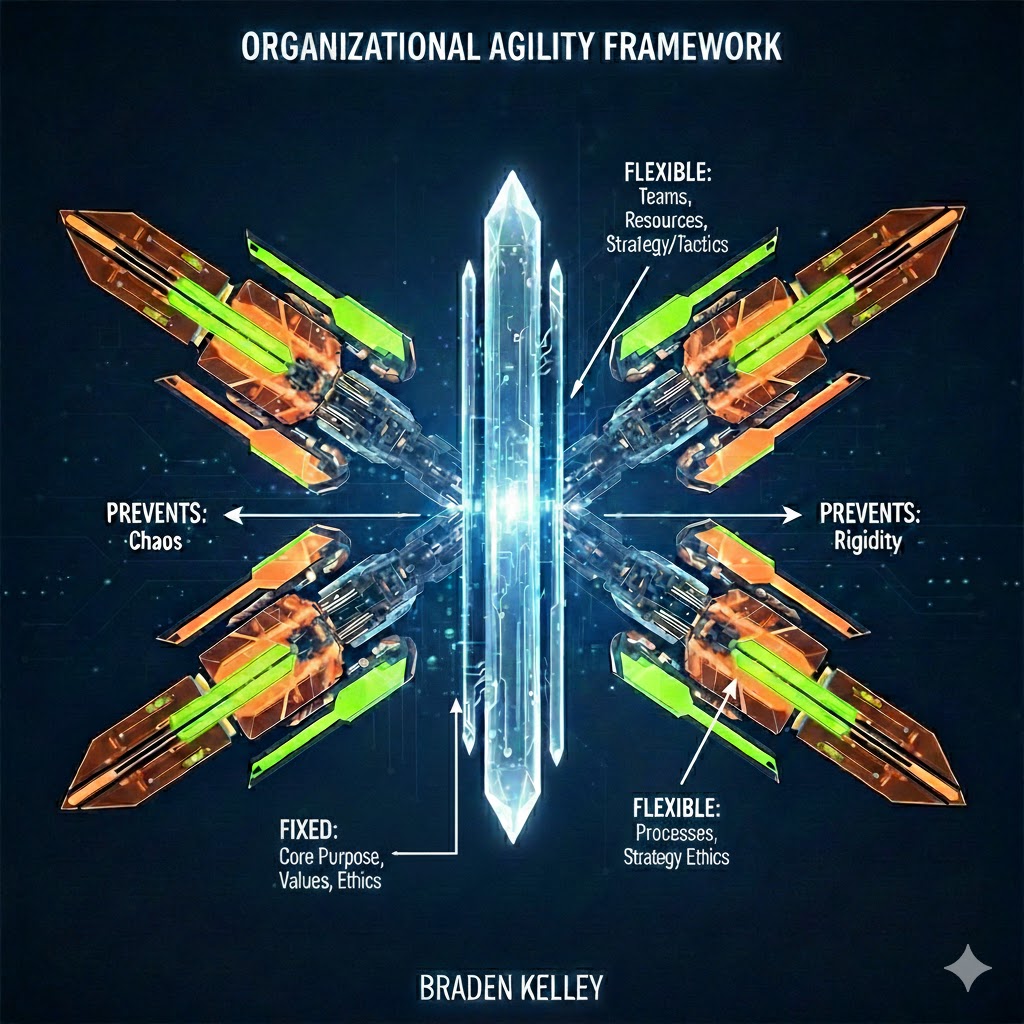
Insight: If you try to make everything flexible, you create an organization with no memory and no identity. If you keep everything fixed, you create a monument to the past. Agility is the art of knowing what to hold onto and what to let go.
IV. Designing for Modular Change
Architecting the Reconfigurable Enterprise
Loose Coupling and Micro-Structures
In a truly agile organization, we must abandon monolithic, deeply intertwined departmental silos. Instead, we move toward “Loose Coupling.” By organizing into small, cross-functional squads with clear interfaces, we ensure that one part of the business can pivot or fail without bringing down the entire system. This modularity allows for “plug-and-play” innovation.
Resource Fluidity: Escaping the Annual Budget Trap
You cannot have an agile strategy if your capital is locked in a 12-month fixed cycle. Resource Fluidity is the ability to shift talent and funding dynamically as opportunities arise. Agile organizations treat budgets as “living documents,” allowing leadership to pull resources from declining initiatives and inject them into high-growth “breakthrough” experiments in real-time.
Rapid Prototyping for Organizational Structure
We often prototype products, but we rarely prototype structure. Before committing to a company-wide reorganization, agile leaders run small-scale organizational experiments. By testing a new reporting line or a new collaborative workflow within a single “pilot” team, we can validate the human impact of the change before scaling it.
The Design Rule: Complexity is the enemy of agility. If your organizational chart requires a map and a legend to navigate, you aren’t built for speed — you’re built for bureaucracy. Simplify to amplify.
V. Measuring What Matters: Agility Metrics
Quantifying the Velocity and Resilience of Change
Time-to-Insight vs. Time-to-Action
In a traditional enterprise, the gap between identifying a market shift (Insight) and actually deploying a response (Action) can be months or even years. Agility is measured by the shrinkage of this gap. We must track our Latency of Decision — the speed at which data travels from the front lines to the decision-makers and back into the field as an executed strategy.
Learning Velocity
Success is a lagging indicator; Learning Velocity is a leading one. How quickly can your organization ingest new information, test it, and turn it into institutional knowledge? By measuring the number of validated experiments per quarter rather than just “project completions,” we shift the focus from output to outcomes.
The Resilience Score
Agility is as much about defense as it is offense. A Resilience Score assesses how much of a “shock” your organization can absorb — be it a supply chain disruption or a competitor’s surprise launch — without a significant drop in service levels or employee engagement. An agile organization doesn’t just bounce back; it “bounces forward” into a new, more relevant state.
The Measurement Shift: If you only measure efficiency, you will optimize yourself into extinction. You must measure your capacity to change, for that is where your future revenue lives.
VI. Conclusion: The Agile Organization as a Living System
Sustaining Competitive Advantage in a Volatile World
Beyond the Project Mindset
We must stop viewing “agility” as a transformation project with a start and end date. True organizational agility is a continuous practice — a state of being. It is the transition from seeing your company as a static machine to viewing it as a living system. Like any organism, your business must constantly sense, respond, and evolve to its environment to survive.
The Polymath Leader
The leaders of tomorrow must be comfortable with the “Whole-Brain” approach. They must be part scientist, using data and the Agility Framework to maintain the stable spine of the company, and part artist, using empathy and human-centered change to inspire the flexibility of the workforce. This balance is the only way to navigate the tension between what must remain fixed and what must remain fluid.
Your Sustainable Advantage
In an era where technology can be copied and capital is a commodity, your ability to change is your only sustainable competitive advantage. By architecting an enterprise that embraces both the comfort of fixed values and the excitement of flexible processes, you don’t just survive disruption — you become the disruptor.
Final Thought: Agility is the ultimate expression of confidence. It is the belief that no matter how the world changes, your organization has the structural integrity and the creative spirit to meet the moment. Let’s stop fearing the pivot and start building the platform that makes it possible.
Implementation Checklist: Activating the Agility Framework
Practical First Steps for the Human-Centered Leader
Moving from theory to practice requires a deliberate focus on the Fixed/Flexible balance. Use this checklist to audit your current state and begin the transition.
-
Identify Your “Stable Spine”:
Document the 3-5 core values and the overarching purpose that must remain Fixed. Do your teams know these are the non-negotiable guardrails? -
Audit for “Rigid Decay”:
Locate one process that exists “because we’ve always done it that way” but no longer serves the customer. Mark it as Flexible and schedule a redesign. -
Establish a “Safe-to-Fail” Zone:
Designate one small-scale project where the team is explicitly rewarded for Learning Velocity rather than just the final ROI. -
Assess Communication Latency:
Track how many days it takes for a customer insight from the field to reach a decision-maker. Aim to reduce this Time-to-Insight by 20% this quarter. -
Beta-Test a “Squad” Structure:
Select one departmental silo and “loosely couple” a cross-functional team (e.g., Marketing, Tech, and Customer Success) to solve a single specific friction point.
Braden’s Tip: Don’t try to change the whole organization at once. Agility is built through fractal change — successful small pivots that create a blueprint for the larger enterprise to follow.
What is a Stable Spine Audit?
In my Organizational Agility Framework, a Stable Spine Audit is a strategic exercise used to identify the permanent, non-negotiable elements of an organization that provide the structural integrity required to support rapid change elsewhere.
Think of it this way: for a human to move with agility — to sprint, jump, or pivot — the spine must remain strong and aligned. If the spine is “mushy,” the limbs have no leverage. In a business, if everything is up for grabs, you don’t have agility; you have chaos.
The Core Components of the Audit
When I lead an organization through this audit, we look for three specific types of “Fixedness”:
- 1. Core Purpose and North Star: Why does the organization exist beyond making a profit? This should be fixed. If your purpose pivots every six months, your employees will suffer from “change fatigue” and lose trust.
- 2. Values and Ethical Guardrails: These are the behavioral non-negotiables. They define how we work. These provide psychological safety because employees know that even in a crisis, the “rules of engagement” won’t shift.
- 3. Essential Architecture: This identifies the critical systems or data standards that must remain centralized and standardized to allow for “plug-and-play” flexibility in the branches or squads.
How to Conduct the Audit
The audit is essentially a filtering process for every major component of your business. You ask your leadership team: “Is this a Spine element or a Wing element?”
| Category | The Stable Spine (Fixed) | The Flexible Wings (Fluid) |
|---|---|---|
| Strategy | Long-term Vision & Purpose | Quarterly Tactics & Experiments |
| Structure | Governance & Core Values | Cross-functional Squads & Roles |
| Process | Essential Compliance & Quality | Daily Workflows & Tools |
| People | Cultural DNA & Talent Standards | Specific Skills & Resource Allocation |
Why It Matters for Innovation
I often see teams that are “frozen” because they don’t know what they are allowed to change. By conducting a Stable Spine Audit, you explicitly tell your team: “These five things are fixed. Everything else is a variable you can experiment with.”
This clarity actually increases the speed of innovation because it removes the “permission bottleneck.” When the spine is stable, the wings can flap as fast as they need to.
Diagnostic Questionnaire: Activating the Organizational Agility Framework
A Leadership Workshop Guide to the Stable Spine Audit
To help you activate the Organizational Agility Framework, here is a diagnostic questionnaire designed to be used in a leadership workshop. The goal is to reach a consensus on what belongs to the “Spine” (Fixed) and what belongs to the “Wings” (Flexible).
Phase 1: Identifying the Fixed (The Stable Spine)
Ask your leadership team to answer these questions individually, then compare notes. Discrepancies here usually indicate where organizational friction is coming from.
- The “North Star” Test: If we changed our product line entirely tomorrow, what is the one reason for existing that would stay exactly the same?
- The Value Constraint: What are the three behaviors that, if an employee violated them, would result in immediate dismissal regardless of their performance?
- The Architectural Anchor: What is the single source of truth (data, brand guideline, or compliance rule) that every department must use to remain part of the collective whole?
- The Non-Negotiable Promise: What is the one promise we make to our customers that we would never “pivot” away from, even for a massive short-term profit?
Phase 2: Identifying the Fluid (The Flexible Wings)
Now, look at the areas where the organization feels “slow.” These are likely things that are currently “Fixed” but should be “Flexible.”
- The “Shadow” Processes: Which of our current “standard operating procedures” (SOPs) were created more than two years ago and haven’t been updated since?
- The Permission Bottleneck: Who has the authority to spend $5,000 to test a new idea? If the answer is “The VP,” that process is too Fixed.
- The Role Rigidity: Are our job descriptions based on tasks (Fixed) or outcomes (Flexible)? Can we move a person from Project A to Project B in 24 hours without a HR mountain to climb?
- The Budgeting Cycle: If a massive market opportunity appeared tomorrow, how long would it take to reallocate 10% of our budget to pursue it?
The Audit Tally
Once you have these answers, map them out:
- Green Zone: Elements everyone agrees are Fixed. These are your strengths.
- Red Zone: Elements everyone agrees are Fixed but should be Flexible. These are your targets for immediate “unlearning.”
- Grey Zone: Elements where the team disagrees. This is where your cultural friction lives.
Closing the Audit
As an innovation speaker, I always remind leaders: The Spine is for Support, not for Strangulation. The goal of this audit isn’t to create more rules, but to create the clarity that allows for more freedom.
Organizational Agility: Frequently Asked Questions
1. What is the difference between organizational speed and organizational agility?
Speed is the velocity of movement in a single direction. Agility is the architectural capacity to change direction at speed without breaking the organization. While speed is about execution, agility is about reconfigurability.
2. Why does the “Stable Spine” actually help an organization move faster?
A “Stable Spine” (fixed core values, purpose, and guardrails) provides psychological safety and clarity. When employees know exactly what is non-negotiable, they no longer need to seek permission for everything else, effectively removing the “permission bottleneck” that slows down innovation.
3. How do you identify if a process should be ‘Fixed’ or ‘Flexible’?
Use the Stable Spine Audit. If a process protects your core DNA, ethical standards, or brand promise, it is “Fixed.” If a process is simply a method for delivery, resource allocation, or internal workflow, it should be “Flexible” and modular to allow for rapid adaptation to market shifts.
Image credits: Braden Kelley (1,100+ FREE quote posters at http://misterinnovation.com), Google Gemini
Content Authenticity Statement: The topic area, key elements to focus on, etc. were decisions made by Braden Kelley, with a little help from Google Gemini to clean up the article and add citations.
 Sign up here to get Human-Centered Change & Innovation Weekly delivered to your inbox every week.