Resolving Psychological Friction in Stalled Change Initiatives
GUEST POST from Art Inteligencia
Executive Summary: The De-Escalation Framework
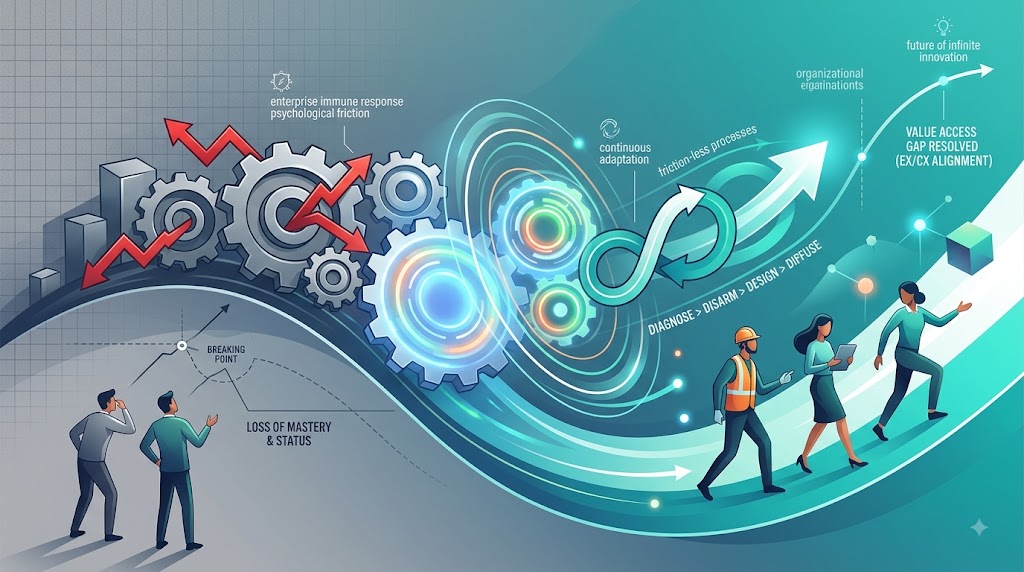
When transformation stalls, leaders rarely face a strategy problem—they face an enterprise immune response.
Change initiatives do not fail because people inherently resist progress; they stall because the psychological friction created by change exceeds the perceived value of adaptation. When organizations push harder through top-down mandates, they inadvertently trigger deeper defensiveness, driving critical initiatives into institutional gridlock.
The De-Escalation Framework shifts the paradigm from enforcement to friction-reduction. Grounded in human-centered innovation, futurology, and experience design (EX/CX), this approach provides change architects and business leaders with a structured methodology to systematically diagnose, disarm, and dismantle organizational drag.
Core Strategic Imperatives:
- Diagnose Root Friction: Audit emotional and cognitive handoffs across the employee journey—not just process efficiency.
- Disarm Resistance: Replace force with co-creation and safe-to-try micro-experiments to neutralize defense mechanisms.
- Design Intentional Simplicity: Align Employee Experience (EX) with Customer Experience (CX) to unlock intuitive, frictionless behaviors.
- Diffuse Organic Momentum: Mobilize internal network connectors and illuminate micro-wins to create continuous, elastic adaptability.
By addressing the human factors of change first, organizations convert inertia into momentum, building a resilient enterprise capable of perpetual, frictionless evolution.
I. The Anatomy of Stalled Change
A. The Organizational Immune System at Work
In classical physics, Newton’s First Law dictates that an object at rest stays at rest unless acted upon by an external force. In organizational design, however, applying external force doesn’t simply produce motion—it produces equal and opposite friction. Innovation inherently demands change, and change destabilizes established comfort zones. When new operating models, enterprise platforms, or digital transformation initiatives are introduced, the enterprise defaults to self-preservation.
Resistance vs. Psychological Friction
Traditional change management treats resistance as an enemy to be conquered through heavier communication, aggressive training mandates, or top-down escalation. This mistakes the symptom for the cause. People rarely resist progress for the sake of being difficult; they resist the psychological friction—the perceived risk, cognitive overload, and threat to status—that accompanies the transition. Pushing harder on a system with high friction doesn’t accelerate movement; it causes the system to overheat and seize.
When this friction goes unaddressed, the organizational immune system mobilizes. It rarely manifests as overt rebellion; instead, it appears as covert drag:
- Passive Compliance: Teams nod in agreement during town halls but return to legacy habits the moment the cameras turn off.
- Analysis Paralysis: Continuous requests for more data, additional committee reviews, and endless pilot iterations designed to postpone full deployment.
- Institutional Drag: A compounding fatigue where every strategic shift feels heavier, costlier, and slower than the last, burning valuable capital and eroding trust across the workforce.
B. Mapping the Root Causes of Psychological Friction
To neutralize friction, change architects must look beyond operational process maps and uncover the hidden psychological landscape of the workforce. Psychological friction generally stems from three primary triggers:
1. Loss of Mastery & Status Threat
When an organization replaces a legacy system or workflow, it instantly devalues years of accumulated expertise. High-performing subject matter experts are suddenly transformed into beginners. The unvoiced fear—“Will I still be valuable here?”—creates powerful defensive behaviors disguised as tactical skepticism.
2. Ambiguity and Cognitive Overload
Human cognitive systems prioritize efficiency and predictability. When leadership presents vague, high-level transformation goals without clear operational pathways, employees face cognitive fatigue. Under high ambiguity, the brain defaults to the familiar—even if the familiar is inefficient.
3. The “Value Access” Gap (EX Breakdown)
Major transformation projects are often framed around macro-level benefits: increased market share, shareholder return, or operational scale. However, if the Employee Experience (EX) degradation required to achieve those goals outweighs the personal utility for the individual contributor, a disconnect occurs. Without a clear answer to “What’s in it for me?”, friction inevitably halts adoption.
II. The Four Pillars of The De-Escalation Framework
Overcoming organizational inertia requires moving away from brute-force mandates and toward intentional, human-centered experience design. The De-Escalation Framework provides a structured four-phase progression to systematically systematically identify, disarm, and resolve psychological friction across stalled initiatives.
Framework Progression Architecture
Friction Points
→
2. DISARM
Immune Response
→
3. DESIGN
Frictionless EX/CX
→
4. DIFFUSE
Organic Momentum
Pillar 1: DIAGNOSE — Map Friction Points (Not Just Process Steps)
Traditional process maps focus strictly on inputs, outputs, and handoffs. They treat human operators as deterministic nodes in an algorithm. Diagnostic de-escalation requires mapping the emotional and cognitive realities experienced across those handoffs.
- Audit the Emotional Journey: Identify where anxiety spikes, where decision fatigue sets in, and where ambiguity creates operational hesitation.
- Mobilize an “Army of Eyes”: Engage frontline troubleshooters and customer champions to highlight invisible friction hidden from executive dashboards.
- Separate Structural from Psychological Drag: Disentangle mechanical issues (e.g., legacy software constraints) from behavioral drivers (e.g., psychological unsafe environments or fear of skill obsolescence).
Pillar 2: DISARM — Neutralize the Organizational Immune Response
When an enterprise senses a threat to its established habits, its defensive mechanisms kick in automatically. Disarming this reaction requires changing the engagement model from top-down imposition to collaborative co-creation.
- Co-Creation as an Antimicrobial: Utilize visual collaborative tools (such as the Change Planning Toolkit™) to involve affected teams directly in shaping the implementation path, instilling shared ownership.
- Lower the Stakes with Micro-Experiments: Shift language and execution away from massive, irreversible rollouts toward low-cost, safe-to-try experimentation loops that significantly reduce systemic risk and fear.
- Establish Psychological Safety Protocols: Normalize naming flawed assumptions and operational risks without fear of reprisal, turning skepticism into actionable strategic feedback.
Pillar 3: DESIGN — Build Frictionless Adaptation into EX and CX
Sustainable change occurs when the desired behavior becomes the path of least resistance. Experience design principles must be applied to both internal Employee Experience (EX) and external Customer Experience (CX) simultaneously.
- Align EX with CX Value Delivery: Ensure internal operational adjustments directly enhance the customer’s value proposition while stripping out unnecessary complexity for employees.
- Design for Intentional Simplicity: Systematically eliminate redundant sign-offs, administrative overhead, and artificial governance bottlenecks that stifle momentum.
- Activate the Value Translation Engine: Explicitly articulate a compelling answer to “What’s In It For Me?” (WIFM) tailored specifically to each key contributor archetype across the organization.
Pillar 4: DIFFUSE — Orchestrate Network-Driven Acceleration
Change does not spread linearly down an organizational chart; it cascades laterally through peer-to-peer social networks. To sustain momentum, leaders must orchestrate organic adoption mechanisms across functional boundaries.
- Mobilize Key Network Archetypes: Identify and empower internal Connectors, Evangelists, and Troubleshooters to carry new working methods across functional silos.
- Illuminate Micro-Wins: Broadcast tangible, early wins continuously to validate progress and convert passive observers into active participants.
- Embed Continuous Elasticity: Anchor initial wins into everyday operational cadence, building institutional muscle for perpetual, effortless adaptation.
III. Operationalizing De-Escalation: A Leader’s Playbook
Transitioning from theoretical understanding to operational execution requires concrete instruments and actionable measurement frameworks. Leaders must systematically measure psychological friction with the same rigor traditionally reserved for financial capital and schedule milestones.
A. The De-Escalation Audit Tool
Before advancing an initiative to its next milestone phase, change architects should execute a rapid diagnostic audit across five core indicators of psychological friction.
B. Metrics That Matter
To keep initiatives moving forward, vanity metrics like training completion rates must be replaced with leading indicators of organizational momentum and behavioral adoption:
1. Experimentation Velocity
Measures the elapsed time between hypothesis formulation, micro-test execution, and data iteration. High velocity indicates low systemic fear and strong operational elasticity.
2. Time-to-Insight Compression
Tracks how rapidly frontline feedback directly alters project design or strategic priorities. Compressing this window demonstrates real responsiveness and builds institutional trust.
3. Lateral Adoption Spread
Measures the rate at which new practices transfer across peer networks without direct managerial intervention, indicating genuine organic momentum.
Conclusion: From Psychological Friction to Organizational Elasticity
Transformation isn’t a one-time event forced upon an enterprise—it is an everyday organizational capability designed into the culture.
When change initiatives stall, the path forward is rarely to push harder with rigid mandates or top-down control. Pushing against systemic inertia only amplifies defensive behaviors, triggering the enterprise immune response and burning valuable institutional trust. Real progress demands a shift from enforcement to friction-reduction.
By applying The De-Escalation Framework, leaders address the fundamental human dynamics of change first. By systematically diagnosing cognitive friction, disarming fear through co-creation, designing elegant employee and customer experiences, and diffusing adoption through organic peer networks, change architects bypass organizational drag entirely.
The Strategic Shift for Innovation Leaders:
Stop asking, “How do we force people to adopt this transformation?”
Start asking, “What psychological friction is blocking natural progress, and how do we design it out of the experience?”
When you dismantle psychological friction, you do more than reignite a stalled initiative—you transform your organization into an elastic, perpetually adaptive enterprise capable of turning future disruption into a continuous competitive advantage.
Frequently Asked Questions
Why do traditional change management frameworks fail during stalled initiatives?
Traditional approaches treat resistance as an obstacle to conquer with heavier mandates and communication. This triggers the enterprise immune response. The De-Escalation Framework focuses on resolving psychological friction—like threat to status, cognitive overload, and alignment gaps—making adaptation the path of least resistance.
How does The De-Escalation Framework disarm the organizational immune system?
It replaces top-down imposition with collaborative co-creation (using tools like the Change Planning Toolkit™), lowers systemic risk via safe-to-try micro-experiments, and establishes psychological safety protocols where teams can openly surface flawed assumptions.
What key metrics track whether psychological friction is actually decreasing?
Instead of vanity metrics like training completion, track Experiment Velocity (how fast hypotheses are tested), Time-to-Insight Compression (how quickly frontline feedback alters priorities), and Lateral Adoption Spread (how fast habits transfer peer-to-peer).
Bring This Thinking to Your Next Event
Braden Kelley is a LinkedIn Top Voice, bestselling author, and innovation keynote speaker who helps organizations get to the future first and build sustainable innovation cultures.
Image credit: Gemini
 Sign up here to get Human-Centered Change & Innovation Weekly delivered to your inbox every week.