Tag Archives: complaints

Customer Experience Failures Are a Gift

Customer Experience Failures Are a Gift Pixabay

GUEST POST from Shep Hyken

When things go wrong for your customer, that’s when you have the best opportunity to prove how good you really are. Anyone can look good when everything is running smoothly, but your true customer service “chops” show up during a service failure.

I recently went to a doctor’s office for an appointment. I arrived early to check in. The nurse at the desk was – no exaggeration – horrified that she had to tell me there was a glitch in the scheduling software, and my appointment had to be rescheduled. While some people might have taken a, “That’s too bad … it happens attitude,” she couldn’t have been more apologetic, showing tremendous empathy, and immediately went to work to find another time for me to return to see the doc.

I was at a restaurant and ordered a sandwich without mayonnaise. (I hate mayonnaise!) Of course, the sandwich came out slathered with mayo. The server spotted the mistake while setting the plate down in front of me. Before it even hit the table, she put it back on her tray. She served the rest of the food to everyone else at the table, and like the nurse who had to reschedule my appointment, she apologized and showed empathy. She immediately went to the kitchen to fix the problem. Several minutes later, I had a perfect sandwich.

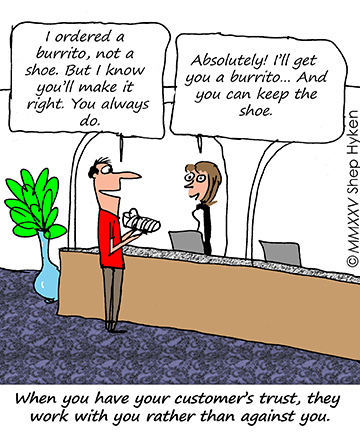
Shep Hyken CX Failure cartoon

After both of these experiences, I received email messages asking me to complete a short survey. I gave each of these people and businesses a perfect, five-star rating. It wasn’t that they were flawless. In both cases, mistakes were made. But they each made a flawless recovery. In both situations, they didn’t offer a refund or anything for free. They just fixed the problem – but they did it with style. And when someone cares as much as these ladies did, how could I stay mad at them?

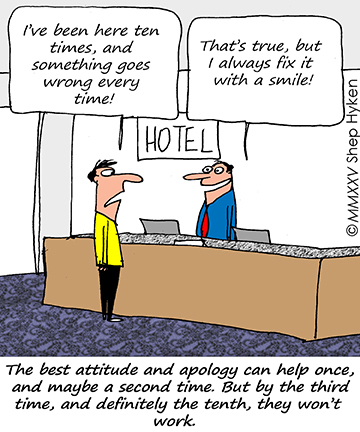
One important point: For this approach to work, problems have to be rare, not frequent, occurrences. No matter how nice employees are or how well they handle issues and complaints, if problems happen regularly, customers won’t trust the company. Excellence in recovery can only overcome occasional failures, not “systematic” ones.

I don’t need to rehash my Five Steps to Handling a Moment of Misery (Complaint), but it’s important to point out that both people handled the problems well. Rescheduling an appointment seems like a bigger issue than remaking a sandwich, but that’s not the point. The point is they both fixed the problem, and the attitude they took while doing so became even more important than the fix.

Both of these stories illustrate how, when you really care, you can win back your customer. A mistake isn’t the end of your relationship with a customer. Handled the right way, it’s an opportunity to build trust and loyalty by showing how good you really are when things don’t go according to plan.

Image credits: Pixabay, Shep Hyken

Subscribe to Human-Centered Change & Innovation WeeklySign up here to join 17,000+ leaders getting Human-Centered Change & Innovation Weekly delivered to their inbox every week.

Aiming for Zero Complaints

Finding Excellence in the Pursuit

Aiming for Zero Complaints

GUEST POST from Shep Hyken

Vince Lombardi, the legendary football coach who won the very first (and second) Super Bowl, said to his team, the Green Bay Packers:

“Gentlemen, we will chase perfection, and we will chase it relentlessly, knowing all the while we can never attain it. But along the way, we shall catch excellence.”

That’s what I thought of when I started my interview with Bill Price, Amazon’s first vice president of global customer service, president of Driva Solutions and co-author (with Gautam Mahajan and Moshe Davidow) of Zero Complaints: The Path to Continuous Value Creation.

The concept of zero complaints intrigues me, and it should intrigue you as well. At times you may create a perfect experience for your customer, and it may happen often, but it won’t happen every time. In our interview, we talked about Price’s latest book and the importance of a relentless focus on perfection. Below are my interpretations of six of the most important takeaways from our interview:

  1. An Aspirational Goal: Like Lombardi’s pursuit of perfection, zero complaints is not attainable, but a lofty goal that will have the byproduct of an excellent customer experience. Price says, “Achieving zero complaints isn’t just an aspirational goal. It’s a practical pathway to sustainable business success.”
  2. The Cost of Customer Complaints: Price emphasized that the financial impact of not addressing complaints is costly. Research by Moshe Davidow, one of the book’s co-authors, found that unresolved complaints could account for 16-20% potential revenue loss through lost business, reputational harm and lower lifetime value of existing customers. It’s imperative to adopt a proactive approach to complaint management.
  3. Service Recovery: The good news about customer complaints is that when they are managed the right way, you can turn complaining customers into loyal customers. Customers don’t want to complain, but if they have to, they will feel confidence when they realize the company will take care of them. Be sure your customer support—both self-service and with live agents—is consistently meeting and exceeding your customers’ expectations.
  4. Proactive Complaint Management: As important as service recovery is, a better solution is to eliminate or reduce the times you have to recover. Study the “journey” your customers take when doing business with you and find ways to eliminate the friction and pain points that they might experience. Focus on delivering an excellent experience, rather than just excellent complaint resolution. This dual approach helps to ensure positive interactions, whether complaints happen or not.
  5. Executive Buy-In: Leadership (and that includes the C-suite) should engage with front-line employees and experience the day-to-day operations firsthand. By working in customer-facing roles or performing normal tasks, leaders can gain valuable insights into existing challenges and improve processes. When decision-makers see the business through a customer’s eyes, they are more likely to implement and support meaningful improvements. Price shared that Amazon founder Jeff Bezos would spend time handling complaint calls. “He strapped on a headset (in the support center) or sat at the computer and answered emails. … Back then, his email address was jeff@amazon.com, and he actually shared that email address publicly.”
  6. The ROI of Zero Complaints: There is a significant return on investment (ROI) that can be realized by minimizing customer complaints. First, reducing complaints leads to better customer retention. When customers have fewer issues, they are more likely to remain loyal and advocate for the brand, thereby attracting new business through word-of-mouth. Second, fewer complaints translates to lower operational costs. A reduction in customer issues means less reliance on customer support managing complaints, freeing up agents to help customers solve problems (not complaints) and free up resources that can be better utilized elsewhere.

Customer expectations are continually rising. Customers are smarter than ever and know from their own experiences what great service is. It is essential for businesses to adapt to a higher standard and expectation. Price says, “We must always maintain that what was good last year isn’t good anymore.”

Image Credit: Shep Hyken

This article was originally published on Forbes.com.

Subscribe to Human-Centered Change & Innovation WeeklySign up here to join 17,000+ leaders getting Human-Centered Change & Innovation Weekly delivered to their inbox every week.