Career Lattice, Not Ladder
LAST UPDATED: December 10, 2025 at 12:12PM

GUEST POST from Chateau G Pato
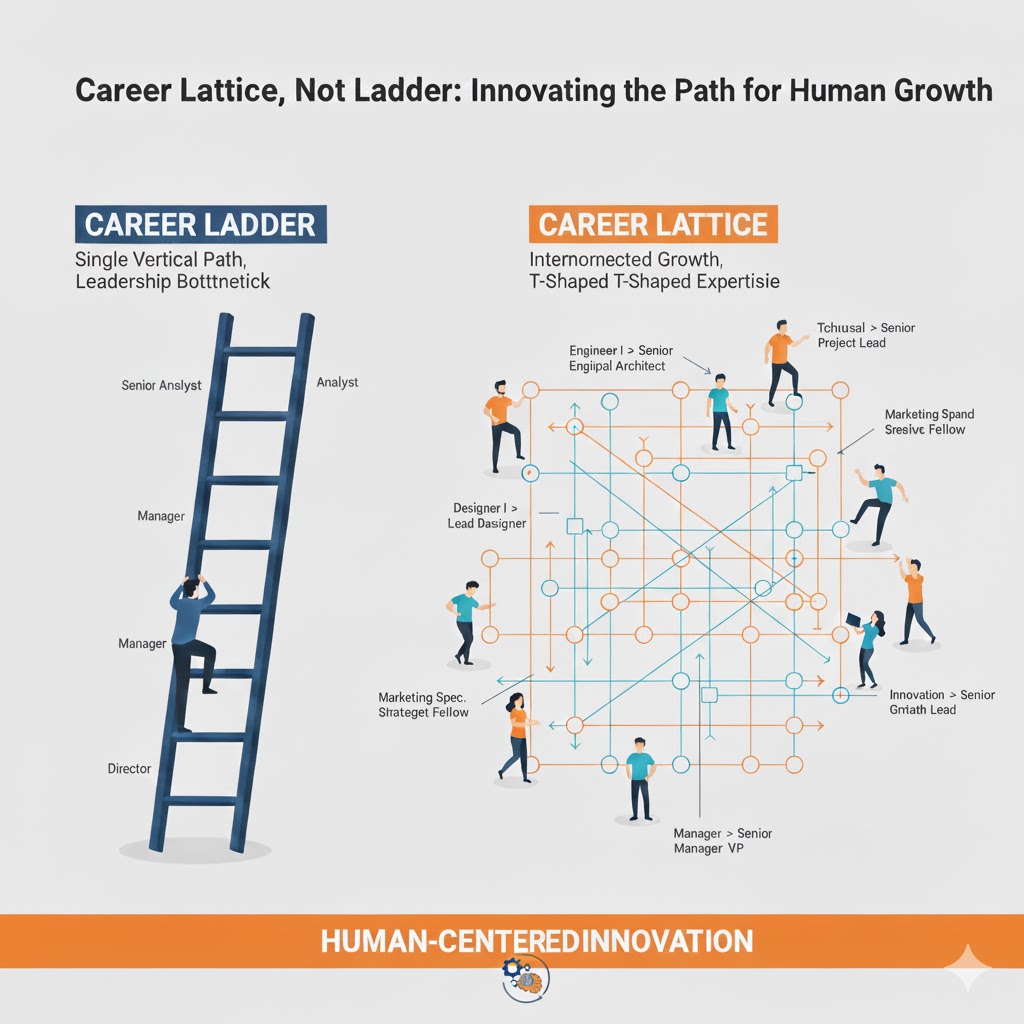
For over a century, the metaphor guiding professional development has been the career ladder: a single, vertical track where success is measured solely by climbing to the next managerial rung. This linear approach is fundamentally broken for the modern, innovation-driven economy. It forces technical experts into supervisory roles they neither want nor excel at, creates deep talent silos, and ultimately limits an organization’s adaptive capacity. The traditional ladder generates leadership bottlenecks and expertise gaps.
The solution is the Career Lattice. This model replaces simple vertical promotion with a complex, interconnected network of roles that rewards movement across functions, deepening of non-managerial expertise, and mastery of cross-disciplinary skills. This horizontal and diagonal movement is the necessary foundation for building a resilient, innovative, and human-centered workforce. The lattice acknowledges that a lateral move from marketing to product development, or a diagonal shift into a subject matter expert track, is often more valuable to the individual’s growth and the company’s innovation ecosystem than a simple management title. Organizations must unlearn the idea that management is the only path to influence and compensation and embrace the horizontal value of the expert. This is the structural requirement for true Human-Centered Innovation.
Visual representation: A diagram comparing the Career Ladder (a single vertical line with few rungs) to the Career Lattice (a broad, interconnected grid showing horizontal, vertical, and diagonal movement between different functions like Engineering, Marketing, and Strategy).
The Three Core Benefits of the Lattice
Shifting to a lattice model yields three transformative benefits that directly fuel innovation:
1. Deepened T-Shaped Expertise
The lattice explicitly supports the growth of T-Shaped Professionals — individuals who possess deep expertise in one area (the vertical bar of the ‘T’) but also broad, cross-functional knowledge (the horizontal bar). A designer who has spent a year in customer service, or a developer who has shadowed the finance team, gains the empathy and perspective necessary to create truly human-centered solutions. The lattice makes these moves desirable and compensable, creating a workforce rich in interdisciplinary context.
2. Unblocking the Expert Track
The biggest failure of the ladder is forcing valuable experts — brilliant engineers, data scientists, or regulatory specialists — into managing people just to gain a pay raise or seniority. The lattice introduces parallel, high-status, high-compensation Expert Tracks (e.g., Distinguished Engineer, Principal Architect, Master Strategist) that are non-managerial. This allows top talent to focus on complex problem-solving and mentorship without sacrificing their career ambition, keeping critical institutional knowledge and technical leadership focused on innovation, not administration.
3. Fostering Organizational Agility
A workforce with experience across multiple functions is inherently more agile. When teams need to pivot or collaborate on a complex, novel problem (the core of innovation), individuals who have worked in different departments understand the language, incentives, and constraints of their partners. This shared context dramatically reduces friction, misunderstandings, and siloed thinking, accelerating the organization’s responsiveness to market shifts. The lattice acts as an organizational glue.
Designing the Lattice: Essential Structural Elements
Simply drawing a box grid is not enough. A functional Career Lattice requires intentional structural changes:
- Value Equivalence: Compensation and seniority must be mapped to skill mastery and organizational impact, not reporting lines. A Principal Architect (non-manager) must be demonstrably capable of earning the same as a Director (manager).
- Internal Mobility as a KPI: The success of managers and HR should be tied to the percentage of employees making meaningful lateral or diagonal moves. Internal mobility must be prioritized over external hiring for specific roles.
- Rotational Assignments: Formalize temporary, project-based assignments outside a person’s core function. These tours of duty expose employees to new challenges and build lattice connections without permanent job changes.
Case Study 1: Transforming a Technology Team into a Business Partner
Challenge: IT Department Viewed as a Cost Center, Lacking Business Empathy
A large financial services company (“FinNova”) had a technically excellent IT department, but it was siloed. IT projects often failed because the team lacked empathy for the daily struggles and strategic needs of the sales and operations teams. The only promotion path in IT was to become an IT manager, increasing the isolation.
Lattice Intervention: Diagonal and Horizontal Movement
FinNova implemented a Career Lattice focused on building business context. They established a “Business Architect” track — a diagonal move from IT specialist. These non-managerial roles required 18 months of embedded work in a business unit (Sales, Compliance, Operations) followed by a return to IT to lead strategic integration projects.
- The Business Architect track was compensated equally to the IT Manager track.
- IT staff were required to complete at least one rotational assignment (e.g., three months in a branch office) before being eligible for the top technical roles.
The Innovation Impact:
The lattice successfully broke the silo. IT projects began incorporating operational realities from the start. The quality of IT strategic advice improved dramatically, and the IT department transitioned from a cost center to a genuine business partner, directly enabling the firm’s transition to a digital-first service model. The lattice created cross-functional translators.
Case Study 2: Retaining Top Talent Through Expertise Recognition
Challenge: Loss of Senior Scientific Researchers to Competitors
A bio-technology startup (“BioLeap”) found that its top PhD-level researchers were leaving for management positions at larger firms after reaching the ceiling of the non-managerial “Senior Scientist” role. The company was hemorrhaging institutional knowledge and technical leadership.
Lattice Intervention: The Expert Track Parallel
BioLeap formally introduced a parallel Expert Track to run alongside the Management Track. They created “Research Fellow” and “Principal Investigator” titles, offering compensation and perks equivalent to Director and VP-level roles, respectively.
- Research Fellows were given protected time for pure research and mentorship responsibilities but zero direct reports.
- The promotion criteria for the Expert Track were focused on patent creation, publication of high-impact research, and mentoring junior scientists — not people management.
The Innovation Impact:
By explicitly valuing and rewarding technical mastery over administration, BioLeap immediately stabilized its senior research team retention. The company not only retained its most valuable minds but also leveraged them as internal consultants and mentors, significantly accelerating the development of novel therapies. The lattice allowed their best scientists to continue being scientists, directly contributing to the core mission of disruptive innovation.
Conclusion: The Lattice is Human-Centered Strategy
The Career Lattice is more than just an HR policy; it is a fundamental shift in strategy that aligns organizational structure with Human-Centered Innovation. It rewards the natural human desire for continuous learning, diverse experiences, and deep mastery, rather than forcing everyone into the narrow, often ill-fitting, constraints of management. Leaders must champion this shift, not just to retain talent, but to build an enterprise that is inherently more versatile, empathetic, and capable of generating sustained, cross-functional innovation. Stop climbing ladders; start weaving a lattice.
“The depth of your expertise matters as much as the height of your title.” — Braden Kelley
Frequently Asked Questions About the Career Lattice
1. How is a Career Lattice different from a dual-track career system?
A dual-track system (Management vs. Technical) is a component of a lattice. A true Career Lattice is much broader: it allows for horizontal movement between different departments (e.g., Marketing to Finance) and diagonal movement from a technical track into a cross-functional role (e.g., Technical Expert to Project Strategist), rewarding diverse experience, not just vertical or single-track progression.
2. Does the Lattice eliminate the need for traditional managers?
No. The Lattice clarifies and elevates the role of the manager. Instead of being the only path to success, management becomes a distinct specialization focused on people leadership, resource allocation, and strategy execution. It ensures that those who become managers are genuinely skilled in leadership, while experts are free to focus on deep technical or strategic contributions.
3. What is the single biggest barrier to implementing a Career Lattice?
The biggest barrier is cultural—specifically, the ingrained perception that higher management titles automatically equate to higher value and compensation. Successfully implementing a lattice requires leaders to publicly, explicitly, and financially validate the equivalence of the top Expert Track roles with Director or VP-level Management Track roles. Without this cultural shift, employees will still default to chasing the traditional title.
Your first step toward building a Career Lattice: Identify your top five non-managerial experts who are nearing a career ceiling. Create a specific, high-status “Principal” or “Distinguished” title for them and publicly announce their promotion, ensuring the compensation is equal to the next level of management. This sends the clearest signal that expertise is valued horizontally.
Extra Extra: Because innovation is all about change, Braden Kelley’s human-centered change methodology and tools are the best way to plan and execute the changes necessary to support your innovation and transformation efforts — all while literally getting everyone all on the same page for change. Find out more about the methodology and tools, including the book Charting Change by following the link. Be sure and download the TEN FREE TOOLS while you’re here.
Image credit: Pexels
 Sign up here to get Human-Centered Change & Innovation Weekly delivered to your inbox every week.