LAST UPDATED: February 22, 2026 at 5:28 PM
GUEST POST from Art Inteligencia
I. Introduction: From Interaction to Integration
We are standing at the threshold of the most significant shift in human history: the transition from tools we operate to systems we inhabit.
The End of the Mouse and Keyboard
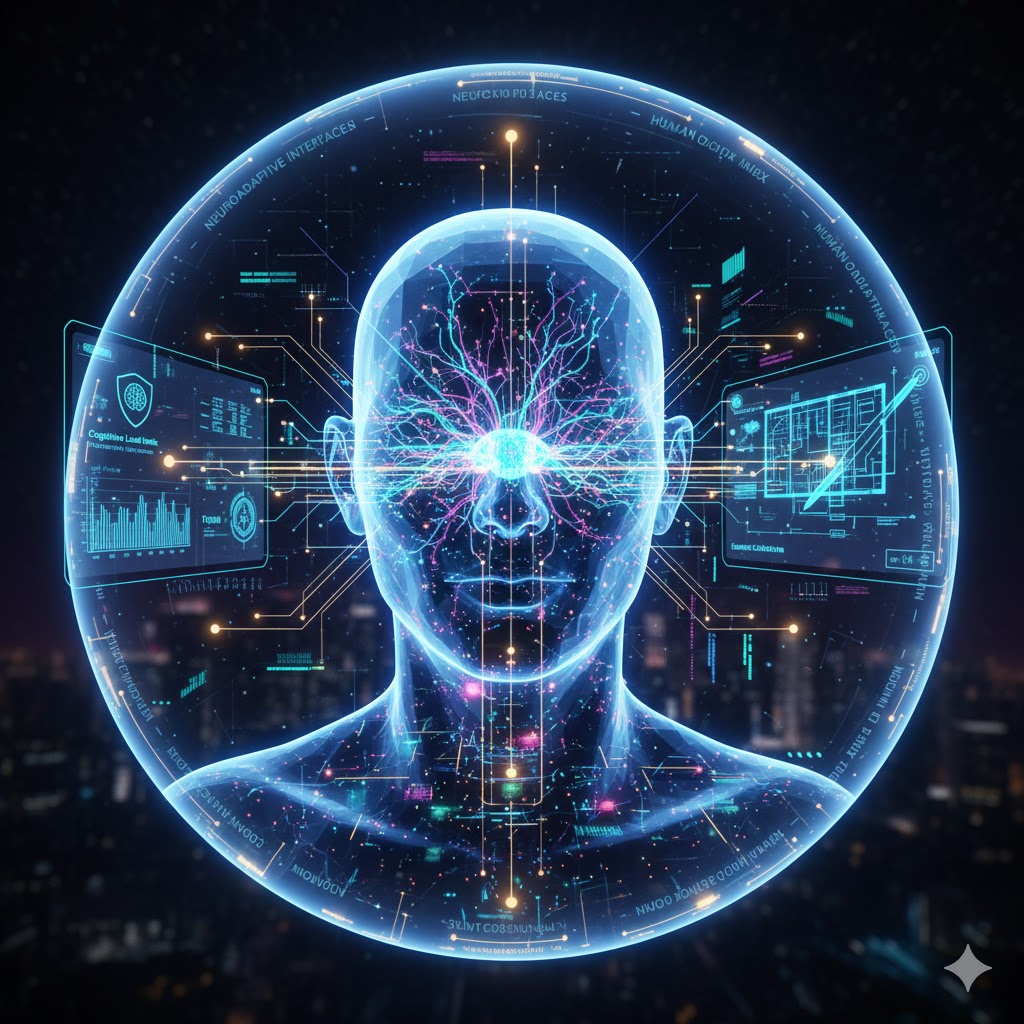
For decades, the primary bottleneck for human intelligence has been the physical interface. Our thoughts move at the speed of light, yet we are forced to translate them through the “clunky” mechanical latency of typing on a keyboard or clicking a mouse. In 2026, these methods are increasingly viewed as legacy constraints. Neuroadaptive Interfaces (NI) bypass these barriers, allowing for a seamless flow of intent from the mind to the digital canvas.
Defining Neuroadaptivity
Traditional software is reactive — it waits for a command. Neuroadaptive systems are proactive and bidirectional. By monitoring neural oscillations and physiological markers, these interfaces adapt their behavior in real-time. If the system detects you are entering a state of “flow,” it silences distractions; if it detects “cognitive overload,” it simplifies the data density of your environment. It is a system that finally understands the user’s internal context.
The Human-Centered Mandate
As we bridge the gap between biology and silicon, our guiding principle must remain Augmentation, not Replacement. The goal of NI is to amplify the unique creative and empathetic capacities of the human spirit, using machine precision to handle the “cognitive grunt work.” We aren’t building a Borg; we are building a more capable, more focused version of ourselves.
II. The Mechanics of Symbiosis: How NI Works
Neuroadaptivity isn’t magic; it is the sophisticated orchestration of bio-signal processing and generative UI.
1. The Feedback Loop: Sensing the Invisible
At the core of a neuroadaptive interface is a high-speed feedback loop. Using non-invasive sensors like EEG (electroencephalography) for electrical activity and fNIRS (functional near-infrared spectroscopy) for blood oxygenation, the system monitors “proxy” signals of your mental state. These are translated into a Cognitive Load Index, telling the machine exactly how much “mental bandwidth” you have left.
2. The Flow State Engine
The “killer app” of NI is the ability to protect and prolong the Flow State. When the sensors detect the distinct neural patterns of deep concentration, the interface enters “Deep Work” mode — suppressing notifications, simplifying color palettes, and even adjusting the latency of input to match your cognitive tempo. Conversely, if it detects the theta waves of boredom or the erratic signals of fatigue, it provides “Scaffolding” — contextual hints or automated sub-task completion to keep you on track.
3. Privacy by Design: The Neuro-Ethics Layer
In 2026, the most critical “feature” of any NI system is its Privacy Layer. This is the technical implementation of “Neuro-Ethics.” To maintain stakeholder trust, raw neural data must be processed at the edge (on the device), ensuring that “thought-level” data never hits the cloud. We are moving toward a standard of “Neural Sovereignty,” where the user owns their cognitive signals as a basic human right.
III. Case Studies: Neuroadaptivity in the Real World
The true value of neuroadaptive interfaces is best seen where human stakes are highest. These real-world applications demonstrate how NI transforms passive tools into intelligent, empathetic partners.
Case Study 1: Precision High-Acuity Healthcare
In complex cardiovascular and neurosurgical procedures, the surgeon’s cognitive load is immense. Traditional monitors provide patient data, but they ignore the surgeon’s mental state. Modern Neuroadaptive Surgical Suites integrate non-invasive EEG sensors into the surgeon’s headgear.
- The Trigger: If the system detects a spike in cognitive stress or “decision fatigue” signals during a critical grafting phase, it automatically filters the Heads-Up Display (HUD).
- The Adaptation: Non-essential alerts are silenced, and the most critical patient vitals are enlarged and centered in the visual field to prevent inattentional blindness.
- The Outcome: A 25% reduction in intraoperative “micro-errors” and significant improvement in surgical team coordination through shared “mental state” awareness.
Case Study 2: Neuroadaptive Learning Ecosystems (EdTech)
The “one-size-fits-all” model of education is being replaced by Agentic AI tutors that use neurofeedback. Platforms like NeuroChat are now being piloted in corporate upskilling and university STEM programs to solve the “frustration wall” problem.
- The Trigger: The system monitors EEG signals for “engagement” and “comprehension” correlates. If it detects a user is repeatedly attempting a formula with high theta-wave activity (signaling frustration or zoning out), it intervenes.
- The Adaptation: Instead of offering the same theoretical text, the AI pivots to a practical, gamified simulation or a case study aligned with the user’s specific disciplinary interests.
- The Outcome: Pilot programs have shown a 40% increase in course completion rates and a 30% faster time-to-mastery for complex technical skills.
IV. The Market Landscape: Leading Companies and Disruptors
The Neuroadaptive Interface market has matured into a multi-tiered ecosystem, ranging from medical-grade implants to “lifestyle” neural wearables.
1. The Titans: Infrastructure and Mass Adoption
The major players are leveraging their existing hardware ecosystems to turn neural sensing into a standard feature rather than a peripheral.
- Neuralink: While famous for their invasive BCI (Brain-Computer Interface), their 2026 focus has shifted toward high-bandwidth recovery for clinical use and refining the “Telepathy” interface for the general market.
- Meta Reality Labs: By integrating electromyography (EMG) into wrist-based wearables, Meta has effectively turned the nervous system into a “controller,” allowing users to navigate AR/VR environments with intent-based micro-gestures.
2. The Specialized Innovators: Niche Dominance
These companies focus on the “Neuro-Insight” layer—translating raw brainwaves into actionable data for specific industries.
- Neurable: The leader in consumer-ready “Smart Headphones.” Their technology tracks cognitive load and focus levels, automatically triggering “Do Not Disturb” modes across a user’s entire digital ecosystem.
- Kernel: Focusing on “Neuroscience-as-a-Service” (NaaS), Kernel provides high-fidelity brain imaging (Flow) for R&D departments, helping brands measure real-world emotional and cognitive responses to products.
3. Startups to Watch: The Next Wave
The edge of innovation is currently moving toward “Silent Speech” and Passive BCI.
| Company | Core Innovation |
|---|---|
| Zander Labs | Passive BCI that adapts software to user intent without conscious command. |
| Cognixion | Assisted reality glasses that use neural signals to give a “voice” to those with speech impairments. |
| OpenBCI | Building the “Galea” platform — the first open-source hardware integrating EEG, EMG, and EOG sensors. |
V. Operationalizing Neural Insight: The Leader’s Toolkit
Adopting Neuroadaptive Interfaces is not a mere hardware upgrade; it is a fundamental shift in management philosophy. Leaders must transition from managing “time on task” to managing “cognitive energy.”
1. Managing the Augmented Workforce
In an NI-enabled workplace, productivity metrics must evolve. Instead of measuring keystrokes or hours logged, leaders will use anonymized “Flow Metrics.” By understanding when a team is at peak cognitive capacity, managers can schedule high-stakes brainstorming for high-energy windows and administrative tasks for periods of detected cognitive fatigue.
2. The Neuro-Inclusion Index
One of the greatest human-centered opportunities of NI is Neuro-Inclusion. These interfaces can be customized to support different cognitive styles — such as ADHD, dyslexia, or autism — by adapting the UI to the user’s specific neural “signature.” We must measure our success by how well these tools level the playing field for neurodivergent talent.
3. From Prompting to Intent Calibration
The skill of the 2020s was “Prompt Engineering.” In 2026, the skill is Intent Calibration. This involves training both the user and the machine to recognize subtle neural cues. Leaders must help their teams develop “Neuro-Awareness” — the ability to recognize their own mental states so they can better collaborate with their adaptive systems.
VI. Conclusion: The Wisdom of the Edge
Neuroadaptive Interfaces represent more than just a breakthrough in hardware; they signify the maturation of human-centered design. By collapsing the distance between a thought and its digital execution, we are finally moving past the era where the human had to learn the language of the machine. Now, the machine is learning the language of the human.
The Symbiotic Future
The organizations that thrive in the coming decade will be those that embrace this symbiosis. These interfaces are the ultimate “Lens” for innovation — bringing human intent into perfect focus while filtering out the noise of our increasingly complex digital lives. When we align machine intelligence with the organic rhythms of the human brain, we don’t just work faster; we work with more purpose, clarity, and well-being.
As leaders, our task is to ensure this technology remains a tool for empowerment. We must guard the privacy of the mind with the same vigor that we pursue its augmentation. The goal is a future where technology feels less like an external intrusion and more like a natural extension of our own creative spirit.
The Final Word: Intent is the New Interface
Innovation has always been about extending the reach of the human spirit. Neuroadaptivity is simply the next step in making that reach infinite.
— Braden Kelley
Neuroadaptive Interfaces FAQ
1. What is a Neuroadaptive Interface (NI)?
Think of it as a tool that listens to your brain. It uses sensors to detect your mental state — like how hard you’re concentrating or how stressed you are — and changes its display or functions to help you perform better without you having to click a single button.
2. How do Neuroadaptive Interfaces protect user privacy?
In the era of “Neural Sovereignty,” these devices use edge computing. Your raw brainwaves never leave the device. The system only shares the “result” — like a request to silence notifications — ensuring your actual thoughts stay entirely within your own head.
3. What is the primary benefit of neuroadaptivity in the workplace?
It’s about Human-Centered Augmentation. By detecting “cognitive load,” the technology helps prevent burnout. It acts as a digital shield, protecting your peak focus hours (Flow State) and providing extra support when your brain starts to feel the fatigue of a long day.
Disclaimer: This article speculates on the potential future applications of cutting-edge scientific research. While based on current scientific understanding, the practical realization of these concepts may vary in timeline and feasibility and are subject to ongoing research and development.
Image credits: Google Gemini
 Sign up here to get Human-Centered Change & Innovation Weekly delivered to your inbox every week.