A Human-Centered Playbook
LAST UPDATED: March 31, 2026 at 3:46 PM
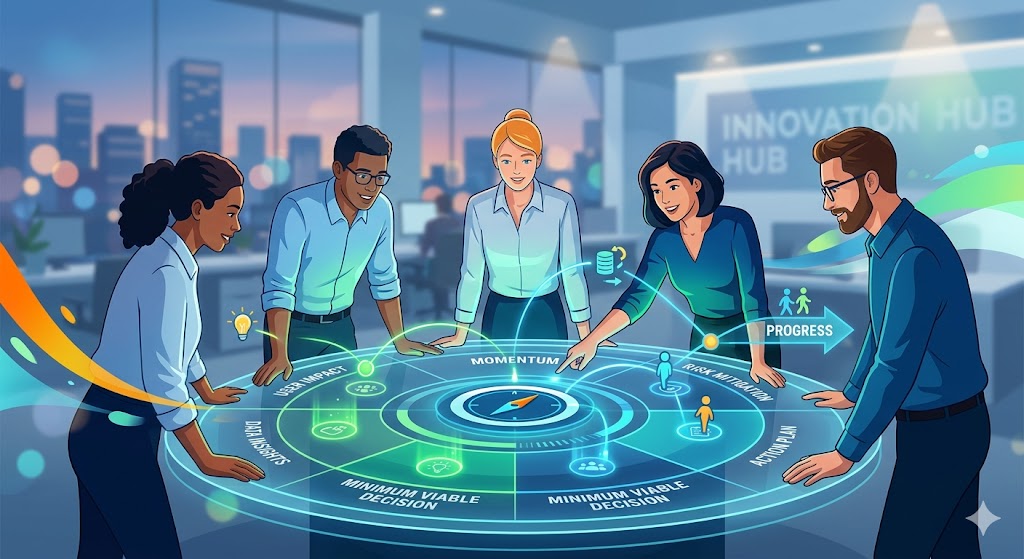
GUEST POST from Chateau G Pato
The Anatomy of the Stall: Why Teams Freeze
In the realm of human-centered innovation, we often focus on the spark of the idea, yet the greatest threat to progress isn’t a lack of creativity — it’s the structural and psychological inertia that sets in when it’s time to choose. Decision paralysis occurs when the friction of making a choice outweighs the perceived benefit of the action itself.
The Paradox of Choice in Strategy
We operate in an era of “data abundance,” where teams often mistake more information for more clarity. However, according to the paradox of choice, an increase in options leads to higher cognitive load and increased anxiety. In a strategic context, this manifests as Analysis Paralysis: the team continues to request “one more study” or “one more data point” as a defense mechanism against the vulnerability of choosing.
The Fear of the “Wrong” Move
At the heart of every stalled project is Loss Aversion. Humans are evolutionarily hardwired to feel the pain of a loss twice as strongly as the joy of a gain. When teams face high-stakes innovation, the fear of losing budget, reputation, or “being wrong” creates a bias toward the status quo. To move forward, we must design experiences that re-frame “inaction” as the highest-risk move a team can make.
The Hidden Tax of Consensus
Many organizations confuse collaboration with consensus. While human-centered design thrives on diverse perspectives, requiring 100% agreement before proceeding acts as a tax on speed. This “consensus trap” often results in “vanilla” decisions — watered-down versions of ideas that offend no one but inspire no one, ultimately leading to strategic drift.
Cognitive Overload and the “Decision Fatigue” Cycle
Teams are often asked to make their most critical pivots at the end of exhausting cycles. When cognitive resources are depleted, the human brain defaults to the path of least resistance: postponement. Recognizing that decision-making is a finite resource is the first step in designing a playbook that protects the team’s mental energy for the moments that truly matter.
Designing for Decision Confidence
Confidence is not a personality trait; it is a byproduct of a well-designed environment. To move a team from hesitation to action, we must move away from accidental decision-making and toward intentional decision architecture. This involves creating the “scaffolding” that supports the weight of a choice before that choice is ever made.
Establishing Decision Architecture
The most common cause of paralysis is ambiguity regarding how the choice will be finalized. By implementing clear frameworks — such as RAPID (Recommend, Agree, Perform, Input, Decide) or DACI (Driver, Approver, Contributor, Informed) — we strip away the interpersonal friction. When the rules of engagement are transparent, the team can focus 100% of their cognitive energy on the problem at hand rather than navigating organizational politics.
The Power of the Minimum Viable Decision (MVD)
Innovation often stalls because we treat every choice as if it were carved in stone. We must train teams to identify Type 1 vs. Type 2 decisions. Type 1 decisions are “one-way doors” — nearly impossible to reverse. Type 2 decisions are “two-way doors” — they are reversible and provide a learning opportunity. The Minimum Viable Decision focuses on making the smallest possible move that generates real-world data, effectively lowering the stakes and reducing the barrier to entry.
Reducing Cognitive Load Through Synthesis
Information density is the enemy of clarity. To design a better decision experience, we must act as information curators. This means moving beyond the “50-page deck” and toward visual synthesis tools like:
- Trade-off Matrices: Visually weighing “Value to User” against “Feasibility to Build.”
- Impact Mapping: Connecting the decision directly to the desired human outcome.
- Choice Forcing: Limiting the team to three distinct paths to prevent the dilution of focus.
Managing the “Emotional Tail” of Decisions
Human-centered design acknowledges that decisions carry emotional weight. We must build in “Decision Buffer Zones” — intentional pauses that allow the team to process the emotional impact of a pivot. By acknowledging the human cost of “killing a project” or changing direction, we preserve the team’s long-term psychological safety and their willingness to commit to the next big choice.
The Human-Centered Playbook: Actionable Plays
Overcoming paralysis requires more than just willpower; it requires a set of repeatable “plays” that teams can execute when they feel the momentum slowing. These plays are designed to disrupt the status quo, lower the emotional cost of failure, and refocus the team on the ultimate goal: delivering value to the human beings at the end of the chain.
Play 1: The Pre-Mortem Ritual
While most teams do a post-mortem after a project fails, a human-centered approach uses the Pre-Mortem to neutralize fear at the start. In this play, the team imagines it is one year in the future and the decision they are about to make has resulted in a total disaster. By working backward to identify the causes of this hypothetical failure, the team can address risks proactively rather than avoiding the decision altogether. It transforms “fear of the unknown” into a “checklist of mitigations.”
Play 2: Time-Boxing the Truth
Perfectionism is often procrastination in a tuxedo. To counter this, we implement Decision Sprints. This play involves setting a hard, non-negotiable deadline for a choice. If the team cannot decide by the end of the sprint, the “Default Action” (agreed upon at the start) is automatically triggered. This forces the team to move from abstract debate to active validation, emphasizing that a 70% solution today is often more valuable than a 90% solution in three months.
Play 3: The Safe-to-Fail Boundary
To encourage bold moves, leaders must define the “Sandbox” — specific areas where teams have full autonomy to experiment because the consequences of failure are contained. By clearly mapping out where a “wrong” decision won’t sink the ship, we provide the psychological safety necessary for creative risk-taking. This play relies on the principle of contained blast radius, ensuring that innovation doesn’t get throttled by unnecessary caution.
Play 4: Visualizing the Trade-offs
When teams are stuck, it’s often because they are looking at the decision from an internal, political, or technical lens. This play uses Experience Mapping to visualize how each option directly impacts the end-user’s journey. By shifting the conversation from “What do we want?” to “Which option best solves their friction?”, we remove ego from the equation. Visualizing these trade-offs on a shared canvas makes the “right” path often emerge organically from the data.
Play 5: The “Two-Way Door” Tagging
Every proposed action in a meeting should be tagged as either a One-Way Door (irreversible/high cost) or a Two-Way Door (reversible/low cost). High-velocity teams recognize that 90% of their decisions are actually Two-Way Doors. This simple linguistic play lowers the collective blood pressure of the room and empowers sub-teams to move forward without waiting for top-down approval.
Leading Through the Fog
When a team is paralyzed, they don’t just need a better process; they need a different kind of leadership. In a human-centered framework, the leader’s role shifts from being the “Ultimate Decider” to being the Architect of the Decision Environment. Leading through the fog requires a balance of radical transparency and the courage to maintain momentum even when the destination isn’t fully visible.
From “Commander” to “Curator”
Traditional leadership often assumes the leader must have the right answer. Human-centered leadership assumes the leader must ask the right questions and curate the right information. By acting as a Curator, you ensure that the team isn’t drowning in “noise” (irrelevant data) and instead has access to the “signal” (customer insights and strategic goals). This reduces the cognitive burden on the team, allowing them to focus on the choice rather than the clutter.
Modeling Vulnerability to Build Safety
Psychological safety is the bedrock of decisive teams. If a team feels that a mistake will be met with punishment, they will naturally default to the “safest” path: doing nothing. Leaders must model Strategic Vulnerability — openly acknowledging what they don’t know and sharing their own reasoning processes, including the doubts they have. This gives the team permission to be imperfect and reduces the “performance anxiety” that often leads to a stall.
Defining the “Commander’s Intent”
Borrowing from military strategy, “Commander’s Intent” focuses on the end state rather than the specific tasks. When leaders clearly communicate the “why” and the “what” (the desired human outcome), the “how” (the specific decision) becomes easier for the team to navigate. This clarity acts as a North Star, helping the team filter out options that don’t align with the ultimate experience we are trying to create.
The “Bias for Action” Pulse
A leader’s most important job in a paralyzed team is to monitor the Organizational Pulse. You must recognize when the “Cost of Delay” has exceeded the “Value of Information.” Leading through the fog means making the call to move forward when you have 70% of the information, rather than waiting for 90%. By rewarding decisiveness as much as correctness, you foster a culture where momentum is seen as a competitive advantage.
Implementing “Check-Ins” Over “Check-Ups”
Instead of micromanaging the decision (a “check-up”), leaders should facilitate “check-ins” that focus on the team’s confidence levels. Asking questions like, “What is the one piece of information that would make us 10% more confident to act today?” shifts the focus from the fear of being wrong to the mechanical requirements of being ready.
Measuring Momentum, Not Just Outcomes
In many organizations, we only celebrate the result of a decision, which inadvertently punishes the risk-taking required for innovation. To defeat paralysis, we must shift our metrics to reward the velocity and quality of the decision-making process itself. By measuring momentum, we transform decision-making from a stressful hurdle into a measurable competitive advantage.
Velocity as a Key Performance Indicator (KPI)
High-performing teams don’t just make better decisions; they make them faster. To track this, we monitor Decision Latency: the time elapsed from the moment a decision requirement is identified to the moment an action is initiated. When teams see “Speed of Learning” as a primary metric, the psychological weight of any single choice is distributed across a series of rapid iterations, making “getting started” more important than “being right” on day one.
The Retrospective Pivot
We must move beyond the “Success vs. Failure” binary. A Retrospective Pivot is a formal review of the process used to arrive at a choice. Instead of asking “Did this work?”, we ask:
- Did we have the right stakeholders in the room?
- Was the “Commander’s Intent” clear enough to guide us?
- Did we identify the “Two-Way Doors” early enough to move with confidence?
This meta-analysis ensures that the team is constantly “sharpening the saw” of their collective judgment, turning every choice — regardless of the outcome — into an investment in future agility.
Quantifying the “Cost of Inaction” (COI)
To provide a human-centered counterweight to the fear of failure, we must visualize the Cost of Inaction. This involves calculating the lost opportunity, market drift, and team morale decay that occurs while a project sits in “limbo.” When the COI is made visible on a dashboard or in a meeting, it provides the necessary friction to overcome inertia, making the risk of staying still appear greater than the risk of moving forward.
Celebrating “Smart Fails” and Rapid Reversals
Finally, a human-centered playbook must include a reward mechanism for Rapid Reversals. If a team recognizes a “Two-Way Door” decision was incorrect and pivots within 48 hours, that should be celebrated as a victory for organizational agility. By de-stigmatizing the act of changing direction based on new data, we remove the “ego-attachment” that often causes teams to freeze or double down on failing strategies.
Conclusion: From Stasis to Strategy
Decision paralysis is not a sign of a “bad” team; it is often a sign of a team that cares deeply about the outcomes but lacks the human-centered infrastructure to navigate uncertainty. When we treat decision-making as a design challenge rather than a management hurdle, we shift the focus from the fear of being wrong to the excitement of learning.
The goal of this playbook isn’t to eliminate risk — innovation, by definition, requires it. Instead, the goal is to design a culture where momentum is the default setting. By implementing clear decision architecture, lowering the stakes through “Two-Way Doors,” and measuring our velocity, we transform the “fog of choice” into a clear path for progress.
Immediate Next Steps: Your 48-Hour Action Plan
Don’t let the implementation of this playbook become another source of paralysis. Start small and start now by taking these three steps within the next two working days:
- Audit Your Current “Stall”: Identify one project that has been sitting in a “review cycle” for more than two weeks. Label it as either a One-Way or Two-Way door. If it’s a Two-Way door, make the call by EOD tomorrow.
- Run a “Pre-Mortem” for Your Next Big Choice: In your next leadership meeting, spend 15 minutes imagining the total failure of your current top priority. Use the identified “failure points” to create a 3-point mitigation checklist.
- Define Your Decision Ritual: Pick one framework (like RAPID or DACI) and apply it to a single recurring meeting. Clear the air on who has the “D” (the final decision) and who provides the “I” (input), and watch the meeting friction evaporate.
The most successful teams aren’t the ones that never fail; they are the ones that fail fast, learn faster, and never stop moving. It’s time to stop admiring the problem and start designing the solution.
Let’s get to work.
Frequently Asked Questions
How do we distinguish between “One-Way” and “Two-Way” doors?
A One-Way door is a high-stakes, nearly irreversible decision (e.g., changing your core brand name). A Two-Way door is reversible or has a low cost of failure (e.g., testing a new landing page). Most team paralysis happens because we treat Two-Way doors with the caution required for One-Way doors.
Can human-centered design actually speed up decision-making?
Yes. By shifting the focus from internal consensus to external user value, we remove the “ego friction” that stalls teams. When the user’s needs are the primary filter, the “right” choice becomes a matter of evidence rather than opinion.
What is the most effective way to break a tie in a deadlocked team?
The “Minimum Viable Decision” (MVD) play is best. Instead of debating which path is right, choose the path that allows you to gather the most data in the shortest time. Let the real-world feedback break the tie for you.
Image credits: Gemini
 Sign up here to join 17,000+ leaders getting Human-Centered Change & Innovation Weekly delivered to their inbox every week.