Author Archives: Nicolas Bry

About Nicolas Bry

Nicolas Bry is an International Innovation Executive, expert in corporate innovation programs, and innovation labs, designing place where good innovation thrives! He currently helps the 20 innovation managers of Orange Africa to develop their projects locally. Previously he created several open innovation programs: innovation with employees (Orange Intrapreneurs Studio), innovation with consumers (Imagine with Orange), innovation with entrepreneurs (Orange African Toolbox). Consolidating this experience with the ones of 40 corporations, he wrote in 2019 The Intrapreneurs' Factory, a practical guide to leverage intrapreneurship for your company. Passionate speaker (TEDx), Masterclasses lecturer @Google Academy and Tech/Business Schools, ISPIM Prize laureate for innovation management in 2016, Nicolas is writer of the innovation blog RapidInnovation.fr. Follow him at @nicobry.

The art of innovation, helping cities and governments to make strategic choices

GUEST POST from Nicolas Bry — originally published on Innovation Excellence.

Pierre-Alexandre Balland is Professor & Innovation Strategy Advisor at Utrecht University and visiting professor at MIT Media Lab, a renowned interdisciplinary research lab, founded in 1985 by Nicholas Negroponte, that encourages the unconventional mixing and matching of seemingly disparate research areas.

Pierre-Alexandre research is about the art of innovation, and he advises companies, cities, and policymakers on innovation strategy.

The combination of the MIT Media Lab brand name with the intriguing ‘art of innovation’ was a powerful trigger to ask Pierre-Alexandre a few questions.

1) Hi Pierre-Alexandre, what is the purpose of the MIT Media Lab, and how does it manage to embed technology, media, science, art, and design in its research programs and faculty projects?

PA: The Media Lab is a unique initiative that aims at inventing the future and defines itself as “antidisciplinary”, a word that is not known by my spell checker. Antidisciplinary is not about bringing different academic disciplines together but creating entirely new spaces. If I work in an Econ department, I am supposed to publish in journals that are defined as Econ journals. I have to follow the established rules. I might have to publish academic papers and not tools. The Media Lab is much more open to novelty in that respect. In particular, it brings together science, engineering, design, and art. If you build cars that only engineers know how to drive you won’t make much of an impact. Bring designers and artists in the mix, and you can change the world. What is also fascinating is that the Media Lab is that it is fully funded by corporate members and most faculty members are entrepreneurs. It brings science and industry together in a way that most European institutions can only dream of, and injects an incredible amount of novelty to the market. This novelty gives a unique comparative advantage to companies.

2) Could you share a few examples of the research programs in the fields targeted by the Media Lab:  neurobiologybiologically inspired fabricationsocially engaging robotsemotive computingbionics, and hyperinstruments?

PA: This is all a bit far from my field so I am not the best person to talk about these fantastic projects. But I am always very impressed by Hugh Herr’s Biomechatronics group who creates bionic limbs inspired by nature that emulates the function of natural limbs. Check his 2014 Ted Talk with dancer Adrianne Haslet-Davis, and you’ll have a tasted of the future too!

3) How did your journey bring you to the MIT Media Lab? How does your teaching the art of innovation cross the academic program of the Media Lab? Are you also involved in research programs?

PA: I joined the Collective Learning group directed by César Hidalgo in 2018 as a visiting professor. César has pioneered a new way to think about the economy as a network. It appears that the current structure of this network contains hidden information about the future of the economy. César has mainly worked on countries and products, and I have mainly worked on cities and technologies. Today we join forces and have published multiple papers on the growth of cities, what are the future tech hubs, and why inequality can emerge in our society as a function of economic evolution. We are now writing a book and producing tools to automate decision-making processes of governments.

4) What does ‘the art of innovation’ include? What are the founding blocks of your teaching/research? It seems to take various shapes, such as a regional map of innovation skills

PA: The art of innovation is first about understanding that wealth creation comes from what we are making, not how hard we work, or how well an organization is managed. It does not matter how good of a surfer you are if there are no waves. Technological change creates these wavers, opens opportunities and the art of innovation is first about identifying these new waves rather than resisting them. For cities and governments I build recommendation systems (like Netflix!) that allow them to identify industries or technologies on which they should invest. I have started building these systems for private investors, and started B2B projects to assess how AI, network science and blockchain can solve big business problems.

5) In your TEDx Talk on ‘Knowledge and the city: the digital age paradox’, you show that cities are the knowledge incubators of modern societies, and why you need proximity and face-to-face interactions to generate the next big idea. How does it reflect your research?

PA: In my research I have found that innovation is increasingly concentrated in space. This is counter-intuitive because we have emails, and Skype type of tools but face-to-face is increasingly important. This is because knowledge is becoming more and more complex, leading to the formation of giant networks that need to coordinate. So far the best coordination tool is to meet in person.

Companies haven’t fully realized that, and keep setting-up branches and labs randomly (or because of historical trajectories). Companies need to map where the knowledge they need is, and plan their location choices accordingly. The reason why companies move to the Silicon Valley or around MIT is not cheap rent. It’s unique knowledge that gives temporary monopoly. This knowledge is complex and does not travel well across oceans.

6)    What are your next challenges?

PA: Our recommendations systems have proven to be very useful for cities and governments to automate complex policy-making decisions. It looks very bright for business and investors too. But the biggest challenge is to use these amazing tools for much more complex challenges such as using AI and big data to mitigate climate change, fight economic inequality and deal with other SDGs. I am working on these projects with a few Ph.D. and master students – but these are definitely the most challenging ones!


.


Subscribe to Human-Centered Change & Innovation WeeklySign up here to get Human-Centered Change & Innovation Weekly delivered to your inbox every week.
Sky is the Limit: Intrapreneurship at Air France

GUEST POST from Nicolas Bry — originally published on Innovation Excellence.

Marine Gall is VP Innovation & Intrapreneurship Programs at Air France, working on innovation, business synergies, transformation, change management, and customer centric items.

She kindly accepted to tell us more about the intrapreneurship program which is now starting its season 2, “Boosting the future”, and has just selected 6 laureates for its 2019 season.

1) Hi Marine, could tell us about the objective, and the content of the intrapreneurship program at Air France?

The objective of the program is clear: develop new business with an innovative approach. This program is at the crossroads of transformation and business. Our goal is to offer an ecosystem to teams that have an initiative, want to commit, and take responsibility.

The program starts with an immersive launchpad and a jury selection, followed by a 4 months POC.

2) Have you some examples of intrapreneurs projects to share with us?

The projects of the 2018 season and the 2019 season are very varied, and affect all the businesses of the company. These are transversal projects. The teams come from Geneva, Nice, Marseille and are very heterogeneous. This program illustrates diversity at Air France.

Some projects are relatively simple on a technical level with little barrier to entry, others are much more disruptive. What counts is the strength and commitment of project leaders to demonstrate, with innovative methods (lean startup, design thinking…) that there is a potential value, and that further investigation is required at each stage of the program by obtaining the green light from the Jury.

3) What most  serious challenges did you have to face when setting-up the program?

The biggest challenge has been to promote the program internally, and ensure that all the business lines were on board to legitimately install this new approach that relies on in-house talent to innovate outside of traditional decision-making channels.

4) What positive impact do you observe as a result of the intrapreneurship program?

We are just starting our second season, the feedback is still modest. It takes time to measure the effectiveness of an intrapreneurship program.

The first feedback from the Intrapreneurs are very positive. They all feel that they have changed, and transformed to some extent. Being an Intrapreneur gives them the feeling of having a diplomatic passport both internally and externally which they appreciate it a lot!

From the company’s point of view it is an accelerator of transformation, and creation of new business. The topics addressed are now in the backlogs trades … which are already planned for the next two years.

5) What are you next challenges, and other perspectives that you have on your innovation agenda?

If today we are in the second season, we think about how to develop this program, and onboard more teams. Intrapreneurship is clearly a tool to develop the spirit of entrepreneurship, and restore energy in the business in order to uncover in our large groups the concept of Time to market.

Innovation is key to being a leader in a sector. The complexity of the world in which we operate encourages us to multiply the tools to offer adapted solutions. It is a mistake to think that only the executive committee hold the innovation vision of a group. Collective intelligence is key, the intuition of employees can reveal extraordinary new business potential, and history has proven it many times!

To offer an intrapreneurship program in a large group like ours is to trust the teams and encourage a different way of working that engages and develops the culture of agility.


.


Subscribe to Human-Centered Change & Innovation WeeklySign up here to get Human-Centered Change & Innovation Weekly delivered to your inbox every week.

Spring Lab: Instilling a Startup Mindset into Large Corporations

GUEST POST from Nicolas Bry — originally published on Innovation Excellence.

1) What is the mission (the reason why, la raison d’être) of Spring Lab, its value proposition, and its main line of services (acceleration devices, learning expeditions, collective intelligence workshop, innov-athons, bootcamp) ?

In a highly competitive world with constantly changing ways and growing customer expectations, your company crucially needs to think and innovate to set itself apart.

But how do companies transform and reinvent themselves?

Spring Lab helps its clients to accelerate the impact of their innovation. 

How? by taping into the best of the startup culture to give businesses a new edge : Inspiring connections, Collective intelligence sessions, Acceleration programs, Startup-like methods…

The Spring Lab team believes in open ecosystems, iterative experimentation, risk daring, pivot, transversality and co-innovation as key success factors of the digital entrepreneurship. They represent a fantastic source of inspiration for big corporations and public institutions to drive their innovation faster and further.

Since 2010, the company has been helping companies to:

  • Boost both their innovation and transformation strategies;
  • Build efficient acceleration programs;
  • Create and facilitate collective intelligence sessions that teams can then replicate.

Our most successful formats:

  • Innovathons (50 to 120 people in open innovation sessions);
  • Seminars from another type (10 to 450 people physically present or online);
  • Learning expeditions to get the best from what others have done already;
  • Training to startup methods (art of pitch, design thinking, creativity….);
  • Setting-up of corporate incubators;
  • Acceleration Workshops for innovative projects;
  • Innovation Strategy, and Transformation Strategy.

2) What user/customer do you target, and what is your unfair advantage?

We accompany many different types of actors, who each have quite similar challenges, but need different solutions to answer them:

  • Top Executives holding desires and strong transformation projects, and who need an agile, ambitious and pragmatic sparring partner;
  • Innovation or Transformation Departments in full setting-up or in search of new impulses;
  • Project leaders with strong ideas to bring to life / develop / implement / scale quickly;
  • HR teams looking for new opportunities to spread agility and creativity in the company.

Why are we special?

  • We have an ability to move the lines and create sustainable impact for our customers (long-lasting after our missions!);
  • We have a strong creativity in the type of experience we propose, enabling to really and strongly engage stakeholders;
  • Customer proximity is an obsession, and the total involvement of the teams the daily proof;
  • You are looking for a partner to manage an impossible mission and crazy projects specialists, we are the partner for you.

3) Spring Lab extracts methodologies, culture, key success factors from startups … and share them with large corporations. How do you manage to keep at the forefront?

Design thinking, agile methods, Business Model Canvas, Creative problem solving, intrapreneurship programs, growth hacking, pitching, fast prototyping, …. are methodologies that we are leveraging.

To keep up-to-date with new innovation tools, the Spring Lab team is always on the look-out: making it a weekly challenge to meet new people, participating AND contributing to as many events as possible, building on its ecosystem to discover the “new big thing”.

But building the ecosystem is not enough, it is crucial to be always on an “experimenting mode” to try new things out. This is why we have put in place our “Kit Kat Breaks” every Friday afternoon: aiming at having every member of the team sharing the new tools, techniques, methods that they have discovered during the week. And to make sure our 2 offices benefit from these exchanges, we have 2 “catalyzers” whose mission is to make sure the information passes on to the other office.

And because staying up to date on start-ups ways of working is our priority we leverage as much as possible on the network of start-ups that our millennial employees have built throughout their studies and friendships.

And finally, reinventing oneself is a lot about … being curious and asking (a lot of) questions : what are you working on, how do you do it, does it work, what would you do differently, what are you missing today to make it work … So … we spend our time asking questions!

4) Could you share a few customer assignments that represent your know-how?

For an Airbus subsidiary we have created a 24h live worldgame for 450 employees in 3 different countries to have them leverage on gamification to work on their values.

For BNP Paribas Leasing Solutions we have built a 9-month program (Stretch Your Business) including 8 hackathons in 8 different countries on the impact of new technologies on their businesses, followed by a 4 month international incubation program, and ended by a one week bootcamp to develop the prototypes.

For M6 we have organized a one-day Learning Expedition on How companies have built, and facilitate digital and technology labs.

5) What for would you recommend a young graduate to join Spring Lab? What are the 3 points you would keep from your ‘Welcome to the Jungle ad’ ?

  1. A very, very! Strong team spirit. Each recruitment is a big event, validated by most members of the team, because every person that comes in will generate a new balance in the team, and we want to make sure it stays a positive, creative, and healthy balance. We organize 2 seminars per year to work together on our vision, our strategy, our projects and make sure people are excited, and willing to keep on building the future of the company;
  2. Spring Lab intrapreneurship program to cultivate entrepreneurship among our employees: because we believe that good employees are inspired and proud employees, we have build our internal entrepreneurship program. 6 days off your annual work time to engage in a project that makes sense with 3 criteria to respect: it “means a lot” to them, it forces them to go a little bit out of their comfort zone, and they take a lot of pleasure in doing it!
  3. To continue leveraging on our strong culture and values, we have named 2 Chief Culture Officers (one in Paris and one in Toulouse) and 1 Positive Impact Officer. Giving a meaning to what we do, making sure we valorize personalities and talents rather than diplomas and egos, strengthening the spirit between our 2 offices, … having fun … are absolutely key at Spring Lab. So we have asked people from our teams to make sure we never forget, however busy we are, however important are our clients, however intense is the business.

6) Spring Lab Paris offices are at We Work Lafayette: why did you choose to settle in a co-working space?

WeWork is part of staying connected, and open, and … trendy 🙂

WeWork has disrupted the real estate business but also traditional models of workplace, and ways of working. And this is what Spring Lab is about.

Living at WeWork ensures us talent-attraction as well as “client-attraction”, placing us as an actor connected to its ecosystem.

Apart from the visibility, we also have the opportunity to benefit from the WeWork community (from Lafayette but not only), having access to hundreds of experts that we have benefited from numerous times already, for ourselves but mostly for our customers.

And of course, we get to participate to the many events organized by WeWork, mostly oriented on innovation issues, helping us identifying new actors, new projects, new trends.

7) What are the next challenges for Springlab ?

The new challenge for Spring Lab is to scale our business and our awareness!

We have spent the last 2 years polishing the little diamond that we are, working on our culture, our mission, our offers, building up our community and our ecosystem.


.


Subscribe to Human-Centered Change & Innovation WeeklySign up here to get Human-Centered Change & Innovation Weekly delivered to your inbox every week.

Intrapreneurship is for employees, and business units at Deutsche Bahn

GUEST POST from Nicolas Bry — originally published on Innovation Excellence.

Tobias Taut is venture architect at Deutsche Bahn, and an enthusiastic venture builder. What a great title! Managing the intrapreneurship program DB Intrapreneurs, means for Tobias building amazing digital services, and enabling people in their innovation ambitions to create tangible and sustainable value. To boost intrapreneurs projects, Tobias also shares his skills in business modelling, lean startup, and design thinking.

What is the aim of intrapreneurship at Deutsche Bahn: New Business generation (inside / outside DB?)? Culture transformation?

DB Intrapreneurs is the founders program of Deutsche Bahn, Germany’s largest mobility service provider. We trust in the innovation power of our employees, and believe that we can activate this potential to develop corporate start-ups.

As the internal incubator, our purpose is to develop and validate digital business models with the goal of spinning them out as external ventures or internal corporate start-ups. To be exact, we have two clear goals:

  • Creating new digital business models which generate new revenues with DB-external companies and thus diversifying DB’s product portfolio;
  • Enabling employees in user-centered and agile methodologies as well as entrepreneurship and thus fostering long-term cultural change.

How is intrapreneurship anchored in Deutsche Bahn strategy and culture? Do you have a sponsorship from the Executive Committee?

Our team is part of the unit “New Digital Business” which is directly reporting to the Chief Digital Officer of the Deutsche Bahn group, Stefan Stroh. Being part of the CDO organization, we are an elementary part of Deutsche Bahn’s digital and cultural transformation strategy across all divisions.

We work hand-in-hand with all business units across silos because we believe that interdisciplinarity and co-creation is key to successfully innovate within a corporate.

We are very happy to have Martin Seiler, Deutsche Bahn’s Board Member for Human Resources, as sponsor who supports in every possible way.

What is the content (steps, timeline), target (all employees?) and perimeter (national scope?) of the intrapreneurs program?

Our program is open to both employees (intrapreneurship track) and business units (company building track) from all parts of the organization, from maintenance over engineering to sales. This means that either employees can apply with their business ideas to take part in one of our batches or together with business we work on building new companies.

For both cases, we have developed, tested and iterated a clearly structured innovation process following three stages where employees first become intrapreneurs, and then entrepreneurs:

  1. Design Phase: In four 1-day workshops, intrapreneurs identify and validate a problem as well as develop a first solution concept. The highlight of the Design Phase is the Pitch Day at the end, where teams pitch for entering the Build Phase where they get funding and intensive coaching.
  2. Build Phase: Over the course of 3-4 months, intrapreneurship teams develop and validate a business and product concept which includes user research, service design, requirements engineering, development of first low-fidelity prototype, business case modelling, and drafting a go-to market strategy.
  3. Grow Phase (open end): If teams were able to achieve a proof of concept at the end of the Build Phase, they will be able to scale-up their own corporate start-up. This incorporates everything, from ramping-up organizational structures to product development and sales.

The program is open to everyone from Deutsche Bahn, regardless where they are based. However, for now, participants came from Germany and one from Silicon Valley. We encourage people to think globally when it comes to their ideas. Ideas should be scalable globally.

Workshops in the Design Phase take place in Berlin and Frankfurt. Both Build and Grow Phases should take place in Berlin, in our DigitalBase of Deutsche Bahn. However, if intrapreneurs decide that it’s better to be in a different city, for example because of access to clients, markets or users, that’s fine. It’s their call.

How are the intrapreneurs projects incubated? What kind of coaching (individual/collective) do you provide? What are the typical exit scenarios for an intrapreneur project?

The way projects are incubated depends on if it is an intrapreneurship project or a company building project.

In intrapreneurship projects, where a team of employees is working on their own ideas, those teams are supported by a Venture Achitect like myself. We act as facilitators, project managers and challengers who give direction. We enable employees in leading their own corporate startup to success. Coaching involves everything around Design Thinking, Lean Start-up, Scrum, Value Proposition Design, Business Modelling and Product Management.

However, in company building projects, where we co-create with a business unit, our role transforms from being the “driving instructor” into being on the driver’s seat. Instead of coaching employees, we ourselves are the Project Leads of the ventures, and are fully responsible for success and failure.

There are basically three different exit options for our intrapreneurship ventures;

  1. Scaling-up the corporate start-up inside a newly-established business unit;
  2. Founding of a new subsidiary company wholly owned by Deutsche Bahn where the intrapreneurs get CxO roles;
  3. Founding of a new start-up by the intrapreneurs (they leave Deutsche Bahn in this case) where our Venture Capital fund Deutsche Bahn Digital Ventures only holds a minority stake.

However, there is another exit: positive failure! We promote that failing early in our innovation process, for example because teams found out that there is no problem-solution fit, is in fact a valuable and positive experience for both employees and Deutsche Bahn itself. Intrapreneurs learned incredibly much in such a short time which is unmatched to other corporate training opportunities.

Is there a specific status or HR policy for the intrapreneurs (full time / part time dedication for the project)? How do you value the experience developed by the intrapreneur at the end of the incubation?

During the Design Phase the intrapreneurs participate in four workshops while working in their regular jobs. For the 3-4 months Build Phase intrapreneurs can work full-time on their business idea.

Our program is explicitly regarded and promoted as an intense training opportunity by HR, Talent Management and most importantly by managers who even sometimes motivate their employees to participate in our program.

What impact of the program do you value most? Have you any success story to share, of some intrapreneur projects transforming into business?

Looking back at working two years at DB Intrapreneurs, lots of rewarding and happy moments pop into my mind. I feel grateful that I was able to coach and enable a variety of teams working on ideas which couldn’t have been more diverse.

One of the most exciting projects is my current one where I work with intrapreneurs from Deutsche Bahn’s maintenance unit. Like so many other units and companies, their business unit is facing consequences of demographic change: skillful experts with sometimes decades of experience are about to retire soon which means that valuable knowledge leaves the company. I am happy to support them fighting brain drain and transforming their vision into a real-life product which can create real tangible value.

What are your next challenges?

Currently we are working on three hot topics:

  • Building an AI-empowered customer service for improving workplace quality and customer support while at the same time reducing cost;
  • Boosting our internal, and external communication to generate more outreach and motivating more employees in starting their own intrapreneurship journey;
  • Developing a structured scale-up plan for our Growth Phase which incorporates every step in scaling-up a corporate start-up, while considering Deutsche Bahn contextuality.

.


Subscribe to Human-Centered Change & Innovation WeeklySign up here to get Human-Centered Change & Innovation Weekly delivered to your inbox every week.

Accelerating New Businesses at Thales Digital Factory

GUEST POST from Nicolas Bry — originally published on Innovation Excellence.

Last September, I was kindly treated at WeWork Lafayette by a team of 3 fine innovation, and transformation representatives from the Thales Group:
Hamilton looks after implementing a Group transverse Digital initiative called Business Innovation & Growth (BIG), and lead Digital Transformation in Marketing to drive enhanced customer engagement and understanding, while building a modern Thales’s Marketing Network.
As Head of Operations, Stéphane handles support functions, and the process of MVP selection / design center, engineering and delivery of the innovative service, and transfer to business unit.
Jean-Yves looks over incubation and acceleration of internal and external startups at Station F on cybersecurity topics, and monitors the Digital Academy (transformation program including culture, business, management, and marketing), addressing all employees, through customized journeys with the Thales Learning Hub.

Thales Digital Factory started in 2017, with 4 people, and grows at the speed of light, reaching a staff of 230 people, committed to the achievement of 24 MVPs, and now dispatched over 3 work spaces: WeWork Paris. WeWork Singapore, ans CortAIx in Montreal.

Let’s go through some key attributes of this venture.

A cultural evolution

Digital transformation at Thales involves digital offers, and digital ways of working, with Ux (User Experience) at the center. Oliver Flous leads the 2 activities, as VP, Digital Transformation & Digital Factory.
The challenge is to achieve a fine product, with a more agile way of working, and in line with TTM (Time To Market). There is a symmetry of attentions to create new offers and to think product differently,: it involves a new mindset, starting from customers’ problems, and introducing technology as a solution to a problem. In a nutshell: revisiting what we do, and how we do it!
Transformation impacts managers as well, in order to find the fit between their know-how, and the determination of young employees.
Digital transformation unfolds new ways of innovating, including idea challenges, 3 months pre-incubation ending with selection for incubation, business orientation, organization in squads, transversal work platforms, and transformational resource streams: Ux design, culture, technologies, data, digital workplace, and cybersecurity.

Design Thinking inside

Design skills are integrated from the start into the digital projects. Resources come from various regions: Paris, Bordeaux, Toulouse. They have changed their focus toward Design Thinking approach.
Design teams support digital product:
  • At the early stage, through the Business Innovation, and Growth initiative (aka BIG): 35 pre-selected project in 2018, around 10 MVP (Minimum Viable Product) projects going for Framing and Delivery in Paris;
  • At the MVP stage led Digital Champions coming from 6 Global Business Units, monitored by Executive Comittee: they are working with business lines to detect MVP candidates; business lines fund product owner, and 6-7 people team salaries at 40% (next year, will be reverse, a 60% funding);
  • And at each stage, to CoDesign with customers, for instance, facilitating workshop with customers invited by a business line, organizing work sessions with Thales customers and end-users; a workshop was thus set-up on the Free-Economy.

A fast-track design process

Let’s now dig-in into the heart of the Factory.
The Factory accelerates the Digital Transformation, by co-selecting innovation opportunities with the business lines, framing them, building MVPs, iterating, and refining along until the final transfer to the business line.
Innovation scope tackles new businesses, as well as “re-platform” existing service, and grow the core business, leveraging digital.
New growth projects might as well transition outside of business units.
The framework goes as follows:
  1. Business Innovation, and Growth Challenges aims at embarking all the employees of the Group to make experimentation the norm, identifying business problems to be solved, and bringing to life Proof of Concept, Proof of Value, and prototyping;
  2. Framing takes place during 2 weeks for most promising ideas: value proposition canvas and business model canvas are fulfilled upstream, and then confronted with the Business Units;
    • They will evolve over 5 to 6 releases; training is provided to lay the skills foundation; 5 workshops challenge are set-up to validate the business case solidity, and enter the next stage;
    • 3 to 4 framing can be handled concurrently, involving 30 to 35 projects, that will end into a selection of a dozen going for MVPs; the other projects can be nurtured, and incubated within the business units;
  3. MVPs are structured in cycle of 8 sprints going over 4 months; 60% of the projects ask for a second cycle to refine the MVP, or complete the hand-over; MVP is business case oriented to test the business line commitment; this framework is designed for acceleration, with a 4 months deadline triggering a positive tension.
Staffing is localized at the Digital Factory, using internal (115) and external resources (115) provided by Accenture. Product owners and technical skills are provided by the business line: this technical know-how is cornerstone in Thales BtoB business.
Squads are autonomous. The dream team composition is a paramount factor for success, as innovative projects are very much tailor-made (at the opposite of a product culture, where the same piece is sold to millions of customers).
The Digital Platform made of a CI/CD chain, Data Lake and Security building blocks is based on Microsoft Azure Cloud and Pivotal Cloud Foundry. This platform is a key enabler for MVP development and product re-platforming insuring delivery speed, product security, and new business model introduction.

A Digital Manifesto illustrates the culture of the Factory, it stresses on the following values:  empowerment (over control), data driven (over opinions), test & learn (over plan), collaboration (over protection), user (over customer), tolerance to failure (over not trying), and key qualities: hungry, humble, aware.

Inspiring with The Talks

Thanks to the impulse given by Raphaël Thobie and his team, Thales has also developped ‘The Talks’, an open stage to let employees share their passion, and experiences:

  • 5 talks for each session, and 10 of them during the year;
  • No filter on the topic, it’s my colleague who’s on stage;
  • At the end, 3 sticky notes, one of them to suggest next connections;
Raphaël has also set-up startups week-ends called MakeItUp for Thales, and has since turned entrepreneur, creating his agency with 3 cofounders, CreateRocks, to support corporates in intrapreneurship, and transformation programs, leveraging human capital with methods, and a digital app, Makerz.

If you’re a starting intrapreneur, I strongly recommed you subscribe to his newsletter Learnerz, who will guide you stet by step over several weeks.

Let long live innovation at the Factory!


.


Subscribe to Human-Centered Change & Innovation WeeklySign up here to get Human-Centered Change & Innovation Weekly delivered to your inbox every week.

International Intrapreneurship Conference at Orange

GUEST POST from Nicolas Bry — originally published on Innovation Excellence.

2019 February 19th took place at Orange Gardens (Paris/Châtillon, France), a comprehensive conference related to intrapreneurship. 200 people gathered for this Intrapreneurship celebration, a huge success!

Following opening by Luc Bretones (Orange), the programme was organized in 3 main tracks:

  1. Intrapreneurs testimonials and roundtable with Hadrien Devichi (Société Générale/Elyxir), Jean-Yves Ingea (Thales/Heropolis), Victor Jouan (Accor), Alexis Bafcop (Orange);
  2. Corporations point of view on intrapreneurship with lectures and roundtable with  Frank Mattes (Innovation-3/Scale-Up Peer Group) and Stephen Cook (BP), Peter Guse (Bosh Startups Platform Grow), Susana Jurado Apruzzese (Telefonica), Jean-Yves Plu (Thales), Robert Kröwing (TÜV), facilitated by Véronique Bouchard (EM-Lyon Business School);
  3. 7 workshops facilitated by Anne-Claire Chanut (Fly The Nest) and Thomas Benaïm (Le Village by CA), Frank Mattes (Innovation-3), Alizée Lozac’hmeur (makesense), Céline Degreef (MyCrowdCompany), Quentin Cailluyer and Paul Granier (Schoolab), Clémence Dubosq (Corporate for Change) and Cédric Laroyenne (Accenture), Daniel Bellahsen and Christina Hassen (Epigo), all companies very active in intrapreneurs incubation and coaching.

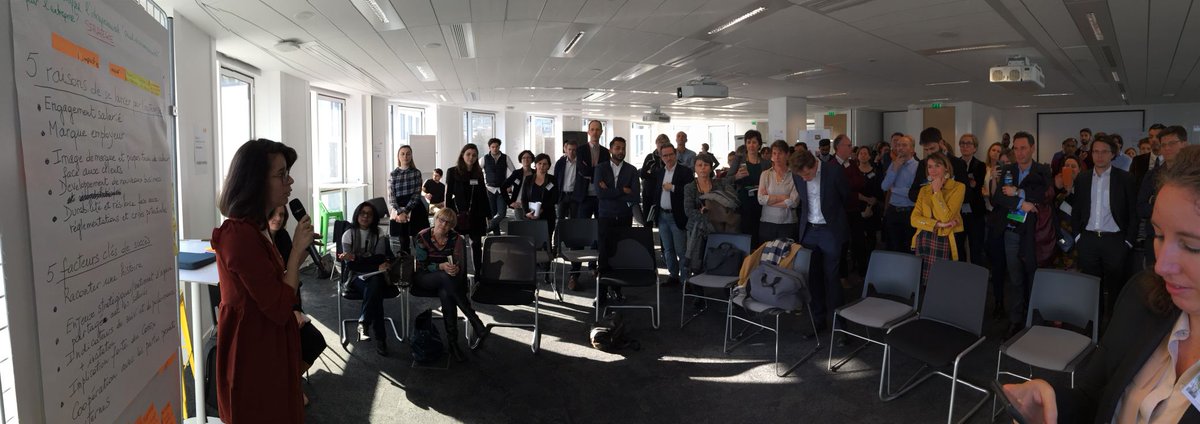
Below are some snapshots and a best of quotes from Twitter (in French and English, following #IntrapreneurDay), as well as the videos of the speakers.

Should you wish a deeper view one fcous of the conference, “scale-up for intrapreneurs”, please have a look at the scale-up canvas article.

We want to thank most sincerely all the speakers and facilitators for their talent and generosity, and all participants that made this event a warm networking moment. Enjoy the reading, and good news: some companies have already volunteered to organize the next Intrapreneurship fest!

Luc Bretones (Orange): opening

Les collaborateurs intrapreneurs résorbent une frustration et contribuent à la transformation de l’entreprise et au développement du business.

Un intrapreneur impacte 300 à 500 collaborateurs au sein du groupe.

Les projets intrapreneurs rejoignent des business units grâce à la qualité de leurs équipes.

Les intrapreneurs vivent une expérience de développement extraordinaire et impactent 300-500 personnes chacun.

L’Intrapreneurs Studio est chez Orange au carrefour de la Transformation et du Business : il développe de nouveaux business et transforme la culture. Une façon de contribuer au changement du mindset de l’entreprise.

L’Intrapreneurs Studio du programme Oz Innovation salariés, c’est la disruption de notre culture d’entreprise.

L’intrapreneurs Studio c’est l’étincelle qui met un bazar positif dans l’innovation du groupe.

MORNING TESTIMONIALS

Hadrien Devichi (Société Générale/Elyxir)

Elyxir, une startup interne, un projet qui ne pouvait pas entrer dans le process classique.

Elyxir fonctionne avec sa BU sponsor comme avec un investisseur.

Viens avec des réponses ! La recette de l’intrapreneur.

Gérer les parties prenantes ! La stratégie d’alliances de l’intrapreneur.

Jean-Yves Ingea (Thales/Heropolis)

Heropolis, une start-up interne devenue start-up externe.

Les déclencheurs d’un projet intrapreneur : l’envie de prendre des risques et d’une culture start-up.

L’intrapreneuriat commence par des rencontres et la découverte d’une nouvelle culture.

La Thales Digital Factory fournit hébergement et coaching aux intrapreneurs.

Hadrien Devichi (Société Générale), Jean-Yves Ingea (Thales/Heropolis), Victor Jouan (Accor), Alexis Bafcop (Orange)

Toutes les aventures intrapreneuriales réussies nécessitent un engagement à temps plein dans l’entreprise.

Intraprendre c’est trouver un vrai sens dans son travail.

L’intrapreneuriat, un startup mindset !

Quand on devient intrapreneur le nombre de personnes avec qui on interagit explose.

Un certificat Intrapreneur HEC-Orange, une belle reconnaissance et valorisation du parcours intrapreneurial.

Et pourquoi pas des serial Intrapreneurs ?

Frank Mattes (Innovation-3/Scale-Up Peer Group) and Stephen Cook (BP)

Corporations know how to navigate red ocean. In the last decade, they’ve learned to explore blue ocean. But the scaling-up white space in-between is where most corporate startups fail.

Pour passer au scale-up, un MVP ne suffit pas. Il faut avoir atteint le stade de la « Minimum Scalable Venture.

Sourcing and scaling of new ventures at BP. Culture is a milestone of our Launch Pad.

Peter Guse (Bosh Startups Platform Grow)

Corporate start-ups is all about team and culture.

Grow provides 3 kinds of freedom.

Corporate startup follow design thinking approach, with the corporation contextuality.

Lean, flexible, and fast incubation, but efficient, and reliable scaling.

Team and culture evolve when transitioning from an internal startup to a business unit. Scaling-up a startup is not only about the business.

Peter Guse (Bosh Startups Platform Grow), Susana Jurado Apruzzese (Telefonica), Jean-Yves Plu (Thales), Robert Kröwing (TÜV), facilitated by Véronique Bouchard (EM-Lyon Business School)

Impact Intrapreneurship is creating new talent! Intrapreneurs are not product managers, they are value creation managers!

L’intrapreneuriat est aussi une façon d’attirer

et révéler les talents en interne.

We attract talents that we would not have attracted before.

Combining internal engineering and external startups at Thales Digital Factory.

Engage customers and employees to create new product freedom is a new responsability.

Applying the Kick box program at TUV: lean methodology, coaching, and credit card!

As the corporate entrepreneur program matures, we established stage gates to act more like VC/PE.

Let’s stay modest, we’re talking about one start-up every 1000 employees at Bosch.

The most important challenge we are facing is culture!

It will always be important to demonstrate value created by corporate entrepreneurship programs.

Demonstrating impact, creating new talents: intrapreneurship challenges at  Telefonica.

We are quicker, more frugal, and closer to the business units. 70 projects, 18 transferred to business, 1 spin-off at Telefonica.

The impact of the Kick box program at TÜV is on agility, and motivation.

Talent attraction, new way of working with customers, time to market are the impacts at Thales Digital Factory. Intrapreneurship crosses the digital transformation of Thalesgroup’ employees mindset.

AFTERNOON WORKSHOPS

Anne-Claire Chanut (Fly The Nest) and Thomas Benaïm (Le Village by CA)

Frank Mattes (Innovation-3)

Alizée Lozac’hmeur (makesense)

Quentin Cailluyer and Paul Granier (Schoolab)

Clémence Dubosq (Corporate for Change) and Cédric Laroyenne (Accenture)

Daniel Bellahsen and Christina Hassen (Epigo)


.


Subscribe to Human-Centered Change & Innovation WeeklySign up here to get Human-Centered Change & Innovation Weekly delivered to your inbox every week.

How Open Innovation led by Purchasing works brilliantly at GRTGaz

GUEST POST from Nicolas Bry — originally published on Innovation Excellence.

Mathilde Delignou is Project Manager Open Innovation and partnership at GRTgaz, one of the leading European operators in natural gas transmission. What is uncommon is that the open innovation activity lies within the Purchasing Department. Mathilde explains to us what this peculiarity proves to be a success story.

1) Hi Mathilde, could you describe your entity, and its mission related to open innovation ?

In France, GRTgaz owns and operates Europe’s longest high pressure natural gas transmission network. It contributes to managing networks in Germany and provides gas transmission appraisal and consultancy services in Europe and worldwide.

GRTgaz has three main missions :

  1. Handle the transmission of its customers’ natural gas,
  2. Supply the recipients directly connected to the transmission network (such as large industrial consumers, power plants using natural gas to generate electricity, the public distribution networks, and the adjacent transmission networks);
  3. Develop its transportation capacities to meet the needs of the market, and strengthen the security of gas supply in France and in Europe.

In 2016, GRTgaz decided to call on external partners in order to identify innovative solutions that answer, and solve problems we are facing in our activities, and to promote the implementation of these innovations within the company.

Since then, we have been setting up innovative partnerships with Start Ups, SME, laboratories, schools in different areas (technical, digital, HR, supply chain, IoT…). Current experiments have even given rise to real successes for our partners who have been able to deploy their solutions within GRTgaz, and also develop their business with new customers.

Our particularity, is that the Open Innovation process is mainly led by the Purchasing Department, even though we are closely working with the R&D department. Our ambition is to bring innovation to GRTgaz’s businesses by soliciting external ecosystems.

The Open Innovation team :

  • Qualifies and reformulates internal needs (so that they are better understandable for our external partners);
  • Points them to adapted sourcing processes we have internally;
  • Carries out the sourcing of potential innovative partners;
  • And finally, helps on setting up the « best » conditions » to build a long term relationship between GRTgaz and our innovative partners.

2) Can you share a few achievements with us?

Since 2016, GRTgaz implemented 16 partnerships with SUPs, SME, laboratories or school. This comes to a global partnership business of 700 000 €, that finances projects launching (studies, POCs, tests..). 25% of these partnerships have already lead to an industrialisation within GRTgaz.

Innovation projects can be related to technical issues, such as for example, the development of specific IoT that must be compliant with explosive atmosphere. SRETT, a 25 employees company, and a specialist in IoT for gelocation of people or goods, has took up this challenge (this is a world premiere !).

Innovative companies can also bring us solutions to cross issues we are facing (HR, digital, logistics…). Last year, Consignity, a very small company, developed a container accessible by an RFID device that allows GRTgaz to overcome the mobilization of an employee to receive deliveries from our carriers. This means that our field experts can fully focus on their activities, and do not have to wait and organize the receipt of goods.

To learn more about it:

https://youtu.be/u5kKBWRAuUI

3) What are the advantages to have an open innovation team located in the Purchasing department?

First of all, our innovative partners, or partners to be, might become suppliers. It makes sense to involve Purchasing Department as soon as possible, to manage relationships, as for traditional suppliers.

In addition, the “traditional purchasing” process can not be applied for this kind of projects. Indeed, the partners are often small structures (SUP / SME) in development. These companies have specific concern: they need to develop their turnover, manage their cash flow, optimize the management of internal resources … We must therefore offer them a simplified purchasing path and appropriate contractual conditions, while ensuring risks of failure on our side.

I take this opportunity to remind you that innovative companies keep the ownership of the solutions they offer to GRTgaz. This is very important because it allows them to offer their innovations to other customers and therefore to grow faster. For GRTgaz, an independent partner, is a reliable partner in the long term.

The Purchasing Department is legitimate to implement this type of process, necessary for Open Innovation, and business development with innovative structures.

From innovative partners’ point of view, this particularity is much appreciated too. A POC can be contractualized without involving the Purchasing Department, because most of the time, financial stakes are not very important.

But if the innovation becomes a success, then the product will be deployed on a large scale. Purchasing will necessarily be involved at that time. When certain points have not been addressed in the right way upstream, it often complicates decisions and process, hinder the implementation, or even block the exchanges. Many start-ups and companies have faced this kind of situation…

Actually, having an Open Innovation team within/close to a Purchasing Department saves time !

4) What are the drawbacks?

I don’t see drawbacks. I only see opportunities for companies.

It brings open-mindedness, transversality between departments, celerity, velocity and performance for the company…

At GRTgaz, we discussed this point : should the Open Innovation activity be part of the R&D&I department, or should it stays at the purchasing department?

Since 2016, Purchasing department leads the activity, and works in tandem with the R&D&I department. We set up a cross management, and a steady reporting that closely includes those 2 departments, and other operational departements. There was not any reason to change the open innovation’s team belonging, as the current organisation gives fully satisfaction to both internal and external partners.

5) What are the main developments you want to achieve in 2019 regarding Open Innovation?

In 2019, main goals are to scale up implementations and to be more business oriented !

We decided to expand the range of the Open Innovation activities to give more business opportunities to innovative partners with GRTgaz. We packaged 3 offers :

  1. The first one allows potential partners to better understand GRTgaz’s needs. We share priority areas of interest in order to better match our concerns regarding innovation fields. This makes it possible to put in contact with the right interlocutors and to access more easily the internal decision-makers;
  2. The second offer enables innovative companies to bring skills to intrapreneurship projects, currently being developed by GRTgaz. It is a way to contribute to a project while developing its turnover;
  3. The latest offer enables innovative companies to provide answers to specific issues (technical or transversal) of the company through the Open Innovation Challenges web site. A partnership with GRTgaz is at the key.

The launch of the 2019 edition is scheduled for March 26! We hope that this edition will be as fruitful as the previous ones.

Credits: Philippe Dureuil


.


Subscribe to Human-Centered Change & Innovation WeeklySign up here to get Human-Centered Change & Innovation Weekly delivered to your inbox every week.

Okoni Innovation Agency: there is no transformation without creation

GUEST POST from Nicolas Bry — originally published on Innovation Excellence.

Pierre Baudry, Marc-Antoine Franc and Cécile Bernardet are respectively founding partner, partner and project director at Okoni, an new kind of Innovation Agency, which involves co-making innovation with their customers.

First Cécile and Marc-Antoine guided me at Okoni premises, then Pierre took his pen to explain how their holistic approach is quite singular, and impactful on the business of their customers.

1) Okoni baseline highlights Creativity and Transformation (“Créer et Se Transformer”) : does it reflect your two main line of services ? Can you share a few examples of assignments illustrating these two lines? How do these two lines complement each other?

Nowadays, corporate transformations are driven by organization and strategy. We believe that there is no transformation without creation. You have to change your products, your know-how, your skills to change your company. Therefore innovation is the key driver.

We supported the transformation of a national top ranked insurance company. We helped them find innovation projects that could be conducted right now as samples of the future. It could be put that  way “how about experimenting the future today?”.

Even our pure design projects can be considered as transformative. It’s because we care as much about the results as the process to get there. So when we design a trash can, we ask ourselves: “Who do we engage? What tools are we going to use in order to include all the players in the design process? How can they learn inspiration?” So no transformation without creation, and no creation without transformation.

2) Okoni manifesto introduces the ‘Consultant-Maker’: could you explain the concept, and where it comes from (“creation is transformation, innovation is learning and changing”)? Is it the same person who develops both skills, or an association of people under the same roof? Does it unfold an hybrid approach mixing consulting and design with making as well? Why is it key to connect the vision with the execution?

First of all since Platon, we’ve disconnected vision and execution. First you need an idea then you shape it. We believe that vision and execution have to be thought altogether at the same time and by the same people. When you give life to an idea, using either physical material and lines of code, you keep creating because you confront it to reality and this confrontation is a tremendous source of creation.

That’s why we put under the same roof designers, prototypers, consultants, architects, sociologists, even a cooking chef! Each of them has a strong chore of skills but we all think execution and vision simultaneously. In our place Le Ma, one the same day some people are fabricating a table, others developing app, and others again are facilitation a brainstorming or putting into figures a new business model. In France no other companies have gone that far in the hybridation of skills and equipment.

3) Could you describe your place the Ma, the biggest integrated FabLab in France, and what resources and facilities can be leveraged there (“6 studios”)?

Le Ma is our place therefore it is hybrid. There are high tech prototyping machines, all materials you would dream off to make mock ups, a highly equiped kitchen, a big empty space to welcome all the projects and people from all the world. It is an unfinished and open place because hospitality is a key value for Okoni. You can show up any time we will open our table for lunch for you, show you how the laser cutter works. It also a totally self-made space. It our flagship for our architecture signature!

4) How do you combine these resources in a project, and especially the user centric design & nudge / ecosystem / making dimensions, and at which steps of the project?

It is very fluid and comfortable actually. Our execution capabilities are so broad and high that we can turn all our ideas into something real: digital, electronics, mechanics, space design, drawing, 3D modeling, printing.

When we start investigating on the field, we need an oversized map to work with people, it’s done in 24h! We want to turn Le Ma into a new generation hotel room in order to foster new ideas, it’s possible in less that a week. You think of a small robot in your hotel room. It can be put together in a couple of weeks!

And our heart and our place are so big that our design is very inclusive. Turning a value chain into an ecosystem is a key expertise of Okoni and it is done community management, communication and creation and making! Put suppliers and client in a fablab and you’ll see that their relationship will change radically.

5) What are the good reasons to come to Okoni for an innovation / transformation project? In what type of project is Okoni approach the most relevant?

Okoni approach is relevant for all projects. Some prerequisites though: the brief has to be open. You want to play for real, go beyond the concept and have a real impact on reality. You are open to change in your organization. You want to have fun, and joy even at work is compulsory, well your’re pretty much ready to be okonized.

6) What is your vision of the future of Okoni?

Being the world top leader in design and consulting because both words will become synonimous.

A smaller ambition would be boring!


.


Subscribe to Human-Centered Change & Innovation WeeklySign up here to get Human-Centered Change & Innovation Weekly delivered to your inbox every week.

Reorganization Viewed from the Inside, with Fly The Nest

GUEST POST from Nicolas Bry — originally published on Innovation Excellence.

Cédric Mao and Erwann Rozier founded Fly The Nest to help startups grow, and leave the nest, keeping a consistent and cohesive team in action.

Since our article last November 2016, there has been a lot of water under the bridge: hereafter, they update their purpose, share with us the inside reorganization they have understaken.

1) Hi Erwann, could you remind us Fly The Nest activity, and share the most recent release of your purpose and vision, that I know you are updating on a regular basis?

At Fly The Nest, we help businesses to scale, by aligning every team members on the vision they want to achieve, making sure they execute what they have in mind, and developing the leadership of everyone.

If you want our official purpose, I’ll translate it to “help individual and collectives to achieve their vision, in harmony with their environnement“. We believe that everyone has a vision of a better world, and should try to implement it: we are here to make it come true.

Today, our short and mid-term vision are focused on scale. We are trying to double our impact (the number of people we animate) in 2019 by developing partnership with VCs, and networks of entrepreneurs. This strategy is starting to work so we have a lot do on recruitment in order to find the best people for our peculiar organization. We also have a lot of communication projects going on, in order to saturate Paris market at the end of next year. By that, we should finally have built a scalable organization, and the tools to operate it.

Our long term vision is mainly internal, and describes what we want for our company in the future. We are still focused on startups and scaleups, for a few years now, but what we do could be applied to anything. So what we want in the next ten years is to broaden our clients base:

  • bigger and more traditional organizations;
  • public projects like cities for example;
  • opening new territories (in France and abroad);
  • working with a network of certified coach for small businesses.

=> In all that vision, what is important for us is to stay based on entrepreneurship, and a decentralized organization. A network where anyone can pave its own path within thousands of opportunities.

2) You recently reorganized your resources: what were the weak signals that trigger this reorganization?

First of all, it was something discussed since the first days of Fly The Nest. As we are building a decentralized organization, we believe that teams should remain small and autonomous, so agility and leadership can thrive. When we reached 10 people in the team, decisions became slower, and harder to make. Committees had been longer and longer, more and more exhausting. Leaders of the company were starting to have too much weight. So we decided to split the team in two.

3) Could you describe the new organization, and explain the rational behind?

We are now past this reorganization, as we organically reorganize every semester. During our biannual summits, we collectively align on the priorities of the company : short and mid-term company goals, main areas of work and targets for each. Then we create squads of 4 to 6 people, each focusing on one area of work.

We really believe that innovation thrive from autonomy, and unplanned discussions. So each squad has its own clients and budget. Squad members spend a lot of their time together (at team meeting or during clients off-sites for example), and they are pretty much free to do anything, as long as they communicate it well. As a little company on its own, these kind of teams are so focus than they deliver very well.

In order to stay coordinate between the squads, we also created guilds, inspired from the Spotify model. The guilds links some of our colleagues by the criteria of competences. For example, the sales guild coordinates leads transfer and training. For each of the important “jobs” at Fly The Nest, we have a guild that meets from time to time in order to structure the activity.

Finally, in the middle of the semester, we spend two days to review every result that has been achieved, and we adjust the direction for the last 3 months of the period.

4) Traditional organizations split resources according to ‘functional job like marketing, sales, production, finance,…’, or geography, or according to ‘customer portfolio (like freedom incorporated Favi)’, or ‘projects portfolio (like scaling Agile at Spotify)’: why wasn’t Fly The Nest comfortable with these patterns? And what does your bespoke organization bring to the table that the traditional organizations did not provide?

Splitting jobs between different fonctions can be very useful when you have a business that needs a lot of different expertises. Like building a submarine for example. At Fly The Nest, our main expertise is people. People are certainly the most complex element of the world, but you don’t need to work with 5 different experts to do what we do.

So from the beginning, we have the chance to not be forced to build silos between work expertise. We all have a very different background, which is wonderful and very useful. But we don’t need to organize ourselves around our skills.

We are closer from ‘customer portfolio‘ as FAVI. When we did our first split, each team had a specific set of clients. One squad had small clients (>30p) and the other big ones, because we had very different objectives for them, and both were important. After 6 months, it was not relevant for us anymore, because our focus were not on the “products” we deliver.

We are quite similar, in fact, to ‘projects portfolio’ at Spotify. As them, we believe that decentralized modularity is the key for performance, well-being, learning, resilience… Everything that a company is looking for seems to hide in a very natural model, where cells interacts with each other, for a common purpose. The Spotify cells are focused on developing a great product, ours are focused on developing a great company.

5) How long has the new organization been going on, and what are the first feedbacks, and KPIs?

We started the company in 2015, and we are very happy that we reached 1 million turnover this year. Our main KPI is the number of people we have been working with, which is around 1,600 these days. All this is due to satisfied clients: they bring us 75% of our clients as our Net Promoter Score may suggest : 80% will recommend us. We also look at our own commitment, as employee of Fly The Nest. And we always score more than 90% so we are satisfied with it 🙂

To conclude, I would say that we have now proved that our business model – working with startups for a flat rate with an holistic approach – can work and creates values for every stakeholder. We have now the responsibility to scale right and strong so we can help much more people to achieve their vision!


.


Subscribe to Human-Centered Change & Innovation WeeklySign up here to get Human-Centered Change & Innovation Weekly delivered to your inbox every week.

The Missing Step for Start-ups Who Want to Scale-up

GUEST POST from Nicolas Bry — originally published on Innovation Excellence.

Last November, I attended the speech of David Skok at Web Summit 2018: it was related to startups scale-up in B2B business. I’m sensitive to the topic, being a participant of the Scale-Up Peer Group, and having drafted the Scale-Up Canvas for intrapreneurs who want to scale-up. Nevertheless, I was quite impressed by the quality of David Skok advices, probably deriving from his 10 years experience at VC Matrix Partners. I will try to summarize them hereafter.

Though the Product/Market fit is the step that precedes scaling in B2C markets, it seems an additional step is necessary in B2B markets claims David: B2B founders don’t reach consistent results when turning up on sales & marketing, and a lot of cash is burn.

The missing steps is to achieve a repeatable, scalable, and profitable growth model.

The 2 most important questions for startups are:

  1. When will we run out of cash?
  2. Are we on track to reach the milestones needed for a successful fundraise?

Startups are a race against time, where one needs extreme focus, and total alignment across all departments.

If you want to get a new breath of fresh cash by closing your next round, a startup needs to prove true the following milestones.

The journey continues with the key startups inflection points:

When you in the search for Product/Market Fit, you focus on testing hypothesis (problem/solution fit), proving the value (does the solution actually creates value for the user?), and that it can be sold (is someone willing to pay?).

When you’re in the search for repeatable, scalable, and profitable growth model, your focus changes: first of all, the startup must find a repeatable sales motion, and prove non-founders can sell, in other words a repeatable sales process that an ordinary representative can do before to scale.

In this phase, you will avoid the common mistakes:

  • Trying to force progress, and jumping ahead to the next phase; as it can take long, you need to conserve cash until the scaling phase;
  • Building products before meeting enough buyers to validate hypothesis, and reach features stability;
  • Hiring salespeople before founders have proven they can sell;
  • Scaling sales before growth process is repeatable, and before solving churn problem;

Your growth model is scalable according to the following exit criteria:

Finally, your growth model has to ensure customer loyalty (negative dollar churn), and profitability:

  • LTV:CAX>3
  • Time to recover CAC > 12-18 months;
  • Gross margins > 70%.

Once achieved, David considers you’re ready to hit the gas and scale. Get out of the burn avoidance mode, and invest for fast growth.

As growing team and culture accordingly is tricky, I would suggest to take some time before scaling to prepare the scale-up of the organization, reviewing the various touchpoints: shared vision and culture, core team for scaling-up, missions, governance, sharing co-leadership with CxO, space, people hire (based on where the core-team is expected to grow, especially sales people) and on-boarding.

Then nothing can stop you!

In a nutshell, adapt focus, and roll-out actions, depending on which stage you are:

Credit: David Skok slideshare, web summit pictures featured thanks to the courtesy of Helen Poetri


.


Subscribe to Human-Centered Change & Innovation WeeklySign up here to get Human-Centered Change & Innovation Weekly delivered to your inbox every week.