Author Archives: Greg Satell

About Greg Satell

Greg Satell is a popular speaker and consultant. His latest book, Cascades: How to Create a Movement That Drives Transformational Change, is available now. Follow his blog at Digital Tonto or on Twitter @Digital Tonto.

4 Ways To Empower Change In Your Organization

GUEST POST by Greg Satell

In 1957, Ken Olsen founded Digital Equipment Corporation (DEC) with his MIT classmate, Harlan Anderson, and by the 1960s, the company had pioneered the minicomputer revolution. Much cheaper than IBM mainframes, but still powerful enough to be useful, these machines helped make DEC one of the world’s leading technology companies.

Hailed as a visionary, Olson was named “America’s most successful entrepreneur” by Fortune magazine in 1986. Yet as AnnaLee Saxenian explained in Regional Advantage, by that time the minicomputer industry was already being disrupted by PC’s and DEC would never recover. It was acquired by Compaq in 1998.

The truth is that everybody gets disrupted eventually, even a visionary entrepreneur like Olsen. What makes the difference is whether you are able to chart a new path. That takes more than merely being smart and ambitious, you need to empower change from within. It’s never easy, but there are some basic principles that can help you reinvent your organization.

Continue reading →

IBM is Building a Network to Drive the Future of Quantum Computing

GUEST POST by Greg Satell

In 1980, IBM was at an impasse. Having already missed the market for minicomputers, it was now seeing a new cadre of competitors emerge. Fledgling companies like Apple and Commodore were selling stripped down computers for personal use and the market was growing quickly. It looked like IBM would miss out again.

So the company’s leadership authorized Don Estridge and Bill Lowe to set up a skunk works in Boca Raton, FL and begin work on what was to become the PC. Working largely in secret and eschewing many of IBM’s traditional standards and processes, the team would bring the PC to market in just a year and change computer history.

Today, the computer industry is at a similar impasse. As Moore’s Law comes to an end, there is an urgent need to introduce new computing architectures, one of the most promising being quantum computing. However, this time, rather than working in secret, it has embarked on a highly collaborative journey to advance the technology and bring it to market.

Continue reading →

4 Questions That Will Make You A Better Innovator

GUEST POST by Greg Satell

In 1999, the day before his eighth startup went public, Steve Blank decided to retire at the age of 45. With time to reflect, he sat in a ski lodge and began to write a memoir with a “lessons learned” section at the end of each chapter. “In hindsight, it was a catharsis of moving from one part of my life to another,” he later told me.

“I was 80 pages in when I realized there was a pattern. When I sat inside the building things didn’t go very well, but when I got outside the building things turned around and got much better,” he remembered. What he meant was that it was only when he got out and talked to customers that he could really get a handle on the business.

We like to think that innovation is about ideas, but it’s really about solving problems. In order to surface problems, you need to ask questions, which is why Steve’s businesses started doing better when he got out of the building to talk to customers. The better questions you ask, the better problems you can identify. Here are 4 questions that will help you do that.

Continue reading →

As The Original Moonshot Turns 50, We Still Need Public Support For Innovation

GUEST POST by Greg Satell

We tend to think of innovation as an individual effort. It’s much easier to visualize someone like Thomas Edison, Steve Jobs or Elon Musk, in a flash of inspiration, coming up with a brilliant idea than it is to imagine a vast, collective effort. Yet make no mistake. Innovation is a team sport and great innovators are great collaborators.

This year marks the 50th anniversary of the Apollo mission which put a man on the moon, one of the most vast collective efforts in history. It involved 400,000 scientists, engineers and technicians working across government, academia and private industry. It was, above all, a public effort that mobilized resources across all facets of society.

Today, the moonshot seems like a relic from another era, when we expected, and often welcomed, government to play a bigger role in our lives. Yet the challenges we face now, such as climate change, energy, manufacturing and healthcare are, in many ways, far more complex than going to the moon and government needs to play a role in solving them.

Continue reading →

Materials Science May Be The Most Important Technology Of The Next Decade. Here’s Why:

GUEST POST by Greg Satell

Think of just about any major challenge we will face over the next decade and materials are at the center of it. To build a new clean energy future, we need more efficient solar panels, wind turbines and batteries. Manufacturers need new materials to create more advanced products. We also need to replace materials subject to supply disruptions, like rare earth elements.

Traditionally, developing new materials has been a slow, painstaking process. To find the properties they’re looking for, researchers would often have to test hundreds — or even thousands — of materials one by one. That made materials research prohibitively expensive for most industries.

Yet today, we’re in the midst of a materials revolution. Scientists are using powerful simulation techniques, as well as machine learning algorithms, to propel innovation forward at blazing speed and even point them toward possibilities they had never considered. Over the next decade, the rapid advancement in materials science will have a massive impact.

Continue reading →

If You Want to Change the World …

GUEST POST by Greg Satell

You Need To Start With Small Groups, Loosely Connected But United By A Shared Purpose

In 1847, a young doctor named Ignaz Semmelweis had a major breakthrough. Working in a maternity ward, he discovered that a regime of hand washing could dramatically lower the incidence of childbed fever. Unfortunately, the medical establishment rejected his ideas and the germ theory of disease didn’t take hold until decades later.

The phenomenon is now known as the Semmelweis effect, the tendency for people to reject new knowledge that contradicts established beliefs. Whether you are a CEO trying to launch a new initiative, a political leader pushing for an important reform or a social activist advocating for a cause, you need more than a big idea to change the world.

The problem is that a new idea has to replace an old one and the status quo has inertia on its side. Even those who are easily convinced have to convince those around them and those, in turn, need to convince others still until the long chain of influence results in a change of the zeitgeist. That’s why to truly make an impact, you need small groups, loosely connected, but united by a shared purpose.

1. Small Groups And Local Majorities

To understand how new ideas take hold it’s helpful to look at a series of conformity experiments conducted by Solomon Asch in the 1950s. The design of the study was simple, but ingenious. Asch merely showed a group of people pairs of cards like these:

Each person in the group was asked to match the line on the left with the line of the same length on the right. However, there was a catch: almost everyone in the room was a confederate who gave the wrong answer. When it came to the real subjects’ turn to answer, most conformed to the majority opinion even when it was obviously incorrect.

The idea that people have a tendency toward conformity is nothing new, but that they would give obviously wrong answers to simple and unambiguous questions was indeed shocking. Now think about how hard it is for a more complex idea to take hold across a broad spectrum of people, each with their own biases and opinions.

The truth is that majorities don’t just rule, they also influence, even local majorities. So if you want an idea to gain traction, the best strategy is not to try to immediately spread it far and wide, but to start with groups small enough to convince a majority. Once you do that, you can begin to work to achieve wider acceptance.

2. Loose Connections

One important aspect of Asch’s conformity studies was that the results were far from uniform. A quarter of the subjects never conformed, some always did, and others were somewhere in the middle. We all have different thresholds for conformity that vary widely, depending on a variety of factors, such as our confidence in our knowledge of a subject.

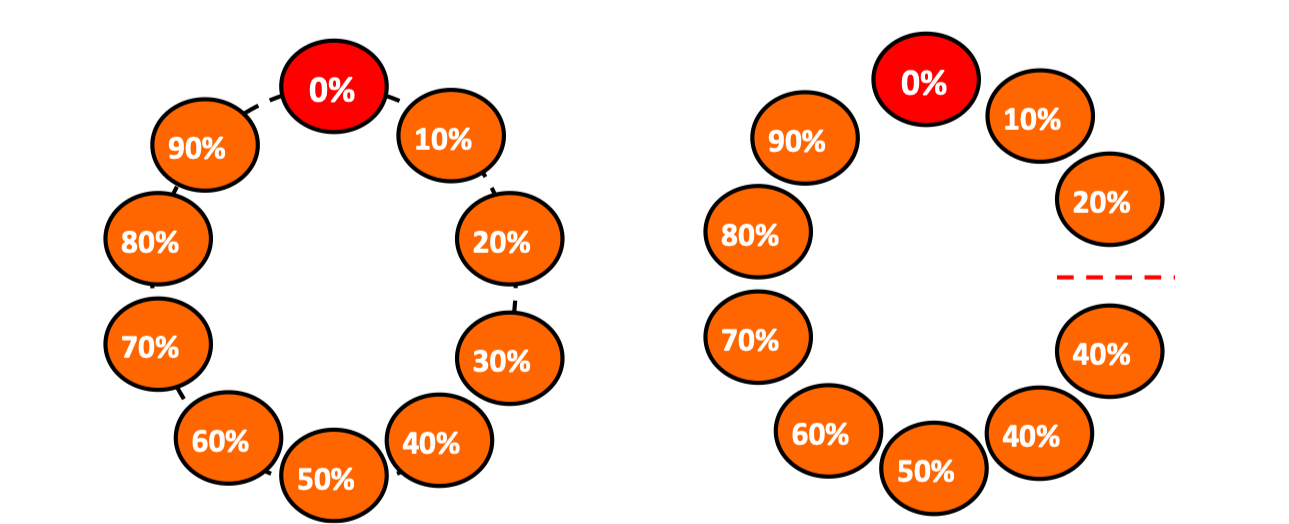
The sociologist Mark Granovetter addressed this aspect with his threshold model of collective behavior. As a thought experiment, he asks us to imagine a diverse group of people milling around in a square. Some are natural deviants, always ready to start trouble, most are susceptible to provocation in varying degrees and the remainder is made up of unusually solid citizens, almost never engaging in antisocial behavior.
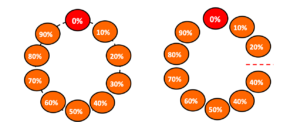


You can see a graphic representation of how the model plays out above. In the example on the left, a miscreant throws a rock and breaks a window. That’s all it takes for his friend next to him to start and then others with slightly higher thresholds join in as well. Before you know it, a full scale riot ensues.

The example on the right is slightly different. After the first few troublemakers start, there is no one around with a low enough threshold to join in. Rather than the contagion spreading, it fizzles out, the three miscreants are isolated and little note is made of the incident. Although the groups are outwardly similar, a slight change in conformity thresholds makes a big difference.

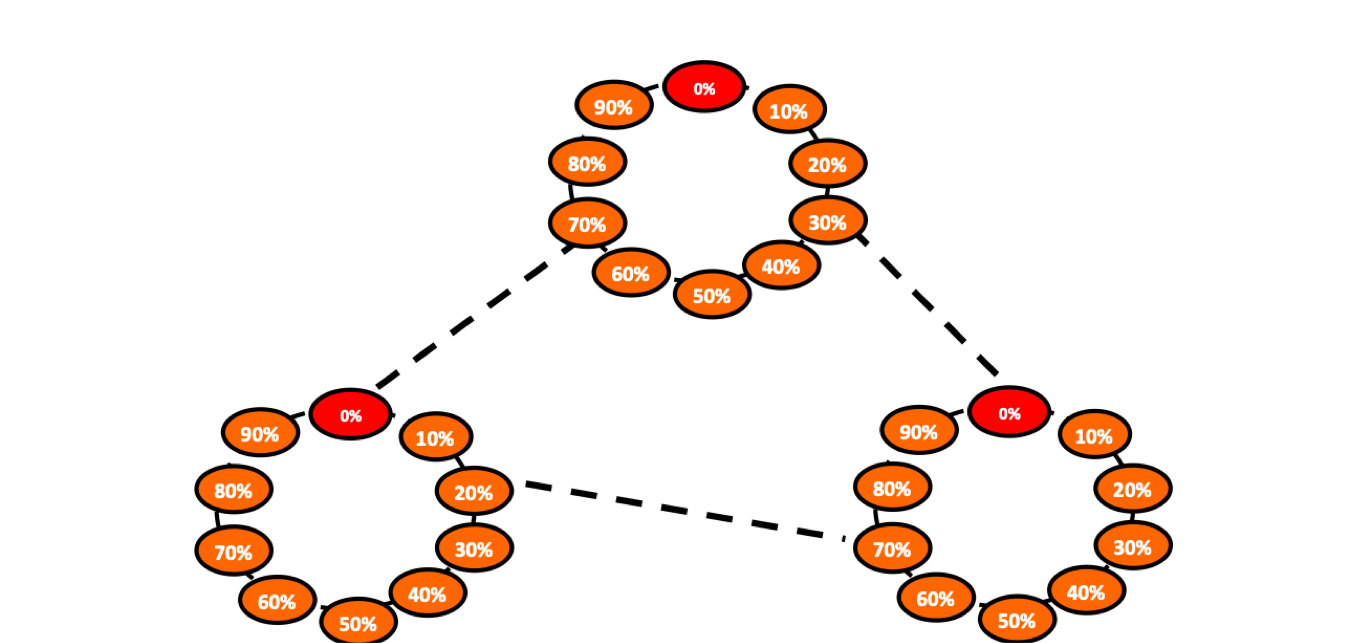
It’s a relatively simplistic example, but through another concept Granovetter developed called the strength of weak ties, we can see how it can lead to large scale change in the final graphic below as an idea moves from group to group.



The top cluster is identical to the one in the first example and a local majority forms. However, no cluster is an island because people tend to belong to multiple groups. For example, we form relationships with people in our neighborhood, from work, religious communities and so on. So an idea that saturates one group soon spreads to others.

Notice how the exposure to multiple groups can help overcome higher thresholds of resistance, because of the influence emanating from additional groups through weak links. Physicists have a name for this type of phenomenon — percolation — and configurations like the ones in the diagram are called a percolating cluster.

As I explain in my book, Cascades, there is significant evidence that this is how ideas actually do spread in the real world. So if you want an idea to gain traction, the best strategy is not to try to convince everybody all at once, but to start with small groups with low resistance thresholds. They, in turn, can help you convince others and build momentum.

3. Forging A Shared Purpose

As many have observed in recent years, you don’t really need leaders to spread ideas. Some, like LOLcats, go viral all on their own. Yet if it’s an idea that you consider to be important, you don’t want to leave things to chance. In many cases, such as the Occupy Movement, even an initially popular idea can spin out of control and lose credibility.

That’s where the importance of leadership comes in. The role of a leader is not so much to guide and direct action, but to inspire and empower belief and a sense of shared purpose. You can’t expect people to do what you want, they first have to want what you want, which is why you can’t change fundamental behaviors without changing fundamental beliefs.

Now we can see where Ignaz Semmelweis went wrong. Rather than working to gain allies among likeminded people, he castigated the medical establishment—those who had high resistance thresholds to a challenge of established beliefs. Instead of being hailed as an innovator, he died in an insane asylum, ironically from an infection he contracted there.

So we need to redefine how we think about leadership. In his new book, Leaders: Myth And Reality, General Stanley McChrystal defines leadership as “a complex system of relationships between leaders and followers, in a particular context, that provides meaning to its members.” Control, as attractive as it may seem, is always an illusion.

You Can’t Overpower, You Must Attract

All too often, we think creating change is about charismatic leaders and catchy slogans. People see Martin Luther King Jr. and “I have a dream” or Obama and “Yes, we can,” and think that you need a heroic leader to make change happen. In a similar way, they see CEOs like Steve Jobs or Elon Musk thrill audiences on stage and think that’s what entrepreneurship is all about.

This is a trap. Movements like Occupy didn’t fail because they lacked a Mandela or Gandhi, any more than countless startups fail because they lack a Steve Jobs or Elon Musk. Successful movements like Otpor in Serbia and Pora in Ukraine prevailed against incredible odds, in much more difficult environments, without visible leaders. Bill Gates isn’t really such a charmer and neither are Sergey Brin and Larry Page, the founders of Google.

Most often, change efforts fail because they seek to overpower rather than attract. Semmelweis sent angry letters to his critics, rather than address their concerns. Many of the Occupy activists were shrill and vulgar. Silicon Valley entrepreneurs are often known for their arrogance as much as for their technical prowess.

The problem is that fantasies about overpowering your foes are much more romantic than doing the hard work of building traction in small groups and then painstakingly linking them together through forging a sense of shared purpose. Yet if you want to truly change the world, or even just your little corner of it, that’s what you need to do.


An earlier version of this article first appeared in Inc.com

Subscribe to Human-Centered Change & Innovation WeeklySign up here to get Human-Centered Change & Innovation Weekly delivered to your inbox every week.

The One Genius Google Innovation Strategy That You’ve Probably Never Heard Of

GUEST POST by Greg Satell

It’s no secret that Google is one of the most innovative companies on the planet. Besides pioneering and then dominating the search industry, it has also become a leader in developing futuristic technologies such as artificial intelligence, driverless cars and quantum computing. It has even launched a life science company.

What makes Google so successful is not one particular process, but how it integrates multiple strategies into a seamless whole. For example, Google Brain started out as a 20% time project, then migrated out to its “X” Division to accelerate development and finally came back to the mothership, where it now collaborates closely with engineering teams to build new products.

Yet perhaps its most important strategy, in fact the one that makes much of the rest possible, is how it partners with top scientists in the academic world. This is no “quick hit,” but a well thought out, long-term game plan designed to establish deep relationships based on cutting edge science and embed that knowledge deeply into just about everything Google does.

Building Deep Relationships to the Academic Community

“We design a variety programs that widen and deepen our relationships with academic scientists,” Maggie Johnson, who heads up University Relations at Google, told me. In fact, there are three distinct ways that Google engages directly with scientists beyond the typical research partnerships with universities.

The first is its Faculty Research Awards program, which are small one-year grants, usually to graduate students or postdocs whose work may be of interest to Google. These are unrestricted gifts, although recipients are highly encouraged to publish their work publicly, that allow the company to develop relationships with young talent at the beginning of their careers.

While anybody can apply for a Faculty Research Award, Focused Research Awards are only available by invitation. Typically, these are awarded to more senior researchers that Google has already had some contact with and last two to three years. However, they are also unrestricted grants that researchers can use as they see fit.

The third way that Google engages with scientists to to proactively engage leaders in a particular field of interest. Geoffrey Hinton, for example, is a pioneer in neural networks and widely considered one of the top AI experts in the world. He splits his time between his faculty position at the University of Toronto and working on Google Brain.

“Spinning In” World Class Scientists

The academic research programs provide many benefits to Google as a company. They give access to the most promising students for recruiting, allow it to help shape university curriculums and keep it connected to breakthrough research in important fields. However, the most direct benefits probably come inviting researchers to spend a sabbatical year at Google, which it calls its Visiting Faculty Program.

For example, Andrew Ng, a top AI researcher, decided to spend a year working at Google and quickly formed a close working relationship with two of the company’s brightest minds, Greg Corrado and Jeff Dean, who were interested in what was then a new brand of artificial intelligence called deep learning. Their collaboration became the Google Brain project.

The Visiting Faculty Program touches on everything Google does. Currently visiting the company are people like John Canny at UC Berkeley, who is helping with the development of TPU’s, chips specialized to run Google’s AI algorithms and Michael Rabin, a Turing Award winning mathematician who is working on auction algorithms. For every Google priority, at least one of the world’s top minds is working with the company on it.

What makes the sabbatical program unusual is how deeply it is integrated into everyday work at the company. “In most cases, these scientists have already been working with our teams through one of our other programs, so the groundwork for a productive relationship has already been laid,” Maggie Johnson told me.

Developing “Win-Win” Relationships

One of the things that makes Google’s outreach to researchers work so well is that it is truly a win-win arrangement. Yes, the company gets top experts in important fields to work on its problems, but the researchers themselves get to work with unparalleled tools and data sets. They also get a much better sense of what problems are considered important in a commercial environment.

Katya Scheinberg, a Professor at Lehigh University who focuses on optimization problems, found working at Google to be a logical extension of her earlier collaboration with the company. “I had been working on large-scale machine learning problems and had some connections with Google scientists. So spending part of my sabbatical year at the company seemed fairly natural. I learned a lot about the practical problems that private sector researchers are working on,” she told me.

Since leaving Google, she’s found that her time at the company has shifted the focus of her research. “Working at Google got me interested in some different problems and alerted me to the possibility of applying some approaches I had worked on before to different fields of application.”

Sometimes scholars stay for longer and can have a transformative impact on the company. As noted above, Andrew Ng spent several years at the company. Andrew Moore, a renowned computer scientist and a former Dean of Carnegie Mellon’s computer program, took a leave of absence from his university to set up Google’s Research Center in Pittsburgh. Lasting relationships like these are rare in industry, but incredibly valuable.

Connecting to Discovery Is Something Anyone Can Do, But You Have to Make the Effort

Clearly,Google is an unusual company. There’s not many places that can attract the type of talent that it can. However, just about any business can, for example, support the work of a young graduate student or postdoc at a local university. In much the same way, inviting even a senior researcher to come for a short time is not prohibitively expensive.

Innovation is never a single event, but a process of discovery, engineering and transformation. It is by connecting to discovery that businesses can truly see into the future and develop the next generation of breakthrough products. Unfortunately, few businesses realize the importance of connecting with the academic world.

Make no mistake, if you don’t discover, you won’t invent and if you don’t invent you will be disrupted eventually. It’s just a matter of time. However, you can’t just show up one day and decide you want to work with the world’s greatest minds. Even Google, with all its resources and acumen, has had to work really hard at it.

It’s made these investments in time, focus and resources because it understands that the search business, as great as it is, won’t deliver outsized profits forever. Today, we no longer have the luxury to manage for stability, but must prepare for disruption.


An earlier version of this article first appeared in Inc.com

Subscribe to Human-Centered Change & Innovation WeeklySign up here to get Human-Centered Change & Innovation Weekly delivered to your inbox every week.

Business Pundits Love to Say These 4 Things — None of Them are True

GUEST POST by Greg Satell

Go to just about any business conference and you will see a pundit on stage. He or she will show some company that failed and explain the silly mistakes that they made, then follow-up with a few basic rules to help you avoid those pitfalls and become super successful. You leave feeling confident, because it all seems so simple and easy.

Yet look a little closer and the illusion falls away. Very few of these pundits have ever run a successful business. At the same time, many of the executives that are shown to be so silly today, were hailed as visionaries of their time, often by the same pundits that ridicule them now. Some went on to great success later on.

The truth is that managing a successful enterprise is a very hard and complex thing to do well. It can’t be boiled down to a few simple rules. For every great enterprise that does things one way, you will find one that’s equally successful that goes about things very differently. So to succeed in the long term, we often need to ignore the myths pundits love to repeat.

1. You Need To Move Fast And Break Things

When the iPhone came out in 2007, Microsoft CEO Steve Ballmer dismissed it, saying, “There’s no chance that the iPhone is going to get any significant market share. No chance.” The tech giant recognized the switch too slowly and largely missed out on the mobile market. Microsoft, it seemed, was a dinosaur, soon to become extinct.

Yet actually the opposite happened. Over the next 10 years, the company grew revenues at the impressive annual rate of better than 10% and maintained margins of nearly 30%. Those are very strong numbers. How can a company miss such an enormous opportunity and still survive, much less thrive?

They key to understanding Microsoft’s business isn’t what it missed, but what it was patiently building. While the world was obsessed with mobile, it was developing its servers and tools division, which eventually became the core of its cloud business that is now growing at stellar rates. That’s why Microsoft is once again vying to be the world’s most valuable company.

While agility can be an important asset for developing applications based on technology that is well understood, it is not a great strategy for developing technology that is truly new and different. To do that, you need to explore, discover and invent from scratch. That takes time and patience.

2. Innovation Is About Ideas

There is nothing that pundits and self-styled gurus like to talk about more than the power of ideas. They put up a picture of someone famous, like Albert Einstein, Mahatma Gandhi, Martin Luther King Jr. or, most enthusiastically, Steve Jobs, and revel the audience with a fascinating story about how their ideas changed the world.

The implication is that you can change the world too if only you could find the right idea. So they suggest all manner of exercises, from brainstorming techniques to meditation and mindfulness, designed to get your creative energy flowing so that you can generate more ideas and rise to greatness, just like those fabulous and famous people.

Yet that’s not how innovation happens. Consider Einstein. He didn’t start with an idea, but with a problem. More specifically, he wanted to know what would happen if you shined a lantern while traveling at light speed. It took him ten years to solve that problem with his theory of special relativity. It took him another ten to solve his next problem and arrive at general relativity.

The truth is that if you want to make a real impact, you don’t start with an idea, but by identifying a meaningful problem to be solved. Revolutions don’t begin with a slogan, they begin with a cause.

3. Lowering Costs Will Make You More Competitive

Not all pundits are pie-in-the-sky dreamers. Some are hard-nosed realists and they will tell you that the key to success is focusing on the bottom line. That means a relentless drive toward efficiency and driving down costs so that you can increase margins and achieve a sustainable competitive advantage.

Yet as MIT Professor Zeynep Ton, explains in The Good Jobs Strategy, that’s often not the case, even in the notoriously stingy retail industry, she points to companies like Costco, Trader Joe’s and Spain’s Mercadona as examples of how you can get better results by investing in training and retaining employees to better serve your customers.

The problem with a relentless drive to cut costs and drive efficiency is you often end up impeding the interoperability and exploration it takes to create value. That’s the efficiency paradox. The more we try to optimize operations, the less we are able to identify improvements, react to changes and discover new possibilities.

This is becoming even more important in the age of automation, where it is all too easy to replace employees with robots and algorithms. The truth is that racing to the bottom of the cost curve will almost guarantee that you will become a commodity business. Value never disappears, it just moves to a new place.  To compete for the long term, you need to identify value at a higher level, develop new business models and redesign work.

4. Companies That Fail Weren’t Paying Attention

The one thing that you can almost guarantee at any conference is that at least one of the fancy pants gurus will tell a story about a great big company, usually Blockbuster, Kodak or Xerox, that was run by eminently silly people. Because these dull executives were asleep at the wheel, they failed to notice the change swirling around them and drove their enterprises into the ground.

The problem is that these stories are almost never true. Make no mistake, it takes talent, intelligence and ambition to run a significant enterprise. So whenever anybody tells you that there was a simple fix to a complex problem, you should raise your B.S. antenna. You’re probably being sold a fairy tale.

Reality is never simple or clear cut. Executives need to make tough decisions with incomplete information, often in a complex time frame. So rather than looking for easy answers, you would do yourself a much greater service by trying to uncover why smart, diligent leaders with good intentions so often get it wrong and learning from them.

Most of all, you need to internalize the fact that success or failure never boil down to a single decision or event. Even the best of us have bad moments and sometimes the least deserving get lucky. The best you can do is to keep moving forward, continue to learn and, most of the time, ignoring the pundits.


An earlier version of this article first appeared in Inc.com

Subscribe to Human-Centered Change & Innovation WeeklySign up here to get Human-Centered Change & Innovation Weekly delivered to your inbox every week.
How IBM Sees The Future Of Artificial Intelligence

GUEST POST by Greg Satell

Ever since IBM’s Watson system defeated the best human champions at the game show Jeopardy!, artificial intelligence (AI) has been the buzzword of choice. More than just hype, intelligent systems are revolutionizing fields from medicine and manufacturing to changing fundamental assumptions about how science is done.

Yet for all the progress, it appears that we are closer to the beginning of the AI revolution than the end. Intelligent systems are still limited in many ways. They depend on massive amounts of data to learn accurately, have trouble understanding context and their susceptibility to bias makes them ripe targets for sabotage.

IBM, which has been working on AI since the 1950s, is not only keenly aware of these shortcomings, it is working hard to improve the basic technology. As Dario Gil, Chief Operating Officer of IBM Research recently wrote in a blog post, the company published over 100 papers in just the past year. Here are the highlights of what is being developed now.

Working To Improve Learning

What makes AI different from earlier technologies is its ability to learn. Before AI, a group of engineers would embed logic into a system based on previously held assumptions. When conditions changed, the system would need to be reprogrammed to be effective. AI systems, however, are designed to adapt as events in the real world evolve.

This means that AI systems aren’t born intelligent.  We must train them to do certain tasks, much like we would a new employee. Systems often need to be fed thousands or even millions of examples before they can perform at anything near an acceptable level. So far, that’s been an important limiting factor for how effective AI systems can be.

“A big challenge now is being able to learn more from less,” Dr. John Smith, Manager of AI Tech at IBM Research, told me. “For example, in manufacturing there is often a great need for systems to do visual inspections of defects, some of which may have only one or two instances, but you still want the system to be able to learn from them and spot future instances.”

“We recently published our research on a new technique called few-shot or one-shot learning, which learns to generalize information from outliers”, he continued. “It’s still a new technique, but in our testing so far, the results have been quite encouraging.“ Improving a system’s ability to learn is key to improving how it will perform.

Understanding Context

One of the most frustrating things about AI systems is their inability to understand context. For example, if a system is trained to identify dogs, it will be completely oblivious to a family playing Frisbee with its beloved pet. This flaw can get extremely frustrating when we’re trying to converse with a system that takes each statement as a separate query and ignores everything that came before.

IBM made some important headway on this problem with its Project Debater, a system designed to debate with humans in real time. Rather than merely respond to simple, factual questions, Debater is able to take complex, ambiguous issues and make a clear, cogent argument based on nuanced distinctions that even highly educated humans find difficult.

A related problem is the inability to understand causality. A human who continues to encounter a problem would start to wonder where it’s coming from, but machines generally don’t. “A lot of the AI research has been focused on correlations, but there is a big difference between correlations and causality,” Smith told me.

“We’re increasingly focused on researching how to infer causality from a large sets of data,” he says. “That will help us do more than diagnose a problem in say, a medical or industrial setting, but help determine where the problem is coming from and how to approach fixing it.”

Focusing On Ethics And Trust

Probably the most challenging aspect of AI is ethics. Now that we have machines helping to support human decisions, important questions arise about who is accountable for those decisions, how they are arrived at and upon what assumptions they are being made.

Consider the trolley problem, which has stumped ethicists for decades. In a nutshell, it asks what someone should do if faced with the option of pulling a lever so that a trolley avoids killing five people laying on a track, but kills another person in the process. Traditional approaches, such as virtue ethics or Kantian ethics, provide little guidance on what is the right thing to do. A completely utilitarian approach just feels intuitively lacking in moral force.

These basic challenges are compounded by other shortcomings inherent in our computer systems, such as biases in the data they are trained on and the fact that many systems are “black boxes,” which offer little transparency into how judgments are arrived at. Today, as we increasingly need to think seriously about encoding similar decisions into real systems, such as self-driving cars, these limitations are becoming untenable.

“If we want AI to effectively support human decision making we have to be able to build a sense of trust, transparency, accountability and explainability around our work,” Smith told me. “So an important focus of ours has been around building tools, such as Fairness 360, an open source resource that allows us to ask questions of AI systems much as we would of human decisions.”

The Future Of AI

When IBM announced its System 360 mainframe computer in 1964 at a cost of $5 billion (or more than $30 billion in today’s dollars), it was considered a major breakthrough and dominated the industry for decades. The launch of the PC in the early 80s had a similar impact. Today’s smartphones, however, are infinitely more powerful and cost a small fraction of the price.

We need to look at AI in the same way. We’re basically working with an early version of the PC, with barely enough power to run a word processing program and little notion of the things which would come later. In the years and decades to come, we expect vast improvements in hardware, software and our understanding of how to apply AI to important problems.

One obvious shortcoming is that although many AI applications perform tasks in the messy, analog world, the computations are done on digital computers. Inevitably, important information gets lost. So a key challenge ahead is to develop new architectures, such as quantum and neuromorphic computers, to run AI algorithms.

“We’re only at the beginning of the journey” IBM’s Smith told me excitedly, “but when we get to the point that quantum and other technologies become mature, our ability to build intelligent models of extremely complex data is just enormous.


An earlier version of this article first appeared in Inc.com

Image: Wikimedia Commons

Subscribe to Human-Centered Change & Innovation WeeklySign up here to get Human-Centered Change & Innovation Weekly delivered to your inbox every week.
How Fantasy Becomes Reality

GUEST POST by Greg Satell

When H.G. Wells was born in 1866, there was no electricity or cars or even indoor plumbing. Still, his active imagination conjured up a world of time machines, space travel and genetic engineering. This was all completely fantasy, but his books foresaw many modern inventions, such as email, lasers and nuclear energy.

It’s no accident that people who invent the future are often fans of science fiction. In fact, in Leading Transformation, the former head of Lowe’s innovation lab explains how he hired science fiction writers to help inspire the company to leverage virtual reality and build a new future for the company.

To create anything truly new and different, you often need to discard the constraints of the present. Yet that comes with a problem. How do you transform fantasy into something real and useful? What makes great innovators truly different is how they combine imagination with practical problem solving in order to bring even the wildest pipe dreams into reality.

How A “Memex” Machine Became The Internet

“Consider a future device for individual use,” Vannevar Bush wrote in The Atlantic in 1945, “which is a sort of mechanized private file and library. It needs a name, and, to coin one at random, “memex” will do. A memex is a device in which an individual stores all his books, records, and communications, and which is mechanized so that it may be consulted with exceeding speed and flexibility. It is an enlarged intimate supplement to his memory.”

It was an unlikely vision for the time. The first computers were just being developed then and were themselves somewhat impractical devices, which is why Bush imagined that the memex would be based on microfilm. Yet Bush was no inveterate dreamer, but in many ways the architect of America’s path to scientific dominance and people took him seriously.

One of those was a young radar technician stationed in the Philippines named Douglas Engelbart, who would return to school to study electrical engineering. It was that expertise, along with Bush’s vision that led him to think of computers, still primitive at the time, as machines that could do more than merely calculate, but “augment the human intellect.”

Engelbart would showcase these ideas in what is now known as the Mother of All Demos in 1968 and Xerox began an enormous research project to bring his vision to market. By 1973, a functional prototype, called the Alto, was built and, a decade later, a young entrepreneur named Steve Jobs would use it to create the Macintosh. The world was never the same.

When Feynman Found “Plenty Of Room At The Bottom”

Richard Feynman was an usual scientist, known almost as much for his pranks as he was for his discoveries. So few were probably surprised at the unconventional title for his address the American Physical Society a few days after Christmas in 1959, There’s Plenty of Room at the Bottom. It was something they had come to expect from the young genius.

Feynman’s fantasy was not unlike Bush’s, except that it was more ambitious. While Bush imagined putting all the world’s knowledge on microfilm, Feynman imagined writing the entire 24 volumes of the Encyclopedia Britannica on the head of a pin. It was just the sort of impractical idea that usually gets people thrown out on physics conferences, not given the stage.

Yet Feynman immediately got down to brass tacks. He proposed using an electron microscope as a writing tool, much like a cathode ray oscilloscope projected images on television screens at the time. He then asked if we can write things on a microscopic scale, why not build things too? Again, he identified problems and proposed potential solutions.

That day, almost single handedly, Feynman invented the field of nanotechnology, although that term wasn’t coined until 1974. These days we use it to etch transistors in silicon wafers to make computer chips and create advanced materials for things like solar cells. Yet the truth is that even now, 60 years after that initial talk, we are just beginning to scratch the surface of Feynman’s vision.

Spacemen, Cavemen And Small World Networks

In the late 1990s, a young graduate student named Duncan Watts was struggling to understand an obscure phenomenon that had baffled scientists for centuries. Known as coupled oscillation, it was a mysterious force that allowed a disparate group of entities, like pacemaker cells in the human heart or certain species of crickets in a forest, to synchronize their behavior.

Nobody could figure out how it worked. Was there some kind of leadership structure with “conductor” leading the synchronized orchestra? Or maybe some complicated web of influence? As much as he pored through the research, tracked the chirping of crickets and tested out formulas to describe behavior, he was still baffled.

What helped break the logjam was two books by the science fiction writer Isaac Asimov. In the first, Caves of Steel, people lived in underground caves and, while everybody was connected to everybody else in their cave, they knew no one outside of it. In the second, The Naked Sun, space colonists led a hermit-like existence, linked to others only through long-range connections.

Neither of these, of course, told Watts anything about pacemaker cells or crickets, but it allowed him to reframe the problem as one of relationships. By imagining the two extremes of the cave people and the space colonists, he was able to come up with a model of relationships that led to the mass synchronization of coupled oscillators.

The paper he would write based on his fantasy-inspired formulas would prove to be a landmark. It would establish an exciting new field of small world networks and lead to a new era in the science of how things are connected, helping to transform fields as diverse as neuroscience, epidemiology and computer science.

Venturing Into The Visceral Abstract

Today we are beset with an dizzying array of problems in the world, climate change, income inequality and the rise of authoritarianism being just a few. Successful businesses face extinction by a seemingly endless wave of disruptions ranging from new technologies to new social phenomenons. It can all seem overwhelming.

It’s important to view these problems from a practical perspective. Each needs to be solved within constraints of economics, politics and competitive pressures. Yet it is also important to realize that the solutions to tough problems will rarely be found in the realm of our experiences. If a solution to any of these problems already existed, they wouldn’t be such tough problems.

The only path through that troubling tautology is fantasy. Once we have exhausted the realm of the possible, we often must venture into the realm of the impossible to see a new direction. A memex machine, a world with “plenty of room at the bottom,” cave societies and space colonies were all ideas of little practical import at the time they were conceived, but benefit us today in important ways through the discoveries they inspired.

We need to accept that we live in a world of the visceral abstract, where the technologies we use to solve the practical problems in our lives are all based on what were once considered utterly impractical ideas. That means to make an impact on reality, we often need to indulge ourselves with fantasy, identify a different path to travel and then begin the work anew.


An earlier version of this article first appeared in Inc.com

Image: Wikimedia Commons

Subscribe to Human-Centered Change & Innovation WeeklySign up here to get Human-Centered Change & Innovation Weekly delivered to your inbox every week.