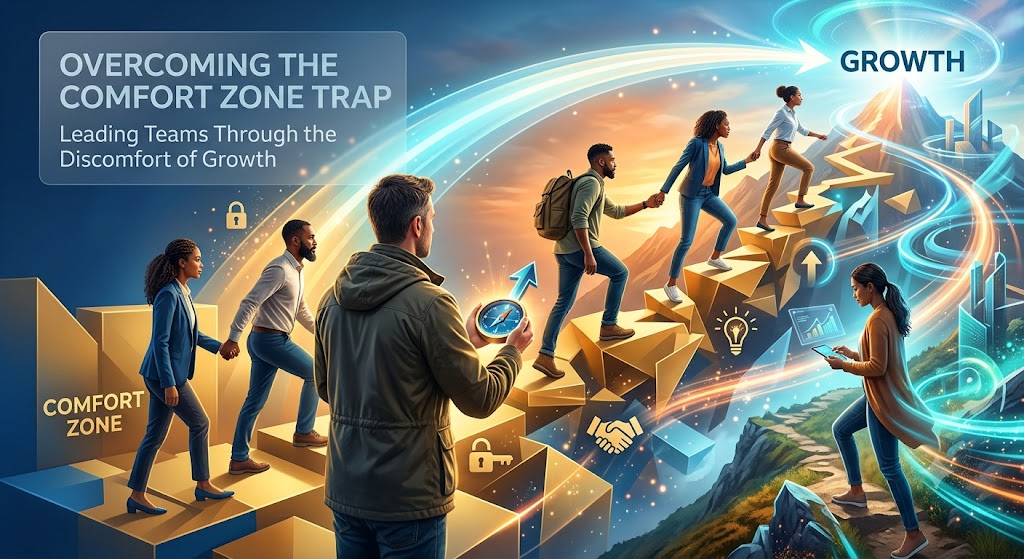
Leading Teams Through the Discomfort of Growth
GUEST POST from Chateau G Pato
The Siren Song of Stagnation
The comfort zone is rarely a place of overt failure; instead, it is a dangerous holding pattern where organizational relevance goes to die. It feels safe, predictable, and remarkably comfortable because it is built on the foundation of past victories. However, in an era defined by continuous disruption and accelerating shifts, the greatest risk to any organization isn’t doing things poorly—it is doing the same things too well for too long.
This creates the Success Trap. When teams achieve high performance, they naturally seek to protect the formulas, structures, and processes that got them there. The very mechanics that drove their initial triumph harden into a protective shell, rendering them blind to emerging trends and highly resistant to necessary change. True human-centered leadership requires recognizing that comfort is not a reward for hard work—it is an early indicator of stagnation.
Growth and comfort cannot coexist. To guide a team into the future, a leader must shift the organizational objective from protecting current capability to actively expanding potential.
The core thesis of modern change leadership is simple yet challenging: growth is not the absence of discomfort; it is the strategic, empathetic application of it. Leaders must step into the role of experience designers, carefully calibrating the “discomfort dial” to stretch their teams’ capabilities without triggering panic. By pairing psychological safety with purposeful challenge, we can transform discomfort from an obstacle into our most reliable fuel for innovation.
Phase 1: Diagnosing the Comfort Zone
Before a leader can guide a team through the discomfort of growth, they must first understand exactly where the organization has grown comfortable. The comfort zone is insidious because it masquerades as efficiency. When a process runs smoothly, or when a team hits their targets using familiar routines, it is easy to mistake stability for success. True diagnostic leadership requires looking beneath the surface of day-to-day operations to identify where compliance has replaced creativity.
Identifying the Signals of Stagnation
Organizational stagnation rarely announces itself with a crisis; it whispers through subtle shifts in team dynamics. Leaders must tune their radar to recognize the early warning signs of a team stuck in place:
- The “Best Practices” Anchor: An over-reliance on historical success formulas, frequently accompanied by the phrase, “We’ve always done it this way.”
- Diminishing Returns on Innovation: Expending identical amounts of energy and resources to achieve increasingly marginal performance improvements.
- The Sound of Silence: Meetings devoid of healthy friction, constructive debate, or alternative points of view. Compliance takes the place of true alignment.
- Incremental Bias: A portfolio of projects consisting entirely of safe, low-risk optimizations rather than bold, exploratory initiatives.
The Fear Audit Framework
To dismantle the comfort zone trap, leaders must conduct a deliberate Fear Audit. Teams rarely resist change because they are lazy; they resist because they are afraid. By categorizing and naming these invisible barriers, a leader can design targeted interventions to address them:
| Fear Type | Underlying Narrative | Diagnostic Behavioral Cue |
|---|---|---|
| Fear of Failure | “If I try something new and it doesn’t work, my reputation or standing will be permanently damaged.” | Extreme risk aversion; hiding mistakes; waiting for explicit permission for minor decisions. |
| Fear of Incompetence | “I am an expert at the current process. If the system changes, I won’t know how to do my job anymore.” | Defensiveness toward new tools or methodologies; aggressively defending outdated systems. |
| Fear of Status Loss | “My organizational value and influence are tied to the current power structure or workflow.” | Passive-aggressive resistance; gatekeeping information; undermining collaborative cross-functional efforts. |
Moving from “Comfort” to “Capability”
Overcoming this phase requires shifting the team’s core focus from defending what they currently have to building what they will eventually need. This is a deliberate shift in the organizational experience design. Leaders must redefine high performance away from static operational execution and tie it directly to active learning, adaptability, and the courage to step into the unknown.
Phase 2: The Architect of Constructive Discomfort
Once you have diagnosed the boundaries of your team’s comfort zone, the role of the leader shifts from an observer to an architect. Leading human-centered change does not mean throwing people into the deep end without a lifeline. Instead, it requires purposefully designing an environment where stretching beyond familiar boundaries is not only encouraged, but systematically supported. This is the art of balancing healthy friction with deep psychological support.
Psychological Safety as the Baseline
The fundamental prerequisite for constructive discomfort is absolute psychological safety. There is a common misconception that psychological safety means making people comfortable. In reality, it is exactly the opposite: it provides the emotional security necessary for people to tolerate being intensely uncomfortable.
Think of psychological safety as an organizational safety net. When professionals know that a mistake will not lead to humiliation, career damage, or a loss of status, they become willing to take the calculated risks required for innovation. Without this baseline of trust, pushing a team out of their comfort zone will not lead to growth—it will cause panic, leading to defensive posturing, burnout, and acute resistance.
Implementing the “Learning Loop”
To institutionalize this dynamic, leaders must replace rigid operational loops with dynamic Learning Loops. The goal is to lower the stakes of individual actions by breaking major, intimidating transformations down into small, rapid, and observable experiments:
- Hypothesize: Clearly define what the team wants to learn or test, shifting the goal from a flawless execution to an insights-driven target.
- Experiment: Run highly contained, low-risk trials where the cost of failure is negligible.
- Analyze: Evaluate the outcomes with radical transparency, treating unexpected results as critical data points rather than personal setbacks.
- Adapt: Rapidly pivot or scale the approach based on the empirical feedback gathered during the process.
Reframing the Narrative of Change
Human beings are evolutionarily wired to perceive unfamiliar territory as a threat. When leaders introduce new systems, metrics, or strategies, teams instinctively focus on what they stand to lose. As change architects, we must consciously change the narrative framework:
| The Threatened Perspective (Old View) | The Growth Perspective (Reframed View) |
|---|---|
| “We are throwing away a proven system that we spent years mastering.” | “We are leveraging our hard-earned expertise to design an even more powerful future state.” |
| “This change is a direct critique of our current performance and efficiency.” | “This evolution is a necessary response to shifting external realities and market dynamics.” |
| “If I fail at this new workflow, my position and value are at risk.” | “The primary value I bring is my capacity to adapt, learn, and grow alongside the business.” |
By shifting the story from one of loss to one of evolution, you remove the psychological friction of change. This allows teams to stop expending their energy protecting the past and start directing it toward mastering the future.
Phase 3: Leading Through the “Neutral Zone”
The most perilous part of any change journey is the middle. In William Bridges’ classic transition model, this is known as the Neutral Zone—the psychological gray area where the old way of working has been officially discontinued, but the new way isn’t yet fully functional or comfortable. This is the space where momentum stalls, frustrations peak, and the powerful temptation to retreat into old habits is at its absolute highest.
Managing this phase requires a unique blend of structural scaffolding and deep emotional intelligence. Leaders cannot manage the neutral zone with purely operational directives; they must navigate it as an experiential journey, providing clear markers and steady support while the ground is shifting beneath the team’s feet.
Navigating the Rollercoaster of Change
When teams enter the neutral zone, productivity often temporarily dips as people expend cognitive energy learning new systems, unlearning old habits, and managing the anxiety of ambiguity. Human-centered leaders do not punish this dip; they anticipate it. They recognize that confusion, false starts, and occasional friction are not signs of a failed strategy, but the literal sound of cognitive pathways and organizational capabilities expanding.
Tactical Anchors for Uncertain Times
To prevent the team from capsizing during this transition, leaders must install three critical tactical anchors to stabilize the organizational experience:
- The Velocity of Micro-Wins: Big transformations take time, and delayed gratification breeds fatigue. Leaders must intentionally break down the long-term vision into short-term, highly achievable micro-milestones. Celebrating these small, observable victories creates a steady cadence of momentum and proves to the team that progress is actively being made.
- The Futurist’s Horizon Lens: When wrapped in immediate discomfort, people naturally develop tunnel vision. The leader must consistently bring the future into the room. By anchoring daily challenges to macro trends and customer insights, you remind the team that standing still is an illusion—and that the discomfort they are experiencing now is the only path to long-term career and organizational relevance.
- Human-Centered Empathy Buffers: Leading through growth does not mean adopting a posture of toxic positivity. Leaders must create explicit spaces for teams to voice their frustrations, clear up confusion, and grieve the loss of their old routines. Acknowledging that change is hard builds the relational trust required to keep pushing forward.
The Transition Dynamic
The following progression maps the shift in leadership focus required to successfully carry a team across the messy middle of change:
| Transition Stage | The Team’s Experience | The Leader’s Primary Role |
|---|---|---|
| 1. The Ending | Anxiety, denial, sense of loss, resistance. | The Communicator: Clearly explain why the old status quo is unsustainable. |
| 2. The Neutral Zone | Confusion, low morale, high friction, creative sparks. | The Scaffolder: Define short-term focus, tolerate mistakes, reward experimentation. |
| 3. The New Beginning | Acceptance, fresh energy, alignment, emerging mastery. | The Sustainer: Lock in new behaviors, align rewards, celebrate the growth achieved. |
By actively scaffolding the neutral zone, leaders transform the messy middle from an organizational hazard into a crucible for genuine agility. The goal is to help the team discover that they can survive—and ultimately thrive—in the space between certainty and clarity.
Phase 4: Sustaining the Edge
The ultimate goal of overcoming the comfort zone trap is not to guide your team through a single, painful transition only to let them settle into a brand-new zone of comfort. In a business landscape characterized by continuous disruption, static stability is an illusion. The true objective of human-centered leadership is to institutionalize agility, converting a one-time change initiative into a permanent, healthy capacity for ongoing evolution.
Sustaining this edge requires embedding change readiness directly into the operating model, leadership metrics, and cultural rituals of the organization. Growth must become an ongoing, iterative practice rather than an exceptional event.
Institutionalizing Agility
To move from episodic change to a sustainable state of perpetual adaptation, leaders must design permanent structural mechanisms that reward exploration and discourage complacency:
- Redefining Core Metrics: Shift performance evaluations from rewarding purely predictable operational execution to actively measuring adaptability, collaborative cross-functional experimentation, and speed-to-insight.
- Ritualizing the Retrospective: Embed radical transparency into the regular business cadence. Normalize discussing what didn’t work just as openly as what did, ensuring that hard-earned knowledge is institutionalized rather than buried.
- Continuous Signal Scanning: Democratize the role of the futurist. Train the entire team to look outward at emerging trends, changing customer behaviors, and technological developments, ensuring the organization is never caught off guard by the future.
The Innovation Maturity Continuum
Organizations navigate distinct levels of readiness when converting raw discomfort into sustained innovative capacity. Leaders can use the following maturity framework to evaluate where their organization sits and determine the next developmental step:
| Maturity Level | Dominant Team Mindset | Systemic Response to Friction |
|---|---|---|
| 1. Reactive | “We only change when forced by a market crisis or operational failure.” | Panic, blame assignment, and an urgent retreat to defensive legacy behaviors. |
| 2. Project-Driven | “We can tolerate discomfort if it is contained within a specific, time-bound initiative.” | Compliance during the project, followed by a slow slide back into old comfort zones. |
| 3. Continuous Agility | “Discomfort is a natural, healthy sign that we are actively expanding our capabilities.” | Curiosity, rapid collaborative adaptation, and a collective pride in the team’s capacity to learn. |
Conclusion: The Leader as a Catalyst
Ultimately, sustaining the edge comes down to a fundamental shift in how we view the role of leadership. The traditional model of a leader was an anchor—someone who provided absolute certainty, stability, and protection from external forces. Today, the human-centered leader must act as a catalyst. The greatest gift you can give your team is not temporary comfort, but the psychological safety, strategic tools, and emotional resilience required to be perpetually, productively uncomfortable.
Conclusion: Embracing the Continuum of Growth
Overcoming the comfort zone trap is not a project with a defined start and end date; it is an enduring leadership philosophy. The moments where your team feels most settled and secure are precisely the moments that require the most vigilant, proactive exploration. Safety is found in your collective capacity to adapt, not in the temporary shelter of static processes or historical victories.
A Call to Action for Transformation Leaders
To move from theory to execution, change leaders must immediately bring these concepts into their daily operational cadence. Do not wait for a major structural reorganization or a market downturn to shake up your team’s routine. True agility is forged through microscopic, deliberate disruptions designed to build the organization’s collective tolerance for the unfamiliar.
The ultimate measure of a human-centered leader is not how much certainty they can manufacture for their team, but how much ambiguity they can empower their team to navigate.
As you step back into your organization, challenge yourself to initiate one immediate disruption exercise by the end of this week. Identify a single, entrenched workflow or an unquestioned “best practice” that has become overly comfortable. Gather your team, leverage your frameworks for psychological safety, and run a rapid, low-stakes experiment to re-evaluate it. By consciously opening up these small pockets of constructive friction, you begin the vital process of transforming discomfort from a source of anxiety into your competitive advantage.
The choice facing modern organizations is stark but simple. We can choose the predictable, temporary warmth of the comfort zone until external forces violently dismantle it—or we can choose the exhilarating, deliberate discomfort of intentional growth. By equipping our teams with the emotional scaffolding, experimental frameworks, and strategic foresight required to step forward, we ensure they don’t just survive the future, but actively design it.
Frequently Asked Questions
How can a leader tell the difference between healthy constructive discomfort and team panic or burnout?
The distinction lies in the presence of psychological safety and agency. In a state of healthy discomfort, team members feel challenged but supported; they possess the tools, autonomy, and safety to experiment, fail, and learn without fear of retribution. When a team crosses into panic or burnout, you will observe chronic anxiety, finger-pointing, a total collapse of open communication, and physical exhaustion. Cultivating a regular feedback loop allows leaders to actively calibrate this baseline.
Why is psychological safety considered a prerequisite for introducing discomfort to a team?
Psychological safety is the structural foundation that prevents discomfort from turning into paralyzing fear. If professionals believe that a mistake, an unpolished idea, or an experimental failure will result in humiliation or career damage, they will instinctively retreat deeper into their comfort zones. True psychological safety doesn’t mean creating an environment free of challenge—it creates the exact container of trust required for individuals to take bold risks.
What is the first step a leader should take to transition a team out of a long-standing “success trap”?
The first step is conducting a thorough Fear Audit to identify what the team is protecting, followed immediately by changing the narrative framework. Leaders must explicitly decouple a professional’s identity from a static process and instead attach it to their capacity to learn and evolve. Introduce low-stakes, rapid experiments (Learning Loops) where the objective isn’t absolute perfection, but the acquisition of critical data and insight.
Image credit: Gemini
 Sign up here to get Human-Centered Change & Innovation Weekly delivered to your inbox every week.