Fix Revenue Leakage Before Your Competitors Do
Most organizations have no idea how their customers, employees, or partners actually experience them. They rely on surveys taken after the fact, dashboards that measure what’s easy to count, and assumptions built up over years of internal perspective. Meanwhile, customers are quietly leaving — and competitors are quietly improving.
An Experience Audit changes that. It gives you an accurate, human-centered picture of your experience landscape — what’s working, what’s broken, where you’re losing people, and where the highest-value improvement opportunities lie. Not based on what you think is happening. Based on what’s actually happening.
The Business Case is Undeniable
The research on customer experience investment is unambiguous — and it has only gotten stronger:
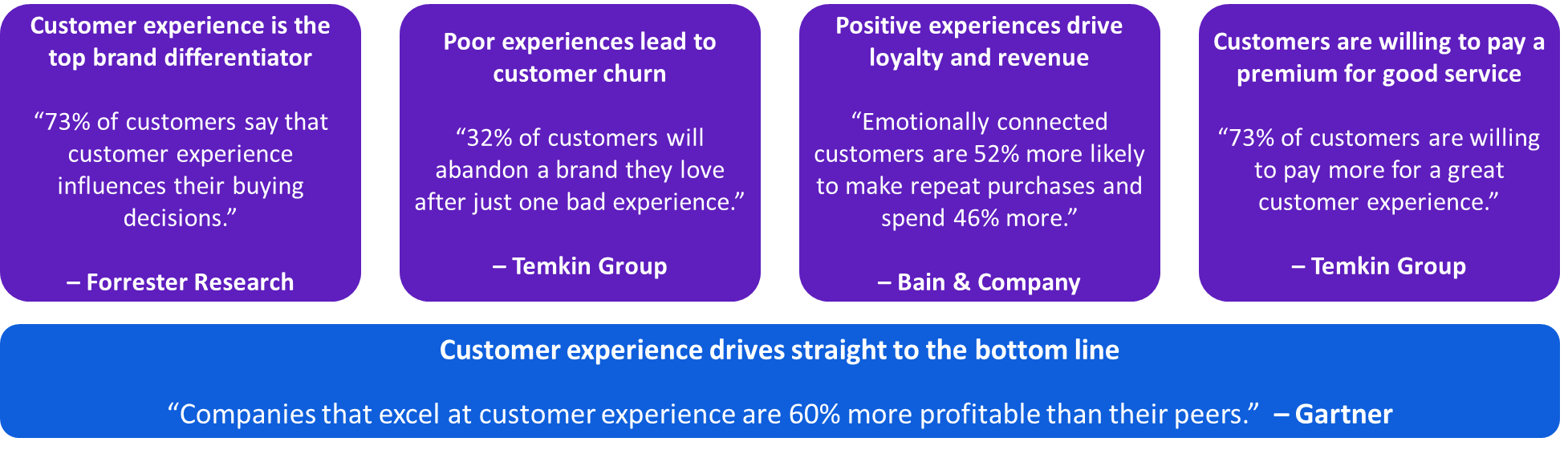
- CX leaders generate 6x the revenue growth of bottom-quartile peers, and the typical CX investment returns 3x within 24 months. (Forrester CX Index 2026)
- 70% of customers abandon a brand after just two bad experiences. (Emplifi)
- Resolving CX issues can reduce churn by 85%. (Esteban Kolsky)
- Companies that excel at CX see an average 80% increase in revenue compared to those that don’t. (Zippia/Zendesk)
- The Qualtrics XM Institute modeled $1 billion companies making a modest CX improvement investment and calculated an average gain of $775 million over three years across 20 industries.
- 89% of businesses are expected to compete primarily on customer experience in 2026. (Gartner)
The question is no longer whether customer experience matters. The question is whether you know — with confidence — where your experience is creating value and where it’s destroying it.
What is an Experience Audit?
An Experience Audit is a systematic, human-centered evaluation of how your customers, employees, partners, donors, or recipients actually experience your organization — across every channel and touchpoint that matters.
Unlike mystery shopping, which evaluates isolated transactions and compliance metrics, an Experience Audit is holistic. It goes beyond creating a journey map to physically and digitally walk the moments that matter in the shoes of those you serve — with the option to benchmark key touchpoint performance against select competitors.
It surfaces the blind spots that internal teams can no longer see, quantifies the experience gaps that are costing you customers and revenue, and identifies the highest-leverage improvement opportunities — including where emerging technologies like AI can be most effectively and efficiently introduced.
Who can be the focus of an Experience Audit?
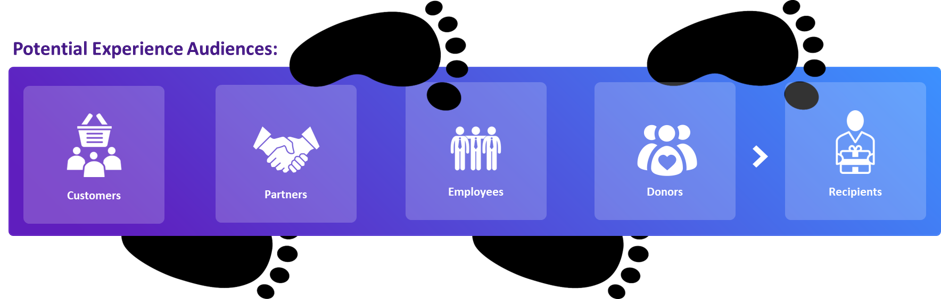
Experience Audits can focus on any audience whose experience with your organization affects your outcomes:
- Customers — the end-to-end purchase, onboarding, service, and renewal journey
- Employees — the hiring, onboarding, day-to-day, and exit experience that drives engagement and retention
- Partners — the channel and distribution experience that determines how hard partners work on your behalf
- Donors — the awareness, giving, and stewardship journey for nonprofits and public sector organizations
- Recipients — the service delivery experience for beneficiaries of nonprofit or government programs
What Makes This Different from a Traditional Audit
Most CX assessments tell you what customers say about their experience. An Experience Audit tells you what their experience actually is — and why the gap between the two exists.
The difference matters because 54% of organizations cite “fragmented or siloed data” as their biggest barrier to leveraging customer insights (Zendesk), and because what customers say in surveys often diverges significantly from what they actually do. An Experience Audit closes that gap through direct observation, journey walking, and competitive benchmarking — not just survey analysis.
It also goes deeper than a journey map. A journey map describes the intended experience. An Experience Audit evaluates the actual experience — including the moments that maps miss, the friction that customers endure without complaint, and the competitive gaps that only become visible when you walk your own journey alongside alternatives.
Experience Audit Activities & Deliverables
A complete Experience Audit typically includes five integrated activities:
1. Audience Research & Persona Validation
Identify distinct audience segments, validate their journeys against current reality, and surface the needs, expectations, and pain points that internal assumptions have obscured.
2. Journey Mapping & Touchpoint Analysis
Create or update persona-based journey maps, identifying key touchpoints, pain points, emotional highs and lows, and improvement opportunities across every relevant channel.
3. Existing Data Evaluation
Analyze your current KPIs, metric data, NPS scores, CSAT data, and sentiment analysis to identify patterns, gaps, and untapped insights that current reporting isn’t surfacing.
4. Walk the Journey
Evaluate key touchpoints firsthand — across retail locations, digital channels, service call experiences, or sales cycles — in both B2B and B2C contexts. This is where most audits find their most surprising and valuable insights.
5. Competitive Benchmarking
Benchmark your experience performance against select competitors and best-in-class examples to understand not just where you are, but how far you are from where you need to be.
The ROI of an Experience Audit
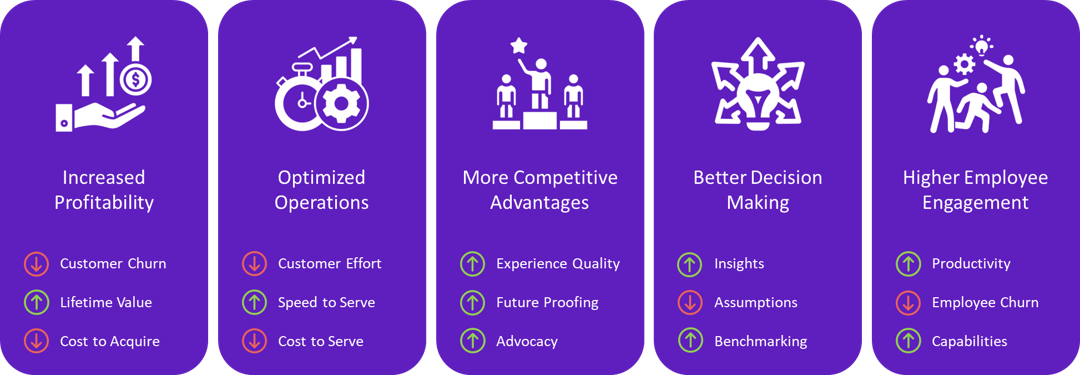
Experience Audits generate return across five dimensions simultaneously:
- Increased Profitability — reducing customer churn, increasing lifetime value, and lowering cost to acquire
- Optimized Operations — reducing customer effort, increasing speed to serve, and lowering cost to serve
- More Competitive Advantages — improving experience quality, future-proofing against disruption, and increasing advocacy
- Better Decision Making — replacing assumptions with insights and establishing competitive benchmarks
- Higher Employee Engagement — improving productivity, reducing employee churn, and building organizational capabilities
The organizations that get the most from an Experience Audit are those that treat it not as a one-time event but as the foundation for an ongoing experience improvement program — using the audit findings to prioritize investments, align stakeholders, and track progress over time.
Why You Cannot Afford to Wait
- The longer existing experience deficiencies persist, the more talent and revenue you risk losing
- 90% of customers expect consistent interactions across all channels — yet most organizations deliver fragmented experiences that destroy trust at critical moments (SDL/Renascence)
- If competitors improve experiences at a faster rate, you risk falling behind and losing market share that is very difficult to recover
- Experience flaws lead to wasted marketing dollars — you’re spending to acquire customers that a broken experience is driving away. Fix the leaky bucket before you pour more in.
- 21% of brands scored lower in Forrester’s 2025 Global Customer Experience Index — meaning most organizations are falling behind on CX even as the competitive stakes rise
Who Should Sponsor an Experience Audit?

Experience Audits are most valuable to executives who need an accurate current-state picture and want to identify high-ROI improvement opportunities — including strategic uses of AI — before committing to large transformation investments.
The most common sponsors are Chief Customer Officers, Chief Experience Officers, Chief Marketing Officers, and Chief Operating Officers — anyone accountable for customer retention, revenue growth, or operational efficiency who suspects (or knows) that experience gaps are limiting results.
Ready to Find What’s Costing You Customers?
An Experience Audit gives you an accurate, evidence-based picture of what your customers, employees, or partners actually experience — and a prioritized roadmap of exactly where to invest for the greatest return. Let’s talk about your situation.
Call Us
Email Us
audit at bradenkelley dot com
What to Expect: The Experience Audit Process
Most consulting engagements feel like a black box until the final deliverable arrives. An Experience Audit is different — the process itself is designed to be transparent, collaborative, and aligned to your priorities at every stage. Here is what a typical engagement looks like from first conversation to final roadmap.
Week 1 — Discovery & Scoping
We begin with a structured discovery conversation to understand your organization, your audiences, your current experience measurement, and your strategic priorities. By the end of Week 1, we have agreed on the specific scope of the audit — which audiences, which channels, which competitors — and a clear timeline for each phase of the engagement.
Weeks 2–3 — Research & Data Review
We review your existing data — NPS scores, CSAT data, support volume patterns, journey maps, VoC programs — and identify the patterns, gaps, and anomalies that current reporting isn’t surfacing. We simultaneously conduct persona validation research to confirm that your existing audience assumptions reflect how your customers, employees, or partners actually think and behave.
Weeks 3–5 — Walking the Journey
This is the most distinctive phase of an Experience Audit — and where the most surprising findings typically emerge. We physically and digitally walk your customer journey across every significant touchpoint: your website, your onboarding process, your support experience, your retail or service locations, your digital channels. We simultaneously walk the equivalent journeys of your key competitors. Most organizations have never experienced their own journey through genuinely fresh eyes. The findings from this phase consistently surface blind spots that no amount of survey data has ever revealed.
Week 5–6 — Analysis & Prioritization
We synthesize findings across all five audit activities into a coherent picture of the experience landscape — what’s working, what’s broken, where the competitive gaps are largest, and which improvements will generate the greatest return on investment. We build the prioritized improvement roadmap and develop the financial case for the highest-priority recommendations.
Final Presentation & Roadmap Handoff
We present findings to your leadership team in a structured session designed to produce alignment and ownership — not just information transfer. You receive validated journey maps, a competitive benchmarking report, a prioritized gap analysis with revenue impact estimates, and a concrete improvement roadmap with clear next steps. The session is designed so that your leadership team leaves with a shared picture of what needs to change, why it matters, and who owns what — not just a deck to file away.
A focused audit covering one audience segment typically runs 4–6 weeks. A comprehensive multi-audience audit with broader competitive benchmarking typically runs 10–14 weeks. We scope every engagement individually — contact us to discuss what’s right for your situation.
Experience Audit in Practice: A Case Study
Illustrative Case Study — Financial Services
The following case is a realistic composite based on common findings in financial services experience audits. Details have been generalized to protect confidentiality.
The Situation
A regional financial services organization was investing heavily in customer acquisition while seeing flat retention rates and declining NPS scores. Leadership believed the experience was “pretty good” — they had high CSAT scores on individual service touchpoints and a customer-facing team that consistently scored well on mystery shopping evaluations. The data said the experience was fine. The retention numbers said otherwise.
They engaged us to conduct an Experience Audit focused on their retail customer journey — from first discovery through account opening, onboarding, and the first 90 days of the customer relationship.
What the Audit Found
The journey walking phase surfaced something immediately: while the in-branch and phone service experiences were genuinely strong — the team was warm, knowledgeable, and responsive — the digital experience surrounding those interactions was creating friction that customers were absorbing without complaining about it.
Three specific findings drove the most significant discussion in the findings presentation:
The onboarding gap. New customers who opened accounts in branch received excellent service during the opening process. But the follow-up digital experience — account setup confirmation, first login, initial funding — was fragmented and confusing. Customers were completing onboarding successfully, but with significantly more effort than comparable competitors required. The CSAT scores from the branch opening masked the friction that happened afterward, because organizations rarely survey the post-opening digital experience separately.
The 30-day silence. After account opening, the organization had no structured touchpoint with new customers for 30 days unless the customer initiated contact. Competitor analysis showed that two of the three primary competitors had invested in proactive onboarding programs that reached out to new customers at day 3, day 7, and day 14 to confirm successful setup and offer assistance. The silence wasn’t a policy decision — nobody had ever mapped the post-opening experience carefully enough to notice it.
The competitive visibility gap. When new customers searched for information about their accounts, products, and features, competitor content consistently ranked higher in search results and provided more immediately useful answers. Customers who needed help were regularly finding competitor resources before finding the organization’s own support content — and several interview participants mentioned that they had called the support line for answers that a competitor’s website had already provided.
The Outcome
The prioritized improvement roadmap focused on three initiatives ranked by revenue impact:
- Onboarding experience redesign — simplifying the post-opening digital journey and creating a structured 30-day onboarding communication sequence, directly addressing the two highest-friction findings
- Proactive new customer outreach program — implementing the day 3/7/14 touchpoint structure that competitive benchmarking had surfaced as a differentiating capability
- Support content investment — building out self-service digital content specifically designed to answer the questions new customers most commonly called about
The financial model estimated that addressing the onboarding gap alone — by improving 90-day retention rates among new customers by 8 percentage points — would generate additional retained revenue significantly in excess of the cost of the audit engagement within the first year.
The most important leadership observation from the findings session: “We knew our CSAT scores were strong. We didn’t know that CSAT was measuring the wrong thing. The friction wasn’t in the interactions we were measuring — it was in the spaces between them.”
The Core Insight This Case Illustrates
The experiences that cost organizations the most are almost never the ones they’re already measuring. The interactions that show up in CSAT scores, NPS surveys, and mystery shopping evaluations are the interactions organizations have chosen to measure — which are systematically not the interactions where the most costly friction lives. An Experience Audit finds what the measurement programs miss by starting with the full customer journey rather than with the metrics already in place.
Ready to Find What’s Costing You Customers?
An Experience Audit gives you an accurate, evidence-based picture of what your customers, employees, or partners actually experience — and a prioritized roadmap of exactly where to invest for the greatest return. Let’s talk about your situation.
Call Us
Email Us
audit at bradenkelley dot com
Further Reading
Braden Kelley and the Human-Centered Change & Innovation team have written extensively on customer experience audits. These articles will help you understand the full opportunity:
- How to Calculate the ROI of Customer Experience
- Why a Customer Experience Audit is Non-Negotiable in 2026
- You Need a Customer Experience Risk & Revenue Leakage Diagnostic
- Why It Matters WHO Conducts Your Customer Experience Audit
- Is Your Customer Experience a Lie?
- Mapping Customer Experience Risk to the P&L
Free Downloads
Start your experience audit education with these three free flipbooks:
 ____
____ ____
____
Frequently Asked Questions About Experience Audits
What is a customer experience audit?
A customer experience audit is a systematic, human-centered evaluation of how customers actually experience your organization — across every channel and touchpoint that matters. Unlike mystery shopping or survey analysis, a full experience audit includes persona research, journey mapping, direct observation and journey walking, existing data evaluation, and competitive benchmarking. The goal is to replace internal assumptions with an accurate picture of the actual customer experience — identifying what’s working, what’s broken, and where the highest-value improvement opportunities lie.
How is an experience audit different from mystery shopping?
Mystery shopping evaluates isolated transactions, compliance with service standards, and individual employee performance. It is useful for monitoring consistency and recognizing strong performers. An experience audit is more holistic — it examines the entire experience across all channels and touchpoints, evaluates the emotional journey of customers (not just transactional compliance), identifies systemic gaps that individual transaction monitoring misses, and provides competitive benchmarking against alternatives. An experience audit answers the question “what is it actually like to be our customer?” rather than “did our employees follow the script?”
How long does an experience audit take?
The timeline depends on the scope and complexity of the audit — the number of audience segments, channels, touchpoints, and competitors to be evaluated. A focused audit covering one audience segment and key digital and physical touchpoints typically takes four to eight weeks. A comprehensive audit covering multiple audience segments, all major channels, and competitive benchmarking across several competitors may take three to four months. We scope every engagement individually based on your specific situation and objectives.
Why does it matter who conducts an experience audit?
Internal teams conducting their own experience audits face a fundamental limitation: they cannot unsee what they already know. Years of organizational context, process familiarity, and internal assumptions make it nearly impossible to experience your own organization the way a new customer or employee does. External auditors bring genuine fresh eyes, competitive perspective from other industries and organizations, and the credibility to surface uncomfortable findings that internal teams may struggle to raise. This is why the most valuable experience audits are conducted by experienced external practitioners rather than internal teams — not because internal teams lack capability, but because the blind spots that matter most are the ones you cannot see yourself.
What deliverables do I receive from an experience audit?
A complete Experience Audit typically delivers: validated audience personas and current-state journey maps; a prioritized gap analysis identifying the touchpoints where experience most significantly falls below expectations or competitive benchmarks; an opportunity assessment quantifying the revenue, retention, and efficiency value of closing the highest-priority gaps; competitive benchmarking showing where you stand relative to select competitors and best-in-class examples; and a prioritized roadmap of improvement recommendations, including where emerging technologies like AI can be most effectively deployed. All deliverables are designed to be actionable — giving you what you need to make confident investment decisions, not just a report that documents problems.
Can an experience audit cover employee or partner experience, not just customer experience?
Yes — experience audits can be conducted for any audience whose experience with your organization affects your outcomes. Customer experience is the most common focus, but employee experience audits are increasingly important as organizations recognize that employee experience directly drives customer experience quality. Forrester found that companies prioritizing employee experience alongside customer experience report 1.8x higher revenue growth. Partner experience audits are valuable for organizations that depend on channel partners, distributors, or ecosystem relationships to reach their markets. Donor and recipient experience audits serve nonprofit and public sector organizations. We scope each engagement based on which audience or combination of audiences is most strategically important to your situation.
Further Reading:
- Customer Experience ROI Calculator
- Customer Churn
- Revenue Leakage
- Customer Loyalty
- Competitive Experience Benchmarking
- Customer Experience Strategy
- Customer Service vs Customer Experience
- Voice of Customer
- Customer Journey Mapping
- Customer Experience Improvement
Statistics References:
- https://www.forrester.com/report/the-us-customer-experience-index-2025/
- https://emplifi.io/resources/blog/customer-experience-statistics
- https://thinkjar.com
- https://www.zendesk.com/blog/customer-experience-statistics/
- https://www.qualtrics.com/xm-institute/
- https://www.gartner.com/en/marketing/insights/articles/key-findings-from-the-gartner-customer-experience-survey
- https://renascence.io/journal/customer-experience-statistics
- https://www.zendesk.com/blog/customer-experience-statistics/
- https://www.forrester.com/report/forrester-customer-experience-index-2025/
- https://www.forrester.com/report/the-business-impact-of-investing-in-experience/