A Practitioner’s Guide to the Most Important Frameworks
by Braden Kelley and Art Inteligencia
Change management models exist because organizational change fails far more often than it succeeds. Research consistently puts the failure rate of major change initiatives at 60–70% — not because leaders lack intelligence or commitment, but because most organizations attempt change without a structured framework for thinking about what change actually requires of people, processes, and leadership.
After two decades of working with organizations on change and innovation, and developing the Human-Centered Change™ methodology — including the Change Planning Canvas™ and more than 70 visual, collaborative tools that make up the Change Planning Toolkit™ — I’ve come to believe that the right change management model is not the one that is most academically respected or most commonly cited. It’s the one that fits your organization’s specific situation, culture, and change challenge.
Change management models solve the implementation side of this equation. For the frameworks that generate the innovations you’ll be implementing, see our guide to innovation frameworks — as that guide notes, ignoring the organizational change dimension is one of the most common reasons innovation frameworks fail in the first place.
This guide covers the most important change management models in use today, what each one does well, where each one falls short, and how to choose the right framework for your change initiative.
What is a Change Management Model?
A change management model is a structured framework that helps leaders plan, implement, and sustain organizational change. Models provide a common language for talking about change, a sequence of steps or activities to follow, and a set of principles that reflect how people and organizations actually respond to change. Without a model, change programs tend to focus on technical deliverables (new systems, new org charts, new processes) while neglecting the human dimensions that determine whether change is actually adopted.
The best change management models for different organizational change types share three characteristics: they are grounded in how people actually experience change (not just how organizations want them to), they provide actionable guidance rather than abstract principles, and they are flexible enough to be adapted to different organizational contexts and change types.
The Most Important Change Management Models
Lewin’s Change Model (Unfreeze-Change-Refreeze)
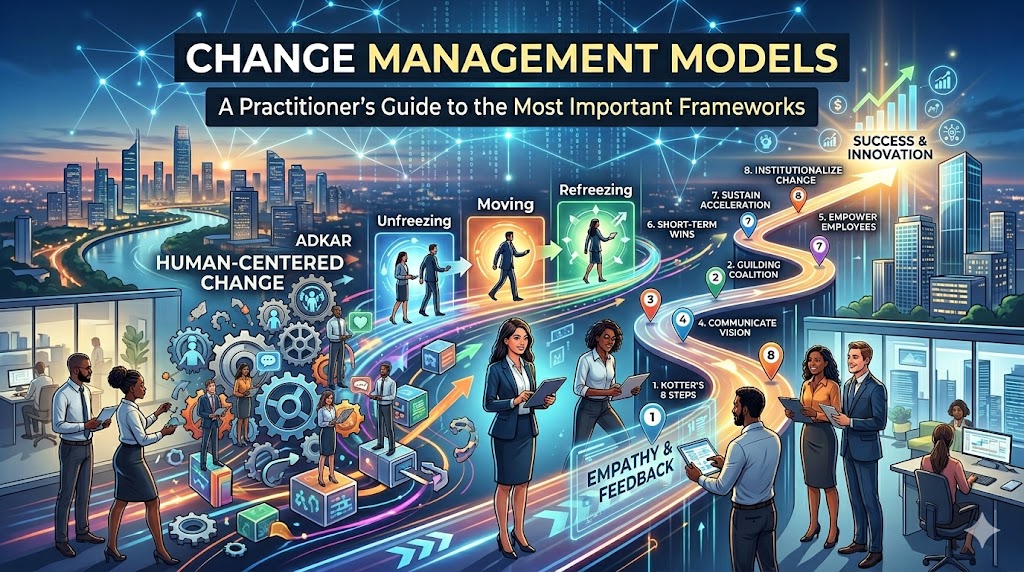
Developed by social psychologist Kurt Lewin in the 1940s, this is the foundational model that most others build on. Lewin proposed that change occurs in three stages:
- Unfreeze — Create the motivation and readiness to change by challenging the status quo, communicating the need for change, and reducing the forces that resist it
- Change — Move toward the new desired state through new behaviors, processes, and ways of thinking
- Refreeze — Stabilize and sustain the new state by embedding new behaviors in culture, systems, and practices
Strengths: Elegantly simple. Captures the essential insight that change requires deliberate unfreezing of current patterns before new ones can take hold — an insight most organizations ignore by jumping straight to implementation.
Limitations: Too linear for complex modern change environments. The “refreeze” concept is increasingly obsolete in organizations that need to change continuously rather than stabilize between change cycles. Also provides little practical guidance on how to execute each stage.
Best for: Providing a conceptual foundation and common language for thinking about change. Less useful as a practical implementation guide.
Kotter’s 8-Step Change Model
Harvard Business School professor John Kotter developed his 8-step model based on research into why change programs fail. The eight steps are: create urgency, build a guiding coalition, form a strategic vision, communicate the vision, remove obstacles, generate short-term wins, sustain acceleration, and institute change.
Strengths: The most widely used change management model in large organizations. Strong emphasis on building a coalition of change champions and creating visible short-term wins to sustain momentum. The urgency-first approach addresses one of the most common failure modes in change programs.
Limitations: Primarily a leadership model — it tells leaders what to do but provides little guidance on the employee experience of change. Sequential step approach can create rigidity in dynamic environments. Does not adequately address resistance or the emotional dimensions of change. Works better for top-down, well-resourced change programs in large organizations than for the complex, multi-directional change challenges most organizations actually face.
Best for: Large-scale organizational transformation programs with strong executive sponsorship. Less effective for culture change or change initiatives that require significant employee participation in the design process.
ADKAR Model (Prosci)
Developed by Jeff Hiatt at Prosci, ADKAR focuses on the individual experience of change rather than the organizational process. The acronym stands for Awareness (of the need for change), Desire (to support the change), Knowledge (of how to change), Ability (to implement new skills and behaviors), and Reinforcement (to sustain the change).
Strengths: The best model available for diagnosing where individual change adoption is breaking down. Highly practical — if someone isn’t changing, ADKAR helps you identify exactly which building block is missing. Strong focus on the human side of change that Kotter’s model underemphasizes. Excellent for managing large-scale ERP implementations, technology rollouts, and process changes where individual adoption is the critical success factor.
Limitations: Individual-focused model that doesn’t address organizational or systemic dimensions of change. Can create a mechanical, compliance-oriented approach to change if not applied thoughtfully. Doesn’t address the cultural and leadership behavioral changes required for transformation. The reinforcement stage is often underfunded and underexecuted in practice.
Best for: Technology adoption, process change, and any initiative where the primary challenge is getting individuals to change their behavior in specific, defined ways.
McKinsey 7-S Framework
Developed by Tom Peters and Robert Waterman at McKinsey in the late 1970s, the 7-S Framework identifies seven interdependent elements of an organization: Strategy, Structure, Systems, Staff, Style, Skills, and Shared Values. The model proposes that effective change requires alignment across all seven elements.
Strengths: The most comprehensive organizational diagnostic tool of the major models. Excellent for identifying where misalignment is undermining change efforts — especially useful for post-merger integration, where organizational systems and values are often deeply misaligned. Forces leaders to think systemically rather than focusing on one or two visible elements of change.
Limitations: A diagnostic model, not an implementation guide. Tells you what needs to be aligned but not how to align it. Complex enough that it often requires external facilitation to apply effectively. Can become an academic exercise without strong executive engagement.
Best for: Organizational diagnosis, post-merger integration, and large-scale transformation programs where systemic alignment is the primary challenge.
Bridges’ Transition Model
William Bridges distinguished between change (the external event or situation) and transition (the internal psychological process people go through in response to change). His model identifies three phases: Endings (letting go of the old), the Neutral Zone (the in-between state of confusion and possibility), and New Beginnings (embracing the new).
Strengths: The most psychologically sophisticated of the major models. The critical insight — that transition begins with an ending, not a beginning — is consistently underappreciated by change leaders who focus on communicating the new state without acknowledging the loss of the old one. Exceptionally useful for understanding and managing resistance to change.
Limitations: A conceptual model rather than a practical implementation framework. Requires skilled facilitation to apply effectively. Less useful for organizations looking for a step-by-step change management process.
Best for: Culture change, leadership transitions, post-restructuring integration, and any change situation where resistance and emotional response are the primary obstacles.
Kübler-Ross Change Curve
Originally developed to describe the emotional stages of grief, Elisabeth Kübler-Ross’s model was adapted for organizational change to describe the emotional journey individuals experience when facing unwanted change: shock, denial, anger, bargaining, depression, acceptance, and integration.
Strengths: Helps leaders understand that resistance and emotional responses to change are normal, predictable, and temporary — not signs of failure. Creates empathy for the human experience of change. Particularly useful for communicating with leaders who are frustrated by employee resistance.
Limitations: Originally developed for grief, not organizational change — the mapping is imperfect. Implies a linear progression through stages that people actually experience non-linearly and idiosyncratically. Can inadvertently normalize a passive, wait-it-out approach to change resistance rather than proactive engagement.
Best for: Building change leadership empathy and designing communication strategies that acknowledge the emotional journey of change.
The ACMP Standard for Change Management
Before covering the Human-Centered Change™ methodology, it’s worth acknowledging the ACMP Standard for Change Management — the professional standard developed by the Association of Change Management Professionals (ACMP). The ACMP Standard is not a prescriptive model but a competency framework that defines what effective change management practice looks like across five process groups: Evaluating Change Impact and Organizational Readiness, Formulating the Change Management Strategy, Developing the Change Management Plan, Executing the Change Management Plan, and Closing the Change Management Effort.
The ACMP Standard is significant because it represents the profession’s consensus on what change management involves — independent of any proprietary model or methodology. Practitioners who hold the Certified Change Management Professional (CCMP™) designation are assessed against this standard. The Human-Centered Change™ methodology is designed to be fully consistent with the ACMP Standard, giving practitioners a practical visual toolkit that aligns with the professional framework their organizations may require.
The Human-Centered Change™ Methodology — A Practitioner’s Evolution
Every model above has genuine value. But after years of applying them in organizations and observing where they fell short, I wrote Charting Change and developed the Human-Centered Change™ methodology to address the gaps that no single existing model fills.
The core problem with most change management models is that they are either too abstract (Lewin, Bridges) or too prescriptive (Kotter), too individually focused (ADKAR) or too organizationally focused (McKinsey 7-S), and critically — none of them are visual or collaborative. They were designed to be communicated to people, not built with them. In an era of complex, multi-stakeholder change, that is a fundamental limitation.
The Human-Centered Change™ methodology takes a different approach. At its center is the Change Planning Canvas™ — a poster-sized visual planning tool that functions as the anchor of a physical or digital Change Planning Wall. Surrounding the Canvas are 70 additional tools from the Change Planning Toolkit™, printed at 11″ x 17″ (A3) size, that cover every dimension of change planning: stakeholder mapping, resistance analysis, communication planning, readiness assessment, and more.
The entire toolkit is designed for both physical and digital use. Change teams can build a Change Planning Wall in a conference room using printed tools, or work entirely in online whiteboarding platforms such as Miro, Mural, FigJam, Lucidspark, Google Jamboard, or Microsoft Whiteboard. This flexibility means the methodology works equally well for co-located, hybrid, and fully distributed teams.
The Change Planning Canvas™ and elements of the Change Planning Toolkit™ (26 of 70+) are included with every copy of Charting Change. Commercial licenses for organizational use are available at bradenkelley.com. The methodology is also delivered through workshops, masterclasses, and private events for organizations that want facilitated implementation support.
The result is a change planning approach that is more visual, more collaborative, more comprehensive, and more likely to produce change plans that are genuinely owned by the teams executing them — rather than documents developed by consultants and communicated downward.
How to Choose the Right Change Management Model
No single model is right for every change situation. The most effective change leaders are fluent in multiple models and know when to apply which one. Here is a practical guide:
| Your primary challenge | Best model(s) to use |
|---|---|
| Building executive alignment and urgency for a large transformation | Kotter’s 8-Step Model |
| Diagnosing why individuals aren’t adopting a new system or process | ADKAR |
| Understanding and managing emotional resistance to change | Bridges’ Transition Model, Kübler-Ross Change Curve |
| Identifying systemic misalignment blocking change | McKinsey 7-S Framework |
| Building a shared, comprehensive change plan with your team | Human-Centered Change™ / Change Planning Canvas™ |
| Post-merger integration or cultural transformation | McKinsey 7-S + Bridges’ Transition Model |
| Technology rollout or process change | ADKAR + Human-Centered Change™ toolkit |
| Large-scale organizational transformation | Kotter + Human-Centered Change™ toolkit |
| Aligning with professional change management standards | ACMP Standard for Change Management + Human-Centered Change™ |
The most common mistake change leaders make is selecting a model based on familiarity or organizational convention rather than fit. If your organization has always used Kotter, that doesn’t mean Kotter is right for your current change challenge. Take the time to diagnose what your specific situation requires before selecting your framework.
Frequently Asked Questions About Change Management Models
What is the best change management model?
There is no single best change management model — the right model depends on your specific change situation, organizational culture, and primary challenge. Kotter’s 8-Step Model works well for large-scale transformation with strong executive sponsorship. ADKAR is best for individual behavior change and technology adoption. Bridges’ Transition Model is most effective for managing emotional resistance and cultural change. The Human-Centered Change™ methodology and its Change Planning Canvas™ provide the most comprehensive visual and collaborative planning toolkit for change teams who need to build a shared, actionable change plan. Most experienced change leaders use multiple models in combination rather than relying on any single framework, and align their work with the ACMP Standard for Change Management as the professional baseline.
What is the most widely used change management model?
Kotter’s 8-Step Change Model and Prosci’s ADKAR model are the two most widely used change management frameworks in large organizations. Kotter’s model dominates in leadership development and executive education contexts. ADKAR dominates in change management practitioner communities and is especially prevalent in organizations that have invested in Prosci certification for their change practitioners. Lewin’s Unfreeze-Change-Refreeze model, while less commonly cited by name in organizational contexts, is the conceptual foundation underlying most other models.
What is the difference between Kotter and ADKAR?
Kotter’s model focuses on what leaders need to do to drive organizational change — it is a leadership action model with eight sequential steps. ADKAR focuses on what individuals need to successfully adopt change — it is an individual change readiness model with five building blocks. Kotter is organizational and top-down; ADKAR is individual and diagnostic. They are complementary rather than competing: many organizations use Kotter to structure their overall change program and ADKAR to diagnose and address individual adoption barriers within it.
Why do change management models fail?
Change management models fail most often not because the models themselves are flawed, but because of how they are applied. The most common failure modes are: selecting a model based on familiarity rather than fit; applying models mechanically without adapting them to organizational context; using models as compliance frameworks rather than genuine planning tools; underinvesting in the human dimensions of change (communication, training, emotional support) while overinvesting in technical dimensions; and abandoning the model when resistance arises rather than using it to diagnose and address the resistance. A good model poorly applied will fail. A good model thoughtfully adapted to the specific situation will succeed.
What is the Change Planning Canvas™ and how do I get it?
The Change Planning Canvas™ is a 35″ x 56″ poster-sized visual change planning tool developed by Braden Kelley as the centerpiece of the Human-Centered Change™ methodology. It is designed to be used collaboratively with the teams executing the change — either physically on a wall surrounded by 70 additional tools from the Change Planning Toolkit™ printed at 11″ x 17″ (A3) size, or digitally in online whiteboarding platforms like Miro, Mural, FigJam, Lucidspark, Google Jamboard, or Microsoft Whiteboard. The Change Planning Canvas™ and elements of the Change Planning Toolkit™ (26 of 70+) are included with every copy of Braden Kelley’s book Charting Change. Commercial licenses for organizational use are available at bradenkelley.com. Unlike traditional change management models that are communicated top-down, the Canvas is designed to build genuine shared ownership of the change plan among the people who will execute it.
What is the ACMP Standard for Change Management?
The ACMP Standard for Change Management is the professional standard developed by the Association of Change Management Professionals (ACMP) that defines competent change management practice across five process groups: Evaluating Change Impact and Organizational Readiness, Formulating the Change Management Strategy, Developing the Change Management Plan, Executing the Change Management Plan, and Closing the Change Management Effort. It is the basis for the Certified Change Management Professional (CCMP™) designation. Unlike prescriptive models such as Kotter or ADKAR, the ACMP Standard is a competency framework that describes what effective change management involves without dictating a specific methodology. The Human-Centered Change™ methodology is designed to be fully consistent with the ACMP Standard. For the step-by-step ACMP process of executing change, see our guide to the change management process.
OR
If you’re curious whether or not your change initiative is likely to succeed or fail, take the FREE two minute diagnostic.
Content Authenticity Statement: The topic area, key elements to focus on, etc. were decisions made by Braden Kelley, with a little help from Claude and Google Gemini to clean up the article, add images and create infographics.
Image credits: Google Gemini
 Sign up here to get Human-Centered Change & Innovation Weekly delivered to your inbox every week.
Pingback: What is the Change Management Process? A Complete Guide