GUEST POST from Art Inteligencia
The Ghost in the Organization
The arrival of generative AI isn’t just another line item in a digital transformation roadmap; it represents a fundamental psychological shift. We are moving from a world where tools follow explicit instructions to one where systems generate cognitive outputs. This transition creates a unique kind of friction — one that cannot be solved with a software patch or a mandatory training session.
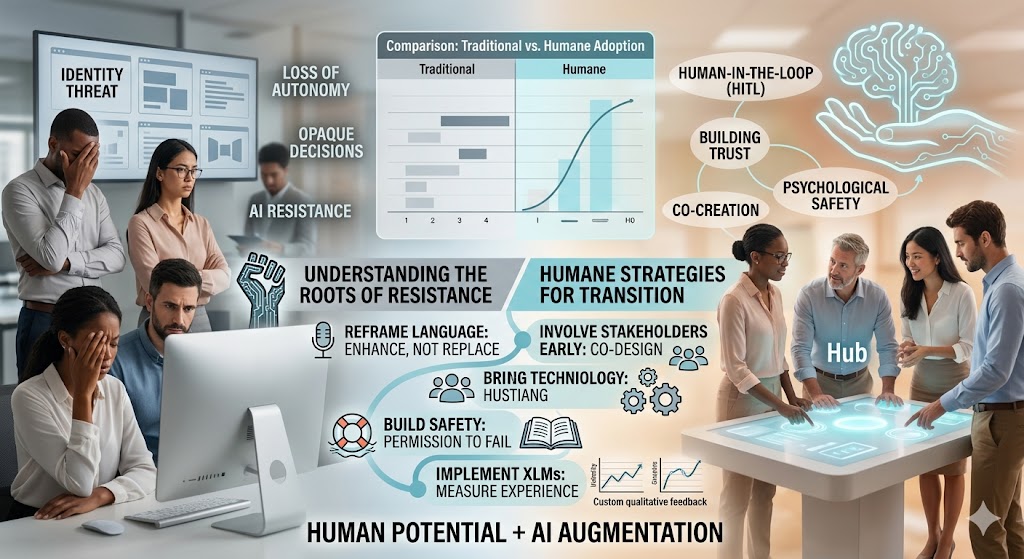
Resistance within an organization is rarely about “obstructionism.” Instead, it is a natural defense mechanism against the perceived loss of agency and the blurring of professional identity. When employees push back, they aren’t rejecting efficiency; they are protecting their sense of purpose.
To navigate this era successfully, leaders must pivot from “managing change” to designing transition. Success will not be measured by the sophistication of the LLM integrated into the workflow, but by the level of psychological safety and empathy woven into the culture. We must ensure that as our systems get smarter, our organizations stay human.
Identifying the Four Pillars of AI Fear
Addressing resistance requires us to look beneath the surface of “efficiency” and “optimization” to understand the visceral concerns that keep employees up at night. Resistance to AI generally crystallizes around four distinct pillars.
1. Identity Erosion
For many professionals, their value is tied to their craft — the ability to write, analyze, or design. When an AI can produce a draft in seconds that previously took a human hours, it triggers a crisis of identity: “If a machine can do this, what is my unique value?” We must redefine roles to focus on the human elements of strategy, ethics, and “soul” that machines cannot replicate.
2. The Black Box Problem
Trust is built on transparency. When AI systems make recommendations or automate decisions without a clear “why,” it creates a vacuum of accountability. This lack of legibility leads to a profound loss of trust in the decision-making process, making employees feel like they are passengers in their own workflows.
3. Economic Survival
This fear goes beyond the headline-grabbing “job replacement.” It includes the more subtle anxiety of task de-skilling and wage stagnation. Employees worry that as tasks become automated, their specialized expertise will be commoditized, reducing their bargaining power and long-term career resilience.
4. The Cognitive Load
We are living in a state of “perpetual beta.” The sheer velocity of AI development forces employees into a cycle of constant upskilling. This creates a cumulative cognitive load that leads to burnout. Resistance, in this context, is often a plea for a sustainable pace of change.
Moving Beyond Technical Implementation
The fatal flaw in many AI initiatives is treating the rollout as a technical deployment rather than a human experience. To address resistance, we must apply the principles of experience design to the organizational change itself. It isn’t about how the technology works; it’s about how the people work with the technology.
Experience Design for Change
We must treat the employee journey with the same rigor and empathy we afford the customer journey. This means mapping the emotional highs and lows of the transition — from the initial “fear of the unknown” to the “messy middle” of skill acquisition — and designing interventions that provide support at each critical touchpoint.
The Human-Centered Innovation Framework
True innovation occurs at the intersection of feasibility, viability, and desirability. To make AI desirable, we must utilize a framework that prioritizes human agency:
- Inquiry over Instruction: Instead of mandating a new tool, start by asking teams: “Where are you currently stuck?” or “What tasks drain your energy?” When AI solves a self-identified pain point, resistance evaporates.
- Co-creation: The most effective way to eliminate the “us vs. them” mentality is to bring the skeptics into the design process. By involving employees in prompt engineering and workflow redesign, we turn them from passive observers into active architects of their own future.
Strategies for Humane Integration
Humane integration is about creating a bridge between current capabilities and future possibilities without leaving the workforce behind. It requires a shift from viewing AI as a “replacement” to viewing it as a “partner” that respects human dignity.
1. Radical Transparency
Ambiguity is the fuel of anxiety. Leaders must be explicit about the roadmap for AI integration. This involves clearly mapping which tasks are targeted for augmentation (making the human faster/better) versus which are targeted for replacement. When employees understand the “why” and the “where,” they can begin to proactively pivot their skill sets.
2. The “Human-in-the-Loop” Guarantee
To address the fear of losing control, organizations should establish a “Human-in-the-Loop” policy. This ensures that while AI can generate drafts, analyze data, or suggest actions, the final accountability, ethical judgment, and creative “soul” remain a human responsibility. This preserves the employee’s role as the essential curator and decision-maker.
3. Psychological Safety Nets
Learning to work with AI involves a steep and often public learning curve. Organizations should create low-stakes “sandboxes” — environments where employees can experiment with prompts, fail, and learn without these efforts being tied to formal performance reviews. Giving people the “right to be bad” at something new is a prerequisite for them eventually becoming great at it.
4. Redefining Value and KPIs
If we continue to measure success solely by “output volume,” humans will always lose to AI. To address resistance, we must evolve our Key Performance Indicators (KPIs). We should shift our focus toward rewarding strategic insight, relational depth, and complex problem-solving — areas where the human element provides a competitive advantage that technology cannot replicate.
The Role of the Modern Leader
In the age of AI, the definition of leadership is undergoing a radical transformation. It is no longer about having all the answers, but about asking the right questions and fostering an environment where human ingenuity can thrive alongside machine intelligence.
The Vulnerable Leader
The most effective leaders are those willing to admit they don’t have a perfect crystal ball. By modeling vulnerability — acknowledging the uncertainty of the AI landscape and sharing their own learning journey — leaders lower the collective anxiety of the organization. This “in-it-together” mentality replaces top-down mandates with shared exploration.
From Commander to Curator
Traditional leadership focused on directing execution. The modern leader, however, acts as a curator. Their role is to help teams evaluate AI-generated outputs, ensuring they align with the organization’s ethical standards, brand voice, and long-term vision. They shift the team’s focus from the “grind” of production to the “art” of selection and refinement.
Empathy as a Hard Skill
Leaders must develop the ability to distinguish between process friction (technical hurdles) and emotional friction (fear and resistance). Addressing the former requires better tools; addressing the latter requires active listening and radical empathy. In a world of automated logic, empathy becomes the ultimate competitive advantage and a non-negotiable leadership competency.
Conclusion: The Future is Symbiotic
As we stand on the precipice of this new era, we must remember that technology is a mirror of our intentions. If we approach AI with a mindset of pure cost-cutting and replacement, we will harvest a culture of fear and stagnation. If, however, we approach it through the lens of human-centered innovation, we can unlock a level of creativity and problem-solving previously unimaginable.
The Human Advantage
The ultimate goal of humane AI integration is not to make humans act more like machines, but to free humans to be more human. By offloading the routine and the repetitive, we create the space to double down on our unique “Human Advantage” — intuition, ethical judgment, and deep emotional connection. These are the qualities that no algorithm can simulate and the true drivers of long-term value.
The challenge for leaders today is to build a future where technology serves the human spirit, not the other way around. We aren’t just building better tools; we are designing better ways for people to thrive in an increasingly complex world. When we lead with empathy and design with intent, resistance transforms into a shared journey toward a more symbiotic future.
Frequently Asked Questions
How do we distinguish between “change management” and “human-centered transition”?
Traditional change management often focuses on the “what” and the “how” of technical implementation. A human-centered transition focuses on the “who.” It prioritizes the psychological and emotional journey of the employee, ensuring that agency and identity are preserved as workflows evolve.
Will AI eventually replace the need for human intuition in innovation?
No. While AI is exceptional at pattern recognition and data synthesis, it lacks the lived experience, ethical nuance, and “gut feeling” that drive true innovation. The future belongs to the “Magic Maker”—the human who uses AI to amplify their creative vision rather than being replaced by it.
What is the first step for a leader facing high team resistance to AI?
The first step is radical transparency. Open a dialogue that moves beyond corporate talking points to address specific fears regarding job security and identity. By acknowledging the friction and creating a low-stakes environment for experimentation, you begin to rebuild the trust necessary for collaboration.
SPECIAL BONUS: Braden Kelley’s Problem Finding Canvas can be a super useful starting point for doing design thinking or human-centered design.
“The Problem Finding Canvas should help you investigate a handful of areas to explore, choose the one most important to you, extract all of the potential challenges and opportunities and choose one to prioritize.”
Image credit: Gemini
 Sign up here to get Human-Centered Change & Innovation Weekly delivered to your inbox every week.