LAST UPDATED: April 23, 2026 at 6:23 PM
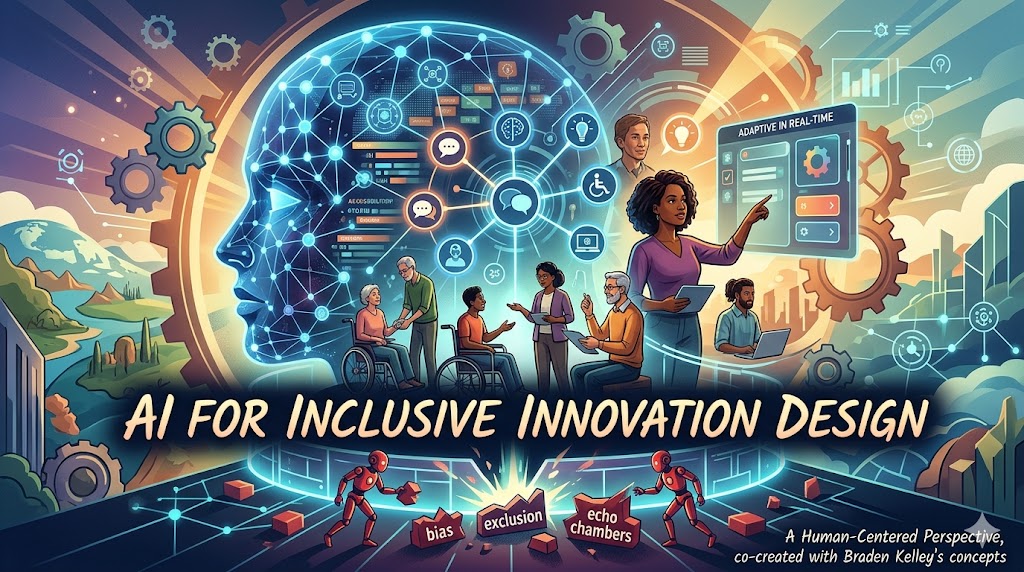
GUEST POST from Art Inteligencia
I. Introduction: The New Frontier of Empathy
In the traditional landscape of human-centered design, our greatest limitation has always been the physical and cognitive bandwidth of the designer. We strive for empathy, yet we are often trapped by our own unconscious biases and the constraints of small sample sizes. As we enter this new era, we must recognize that AI is not a replacement for human intuition; it is a cognitive exoskeleton that allows us to see, hear, and design for those who have been historically pushed to the margins.
The Shift from Compliance to Belonging
For too long, “inclusive design” has been treated as a synonym for accessibility — a checklist of compliance requirements to be met at the end of a project. Inclusive Innovation demands more. It requires us to move beyond simply making things “usable” for people with disabilities and toward intentionally creating a sense of belonging for every user, regardless of their physical, cognitive, or socio-economic reality.
Designing with the Edge Cases
The core philosophy of this shift is a move away from the “Average User” myth. When we use AI to analyze and integrate the needs of edge cases — those users with the most extreme or unique requirements — we don’t just help a minority. We create more resilient, flexible, and intuitive solutions that benefit the entire ecosystem. AI gives us the power to scale this “designing for one” approach to reach the many.
“The goal is no longer to design for the many, but to design with the edges.” — Braden Kelley
II. Phase 1: AI-Powered Empathy and Discovery
Discovery is the bedrock of innovation, yet it is often where exclusion begins. Traditional research methods — surveys, focus groups, and ethnographic studies — are frequently limited by geography, language, and the “loudest voice” bias. AI transforms this phase by acting as a bridge between the designer’s perspective and the vast, diverse realities of the global population.
Breaking the Echo Chamber with Natural Language Processing
By leveraging advanced Natural Language Processing (NLP), we can now synthesize insights from billions of data points — social conversations, support forums, and local community archives — in real-time. This allows designers to move beyond their immediate bubble and understand how different cultures, dialects, and marginalized communities articulate their own problems. We aren’t just reading data; we are hearing the nuances of lived experiences that were previously “noise” in the system.
Simulating Lived Realities for High-Fidelity Empathy
Empathy is often hindered by the inability to truly experience another person’s friction. AI-driven simulations allow us to model various physical or cognitive constraints within a digital environment. Whether it is simulating visual impairments, motor control challenges, or cognitive load issues, AI helps designers “feel” the friction points during the early discovery phase. This proactive identification ensures that we aren’t “fixing” exclusion later, but preventing it from the start.
Uncovering Latent Needs through Pattern Recognition
Traditional analytics look for the “mean,” often ignoring the outliers. However, in inclusive innovation, the outliers are where the breakthroughs happen. AI excels at uncovering latent needs — identifying subtle patterns in behavior from underrepresented groups that signal a significant, unmet demand. By analyzing these “quiet” signals, we can spot opportunities to innovate for specific communities that eventually lead to universal improvements in the user experience.
III. Phase 2: Co-Creation and Radical Prototyping
The most profound shift in inclusive innovation is the transition from designing for a community to designing with them. AI serves as the ultimate translator and facilitator in this process, stripping away the technical barriers that have traditionally kept “non-designers” out of the creative engine room.
Democratizing the Design Language
Generative AI tools act as a bridge for individuals who have the lived experience but perhaps lack formal design training. By using natural language prompts or simple sketches, end-users from diverse backgrounds can generate high-fidelity visual prototypes of the solutions they envision. This democratization of the design language ensures that the people closest to the problem are the ones leading the architectural vision of the solution.
Rapid Iteration for Universal Accessibility
In a traditional workflow, testing for accessibility is a slow, iterative process. AI changes the math. Automated agents can now instantly audit prototypes against Universal Design principles and international standards like the Web Content Accessibility Guidelines (WCAG). This allows for “real-time inclusion,” where flaws in contrast, navigation logic, or screen-reader compatibility are identified and corrected the moment a design is conceived, rather than weeks later during a formal audit.
The “Infinite Version” Paradigm
We are moving away from the “One-Size-Fits-All” model toward what I call The Infinite Version Paradigm. Rather than forcing every user to adapt to a single static interface, AI allows the interface to dynamically adapt to the user. Whether it’s adjusting cognitive load for a neurodivergent individual or reconfiguring navigation for someone with limited motor control, AI enables a level of deep personalization that makes the product feel like it was built specifically for the individual using it.
IV. The Ethical Guardrail: Auditing for Algorithmic Bias
As we embrace the speed of AI, we must remain vigilant. AI is a mirror; if we feed it a history of exclusion, it will reflect and amplify those same biases in the designs it generates. Inclusive innovation requires a rigorous, proactive approach to ethics — ensuring that our “intelligent” assistants aren’t inadvertently building new digital walls.
The Mirror Effect: Acknowledging Embedded Bias
We must start with the uncomfortable truth: datasets are often skewed toward the dominant culture. If an AI is trained on images, text, and code that ignore marginalized groups, its output will naturally cater to the “standard” user. As innovation leaders, our job is to interrogate the training data and recognize where the gaps exist before we let the AI begin the design process.
Proactive Bias Hunting and Red Teaming
To counter these risks, we employ “Red Team” AI agents. These are secondary AI systems specifically programmed to attack a design from the perspective of different personas — searching for exclusionary patterns, cultural insensitivity, or hidden barriers to entry. By simulating how a neurodivergent user or someone from a different socio-economic background might interact with the product, we can catch “algorithmic microaggressions” before they ever reach the user.
Transparency and the “Open Box” Approach
Inclusive innovation cannot happen in a “Black Box.” To build trust with diverse communities, we must be transparent about how AI decisions are being made. This means moving toward Explainable AI (XAI), where the logic behind a personalized recommendation or an interface adjustment is clear and auditable. When users understand why a system is adapting to them, they feel empowered rather than monitored.
“Innovation without ethics is merely disruption. True inclusive innovation requires the courage to slow down and audit the algorithm to ensure it serves everyone.” — Braden Kelley
V. The Future Role of the Innovation Leader
The integration of AI into the design process necessitates a fundamental evolution of our leadership models. As the technical barriers to execution lower, the value of the innovation leader shifts from managing the “how” to orchestrating the “why.” We are moving from an era of craft-based creation to one of strategic curation and ethical stewardship.
From Creator to Curator
In an AI-augmented world, the designer’s primary skill is no longer just the ability to push pixels or write code, but the ability to orchestrate collaboration between human stakeholders and machine intelligence. The innovation leader becomes a curator of perspectives, ensuring that the AI has the right “empathy inputs” to generate inclusive outputs. Our job is to provide the vision and the values that guide the algorithm’s creative power.
The Competitive Edge of Inclusive Futurology
From a futurology perspective, designing for inclusion isn’t just a moral imperative — it’s a massive market opportunity. Historically, innovations that solve for “the edges” (such as the typewriter, originally designed for the blind) eventually redefine the mainstream. By using AI to anticipate the needs of the marginalized, organizations build more resilient, flexible, and robust products. Those who master inclusive design today are building the foundational infrastructure for tomorrow’s global economy.
Sustaining the Human-Centered Focus
As we look toward a future of agentic AI and neuroadaptive interfaces, the risk of “dehumanization” grows. The role of the innovation leader is to act as the guardian of the human experience. We must ensure that as our tools become more autonomous, they remain subservient to the goal of enhancing human connection, dignity, and agency. The future belongs to those who can use the highest technology to serve the deepest human needs.
VI. Conclusion: Human-Centered, AI-Augmented
We stand at a unique crossroads in the history of innovation. For the first time, we possess tools powerful enough to bridge the gap between our empathetic intentions and the practical realities of large-scale design. But as we have explored, the true power of AI for Inclusive Innovation Design does not lie in the code itself, but in how we choose to direct that code to serve the human spirit.
Innovation is Only “New” if it is Inclusive
If we continue to use AI merely to optimize for the majority, we are not innovating; we are simply accelerating the status quo. Real innovation happens when we use these technologies to include those who were previously left behind. By bringing the “edge cases” into the center of our design process, we unlock new forms of value that were previously invisible.
The Path Forward: From Average to Infinite
The transition from the era of the “Average User” to the era of Infinite Inclusion is now underway. As innovation leaders, our mission is to ensure that AI acts as a leveling force — one that dissolves barriers, celebrates diversity, and creates a world where every individual feels that the products and services they interact with were built with them in mind.
The goal isn’t to make AI more human, but to use AI to make us more humane in how we design the world around us.
Let’s get to work on building a future that belongs to everyone.
Frequently Asked Questions
How does AI specifically enable more inclusive innovation?
AI acts as a cognitive exoskeleton, allowing designers to synthesize diverse global perspectives through Natural Language Processing (NLP) and simulate lived realities. It democratizes the design process by enabling non-designers to prototype their own solutions and dynamically adapts interfaces to meet individual accessibility needs in real-time.
What is the ‘Infinite Version’ paradigm in inclusive design?
The Infinite Version paradigm moves away from “one-size-fits-all” products. It uses AI to create interfaces that dynamically reconfigure themselves based on a user’s unique physical or cognitive requirements, ensuring the experience is personalized for every individual rather than forced into a static average.
How do we prevent AI from amplifying existing biases in the design process?
We prevent bias by implementing “Red Team” AI agents to proactively hunt for exclusionary patterns, auditing training datasets for diversity gaps, and adopting Explainable AI (XAI) practices. This ensures the design process remains transparent and accountable to human-centered ethical standards.
SPECIAL BONUS: Braden Kelley’s Problem Finding Canvas can be a super useful starting point for doing design thinking or human-centered design.
“The Problem Finding Canvas should help you investigate a handful of areas to explore, choose the one most important to you, extract all of the potential challenges and opportunities and choose one to prioritize.”
Image credit: Google Gemini
 Sign up here to get Human-Centered Change & Innovation Weekly delivered to your inbox every week.