LAST UPDATED: March 30, 2026 at 4:56 PM
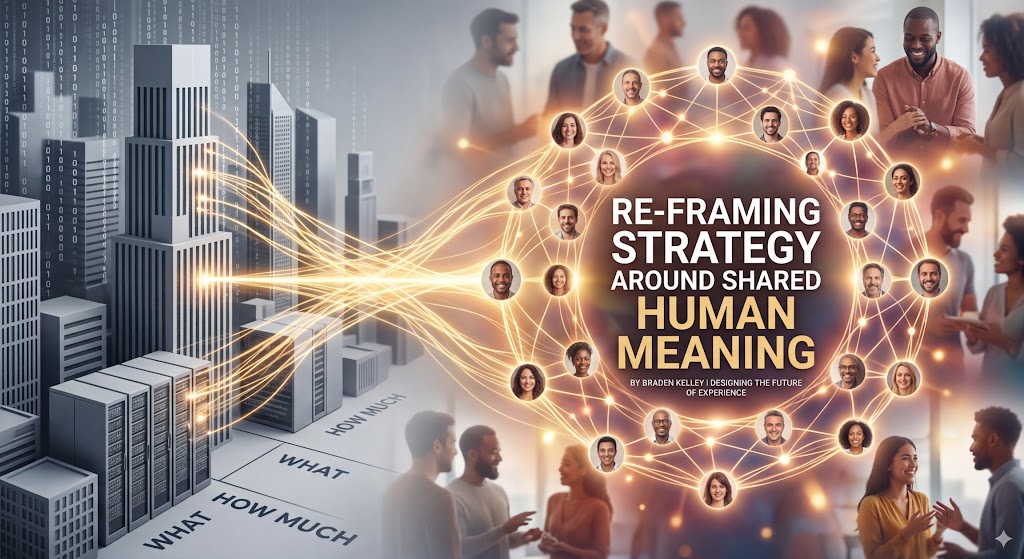
GUEST POST from Chateau G Pato
The Strategic Void: Beyond Efficiency and Into Meaning
For decades, the standard playbook for corporate strategy has been dominated by a pursuit of mechanical excellence. We have optimized supply chains, refined “Lean” processes, and engaged in relentless feature-matching wars, often reducing our relationship with the market to a series of transactional data points. However, in an era of rapid disruption and infinite choice, these traditional levers of competitive advantage are losing their grip.
The modern marketplace is suffering from what I call “Innovation Fatigue.” Organizations are shipping more “solutions” than ever before, yet customers feel less connected to the brands they use. This gap exists because strategy has historically been built around value capture rather than value resonance. When a strategy is anchored solely in cold efficiency and price optimization, the resulting brand is technically functional but emotionally vacant.
“The most dangerous strategic void isn’t a lack of resources or technology – it’s a lack of shared human meaning.” — Braden Kelley
To bridge this void, we must re-frame our strategic intent. We are moving away from a world where we simply solve problems for “users” and toward a world where we create shared meaning with people. This shift requires us to recognize that strategy is not just a spreadsheet of market share; it is a living narrative that must align the aspirations of the organization with the lived experience of the human beings it serves.
In this article, we explore how to move beyond the transactional and anchor your organization’s future in the deep, durable soil of human significance. By centering strategy on Shared Human Meaning, we don’t just build better products — we build indispensable roles in the lives of our customers and employees alike.
Moving Beyond Customer Centricity to Human Centricity
For years, “Customer Centricity” has been the gold standard of modern business. We’ve been told to obsess over the customer, to map their journeys, and to optimize their touchpoints. But in our rush to satisfy the “customer,” we have inadvertently reduced complex human beings to transactional personas. We see them as “users,” “segments,” or “leads” — terms that strip away the very essence of why people do what they do.
The Shift: From Users to People
The fundamental shift required for Shared Human Meaning is moving from a focus on the user to a focus on the person. A user is a temporary state of being; a person is a permanent reality with fears, aspirations, and a specific life context. When we design strategy for “users,” we focus on usability and utility. When we design for people, we focus on Human Experience (HX).
Human Experience (HX) supersedes User Experience (UX) because it acknowledges that the interaction with your product or service does not happen in a vacuum. It happens in the middle of a chaotic Tuesday, amidst family stress, career ambitions, and personal values. Strategy must account for this life context if it hopes to resonate.
The Meaning Exchange Framework
Traditional strategy focuses on a Value Exchange: “I give you $X, you give me Y product.” While functional, this is easily disrupted by a competitor offering a lower price or a faster delivery. To build a durable strategy, we must evolve toward a Meaning Exchange.
- Functional Value: Does the product work? (The baseline).
- Emotional Value: How does the product make the person feel? (The differentiator).
- Shared Meaning: Does this interaction reinforce the person’s identity or help them connect with what matters most to them? (The strategy).
When an organization aligns its internal purpose with the external identity of its community, it creates a “Meaning Loop.” In this state, the brand is no longer a vendor; it is a partner in the human experience. This is where true loyalty is forged — not through points and prizes, but through the deep recognition of one another’s humanity.
Re-tooling the Innovation Pipeline for Human Significance
The greatest threat to innovation is not a lack of ideas, but a lack of insight. Most innovation pipelines are designed as linear industrial processes: ideate, prototype, test, launch. While efficient, this model often fails to capture the nuances of human behavior. To build a strategy around shared meaning, we must re-tool the pipeline to prioritize depth over volume.
Thick Data over Big Data
In the modern enterprise, we are drowning in “Big Data” — the quantitative metrics of what, where, and how often. But Big Data is notoriously bad at explaining why. To find shared meaning, we must embrace “Thick Data.”
Thick Data is the qualitative information derived from ethnography, deep interviews, and participant observation. It reveals the emotional subtext and cultural shifts that a spreadsheet cannot see. While Big Data can tell you that a customer abandoned their cart, Thick Data tells you they did so because the checkout process made them feel anxious about their financial security. Strategy must be built on the bedrock of these human truths.
From “Designing For” to “Designing With” (Co-Creation)
The era of the “lone genius” or the isolated R&D lab is over. True innovation in the space of shared meaning requires Radical Co-Creation. This is the practice of bringing the person — the human being who will actually use the solution — into the heart of the creative process.
When we co-create, we move beyond asking for feedback on a finished product. We invite people to help us define the problem itself. This ensures that the resulting strategy isn’t just a solution to a technical hurdle, but a response to a lived human challenge. It transforms the relationship from provider-and-recipient to collaborators-in-progress.
The Strategic Role of Storytelling
Strategy is often presented as a dry document full of bullet points and financial projections. However, human beings do not find meaning in bullet points; we find meaning in stories. A human-centered innovation pipeline treats storytelling as a core competency, not an afterthought.
A powerful strategic narrative does two things:
- Internally: It gives every employee a “Hero’s Journey” to participate in, aligning their daily tasks with a larger purpose.
- Externally: It invites the customer to inhabit a story where their needs are recognized and their aspirations are supported.
“If you want to change the strategy, you must first change the story you are telling about the people you serve.” — Braden Kelley
By re-tooling the pipeline to value deep insight, collaborative creation, and narrative resonance, we ensure that every “innovation” we ship is an investment in the shared meaning that binds us to our community.
Operationalizing Meaning: The Change Management Angle
The most profound strategic vision remains an empty promise if it cannot survive the internal friction of the organization. Shared Human Meaning is not a marketing campaign; it is an operational mandate. To move from theory to reality, we must treat “meaning” as a core organizational capability that requires deliberate change management.
Internal Alignment: The Mirror Effect
There is an inescapable truth in experience design: The experience you deliver to your customers will always be a reflection of the experience you provide to your employees. You cannot expect a workforce that feels like a “cog in a machine” to deliver soulful, human-centered meaning to the market.
Operationalizing meaning starts with internal alignment. This means ensuring that every employee — from the front line to the back office — understands how their specific tasks contribute to a larger human purpose. When employees find meaning in their work, they move from compliance to commitment. They become the primary ambassadors of the shared meaning you wish to project outward.
Breaking Silos Through a Singular Human Lens
Traditional organizational structures are built for efficiency, often resulting in silos where Marketing, R&D, and Operations speak different languages. To operationalize meaning, these departments must be unified under a singular human-centered North Star.
When the “Human Experience” is the unifying metric, the hand-offs between departments become seamless. R&D isn’t just building a feature; they are solving a human frustration. Operations isn’t just cutting costs; they are protecting the reliability of a human promise. Change management, in this context, is the process of re-wiring the organization to prioritize cross-functional empathy.
Metrics that Matter: Measuring the “Return on Meaning”
We manage what we measure. If your only KPIs are quarterly revenue and churn rates, your strategy will inevitably drift back toward the transactional. To sustain a strategy of shared meaning, we must introduce new Metrics of Significance:
- Return on Meaning (ROM): Assessing how deeply a specific initiative reinforced the core values of the community.
- Relational Health: Moving beyond Net Promoter Scores (NPS) to measure the strength of the emotional bond and trust between the person and the organization.
- Internal Purpose Alignment: Surveying employees not just on “engagement,” but on their personal connection to the organization’s human-centered goals.
“Efficiency tells you if you are doing things right; Shared Meaning tells you if you are doing the right things.”
Operationalizing meaning is an act of leadership. It requires the courage to slow down the “efficiency machine” long enough to ensure the organization’s heart is beating in sync with the people it serves.
Conclusion: The Future of Strategy is Relational
We are entering a post-transactional era. As technology becomes more commoditized and artificial intelligence flattens the playing field for functional features, the only durable differentiator left is Human Significance. Strategy can no longer be a static document that lives in a binder; it must be a living, breathing expression of shared human values.
The Call to Action: Anchor Your Purpose
To lead in this new landscape, organizations must have the courage to stop chasing every trend and instead anchor themselves in a singular, human-centered purpose. This requires a fundamental re-evaluation of what we consider “success.” Profit is no longer the starting point; it is the by-product of a well-executed strategy of meaning.
When you solve a human problem, you earn a customer. When you share a human meaning, you earn an advocate. The leaders of tomorrow will be those who can weave their organizational goals into the personal narratives of the people they serve.
The Indispensable Organization
Organizations that successfully re-frame their strategy around shared meaning don’t just survive disruptions — they become indispensable. They move from being “service providers” to “meaning makers.” In a world that is increasingly noisy and fragmented, people are desperate for brands and institutions that recognize their humanity, respect their context, and reflect their values.
- Strategy is Narrative: It’s the story we tell together.
- Innovation is Empathy: It’s the evidence that we are listening.
- Design is Experience: It’s the proof that we care.
“In the end, we will not be remembered for the features we shipped, but for the meaning we added to the human story.”
The void in modern strategy is a human-shaped one. Filling it isn’t just a business necessity; it’s a leadership responsibility. By centering our efforts on Shared Human Meaning, we build more than just companies — we build a future where innovation and experience design truly serve the progress of humanity.
Frequently Asked Questions
Understanding the intersection of strategy and human meaning requires a shift in perspective. Below are answers to the most common inquiries regarding this transition.
How does “Shared Human Meaning” differ from a standard “Purpose Statement”?
A purpose statement is often internal and aspirational — it’s what a company wants to be. Shared Human Meaning is relational. It is the intersection where the organization’s “Why” meets the customer’s lived values and identity. It isn’t just about what you stand for; it’s about how what you stand for helps the customer define who they are.
Is this approach only for consumer-facing (B2C) brands?
Not at all. In fact, it is perhaps more critical in B2B. Behind every corporate contract is a human being dealing with professional anxiety, a desire for career growth, and a need for psychological safety. B2B strategies that address these human drivers create far more loyalty than those that focus solely on “feeds and speeds.”
Can Shared Human Meaning be measured quantitatively?
Yes, but it requires new metrics. We look at Return on Meaning (ROM) and Identity Alignment. This involves measuring the depth of the emotional bond, the degree to which a person feels the brand represents their values, and long-term retention rates that far exceed industry benchmarks for transactional loyalty.
Image credits: Gemini
 Sign up here to join 17,000+ leaders getting Human-Centered Change & Innovation Weekly delivered to their inbox every week.