LAST UPDATED: February 17, 2026 at 11:19AM
GUEST POST from Chateau G Pato
I. Introduction: The End of Complicated, The Rise of Complex
For decades, leadership development has been treated like an engineering problem. We designed succession plans as if we were replacing parts in a machine—linear, predictable, and “complicated.” But the modern business landscape has graduated from complicated to complex.
The Shift: In a complicated system, cause and effect are linked; if you follow the manual, you get the result. In a complex environment, everything is interdependent, volatile, and non-linear. You cannot manage complexity; you can only navigate it.
The Failure of the Traditional Pipeline
The “follow-the-leader” model is officially broken. Traditional pipelines focus on historical case studies and rigid competencies that reward efficiency over adaptability. This creates leaders who are excellent at maintaining the status quo but paralyzed when the map no longer matches the terrain.
The New Thesis: Capability Cultivating
To thrive, we must move away from static succession planning and toward Capability Cultivating. We aren’t just looking for the next person to sit in the big chair; we are building a network of human-centered change agents.
“The goal is no longer to produce managers who command and control, but to orchestrate collective intelligence across the entire organizational ecosystem.”
— Braden Kelley
This article explores how we move from the industrial-age mindset of “predict and provide” to a modern leadership philosophy of “sense and respond.”
II. Core Competencies for the Complexity Era
In a stable environment, we hired for experience. In a complicated environment, we hired for expertise. But in a complex environment, we must hire and develop for adaptability. To lead through the “Permanent Whitewater” of modern business, our pipeline must prioritize three non-negotiable human-centered traits.
1. Systemic Empathy
Moving beyond interpersonal kindness to ecosystem awareness. Leaders must understand how a decision in R&D ripples through Supply Chain and impacts Customer Experience. It is the ability to see the organization as a living organism rather than a mechanical org chart.
2. Iterative Agility
Complexity kills “Big Bang” transformations. We need leaders who favor continuous, human-scale experiments. This involves the courage to “fail fast, learn faster” and the discipline to scale what works while discarding what doesn’t before it becomes a liability.
3. Ambiguity Tolerance
The “Hero Leader” who has all the answers is a myth that causes bottlenecks. True leaders in complexity possess the humility to co-create. They are comfortable standing in the “gray zone,” holding space for diverse perspectives to emerge into a solution.
The Shift in Talent Identification
When we evaluate our high-potentials, we are no longer looking for the loudest voice in the room or the person who hits their KPIs through sheer force of will. We are looking for the connectors — those who naturally bridge silos and empower others to navigate uncertainty.
“Leadership in complexity is not about being the smartest person in the room; it’s about ensuring the room is smart enough to solve the problem.”
— Braden Kelley
III. Designing the Pipeline: From Static to Dynamic
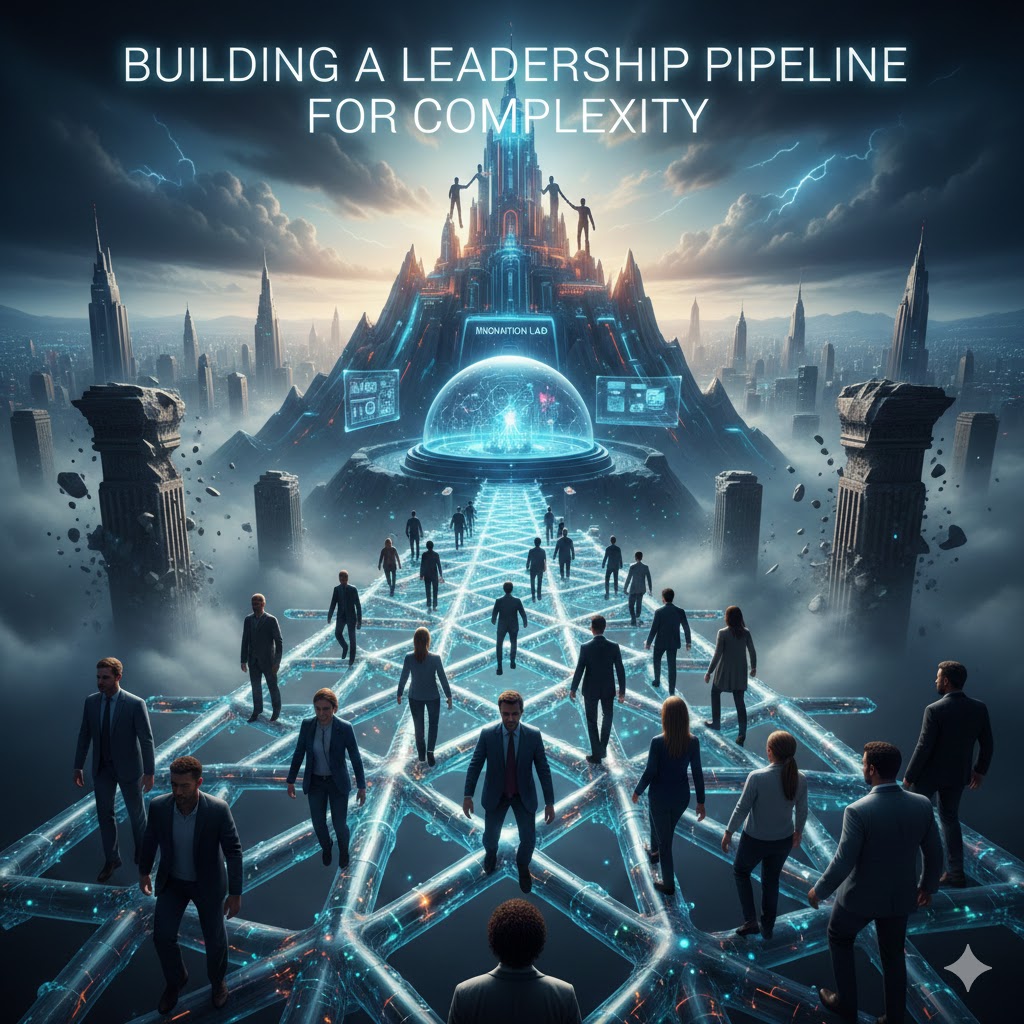
The traditional leadership pipeline is often a rigid, vertical ladder. In a complex world, a ladder is a liability — it only goes in two directions. To build a resilient organization, we must transform the pipeline into a dynamic lattice that encourages fluid movement and cross-pollination.
1. Breaking the Silos: Cross-Functional “Tours of Duty”
Depth of expertise is no longer enough; we need breadth of perspective. By implementing mandatory “Tours of Duty” across disparate departments (e.g., moving a Marketing lead into Operations for six months), we force potential leaders to solve problems outside their comfort zones. This builds the systemic empathy we discussed in Section II.
2. The Innovation Lab as a Training Ground
How do you identify who can handle complexity before they reach the C-Suite? You place them in high-uncertainty environments.
- Real-World Stress Tests: Assign high-potentials to “Horizon 3” innovation projects where there is no established playbook.
- Observing Response: Watch how they lead when the data is incomplete and the “right” answer doesn’t exist yet.
- Psychological Safety: Use these labs to reward the process of learning, not just the final ROI.
3. Mentorship vs. Sponsorship
Mentorship is about advice; Sponsorship is about access. A dynamic pipeline requires sponsors who:
| Role | Action in Complexity |
|---|---|
| The Mentor | Helps the leader refine their internal compass and emotional intelligence. |
| The Sponsor | Uses their political capital to give the leader “air cover” to take calculated risks. |
By diversifying who we sponsor, we ensure the pipeline isn’t just a mirror of the past, but a bridge to a more inclusive and innovative future.
“The most effective way to prepare for an unpredictable future is to build a leadership team that is as diverse and interconnected as the challenges they will face.”
— Braden Kelley
IV. Human-Centered Selection Criteria
If we continue to use 20th-century benchmarks to select 21st-century leaders, we will continue to get 20th-century results. To build a pipeline for complexity, we must look beyond the “Alpha” archetypes and identify those who can navigate the “Beta” reality of constant flux.
“We don’t need leaders who can predict the future; we need leaders who can respond to it alongside their people.”
— Braden Kelley
Beyond IQ and EQ: Introducing CQ (Change Quotient)
While Intelligence (IQ) and Emotional Intelligence (EQ) remain foundational, they are insufficient for complexity. We must measure a candidate’s Change Quotient (CQ).
- Adaptability: How quickly can they unlearn an outdated strategy when the market shifts?
- Resilience: How do they manage the psychological safety of their team after a failed experiment?
- Visionary Realism: Can they maintain a long-term “North Star” while pivoting the short-term tactics?
The “Un-Leader” Traits
When vetting high-potentials, we should look for traits that were historically seen as “soft” but are now “strategic”:
| Traditional Trait (Complicated) | Complexity Trait (Human-Centered) |
|---|---|
| Command & Control | Curiosity & Coaching |
| Individual Heroism | Collective Orchestration |
| Perceived Invincibility | Strategic Vulnerability |
| Risk Mitigation | Risk Literacy |
Identifying Potential in the “Fringes”
Complexity often reveals the best leaders in unexpected places. Look for the “Positive Deviants” — those individuals who are already finding innovative workarounds to legacy problems without being asked. These are your natural human-centered change agents.
V. Operationalizing Complexity Leadership
Strategy without execution is just a hallucination. To build a sustainable pipeline, we must move these human-centered principles out of the HR manual and into the daily operating rhythm of the business. This requires shifting the structural “gravity” of the organization.
1. Real-Time Feedback Loops: The Death of the Annual Review
In a complex environment, waiting twelve months to give feedback is a strategic failure. We must replace static performance management with dynamic pulse checks.
- 360-Degree Visibility: Feedback should flow upward and laterally, measuring a leader’s ability to remove friction for their team.
- Micro-Coaching: Using digital tools to provide “just-in-time” coaching nudges based on current project challenges.
2. Rewarding Collaborative Outcomes
If you reward individual department KPIs, you will get silos. If you want a pipeline that navigates complexity, you must incentivize the “in-between” spaces.
3. Scaling the Mindset: Leading at the Edge
Complexity leadership isn’t just for the C-Suite. We must democratize these capabilities so that the “edge” of the organization—those closest to the customer—can make autonomous decisions.
| Operational Lever | Action for Scalability |
|---|---|
| Decision Rights | Pushing authority down to the lowest possible level of competence. |
| Information Flow | Radical transparency — ensuring everyone has the context needed to lead. |
| Learning Rituals | “After Action Reviews” that focus on how we decided, not just the outcome. |
By operationalizing these behaviors, we ensure that leadership isn’t a title held by a few, but a capacity held by many. This is how an organization becomes truly anti-fragile.
VI. Conclusion: A Call to Action
Building a leadership pipeline for complexity is not a “nice-to-have” HR project; it is a fundamental survival strategy for the 21st century. The world is moving too fast for a single leader at the top to possess all the answers. The most successful organizations of the future will be those that treat leadership as a distributed capability rather than a concentrated authority.
The Innovation Leader’s Perspective
When I speak to global audiences about the future of work, the message is clear: Innovation is a team sport, and leadership is the coaching that makes it possible. If your pipeline only produces “players” who follow a rigid playbook, you will be defeated by the first team that knows how to improvise.
As an innovation speaker, I challenge you to look at your “high-potentials” and ask: Are they prepared to lead through the unknown, or are they just experts at navigating the known?
The Path Forward
The most famous and effective leaders of tomorrow — those who truly leave a legacy — will be the ones who viewed their role as a service to the innovators and change-makers within their ranks. By focusing on human-centered change, you aren’t just filling seats; you are future-proofing your culture.
Complexity is here. The question is: Are your leaders ready to dance with it?
Frequently Asked Questions
1. What is the difference between a complicated and a complex leadership environment?
A complicated environment is linear and predictable, where expertise and established manuals lead to consistent results. A complex environment is volatile and interdependent, where small changes can have unpredictable, non-linear effects. Leading in complexity requires shifting from “command and control” to “sense and respond.”
2. What is “Change Quotient” (CQ) and why does it matter?
Change Quotient (CQ) is a measure of a leader’s ability to navigate and lead through constant flux. It goes beyond IQ and EQ by evaluating a leader’s adaptability, resilience after failure, and their ability to maintain a strategic “North Star” while pivoting tactics in real-time.
3. How can organizations practically start building a dynamic leadership pipeline?
Organizations should move from vertical ladders to a dynamic lattice. This involves implementing cross-functional “Tours of Duty,” using innovation labs as stress tests for high-potentials, and shifting from individual KPIs to shared success metrics that reward systemic collaboration.
Image credits: Google Gemini
 Sign up here to get Human-Centered Change & Innovation Weekly delivered to your inbox every week.