GUEST POST from Art Inteligencia
I. The Friction Point: The Breakdown of Traditional Talent Pipelines
Technology never changes organizations—people using technology change organizations. Yet today, many executive teams are rushing toward artificial intelligence with a single-minded focus on operational efficiency, blind to the structural erosion happening beneath their feet. By viewing AI primarily as a tool for short-term headcount reduction and rapid task automation, leaders are unwittingly severing the vital nervous system of organizational capability: the talent development pipeline.
The Death of “Entry-Level” Work
Historically, entry-level work served a critical, hidden purpose. Gathering data, writing initial draft reports, formatting presentations, and conducting basic analyses were never just low-value tasks—they were the foundational training grounds of knowledge work. Through these daily, iterative activities, junior professionals absorbed organizational context, observed senior decision-making, and built domain mastery.
As generative and agentic AI models absorb these lower-complexity tasks, entry-level roles are vanishing overnight. While this creates an immediate spike in margin efficiency, it unintentionally destroys the dynamic apprenticeship model that has sustained knowledge work for generations. Without the ground-level work, rising talent loses the experiential learning required to cultivate judgment, nuance, and strategic intuition.
The Seniority Paradox
This dynamic has birthed a dangerous systemic paradox within modern enterprise hiring:
- Demanding Instant Experts: Organizations increasingly demand mid-level and senior leaders capable of managing complex, high-stakes trade-offs in an unpredictable economic environment.
- Starving the Pipeline: Simultaneously, these same organizations have eliminated the entry-level on-ramps necessary to cultivate the next generation of senior leaders.
We are creating an unsustainable capability gap. In our rush to eliminate basic tasks, we are starving our organizations of future wisdom.
Maximizing Short-Term Value vs. Minimizing Long-Term Friction
When leadership cuts junior talent to maximize immediate ROI metrics, they introduce massive systemic friction into their 3- to 5-year horizons. Innovation requires a continuous, bottom-up stream of fresh perspectives combined with deep contextual understanding. When you eliminate early-career talent, you eliminate your enterprise’s “army of eyes”—the very people closest to emerging trends, customer frictions, and new technologies.
To build a sustainable future of work, leaders must recognize that true efficiency isn’t about replacing human contribution. It is about designing human-centered systems where technology elevates learning velocity and prepares human talent to thrive in an AI-integrated world.
II. Redefining the System: What is the AI Apprenticeship Economy?
To navigate the breakdown of traditional talent pipelines, we must shift our perspective from failing fast to learning fast. The answer to task automation is not to abandon junior talent, but to re-architect the enterprise around a new model: The AI Apprenticeship Economy. In this model, artificial intelligence transitions from a transactional utility into an active, collaborative partner designed to accelerate human capability and democratize mastery.
Beyond Automation to Augmentation
For decades, digital transformation efforts have focused on removing friction through sheer automation. But when you automate learning out of the process, you strip away human agency and adaptability. Human-Centered Change™ requires that we design AI systems that augment human judgment rather than replace it. In the AI Apprenticeship Economy, every workflow becomes a dynamic feedback loop where technology handles synthesis and rapid iteration, leaving humans to focus on framing, context, and high-value decision-making.
The Triad of Modern Mastery
At the heart of this new economy is a collaborative triad that redefines how work gets done and how skills are acquired:
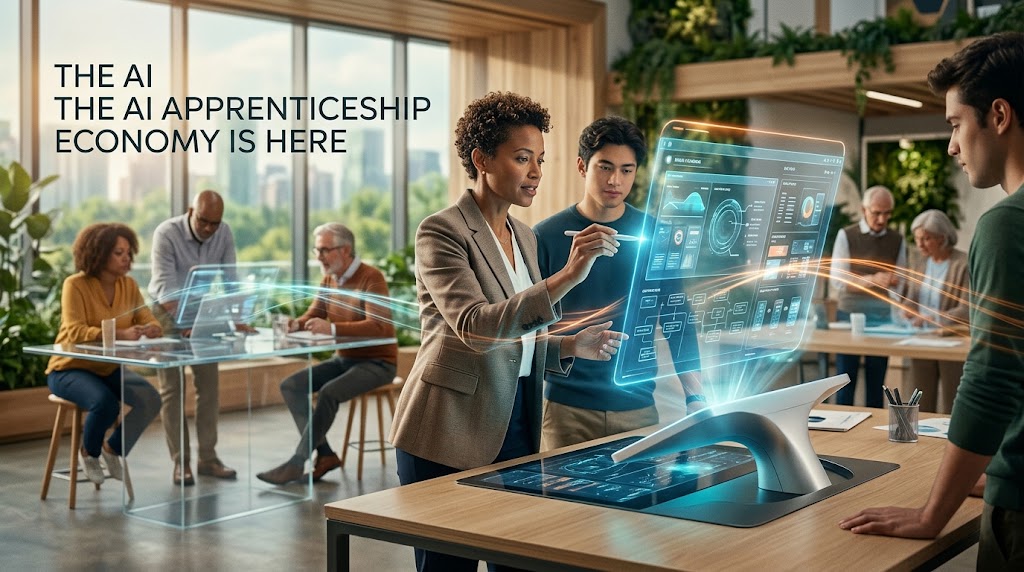
- 1. The Apprentice (The Learner): Rather than spending years performing repetitive data gather and basic synthesis, the apprentice uses AI to elevate their role immediately. Their focus shifts to asking incisive questions, defining core problems, curating context, and validating AI outputs against real-world constraints.
- 2. The Mentor (The Human Expert): Free from the burden of constantly reviewing low-level draft work, senior experts pivot to high-leverage coaching. They focus on imparting tacit knowledge, ethical boundaries, emotional intelligence, and strategic instincts—the critical nuances that algorithms cannot replicate.
- 3. The AI Agent (The Digital Co-Pilot): Acting as an always-on digital tutor, the AI agent provides real-time feedback, simulates complex scenarios, and builds rapid prototypes. It allows the learner to experiment safely, test hypotheses in minutes, and compress years of traditional learning curves into months.
The Principle of Minimum Novelty
One of the biggest mistakes organizations make during technological shifts is introducing too much change at once, triggering cultural defense mechanisms. Successful AI integration relies on the Principle of Minimum Novelty—maximizing the reuse of existing organizational rhythms, communication channels, and cultural habits, while introducing just enough technological novelty to unlock breakthrough performance.
By embedding AI co-pilots directly into daily team interactions rather than forcing entirely new platforms, leaders create a comfortable, low-friction path to skill acquisition. This preserves psychological safety while dramatically increasing the speed at which apprentices master complex domains.
III. Human-Centered Change™ Framework for AI Adaptation
Integrating artificial intelligence into organizational capability isn’t an IT initiative—it is a deeply human, socio-technical shift. Applying structured methodologies like the Change Planning Canvas™ allows leaders to visually map, align, and orchestrate this transition without overwhelming their people or triggering cultural resistance.
1. Creating Psychological Safety for Co-Learning
People do not resist change; they resist being changed. When AI is framed purely as an efficiency drive, employee defense mechanisms activate, driving knowledge underground. True adaptation requires psychological safety—an environment where apprentices and senior practitioners alike feel secure experimenting with digital tools, exposing knowledge gaps, and treating AI as an engine for rapid adaptation rather than workforce replacement.
2. Harnessing the “Army of Eyes”
Innovation and change cannot be mandated strictly from the C-suite. By positioning early-career professionals as AI apprentices, organizations activate an active “army of eyes” across every business unit. These team members are uniquely positioned to identify operational friction, spot emerging customer behaviors, and surface practical, bottom-up AI use cases that leadership would otherwise miss.
3. Structuring the Visual Change Journey
To navigate this transformation smoothly, organizations must make the path visible to every team member. By designing transparent progression pathways, leaders help employees move deliberately through three core stages of maturity:
- Stage 1: AI-Assisted Learner — Utilizing AI tools for basic task acceleration, context gathering, and initial hypothesis generation under expert supervision.
- Stage 2: AI-Augmented Practitioner — Seamlessly co-creating workflows with digital agents, applying critical thinking to refine AI outputs, and solving mid-level domain challenges independently.
- Stage 3: AI-Enabled Master — Architecting end-to-end human-AI systems, mentoring junior apprentices, and applying high-stakes strategic judgment to drive continuous innovation.
IV. Reimagining Experience Design (EX) for the AI Era
To fully realize the value of the AI Apprenticeship Economy, we must apply the principles of Experience Design (EX) to the daily life of knowledge workers. Upgrading the employee experience is not about adding more software tools into an already fragmented tech stack—it is about thoughtfully designing human-centered touchpoints where technology removes friction and empowers meaningful work.
Designing the Collaborative Workflow
Most enterprise software is designed around transactional outputs rather than experiential learning. Reimagining the employee experience requires mapping end-to-end workflows to ensure AI integration enhances human agency rather than stripping it away. When digital agents handle the heavy lifting of data collation, synthesis, and administrative friction, workers are freed to engage in high-value activities: strategic framing, creative problem solving, and empathetic stakeholder engagement.
Interactive Prototyping & Dynamic Feedback Loops
In traditional corporate environments, testing a new strategic idea or business concept could take weeks or months of linear execution. In an AI-augmented workspace, apprentices use Generative AI and low-code agents for rapid, interactive prototyping. Ideas can be modeled, stress-tested, and iterated upon in hours. This compresses the learning loop, shifting the primary focus of early-career professionals from slow execution to rapid hypothesis testing and critical evaluation.
Preserving and Scaling Tacit Knowledge
One of the greatest challenges in experience design is capturing “tacit knowledge”—the unwritten intuition, historical context, and nuanced judgment that experienced masters possess. By designing workflows where mentors, apprentices, and AI agents collaborate in shared visual environments, organizations can passively capture these critical insights. The AI records not just the final output, but the human rationale behind strategic trade-offs, building an evolving, collective intelligence repository that continuously elevates the entire organization.
V. Strategic Action Plan: How Leaders Build the Future Workplace Today
Transitioning from a traditional labor model to an AI Apprenticeship Economy requires deliberate, proactive leadership. Executive teams cannot afford to wait for workplace norms to settle organically. To construct a resilient, high-capability workforce, leaders should execute on three strategic imperatives:
1. Audit the Experience, Not Just the ROI
While financial metrics and immediate productivity gains are easy to measure, they provide a dangerous false positive if capability development is eroded in the process. Leaders must conduct comprehensive Experience Design (EX) audits across business units to evaluate how AI tools are actually impacting talent growth. Ask critical questions:
- Are digital tools stripping junior staff of foundational learning experiences, or are they accelerating their time-to-mastery?
- Where are the friction points in mentor-apprentice knowledge transfers, and how can co-pilots bridge those gaps?
2. Establish AI Apprenticeship Pathways
Modernize legacy job descriptions, performance metrics, and career progression models. Shift job evaluations away from rote execution volume and toward collaborative capability, contextual reasoning, and problem framing. Design dedicated apprenticeship tracks where early-career professionals are explicitly evaluated on their ability to orchestrate AI agents, challenge assumptions, and rapidly prototype strategic solutions under expert guidance.
3. Focus on Problem Definition Over Tool Adoption
Technology without clear direction only scales inefficiency faster. As I often emphasize, solutions are 90% defining the problem and the rest is solving it. Equipping employees with AI co-pilots is meaningless if they lack the critical thinking required to identify the root challenge. Organization-wide training must prioritize root-cause analysis, precise framing, and contextual curation before deploying advanced algorithmic tools.
VI. Conclusion: The Human Imperative in the AI Age
The future of work will not be defined by algorithms replacing human ingenuity, nor will it belong to organizations that treat artificial intelligence merely as a faster typewriter. The true competitive advantage in the digital era belongs to enterprises that understand a fundamental truth: technology never changes organizations—people using technology change organizations.
The Core Insight
The AI Apprenticeship Economy offers a path forward that transcends the false dichotomy of total automation versus human legacy. By elevating AI from a transactional tool to a digital co-pilot, we restore the bridge between novice and master. We create a sustainable ecosystem where junior talent learns faster, senior leaders scale their wisdom further, and the entire organization develops an unmatched capacity for continuous transformation.
A Call to Executive Action
As leaders, our primary mandate is not simply to harvest short-term efficiencies, but to architect the conditions under which human potential can flourish. Don’t just automate tasks—design experiences. Don’t just optimize processes—build capability. By investing in human-centered change today, you build an agile, resilient workforce capable of inventing the future tomorrow.
Frequently Asked Questions
1. What is the AI Apprenticeship Economy?
The AI Apprenticeship Economy is a human-centered organizational framework where artificial intelligence transitions from a basic task-automation tool into a digital co-pilot. In this model, AI accelerates experiential learning, mentorship, and capability building—allowing junior talent to master complex domain knowledge faster while preserving critical human judgment.
2. How does AI impact entry-level knowledge workers?
While AI automates low-complexity tasks that traditionally made up entry-level work, it also eliminates the traditional ground where junior talent built context and domain mastery. The AI Apprenticeship model fixes this by shifting entry-level roles from repetitive execution to problem framing, context curation, and rapid prototyping alongside senior mentors and digital agents.
3. Why is Human-Centered Change™ critical for AI adoption?
Technology alone does not transform organizations—people using technology do. Applying a Human-Centered Change™ approach creates psychological safety, reduces change friction, and empowers employees at all levels to innovate bottom-up, ensuring AI integration builds sustainable human capability rather than causing cultural burnout or capability loss.
Bottom line: Futurists are not fortune tellers. They use a formal approach to achieve their outcomes, but a methodology and tools like those in FutureHacking™ can empower anyone to be their own futurist.
Image credit: Gemini
 Sign up here to get Human-Centered Change & Innovation Weekly delivered to your inbox every week.